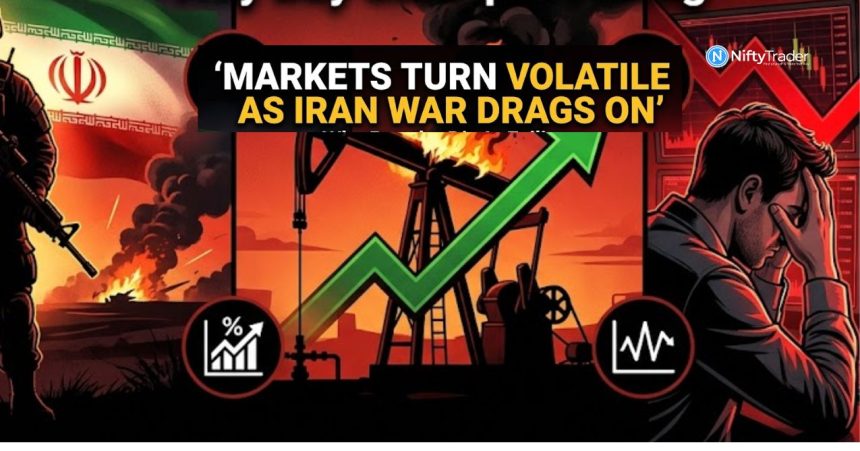
Global markets are showing clear signs of stress as the ongoing Iran war continues to inject uncertainty into risk sentiment, with volatility rising even without a clear escalation trigger.
The familiar investing wisdom “buy on the cannons, sell on the trumpets” is being tested in real time, as traders struggle to distinguish between opportunity and risk in a conflict that shows no clear resolution path.
What Just Changed
Markets are not reacting to a single headline; they are reacting to persistent uncertainty.
- The Nifty 50 has already corrected sharply in recent sessions
- Broader risk sentiment remains weak amid geopolitical escalation
- Volatility is being driven by conflicting signals: diplomacy headlines vs continued ground tension
According to recent data, markets have been under pressure as the conflict drags on, with investors unable to price a clear endgame.
Key shift:
This is no longer a “shock event” it is becoming a prolonged uncertainty cycle
Why This Market Reaction Is Different
Traditionally, markets follow a predictable pattern during wars:
- Panic selling initially
- Stabilisation as uncertainty reduces
- Rally when visibility improves
But this time, the pattern is breaking.
Why?
- No clear timeline for resolution
- Multiple geopolitical actors involved
- Oil, inflation, and growth risks rising simultaneously
This creates a “no clarity, no conviction” environment, the worst possible setup for traders.
Why “Buy the Dip” Is Not Working Cleanly
The classic strategy:
Buy during fear → sell when clarity returns
But right now:
- Fear is not peaking; it’s lingering
- Positive headlines are not fully trusted
- Markets are reacting to every small signal change
This leads to:
- Sharp rallies → quickly sold into
- Weak bounces → no follow-through
📌 Translation for traders:
This is a trading market, not a trending market
Sector Impact: Where the Real Signals Are
The war is not hitting all sectors equally, and this is where traders should focus.
🔴 Under Pressure
- Consumer discretionary (cost pressures, demand risk)
- Smallcaps (risk-off selling, liquidity exit)
- Export-heavy sectors (global slowdown concerns)
Recent data shows broad-based damage in smaller stocks, with risk capital exiting aggressively.
🟢 Relative Strength / Watchlist
- Energy (benefits from higher oil prices)
- Defence-linked themes
- Select largecaps (safe-haven rotation)
Insight:
Money is not leaving markets it is rotating toward safety
The Bigger Risk Markets Are Pricing In
The real concern is not just the war; it’s what the war triggers:
- Rising oil prices → inflation pressure
- Inflation → central banks stay cautious
- Higher rates → lower equity valuations
Global markets are already factoring in:
- Slower growth
- Sticky inflation
- Earnings uncertainty
What Smart Traders Are Doing Now
Instead of reacting emotionally, experienced participants are
1. Avoiding Aggressive Dip Buying
Because:
- No clear bottom formation yet
- Sentiment still fragile
2. Focusing on Positioning, Not Prediction
Markets are reacting to flows, not just fundamentals
3. Staying Selective
- Large caps > small caps
- Strong balance sheets > speculative bets
The Real Takeaway
This market is not about:
- predicting the war outcome
- guessing the next headline
It is about understanding how uncertainty is being priced day by day
Bottom Line for Traders
- This is not a clean “buy the dip” phase yet
- Volatility will likely stay elevated
- Market behaviour = cautious, reactive, and headline-driven
👉 The real signal right now: Markets are not panicking but they are uncomfortable
Also check:
FAQs
Why are markets not bouncing despite war fears?
Markets typically rebound once uncertainty peaks, but this time uncertainty is persistent, not temporary. The absence of a clear resolution timeline is preventing strong conviction buying.
Is this a good time to “buy the dip”?
Not decisively. The current environment shows an expectation gap; traders expect sharp rebounds, but markets are delivering weak, short-lived rallies due to fragile sentiment.
Which sectors are most affected by the Iran war?
Consumer, smallcaps, and export-driven sectors are under pressure, while energy, defence, and select largecaps are showing relative resilience due to capital rotation.
What is driving market volatility right now?
Volatility is being driven by headline risk, oil price uncertainty, and shifting global growth expectations, rather than a single trigger making price action more erratic.
What is the biggest risk markets are pricing in?
The key forward-looking risk is a chain reaction: rising oil → higher inflation → delayed rate cuts → pressure on equity valuations.
Why are rallies getting sold into quickly?
Because traders lack conviction. Without clarity, market participants prefer to reduce risk on strength rather than build positions, leading to repeated sell-offs.
Are institutional investors exiting the market?
Not entirely. There is more evidence of rotation than exit capital shifting toward safer, large-cap, and defensive plays rather than leaving equities completely.
What strategy are smart traders using now?
They are focusing on positioning over prediction, staying selective, avoiding aggressive dip buying, and reacting to market behaviour rather than anticipating outcomes.