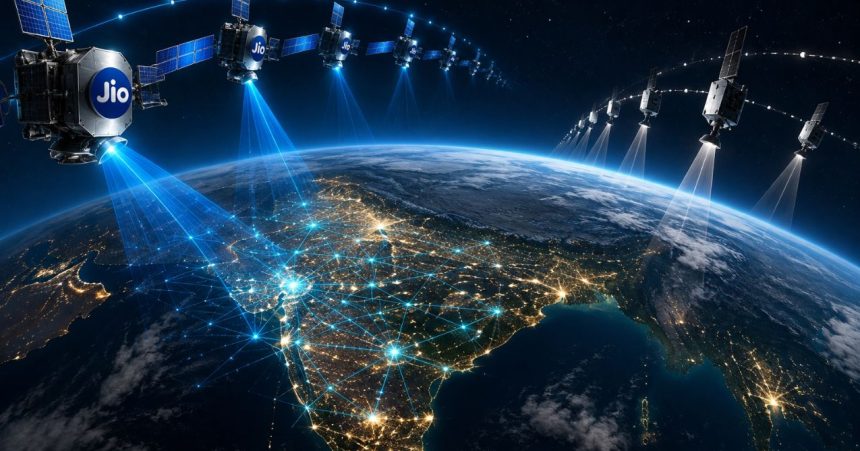
Mukesh Ambani’s Reliance Industries is evaluating a multi-billion dollar entry into low Earth orbit (LEO) satellite communications through Jio Platforms, The Economic Times reported on May 6, 2026, citing people with knowledge of internal discussions. The plan covers building satellites, payloads, launch vehicles, and user terminals, while Reliance simultaneously holds talks with Indian government bodies over securing orbital slots and weighs acquisitions of existing satellite operators to compress timelines. The Economic Times did not disclose a specific investment figure. No acquisition target has been confirmed.
What Jio Already Has, and Why It Falls Short
Jio’s existing satellite footprint is established but technically limited. In February 2022, Jio Platforms and Luxembourg-based SES formed a joint venture, with Jio holding 51% and SES holding 49%, to deliver broadband services across India using a combination of geostationary (GEO) and medium Earth orbit (MEO) satellite constellations, with up to 100 Gbps of capacity from SES. The entity is now called Orbit Connect India.
Jio-SES is one of only three satellite operators to have obtained full regulatory clearances to operate in the Indian market, the others being Eutelsat OneWeb and Starlink. Despite those clearances, neither OneWeb, licensed in 2021, nor Jio Satellite, licensed in 2022, has yet launched commercial services. Both are still working through mandatory security compliance requirements set by India’s Department of Telecommunications (DoT).
The launch timeline has slipped repeatedly. In June 2025, DoT extended provisional trial spectrum for both Orbit Connect India and Eutelsat OneWeb by six months, until November 2025, after both companies failed to fully meet India’s security requirements, which include data localisation, lawful interception, NavIC integration, and per-gateway security clearances. At a press briefing on July 24, 2025, SES Vice President for Asia-Pacific Harsh Verma stated: “We have been ready with our ground infrastructure and everything else for the last two years. Commercial traffic is not yet permitted. In my opinion, we are just a few months away; it should happen within this year.” Verma added that by end of 2026, three additional SES O3b mPOWER satellites would enter service, tripling capacity available to Jio. As of May 6, 2026, ten months after that statement, commercial services have still not launched.
The fundamental technical problem sits beneath all of this. MEO satellites orbit at significantly higher altitudes than LEO satellites, introducing latency that makes them uncompetitive for real-time consumer broadband. LEO satellites orbit just 500–1,200 km above Earth. Starlink, operating at that altitude, delivers latency of 20–40 milliseconds, comparable to fixed broadband. The Jio-SES MEO setup, using just six medium-orbit satellites, cannot match those numbers. Building or acquiring a LEO constellation would shift Jio from a technically constrained satellite operator to an infrastructure owner competing on equal technical terms with Starlink and Amazon’s Project Kuiper.
The Market Being Targeted
The global LEO satellite market was valued at $12.64 billion in 2024 and is projected to reach $41.31 billion by 2033 at a CAGR of 14%, according to Grand View Research. Mordor Intelligence, using data updated as of January 2026, estimates the market at $28.81 billion in 2025, growing to $50.96 billion by 2031 at a 9.36% CAGR, with communication services accounting for 57.1% of the total in 2025. The divergence reflects different scope definitions, some firms count only satellites, others include ground infrastructure and terminals.
India’s own space economy, per IN-SPACe’s projections, could reach $44 billion by 2033, rising from its current 2% of the global total to approximately 8%. India has roughly 950 million internet subscribers in a population of 1.4 billion, making it one of the largest underserved satellite broadband markets in the world.
The scale of Reliance’s stated ambitions is already on record. At India’s AI Impact Summit in 2026, Mukesh Ambani announced that Jio and Reliance together will invest ₹10 lakh crore over seven years to build India’s sovereign AI and digital infrastructure, including gigawatt-scale data centres with over 120 MW coming online in 2026 at Jamnagar. A multi-billion satellite investment fits that capital posture.
Three Strategy Shifts in 18 Months
The pace of Reliance’s repositioning is the most significant editorial fact in this story.
Late 2024 — Opposition: Reliance lobbied TRAI to auction satellite spectrum rather than allocate it administratively. An auction model would have imposed significant entry costs on Starlink and other foreign operators. The government rejected the position and proceeded with administrative allocation, as TRAI had recommended.
March 2025 — Distribution partnership: Jio reversed course and signed a distribution agreement with SpaceX on March 12, 2025. Under the deal, announced alongside a near-identical Airtel-SpaceX partnership, Jio agreed to distribute Starlink equipment through its retail stores and online marketplaces and provide customer installation and activation support, leveraging its 515.3 million subscribers and nationwide retail infrastructure. Jio Group CEO Mathew Oommen said at the announcement: “Our collaboration with SpaceX to bring Starlink to India strengthens our commitment and marks a transformative step toward seamless broadband connectivity for all.”
May 2026 — Potential ownership: The ET report indicates Reliance may now be evaluating building a competing LEO constellation, which would make Jio a direct rival to the same company whose hardware its stores are currently selling.
Where Starlink Stands Right Now
On July 8, 2025, IN-SPACe granted Starlink final approval to operate its Gen 1 LEO constellation over Indian territory using Ka and Ku frequency bands, a licence valid until July 2030. Starlink’s Gen 1 constellation carries a projected capacity of 600–700 Gbps across India, drawn from a fleet of 4,408 satellites. The company plans to expand its global fleet from 6,000+ to 42,000 satellites long-term.
Despite the IN-SPACe clearance, Starlink has not launched commercial operations. As of May 4, 2026, per Business Standard, Starlink’s security clearance from Indian intelligence agencies remains pending, and the satellite spectrum allocation rules under the Telecommunications Act 2023 have not yet come into force, meaning no operator in India has a commercial spectrum assignment. Telecom Minister Jyotiraditya Scindia told reporters in February 2026 that the government was working to ensure satellite service rollout did not suffer from regulatory delays on spectrum assignment and pricing.
The strategic irony is direct: Jio’s retail network, India’s largest telecom distribution system with 515.3 million subscribers, is currently one of the primary mechanisms positioned to help Starlink penetrate the Indian market. That is the outcome Reliance spent political capital in 2024 attempting to prevent through TRAI.
The Acquisition Question: What Is Confirmed vs. Unconfirmed
Building a LEO constellation from scratch takes years, SpaceX spent the better part of a decade before Starlink reached commercial scale. Acquiring an existing operator with licensed spectrum, operational ground infrastructure, and registered orbital slots compresses that timeline substantially.
Confirmed: Reliance is in active discussions with Indian government bodies about orbital slot strategy, per the ET report.
Not confirmed: Any specific acquisition target. No named company has been identified in any verified source as being in active talks with Reliance. Any publication naming a specific target without a sourced confirmation is speculating.
What This Means for RIL Stock
As of May 5, 2026, Reliance Industries shares closed at ₹1,463.10 on NSE, down 9.23% from their 52-week high of ₹1,611.80 and up 13.59% from their 52-week low of ₹1,288.10. The stock has declined 0.4% over six months and gained 2.22% over the past year. Market capitalisation stands at approximately ₹19.4 lakh crore.
Earnings context: Reliance’s net profit fell 12.55% year-on-year to ₹16,971 crore in Q4 FY2026 and declined 8.98% sequentially. Revenue has grown for four consecutive quarters, from ₹2.58 lakh crore to ₹2.98 lakh crore, but profit compression is the current investor concern.
A formally committed LEO satellite programme, with a named investment figure, confirmed acquisition, or signed government orbital agreement, would give RIL direct listed equity exposure to the global space economy at a scale no other Nifty 50 company currently has. What exists today is an evaluation, not a commitment. Until capital is formally allocated and a structure announced, this remains a watch item for investors.
Verified Facts at a Glance
| Item | Fact | Source |
|---|---|---|
| Jio-SES JV structure | Jio 51%, SES 49% | SES press release, Feb 14, 2022 |
| Orbit Connect India capacity | Up to 100 Gbps from SES | SES press release, Feb 2022 |
| Jio-SES MEO satellites | 6 satellites | Communications Today, Jun 2025 |
| Trial spectrum extension | Extended to November 2025 | DoT / Telecom Talk, Jun 2025 |
| SES launch forecast | “A few months away” — Harsh Verma, SES VP Asia-Pacific | Light Reading, Jul 24, 2025 |
| SES capacity expansion | 3x by end of 2026 via new O3b mPOWER satellites | Light Reading, Jul 24, 2025 |
| Jio-SpaceX deal signed | March 12, 2025 | Business Today, Mar 12, 2025 |
| Starlink IN-SPACe approval | July 8, 2025, valid to July 2030 | IN-SPACe |
| Starlink Gen 1 India capacity | 600–700 Gbps, 4,408 satellites | IN-SPACe filing |
| Starlink security clearance | Still pending as of May 4, 2026 | Business Standard, May 4, 2026 |
| Spectrum rules status | Not yet in force as of May 2026 | Business Standard, May 4, 2026 |
| Starlink global fleet | 6,000+ satellites, target 42,000 | Digit.in |
| India space economy 2033 | $44 billion projected | IN-SPACe / Business Today |
| LEO market 2024 | $12.64 billion | Grand View Research |
| LEO market 2033 forecast | $41.31 billion, 14% CAGR | Grand View Research |
| LEO market 2031 forecast | $50.96 billion, 9.36% CAGR | Mordor Intelligence, Jan 2026 |
| Jio subscribers | 515.3 million (Q3 FY26) | Business Today |
| Reliance ₹10L cr investment | AI Impact Summit 2026, Mukesh Ambani | Business Today |
| RIL share price (May 5, 2026) | ₹1,463.10 | NSE / INDmoney |
| RIL 52-week range | ₹1,288.10 – ₹1,611.80 | NSE |
| RIL Q4 FY26 net profit | ₹16,971 crore, −12.55% YoY | INDmoney / Screener |
| RIL market cap (May 2026) | ~₹19.4 lakh crore | NSE |
FAQ
Q: Does Jio have its own satellite internet service?
Jio operates Orbit Connect India, a joint venture with SES using six MEO satellites. It holds all required regulatory licences but has not yet launched commercial services as of May 2026, pending final DoT security clearances.
Q: When will JioSpaceFiber launch in India?
SES VP Harsh Verma said in July 2025 that the Jio-SES service was “a few months away” and expected within 2025. As of May 2026, commercial services have not commenced. No new official launch date has been confirmed.
Q: Is Reliance building its own LEO satellite constellation?
Reliance is evaluating a LEO satellite build or acquisition through Jio Platforms, The Economic Times reported in May 2026. No investment figure has been committed and no deal has been signed.
Q: What is the difference between LEO and MEO satellites for internet?
LEO satellites orbit at 500–1,200 km and deliver latency of 20–40 milliseconds, comparable to fixed broadband. MEO satellites orbit higher, with greater latency. Jio’s current SES partnership uses MEO; Starlink uses LEO.
Q: Who are the licensed satellite internet operators in India?
Three operators hold full IN-SPACe clearances: Eutelsat OneWeb, Jio Satellite (Orbit Connect India), and Starlink. None has launched commercial consumer services as of May 2026.
“This article is based on reporting by The Economic Times dated May 6, 2026. Reliance Industries and Jio Platforms have not issued an official statement.”