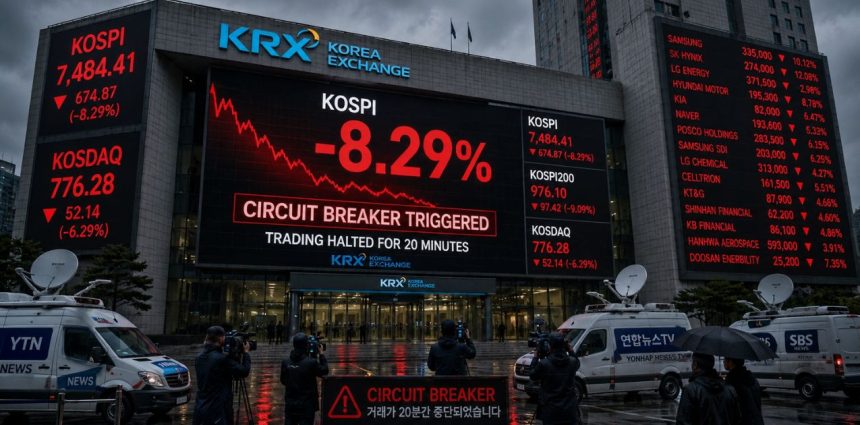
South Korea’s KOSPI plunged as much as 9.1% on June 23, prompting the Korea Exchange to trigger a market-wide circuit breaker and halt trading for 20 minutes as investors scrambled to exit semiconductor positions after a record-breaking rally ran out of steam. The benchmark closed at 7,484.41, down 8.29%, marking its steepest single-session decline since March 4.
The Selloff in Numbers
SK Hynix slumped more than 12% while Samsung Electronics lost more than 10%, the two chipmakers that had essentially single-handedly powered the KOSPI’s extraordinary bull run this year. This was the second circuit breaker event of June alone, with KOSPI 200 futures falling 5% to trigger the halt.
| Stock / Index | Intraday Move | Context |
|---|---|---|
| KOSPI (close) | −8.29% | Worst day since March 4, 2026 |
| SK Hynix | −12% intraday | Was up 350%+ YTD entering June 23 |
| Samsung Electronics | −10%+ | Briefly near $1 trillion market cap |
| LG Energy Solution | −2.98% | Secondary drag |
| Hyundai Motor | −8.78% | Broader sentiment hit |
| Kia Corp | −6.47% | Parallel auto sector weakness |
Source: Korea Exchange, Bloomberg, June 23, 2026
Foreign investors had already been rotating out. Foreign investors had dumped approximately $62 billion of South Korean stocks as of late May. On June 23 alone, they sold more than 4 trillion won ($2.6 billion) of KOSPI shares by midday, per Bloomberg. Retail traders moved in the opposite direction, adding to positions as the index was falling.
Also Read: Market Rebound — Is the Worst of the Sell-Off Already Over?
What Actually Caused This
The decline was driven by a mix of concerns over AI competitiveness following leadership departures at Google, and regulatory scrutiny regarding excessive leverage in semiconductor-linked financial products, which triggered panic selling and forced liquidation of volatile instruments.
That’s not the whole story, though. South Korea is considering stabilisation measures specifically because leveraged products tied to semiconductor stocks have exacerbated volatility, with market regulators stating these products were launched too hastily.
Financial Supervisory Service (FSS) Governor Lee Chan-jin made a rare public acknowledgement of regret, saying the regulator had been too hasty in approving leveraged ETFs linked to Samsung and SK Hynix.
On the US side, SpaceX shares slid on June 22, and sentiment over high-flying tech stocks turned wobbly overnight, contributing to the negative open in Seoul. Micron Technology’s quarterly earnings, due this week, added to uncertainty across the memory chip space.
The ETF Bomb Nobody Fully Defused
Oddly, even as SK Hynix was falling 8% during the June 8 episode earlier this month, the ACE SK Hynix Leveraged ETF briefly surged about 50% and traded at an intraday premium of nearly 86% to its net asset value, a severe pricing distortion that occurred during the closing call auction when liquidity providers are temporarily exempt from their obligation to submit quotes that keep ETF prices aligned with underlying asset values.
Three SK Hynix single-stock leveraged ETFs, the ACE fund from Korea Investment Management, the 1Q SK Hynix Leveraged ETF from Hana Asset Management, and the Kiwoom SK Hynix Leveraged ETF, were placed on the KRX investment-caution list.
According to KRX data, there were 2,889 disclosures this year involving ETF premiums or discounts exceeding regulatory thresholds, up 32% from 2,189 a year earlier and nearly triple the 1,077 recorded during the same period in 2024. The structural problem is worsening, not stabilising.
Concentration Risk: The Core Problem
| Metric | Figure | Source |
|---|---|---|
| Samsung + SK Hynix share of KOSPI market cap | ~50% | Goldman Sachs / Bloomberg |
| SK Hynix YTD gain entering June 23 | ~350% | Bloomberg |
| Retail margin debt (as of June 4) | ₩37.74 trillion | Korean FSC |
| Foreign net selling YTD (as of late May) | $62 billion | AInvest / Bloomberg |
| Global single-stock leveraged ETF AUM | $60 billion+ | Goldman Sachs |
Source: Korea Exchange, Financial Services Commission, Goldman Sachs, Bloomberg
Samsung Electronics and SK Hynix now account for over 50% of KOSPI index market capitalisation, a sharp rise from 34% at the end of last year. When those two names move violently, the index has nowhere to hide.
Han Ji-young, an analyst at Kiwoom Securities, told Reuters the fall was triggered by profit-taking pressure among foreign investors and is likely a short-term phenomenon. Peter Kim of KB Securities told CNBC the key risk that ends semiconductor upcycles, overcapacity, is “at least a couple of years” away from materialising, and described the current episode as a deleveraging event rather than a structural break.
What Investors Should Watch
SK Hynix booked Q1 FY2026 revenue of 52.6 trillion won, a 60% jump from the prior quarter and a 198% surge year-over-year; operating profit hit 37.6 trillion won with an operating margin of 72%. The fundamentals have not collapsed. What changed is positioning, leverage, and sentiment.
Nvidia CEO Jensen Huang confirmed during a Seoul visit on June 5 that SK Hynix, Samsung, and Micron all passed certification for HBM4 memory chips destined for the Vera Rubin AI platform, with shipments starting in Q3 2026. Analysts estimate SK Hynix will supply 60–70% of the HBM4 volume for that platform.
The next immediate trigger: Micron Technology’s quarterly results, due June 24. A weak or cautious read from Micron on memory pricing or AI demand could extend the selling pressure in Seoul well into next week.
Bottom Line
The June 23 crash is not a verdict on AI or memory chips SK Hynix’s 72% operating margins make that clear. It is a verdict on how a market lets two stocks carry 50% of its weight, allows margin debt to pile to record levels, and then approves leveraged ETFs that turn a correction into a rout. Micron’s earnings on June 24 are the next live wire.
Read Next: SpaceX ETFs Clock $8.2 Billion Volume in 3 Days as MSCI
FAQ
Why did KOSPI circuit breaker trigger on June 23, 2026?
KOSPI 200 futures plunged 5%, hitting the threshold for a mandatory trading halt. This was the second such circuit breaker event in June, triggered by a combination of foreign profit-taking, AI tech sentiment concerns from the US session, and regulatory scrutiny of highly leveraged semiconductor ETFs.
How much did SK Hynix fall on June 23?
SK Hynix slumped more than 12% intraday on June 23, extending its decline after the circuit breaker was lifted. The stock had gained over 350% year-to-date entering the session, making it the world’s best-performing large-cap stock in 2026.
Is South Korea’s regulator taking action?
Yes. South Korea’s regulator approved leveraged ETFs tied to SK Hynix, subsequently apologised for the rushed launch, and is now monitoring markets while weighing stabilisation steps amid record margin borrowing. The FSS is also considering additional measures to limit the fallout from sharp swings in semiconductor-linked ETF products.
Disclaimer: This article is for informational purposes only and does not constitute investment advice. Stock markets are subject to risks. Please consult a SEBI-registered financial advisor before making investment decisions.