Key Takeaways
- The US Senate passed the “Lindsey O. Graham Sanctioning Russia and Iran Act of 2026” 86-11 on Friday, August 7, sending it to the House, which reconvenes August 31.
- The bill authorizes tariffs of up to 100%, not automatically 100%, on the world’s top five buyers of Russian crude oil or natural gas, and separately on the top five countries facilitating Russian sanctions evasion.
- India and China are widely flagged as likely exposed given their volumes of Russian crude purchases; the exact list will be formally determined by the US Trade Representative after enactment, reassessed every 180 days.
- A country avoids the tariff trigger only if it stops making new purchases of Russian crude oil or gas within 30 days of enactment, continuing to buy after that window is what activates exposure.
- The bill’s 15% import-exception clause applies only to natural gas, not crude oil, which is India’s primary Russian energy import, so it likely offers little practical relief.
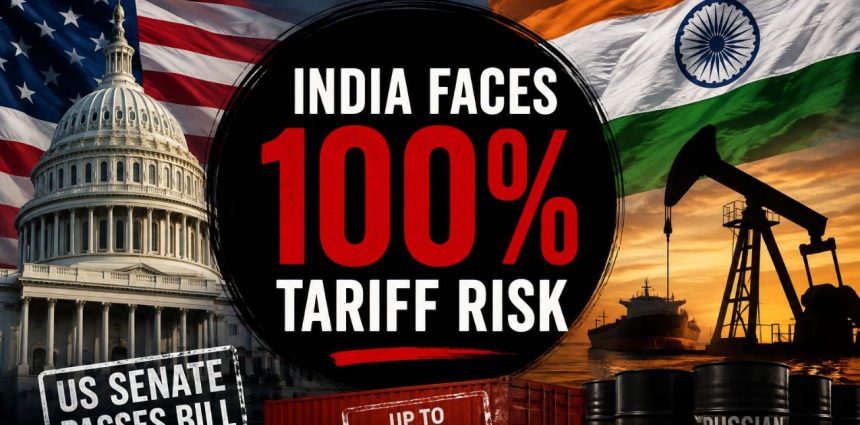
The US Senate voted 86-11 on Friday to pass a sweeping Russia sanctions bill that gives President Donald Trump authority to impose tariffs of up to 100% on countries that are major buyers of Russian oil and gas, a group that includes India. The bill, named for the late Senator Lindsey Graham, now moves to the House of Representatives, which returns from recess on August 31.
India has not been hit with a 100% US tariff. The Senate has passed legislation that could give the President authority to impose tariffs of up to 100% on qualifying major buyers of Russian energy if the bill becomes law.
That distinction matters for Indian markets. The bill does not automatically impose a 100% tariff on India; the next key steps are House passage, the final scope of the legislation and whether the presidential tariff authority is ultimately used. India’s exposure is significant because Indian refiners imported about 1.92 million barrels per day of Russian crude in May, accounting for roughly 36.5% of the country’s total crude imports, according to Reuters.
What the Bill Does to Russia
Beyond the tariff authority, the legislation sanctions Russian President Vladimir Putin, senior political and military officials, major Russian banks including Sberbank, VTB and Gazprombank, and Russian energy projects such as the Arctic LNG ventures.
It also imposes duties of up to 500% on goods imported directly from Russia, and extends the Iran Sanctions Act of 1996, originally set to expire in 2026, out to 2031. Per the bill text, the entire Act (apart from the Iran Sanctions Act extension) sunsets automatically five years after it becomes law.
The 100% Tariff Threat — How It Actually Works
This is the part getting compressed in most coverage. The bill doesn’t hand out a flat 100% tariff to any country that has historically bought Russian oil. Under Section 113, a country is exposed only if it is among the five largest importers, by volume, of Russian crude oil or natural gas over the trailing 12 months, and it makes new purchases of that oil or gas on or after 30 days following enactment. Stop buying within that 30-day window, and the tariff trigger doesn’t apply.
Separately, the top five countries facilitating Russian sanctions evasion, shadow-fleet operators, insurers, financiers, face the same exposure. The rate itself is a ceiling (“up to” 100%), set by the President, not a fixed number, and the President retains broad waiver power if he certifies to Congress that an exemption serves US national interest. The bill also requires the US Trade Representative to re-determine the top-five list every 180 days based on the most recent trade data, this isn’t a one-time snapshot.
Why India Is Exposed
India has been one of the largest buyers of discounted Russian crude since 2022, alongside China. That volume is what puts it in range of Section 113’s top-five criteria, according to Reuters and Economic Times reporting on the bill’s likely impact.
One nuance worth flagging: the bill’s exception for countries importing under 15% of their natural gas from Russia applies specifically to gas, not crude oil, and India’s Russian energy exposure is overwhelmingly crude, not gas. That exception is unlikely to offer India meaningful cover unless it also curbs new crude purchases.
The Political Fight
The bill passed with broad bipartisan support, but not without friction. An amendment from Senator Rand Paul and Senator Ron Wyden that would have stripped the tariff powers entirely was defeated; Paul was the lone Republican “no” vote.
Senator Raphael Warnock, who had held up the bill over the tariff clause, said he’d secured a written commitment from US Trade Representative Jamieson Greer that tariffs would be lifted once a country stops buying Russian energy or aiding sanctions evasion. Representatives Gregory Meeks and Don Beyer separately criticized the bill in the House, arguing it hands Trump broad tariff powers he could use well beyond Russia policy.
What Happens Next
The bill needs House passage and Trump’s signature to become law. Trump has backed the package, adding pressure on the House. The House had already passed a separate Ukraine-focused sanctions bill in June, so reconciling the two chambers’ versions is the next real test, expected after the House returns August 31.
NiftyTrader Desk View
| Sector | Key Trigger | Trader View |
|---|---|---|
| Oil Marketing Companies (IOC, BPCL, HPCL) | Direct exposure to discounted Russian crude sourcing | Watch for policy signals on whether India curbs new Russian purchases within the 30-day window once the bill is signed |
| Export-oriented sectors (textiles, gems & jewellery) | Broader US-India trade friction risk if tariff authority is used | Sensitive to House timeline and any USTR list confirming India’s inclusion |
| USD-INR | Tariff-driven trade uncertainty | Rupee volatility possible around House vote and any presidential signature |
Track how FIIs are positioning around this headline risk on the NiftyTrader FII-DII Tracker: niftytrader.in/fii-dii-data
Bottom Line
This is a Senate-passed bill, not a law, and even once enacted, the 100% tariff on India isn’t automatic. It hinges on India remaining among the top five Russian oil/gas importers and continuing new purchases past a 30-day grace period, with the President holding discretion on the actual rate and a standing waiver option. The real trigger to watch isn’t Friday’s Senate vote, it’s what the House does after August 31, and whether India adjusts its Russian crude sourcing before the 30-day clock even starts running.
Read Next: 23,000 Jobs Lost, S&P 500 Hits Record 7,757, Nasdaq +1.3%, Fed Odds Fall to 44%
This article is for informational purposes only and does not constitute investment advice. NiftyTrader does not recommend buying, selling, or holding any securities mentioned. Please consult a SEBI-registered financial advisor before making investment decisions.