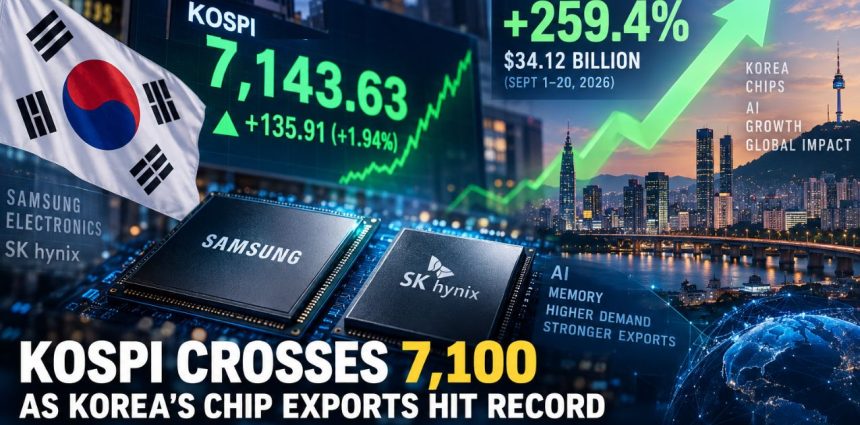
South Korea’s KOSPI jumped back above 7,100 on Tuesday, rising nearly 2% as Samsung Electronics and SK hynix followed Wall Street’s AI-led semiconductor rally.
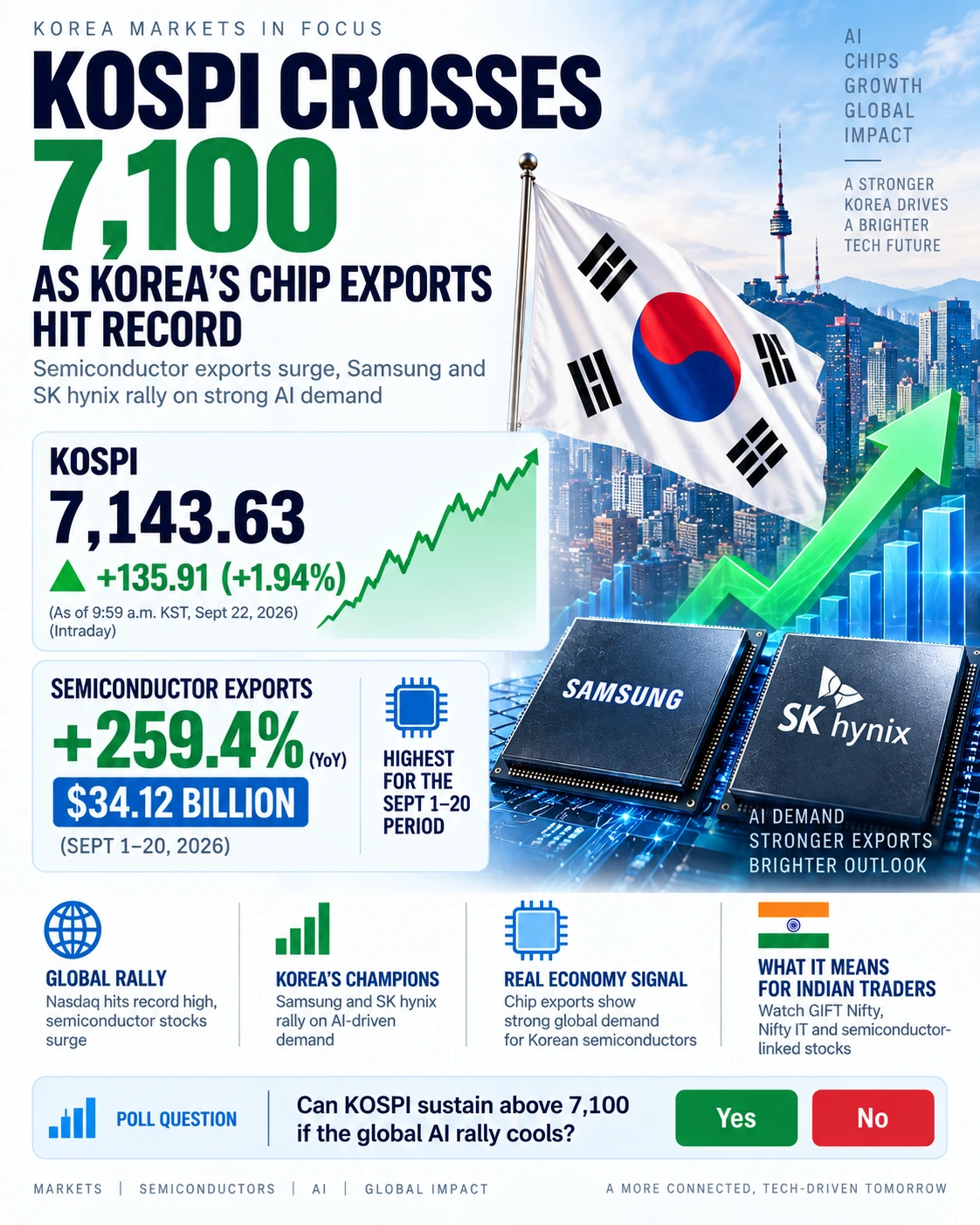
The bigger market signal came from Korea’s latest trade data: semiconductor exports surged 259.4% year on year to $34.12 billion in the first 20 days of September, reaching a record for that comparison period.
Now traders are watching whether strong chip exports, memory demand and AI spending can keep validating the earnings expectations already built into Korean semiconductor stocks.
CHECK LIVE: NiftyTrader: Live Options Analytics & F&O Trading Tools
KOSPI Jumps Above 7,100
At 9:59 a.m. KST (00:59 GMT), the KOSPI was up 135.91 points, or 1.94%, at 7,143.63. Samsung Electronics gained 2.28%, while SK hynix rose 2.94% at that snapshot. The index had also touched an intraday high near 7,163.48.
The immediate trigger came from Wall Street.
The Nasdaq rose 2.26% to a record 27,122.09 on Monday, while the Philadelphia Semiconductor Index gained about 4.3%. AMD surged almost 10% and crossed a $1 trillion market capitalisation, while Intel and Arm also posted sharp gains.
The Korean move therefore started as a global technology trade.
But Tuesday’s export numbers give the rally a second layer.
Important: 7,143.63 is an intraday snapshot, not the September 22 closing level.
Korea’s Chip-Export Surge Changes the Story
Korea Customs Service data for September 1–20 showed total exports rising 78.3% year on year to $71.409 billion.
Semiconductor exports were the standout:
$34.12 billion, up 259.4% year on year.
Semiconductors accounted for roughly 48% of Korea’s total exports during the period, while the semiconductor figure was a record for the September 1–20 comparison period.
That is important because it provides evidence that the AI and memory boom is showing up in actual trade flows, not just stock prices.
The distinction matters.
A strong Nasdaq session can lift Korean chip stocks for a day. Exceptionally strong export data provide a different type of signal: actual demand for Korean semiconductor products remains powerful.
The figures are still preliminary, however, and one unusually strong 20-day period does not establish that the current growth rate will continue indefinitely.
So the next test is straightforward:
Do export growth and chip demand translate into sustained memory pricing, customer orders and earnings?
What It Means for Indian Markets
This is where the Korean move becomes relevant for NiftyTrader readers.
Indian traders can watch GIFT Nifty, Nifty IT and semiconductor-linked stocks for any spillover from the renewed global AI trade.
But the relationship should not be treated as automatic.
The useful takeaway is not simply that “KOSPI up means Indian IT up.” Instead, traders should look for confirmation across multiple markets: Wall Street technology stocks, Asian semiconductor shares, GIFT Nifty and the early Nifty IT reaction.
That makes Korea an early global signal to watch, rather than a standalone predictor of the Indian market.
TRACK HERE: GIFT NIFTY, Nifty IT ANALYSIS, FII DII DATA
Samsung and SK Hynix Are at the Centre
The two Korean semiconductor leaders are benefiting from the same broad AI-memory cycle, but their exposure is not identical.
Samsung Electronics reported KRW 171.5 trillion in second-quarter revenue and KRW 89.5 trillion in operating profit. Its Device Solutions division generated KRW 127.5 trillion in revenue and KRW 89.2 trillion in operating profit.
Samsung said its Memory Business reached another record quarter and highlighted strong server demand, AI-related demand, HBM4 and HBM4E development.
SK hynix reported KRW 79.3187 trillion in second-quarter revenue and KRW 60.5426 trillion in operating profit, with revenue up 257% year on year and operating profit up 557%.
The company highlighted HBM, AI-server DRAM and enterprise SSDs and said demand exceeded supply capacity. It also said it had finalised long-term agreements with around 10 customers.
The implication is clear: both companies are seeing strong demand for memory products tied to AI infrastructure.
The market will now be watching whether that strength persists.
ALSO READ: Samsung’s AI Cash Boom Is Triggering a $72 Billion Shareholder Test — What Changed?
Why the U.S. AI Rally Matters
Monday’s Wall Street move was broader than a single Nvidia-driven session.
AMD jumped almost 10% and moved above a $1 trillion market capitalisation. Intel gained more than 12%, while Arm advanced roughly 17%. The Nasdaq reached a fresh record, while Meta also rallied sharply.
For Korea, the transmission mechanism is straightforward:
AI application demand → higher computing demand → semiconductor demand → memory demand → Samsung/SK hynix earnings expectations.
Tuesday’s export figures add evidence to that chain.
The uncertainty is whether the market can continue moving from AI enthusiasm to actual orders, pricing and earnings growth.
Korea’s $350 Billion U.S. Investment Plan
A second development is unfolding alongside the semiconductor rally.
South Korea’s $350 billion U.S. investment framework is moving toward specific projects. Reuters reported that a 6.3-gigawatt gas-fired power project in Encinal, Texas, worth more than $20 billion, was selected as the first project Seoul intends to pursue. The project is intended to support AI data centres and semiconductor facilities.
The broader framework includes $150 billion associated with shipbuilding, while another $200 billion of strategic investment remains under discussion. Nuclear projects, possible Westinghouse participation and other infrastructure investments have also been discussed.
The key distinction is that the $350 billion headline commitment is not the same as $350 billion of immediately deployed capital.
For investors, project-level details now matter more than the headline number: commercial viability, funding structure, timing and the eventual scale of actual investment.
That makes the U.S. package a supporting story for Tuesday’s market, rather than the primary reason for the KOSPI move.
The KOSPI Rally Still Has a Volatility Problem
There is another piece of context investors should not ignore.
The KOSPI closed 2025 at 4,214.17. Against the 7,143.63 intraday level, the index was roughly 69.5% above its 2025 year-end level.
But the index was also still about 21.6% below its June 22 record close of 9,114.55.
That means Tuesday’s rally is better understood as a strong rebound within a highly volatile year, rather than a one-way move higher.
For investors, that creates two competing signals:
Fundamental: Korea’s semiconductor exports and AI-linked corporate demand are extremely strong.
Market: the KOSPI has already experienced very large moves, making expectations and positioning increasingly important.
What Traders Should Watch Next
1. Semiconductor exports
The September 1–20 number is exceptionally strong. Future readings will show whether the acceleration is sustained.
2. Memory pricing
Samsung and SK hynix have both pointed to strong AI-server demand and tight supply. Contract pricing and shipments will matter more than one strong stock-market session.
3. HBM execution
HBM4 and next-generation memory products remain central to the AI infrastructure cycle. Investors will be watching whether new product capacity converts into sustained revenue and margins.
4. The U.S. investment framework
The Texas project gives the $350 billion framework a more concrete form, but substantial parts of the strategic-investment package remain under discussion.
5. Oil, U.S. yields and the dollar
AI optimism is supporting technology stocks, but oil prices and interest-rate expectations remain important macro variables for global risk appetite.
The Bigger Market Signal
Tuesday’s KOSPI move is important because several signals are now lining up:
Global: Wall Street technology and semiconductor stocks rallied sharply.
Corporate: Samsung and SK hynix continue to report strong AI-memory demand.
Trade: Korean semiconductor exports jumped 259.4% in the first 20 days of September.
Infrastructure: Seoul is moving from a broad U.S. investment framework toward specific AI-related infrastructure projects.
That makes this more than a simple “Asian stocks followed Wall Street” story.
The market’s next question is whether these signals remain aligned.
Bottom Line
The KOSPI’s return above 7,100 has two clear drivers: a powerful global AI and semiconductor rally, and exceptionally strong Korean chip-export data.
Samsung Electronics and SK hynix are reporting strong AI-memory demand, while the U.S. investment framework is beginning to move from headline commitment toward specific projects.
But the index has already experienced a major move in 2026, and global rate, oil-price and technology-valuation risks remain.
The next phase of the rally will therefore depend less on another single strong session and more on whether chip exports, memory pricing, customer demand and AI investment continue to validate the expectations already embedded in Korean semiconductor stocks.
📌 Market Pulse
📈 KOSPI’s AI Rally Gets a Chip-Export Test
KOSPI moved back above 7,100 as Samsung Electronics and SK hynix followed Wall Street’s semiconductor rally.
Korea’s semiconductor exports jumped 259.4% in the first 20 days of September.
The data provide a real-economy confirmation of strong AI-related chip demand.
For Indian traders, GIFT Nifty and Nifty IT are key spillover indicators to watch.
The bigger test is whether export growth and memory demand remain strong enough to support current market expectations.
Read Next: NSE IPO Ends at 5.71x After ₹90,300 Cr Demand; QIB Bids Hit 12.68x
Frequently Asked Questions
Why did KOSPI rise on September 22, 2026?
The immediate catalyst was a strong Wall Street technology session, while Korea’s exceptionally strong semiconductor export data provided an additional fundamental signal.
How strong were Korea’s semiconductor exports?
Semiconductor exports reached $34.12 billion during September 1–20, up 259.4% year on year, according to Korea Customs Service.
Why are Samsung Electronics and SK hynix important?
Both companies are major Korean semiconductor businesses and have highlighted strong AI-server, HBM and memory demand in their latest results.
What is the $350 billion South Korea-U.S. investment framework?
It is an investment commitment associated with the bilateral trade arrangement, with $150 billion linked to shipbuilding and another $200 billion covering strategic investments being worked through.
Has all $350 billion already been invested?
No. The framework is being translated into specific projects, while substantial parts of the strategic-investment component remain under discussion.
Is 7,143.63 the September 22 closing level?
No. It was an intraday snapshot at 9:59 a.m. KST.