H-1B Fee Extended by Trump for a Year — IT Stocks Under Pressure, OFSS Down 6.6%
The latest US H-1B visa decision has put Indian IT stocks back in focus. With the $100,000 fee requirement extended for another year, investors are watching whether higher hiring costs could affect the business models and margins of Indian technology companies.
The Nifty IT index fell around 0.7% on September 21, while several IT stocks traded sharply lower during the session.
Track Live : NSE Option Chain — Live | BSE Option Chain — Live Sensex & Bankex Options Data Today
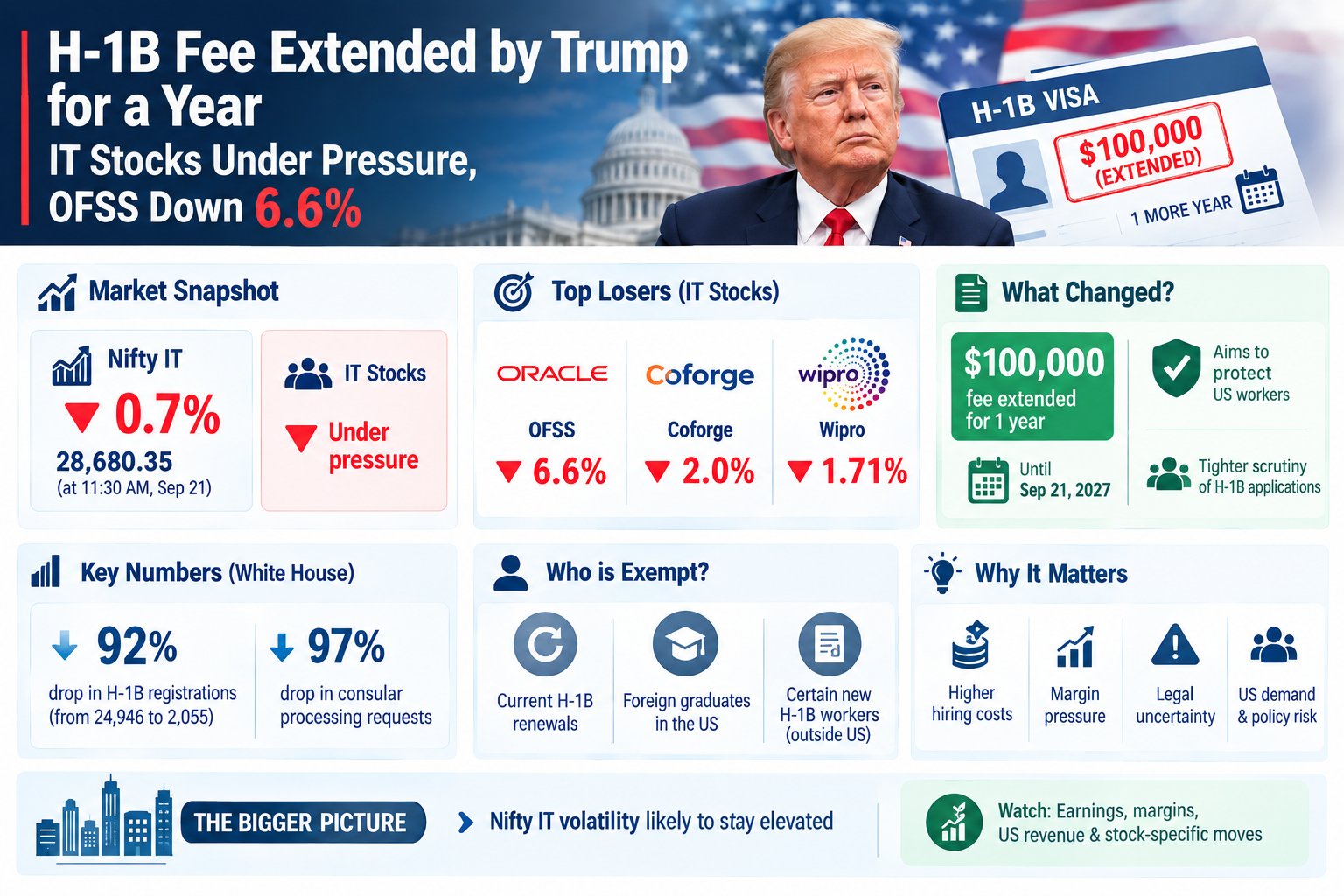
Nifty IT stocks feel the pressure as H-1B Fee Extended by Trump
The immediate reaction was visible across Indian IT stocks.
At around 11:30 am, the Nifty IT index was down 0.6% at 28,680.35. Oracle Financial Services Software, Coforge and Wipro were among the major losers, falling around 6.6%, 2% and 1.71%, respectively.
The broader concern for investors is that tighter H-1B rules could increase the cost and complexity of deploying Indian technology professionals to the US.
For IT companies with significant US exposure, traders are therefore watching potential effects on staffing costs, project execution and margins.
IT stocks see selling pressure
Several Indian IT stocks declined following the announcement:
| Stock | Reported decline |
|---|---|
| Oracle Financial Services Software (OFSS) | 6.6% |
| Coforge | 2.0% |
| Wipro | 1.71% |
| Nifty IT | 0.6–0.7% |
Other reports showed OFSS falling more than 7% intraday, while Infosys, Wipro and Coforge were down by up to around 2%. The market reaction was linked to the H-1B extension, although OFSS also faced a separate company-specific overhang related to Oracle and data-centre financing.
Why the H-1B extension matters for Indian IT investors
Indian professionals remain the largest beneficiary group of the US H-1B programme, making the policy particularly relevant for India’s technology sector.
However, the latest proclamation does not simply represent a blanket increase in costs for every existing H-1B worker. The restriction primarily concerns certain workers outside the US whose petitions are not accompanied by the $100,000 payment, with national-interest exemptions available under the proclamation.
This distinction is important for investors because the earnings impact will depend on how individual companies manage their workforce and US hiring requirements.
Track Live : Gap Up / Gap Down Stocks – Today’s NSE Opening Gaps
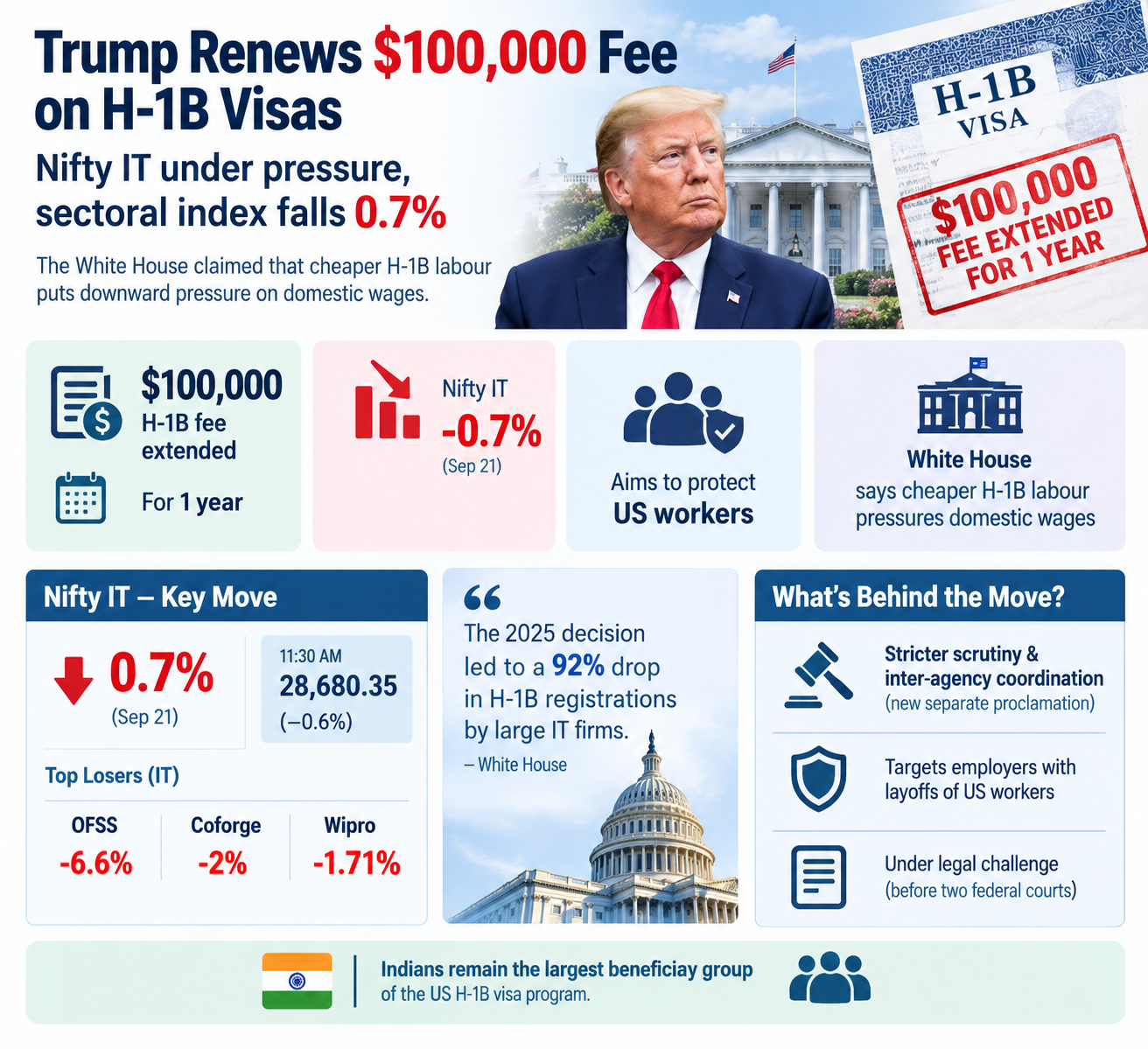
White House reports 92% decline in registrations
One of the most significant figures cited by the administration is a 92% decline in H-1B registrations from the largest IT outsourcing firms.
The White House says registrations from those firms fell from 24,946 to 2,055, representing a 92% reduction following the 2025 proclamation.
The administration also reported a nearly 97% decline in consular-processing requests, which are used to bring workers into the US.
These are White House-reported figures, so they should be attributed to the administration rather than presented as an independently verified industry-wide estimate.
Read More : Tata Chemicals Plunges 11.5% as Tata Trusts Calls Chandrasekaran’s Reappointment Illegal
Who is exempt from the $100,000 requirement?
The measure is narrower than the phrase “$100,000 H-1B fee” might suggest.
Reporting on the extension notes that it does not apply to current H-1B holders renewing their visas, and foreign graduates already in the United States can also be outside the scope of the new entry restriction. Reuters reported that current visa holders and foreign graduates already in the US are exempt.
The proclamation itself specifically addresses qualifying workers currently outside the United States and allows the Department of Homeland Security to grant national-interest exceptions.
Therefore, for an article, it would be safer to write “certain new H-1B workers” rather than saying the fee applies to all H-1B visas.
Trump also orders tighter scrutiny of employers
The H-1B fee extension came alongside a separate executive order designed to increase inter-agency scrutiny of H-1B applications.
The White House says the Departments of State, Labor and Homeland Security will coordinate more closely and consider an employer’s recent or planned layoffs of similarly situated US workers when assessing H-1B applications.
The administration says the objective is to identify cases where H-1B hiring could coincide with the displacement of US workers.
The order also directs agencies to consider additional information concerning wages, industry conditions and employment specialisation.
Here’s what happened today and why traders reacted
US President Donald Trump has extended the 2025 H-1B visa restriction for another 12 months, keeping the $100,000 payment requirement for certain H-1B petitions involving workers outside the US. The extension runs until September 21, 2027, according to the White House proclamation.
The White House said the earlier measure had significantly reduced H-1B registrations by large IT outsourcing companies. It reported a 92% decline in registrations from the largest IT outsourcing firms since the 2025 proclamation took effect.
Trump said the policy is intended to protect US workers and ensure that companies recruit highly skilled workers when required.
“An extension of the 2025 Proclamation will continue to protect the economic and national security interests of the United States,” Trump said.
The White House has also ordered greater scrutiny of H-1B applications, including consideration of recent or planned layoffs of similarly situated US workers.
What could happen to IT stocks in the coming days
The H-1B decision could keep Nifty IT volatility elevated, particularly in stocks perceived to have greater exposure to US staffing requirements.
Investors may now focus on upcoming quarterly commentary, especially management guidance on hiring costs, onsite-offshore employee mix, US demand and operating margins.
The policy is also facing legal scrutiny, adding another layer of uncertainty around its longer-term impact.
For traders, the immediate focus is likely to remain on Nifty IT momentum and individual stock reactions. For long-term investors, company-specific earnings, margins and US revenue growth may provide a broader picture than the H-1B announcement alone.