
The National Stock Exchange IPO drew about ₹90,300 crore of demand on the final day, but the headline subscription masks a sharp institutional-retail split. QIBs drove nearly 63% of the total bid quantity, while NSE enters its proposed listing with strong market dominance, a ₹4.42 lakh crore upper-band valuation and continued exposure to derivatives-related regulatory and volume risks.
IPO and market data updated through September 21, 2026, unless stated otherwise.
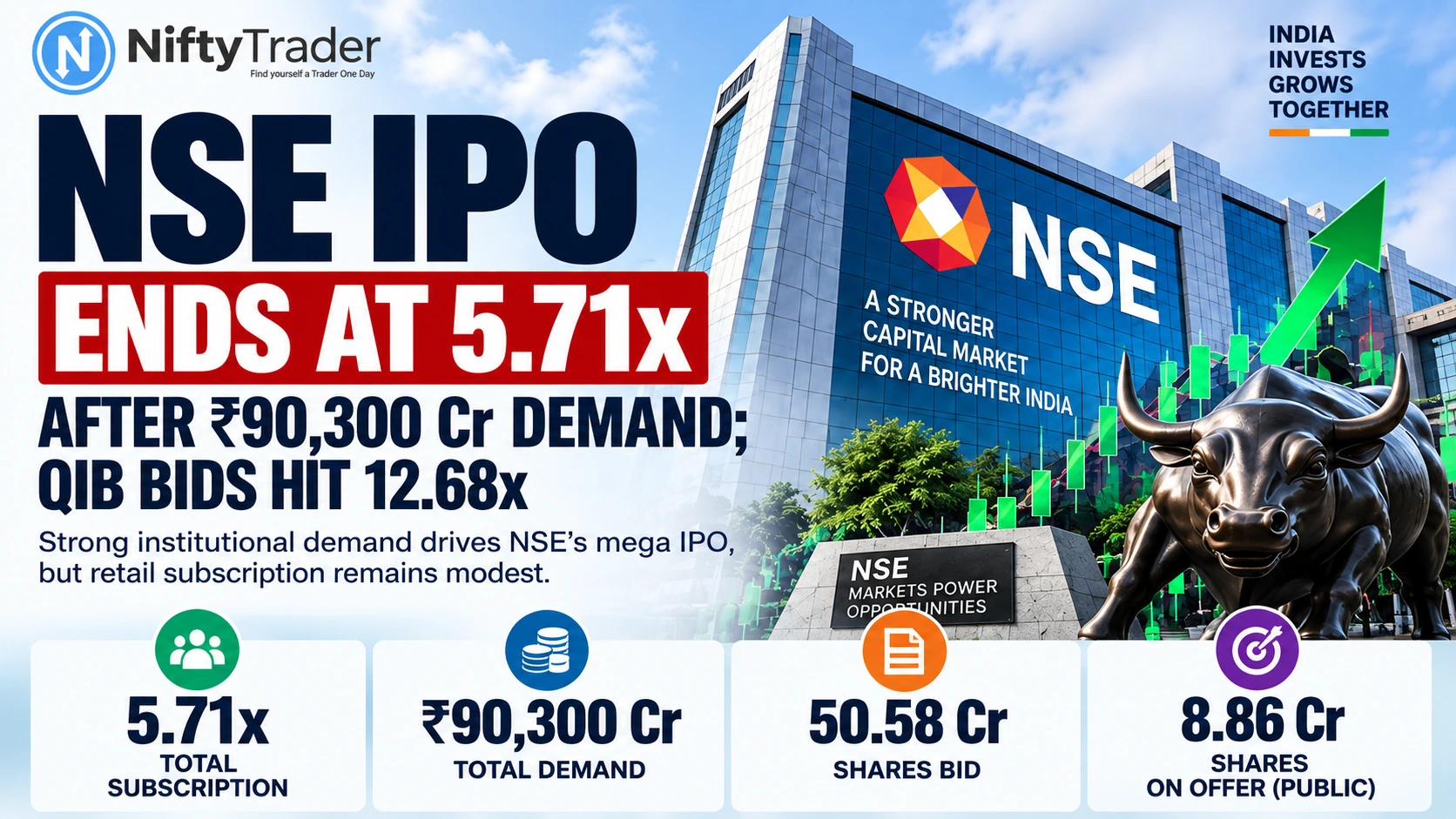
The National Stock Exchange of India’s much-awaited initial public offering ended its three-day bidding process with a 5.71-times subscription, attracting bids for 505.81 million shares against 88.64 million shares offered to the public. Based on the final exchange data, investor demand was worth roughly ₹90,300 crore.
But the most important detail is not simply the 5.71x headline.
The demand was overwhelmingly driven by institutional and high-net-worth investors. The Qualified Institutional Buyer (QIB) portion, excluding the anchor allocation, was subscribed 12.68 times, while the non-institutional investor category was subscribed 6.55 times. Retail investors subscribed 1.39 times.
That creates an important expectation gap around the issue. NSE has attracted very strong institutional demand, but the final numbers do not show an equally aggressive retail rush. At the same time, the company is coming to market after a year of weaker FY26 earnings and at a valuation that assumes investors will continue to value its dominant market position and long-term capital-market growth.
TRACK HERE: NSE IPO | NIFTYTRADER
Need to Know: NSE IPO Final Numbers
| NSE IPO metric | Final / latest detail |
|---|---|
| IPO structure | Offer for Sale (OFS) |
| Total shares offered | 12,64,36,650 |
| Public shares available after anchor allocation | 8.86 crore |
| Price band | ₹1,700–₹1,785 |
| Final subscription | 5.71x |
| Shares bid | 50.581 crore |
| Approx. bid demand | ₹90,300 crore |
| QIB subscription | 12.68x |
| NII subscription | 6.55x |
| Retail subscription | 1.39x |
| Employee subscription | 2.40x |
| Upper-band implied market capitalisation | ₹4,41,787.50 crore |
| Minimum retail application | 8 shares / ₹14,280 |
| Proposed listing | BSE, September 24, 2026 |
NSE’s official issue information confirms the ₹1,700–₹1,785 price band, eight-share lot size, ₹2 lakh retail application ceiling and 12,64,36,650-share OFS structure.
Check Live: IPO – Latest & Upcoming IPOs List 2026 | Check Live BSE NSE IPOs
₹90,300 Crore Demand: Where Did It Come From?
The final subscription data makes the demand composition unusually clear.
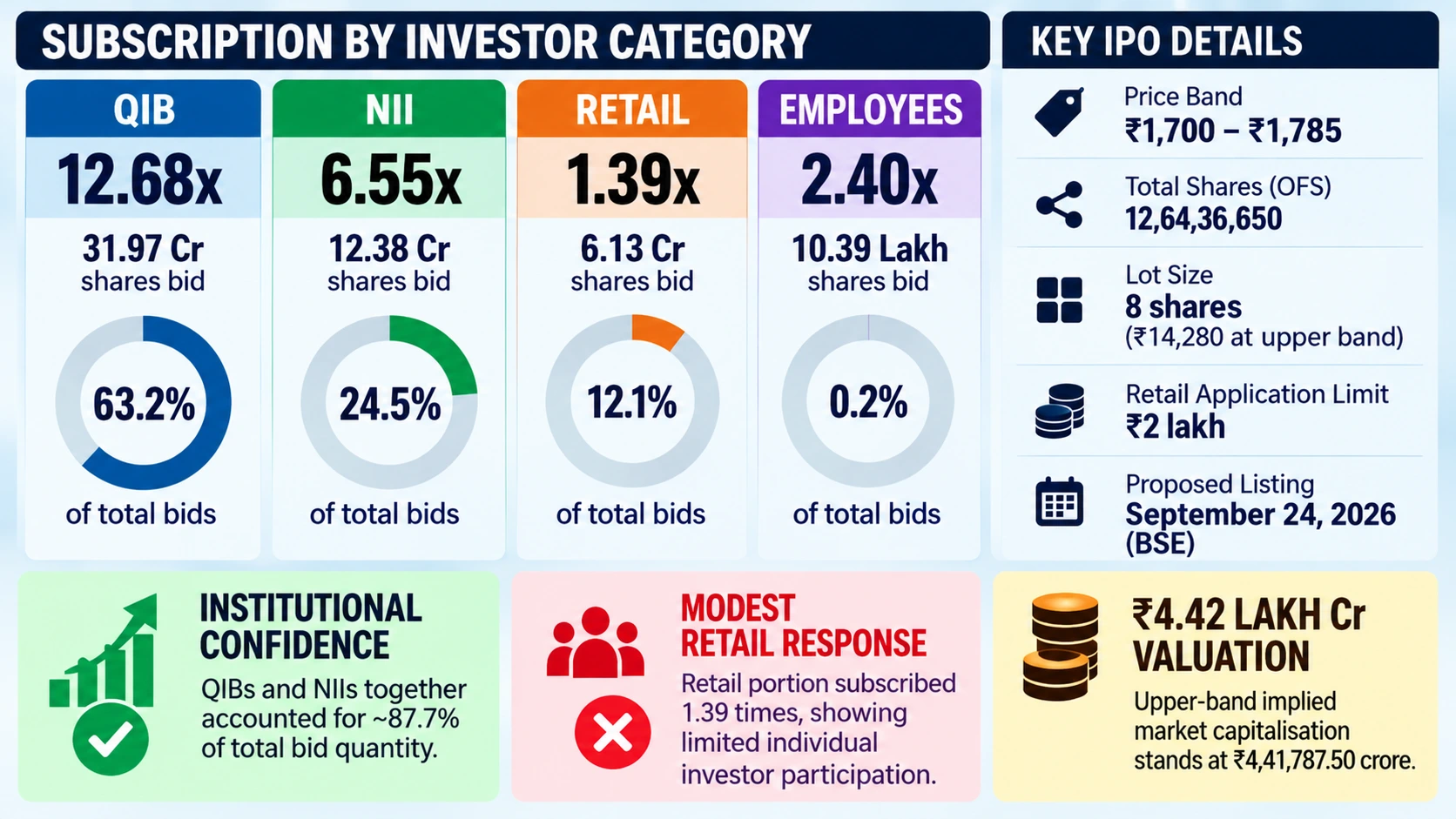
QIBs bid for about 31.97 crore shares against 2.52 crore shares reserved for them. NIIs bid for about 12.38 crore shares against 1.89 crore shares reserved. Retail investors bid for roughly 6.13 crore shares, against 4.41 crore shares on offer. The employee portion attracted about 10.39 lakh shares of bids against 4.33 lakh shares reserved.
| Investor category | Shares reserved | Shares bid | Subscription | Share of total bids |
|---|---|---|---|---|
| QIB | 2.52 crore | 31.97 crore | 12.68x | ~63.2% |
| NII | 1.89 crore | 12.38 crore | 6.55x | ~24.5% |
| Retail | 4.41 crore | 6.13 crore | 1.39x | ~12.1% |
| Employees | 4.33 lakh | 10.39 lakh | 2.40x | ~0.2% |
| Total | 8.86 crore | 50.58 crore | 5.71x | 100% |
The calculation points to a notable market structure: QIBs and NIIs together accounted for roughly 87.7% of the total bid quantity. That means the final 5.71x subscription should not be read as a uniformly distributed retail-led frenzy.
Instead, the result shows that large investors were willing to commit heavily to the exchange, even as NSE faces questions about the pace of derivatives growth and changing market regulations.
The QIB Rush Came Late
The subscription journey also matters.
On the first day, the IPO was only around 0.43x subscribed overall, with QIB demand at 0.19x. By the second day, the issue had crossed full subscription territory as institutional and non-institutional demand accelerated. The final-day institutional rush then pushed the QIB category to 12.68x.
That pattern is particularly relevant for a very large IPO.
Investors often watch the final day closely for QIB participation, and NSE’s demand confirms that institutions entered the book aggressively toward the end of the offering. Reuters reported that the strong QIB response suggested investors were prepared to look beyond the recent moderation in derivatives activity and focus on NSE’s longer-term position in Indian capital markets.
The uncertainty, however, shifts from whether the IPO could attract demand to how that demand translates into secondary-market trading after listing.
A heavily subscribed IPO can still experience a different market response once the stock begins trading, because subscription demand and post-listing price discovery are not the same thing.
This Was Not a Fresh-Capital IPO
One of the most important facts for investors is that NSE is not raising growth capital through this IPO.
The offering is entirely an Offer for Sale, meaning existing shareholders are selling shares. NSE is not issuing fresh equity as part of the transaction, so the IPO proceeds, after applicable expenses, go to the selling shareholders rather than to the exchange for expansion, acquisitions or working capital.
The total offer consists of 12.64 crore existing shares. The issue was anchored before the public bidding began, with about 3.78 crore shares allotted to anchor investors at ₹1,785 per share, raising roughly ₹6,746 crore before the public issue opened.
This distinction changes the way the IPO should be interpreted.
Investors are essentially buying into an already established market-infrastructure business and its future earnings potential. They are not financing a new capacity or expansion plan through primary capital.
Also Check: Current IPOs 2026 – Ongoing SME & Mainboard IPOs in India
Why NSE Commands So Much Attention
The attraction is rooted in scale.
NSE held a 92.99% share of India’s cash-market turnover and a 99.79% share of equity-futures turnover in FY26, while its equity-options market share was 74.71% by premium turnover, according to data disclosed around the IPO.
As of June 30, 2026, NSE had 132.37 million unique registered investors, up significantly from its investor base several years earlier. It also had more than 3,000 listed entities on its platforms.
The exchange operates across equity markets, derivatives, currency derivatives, commodities, debt and related market-infrastructure businesses. Its ecosystem also extends into clearing, market data, connectivity, indices and other services.
That combination gives NSE something that many conventional businesses do not have: scale can reinforce liquidity, and liquidity can reinforce participation.
The market is therefore not valuing NSE merely as an exchange. The IPO valuation also reflects its position as a core piece of India’s financial-market infrastructure.
The Earnings Story Is More Complicated
NSE’s franchise strength does not mean its recent earnings trend has been uninterrupted.
For FY2026, NSE reported ₹16,601.31 crore of revenue from operations, down from ₹17,140.68 crore in FY2025. Profit after tax fell to ₹10,302.06 crore from ₹12,187.69 crore, a decline of roughly 15.5%.
The pressure was closely linked to transaction income.
According to NSE’s IPO disclosure, transaction charges accounted for 78.65% of FY26 revenue from operations, while the options business alone contributed 60.22% of operating revenue.
| Financial metric | FY24 | FY25 | FY26 |
|---|---|---|---|
| Revenue from operations | ₹14,780.01 cr | ₹17,140.68 cr | ₹16,601.31 cr |
| Transaction-charge revenue | ₹12,129.64 cr | ₹13,635.76 cr | ₹13,057.01 cr |
| Transaction charges as % of revenue | 82.07% | 79.55% | 78.65% |
| Options contribution to revenue | 64.62% | 59.47% | 60.22% |
| PAT | ₹8,305.74 cr | ₹12,187.69 cr | ₹10,302.06 cr |
The data reveals the central market tension around the NSE IPO.
The same derivatives engine that helped create exceptional profitability also creates concentration risk.
Regulatory changes affecting equity derivatives, taxation changes and shifts in trading behaviour have moderated parts of the derivatives market. Reuters has reported that changes including the new Closing Auction Session, have been linked by analysts and market participants to changes in derivatives activity and volatility. NSE’s IPO disclosures also warn that an inability to maintain trading volumes could pressure transaction revenue.
Q1 FY27 Offers a More Positive Signal — But One Quarter Is Not a Trend
The latest financial data gives investors another piece of the puzzle.
For the quarter ended June 30, 2026, NSE reported ₹4,560.41 crore of revenue from operations, up 13.10% year on year. Operating EBITDA rose 14.84% to ₹3,594.25 crore, while profit after tax increased 6.71% to ₹3,120.08 crore.
| Metric | Q1 FY27 | Q1 FY26 | YoY change |
|---|---|---|---|
| Revenue from operations | ₹4,560.41 cr | ₹4,032.24 cr | +13.10% |
| Operating EBITDA | ₹3,594.25 cr | ₹3,129.74 cr | +14.84% |
| PAT | ₹3,120.08 cr | ₹2,923.85 cr | +6.71% |
There is therefore a clear expectation gap between the FY26 decline and the early FY27 recovery.
The latest quarter suggests the earnings slowdown is not necessarily a straight-line deterioration. But one quarter is not enough to establish a durable new growth trajectory.
That makes the next few quarters important for the public market valuation.
₹4.42 Lakh Crore Valuation: What Investors Are Paying For
At the upper end of the price band, NSE’s implied market capitalisation is about ₹4,41,787.50 crore. On FY26 earnings, the issue works out to roughly 42.89 times earnings and about 13.76 times FY26 book value, based on the disclosed valuation metrics.
For context, BSE’s FY26 P/E has been reported at around 54.28 times, putting NSE at a lower earnings multiple than its listed domestic exchange peer at the IPO price cap.
But a lower multiple does not automatically remove valuation risk.
NSE is arriving with dominant market shares, exceptionally high operating profitability and a much larger franchise. At the same time, FY26 earnings declined, options-related revenue remains significant, and market rules can affect trading volumes.
From an analytical perspective, the IPO valuation appears to incorporate expectations that NSE’s scale, capital-market participation and diversification can continue to support earnings even if derivatives growth becomes less explosive than in earlier years.
Reuters reported that the IPO valuation was around 15%–20% below levels discussed during pre-deal roadshows, highlighting that the eventual pricing reflected a degree of adjustment from earlier expectations.
Also Check: Latest IPO GMP Today (Live IPO Grey Market Premium)
The Regulatory Overhang Has Changed, Not Disappeared
NSE’s journey to the public markets has been unusually long.
The exchange’s listing plans had been delayed for years amid regulatory investigations, particularly around the co-location matter. In 2026, the process moved forward after regulatory developments cleared important hurdles.
In July, NSE completed payments linked to the ₹1,491.21 crore settlement involving the co-location and dark-fibre matters, including a fresh payment of ₹714.74 crore after an earlier deposit.
That removed a major obstacle ahead of the IPO.
However, the distinction is important: resolving a historical regulatory overhang does not mean the exchange is insulated from future regulatory changes.
The business remains exposed to rules affecting derivatives, transaction taxes, trading structures and market participation. Technology failures, cyber risks and changes in trading behaviour are also identified as material risks in NSE’s IPO disclosures.
The Big Forward Risk: Can NSE Grow Beyond Options?
This is likely to become one of the most closely watched questions after listing.
Options have been a major contributor to NSE’s transaction revenue. At the same time, the exchange’s market share in equity options has moderated from earlier levels, according to IPO-related disclosures. Its share was 74.71% in FY26 by premium turnover, while Q1 FY27 data showed a further moderation to 68.48%.
The long-term growth story therefore depends on more than simply maintaining the current options boom.
Cash-market participation, index products, data services, listings, clearing, connectivity and other businesses can broaden the earnings base. India’s expanding investor population and deeper financialisation can also support exchange activity over time.
But the pace of that diversification will matter.
A more diversified revenue base could reduce the sensitivity of earnings to any single trading segment. A prolonged slowdown in derivatives without sufficiently rapid growth elsewhere could create greater pressure on revenue growth.
What Happens Between Allotment and Listing?
The IPO now moves from subscription to price discovery.
The basis of allotment is scheduled for September 22, with refunds and share credit expected on September 23. NSE’s shares are proposed to list on the BSE on September 24, 2026, subject to completion of the required listing formalities.
That means the next major event is not another subscription number. It is the transition from a heavily subscribed IPO to a continuously traded stock.
Investors will then get a live market signal on how the ₹1,785 issue price compares with what buyers and sellers are willing to pay in the secondary market.
Grey-market premiums may attract attention before listing, but they are unregulated, unofficial and highly sensitive to market sentiment. They should not be treated as a reliable forecast of the eventual listing price.
What Investors Will Watch After Listing
The first few reporting periods could provide a clearer test of the IPO valuation.
The key operating indicators are likely to include NSE’s cash-market and derivatives volumes, options market share, transaction-charge growth, activity across non-derivatives businesses and the pace of investor additions.
The earnings mix will be especially important.
If transaction revenue continues to dominate while derivatives volumes remain under pressure, the market may focus more heavily on valuation support from the rest of NSE’s ecosystem. Conversely, sustained growth in cash markets, data, indices, listings and clearing could strengthen the case for a broader earnings base.
The market will also watch whether the company can maintain its high profitability while investing in technology, cybersecurity and new market infrastructure.
NSE IPO: Strong Demand, But a More Nuanced Story
The final 5.71x subscription and roughly ₹90,300 crore of demand establish that NSE attracted substantial investor interest.
But the deeper story sits underneath the headline number.
QIBs subscribed 12.68 times, NIIs 6.55 times, while retail demand was 1.39 times. Roughly 87.7% of total bid quantity came from QIBs and NIIs, making the demand distinctly institutional rather than evenly spread across investor groups.
At the same time, NSE is entering public markets with enormous domestic market share, a large and growing investor base and very high operating profitability.
The counterweight is equally important: FY26 revenue and profit declined, transaction charges still dominate the business, options account for a large portion of operating revenue, and regulatory changes can materially influence trading behaviour.
That leaves the post-listing phase with a clear test. NSE has already demonstrated that investors want exposure to the franchise. The more difficult question is whether future earnings growth can consistently justify the valuation assigned to that franchise.
For now, the IPO has answered the demand question decisively. The earnings-growth, diversification and valuation questions will be answered in the public market over time.
NSE IPO Timeline
| IPO event | Date |
|---|---|
| Anchor allocation | September 16, 2026 |
| Public subscription opened | September 17, 2026 |
| Public subscription closed | September 21, 2026 |
| Final subscription | 5.71x |
| Basis of allotment | September 22, 2026 |
| Refund/share credit | September 23, 2026 |
| Proposed BSE listing | September 24, 2026 |
Read Next: Stock Triggers for September 22: ONGC Gas, GRSE’s ₹2,896 Cr Yard and Waaree’s 2 GW Order
NSE IPO FAQs
What was the final NSE IPO subscription?
The NSE IPO was subscribed 5.71 times based on the final bidding data, with bids for about 50.58 crore shares against 8.86 crore public shares on offer.
How much demand did the NSE IPO attract?
The issue attracted approximately ₹90,300 crore of bid demand, according to final exchange-data reports.
Which investor category led the NSE IPO?
QIBs led the demand with 12.68x subscription, followed by NIIs at 6.55x and retail investors at 1.39x.
Is the NSE IPO a fresh issue?
No. It is entirely an Offer for Sale, so NSE itself does not receive the IPO proceeds.
What is the NSE IPO price band?
The price band is ₹1,700 to ₹1,785 per share, with a lot size of eight shares.
What is NSE’s implied market capitalisation at the upper band?
At ₹1,785 per share, the implied market capitalisation is approximately ₹4.42 lakh crore.
When is NSE expected to list?
The current IPO timetable places the proposed BSE listing on September 24, 2026, after allotment and share credit.
What is the biggest risk to the NSE earnings story?
A key disclosed risk is dependence on transaction charges, particularly equity options, alongside regulatory and trading-volume changes that can affect market activity.
Does strong IPO subscription guarantee listing gains?
No. Subscription data measures demand during the primary offering, while the listing price is determined in the secondary market. Unofficial grey-market indications can also change quickly and are not guarantees of listing performance.