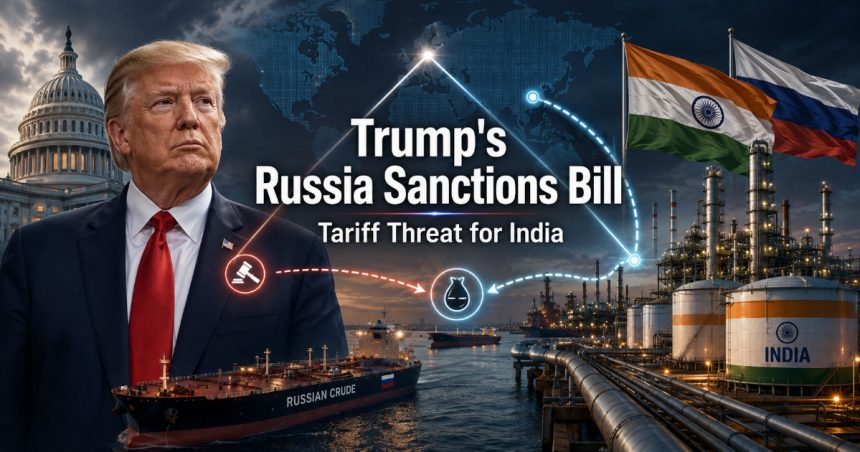
US 100% Tariff Bill: India’s Russian Oil Imports Face Fresh Risk After Senate Vote
The Trump Russia Sanctions Bill has put India’s Russian oil strategy back under the spotlight. The US Senate has now overwhelmingly backed legislation that could give President Donald Trump the power to impose tariffs of up to 100% on goods from countries that continue buying Russian oil and gas.
For India, the timing matters. Russian crude has become a major part of the country’s energy mix because of competitive pricing, while New Delhi is simultaneously trying to deepen trade and energy ties with Washington.
The bill is not yet law. It must still clear the US House of Representatives and be signed by the President before the proposed tariff powers can be used.
Track Live : NSE-Listed Companies and Indian Stock List
US 100% Tariff Bill: The US Senate vote puts India in the crosshairs
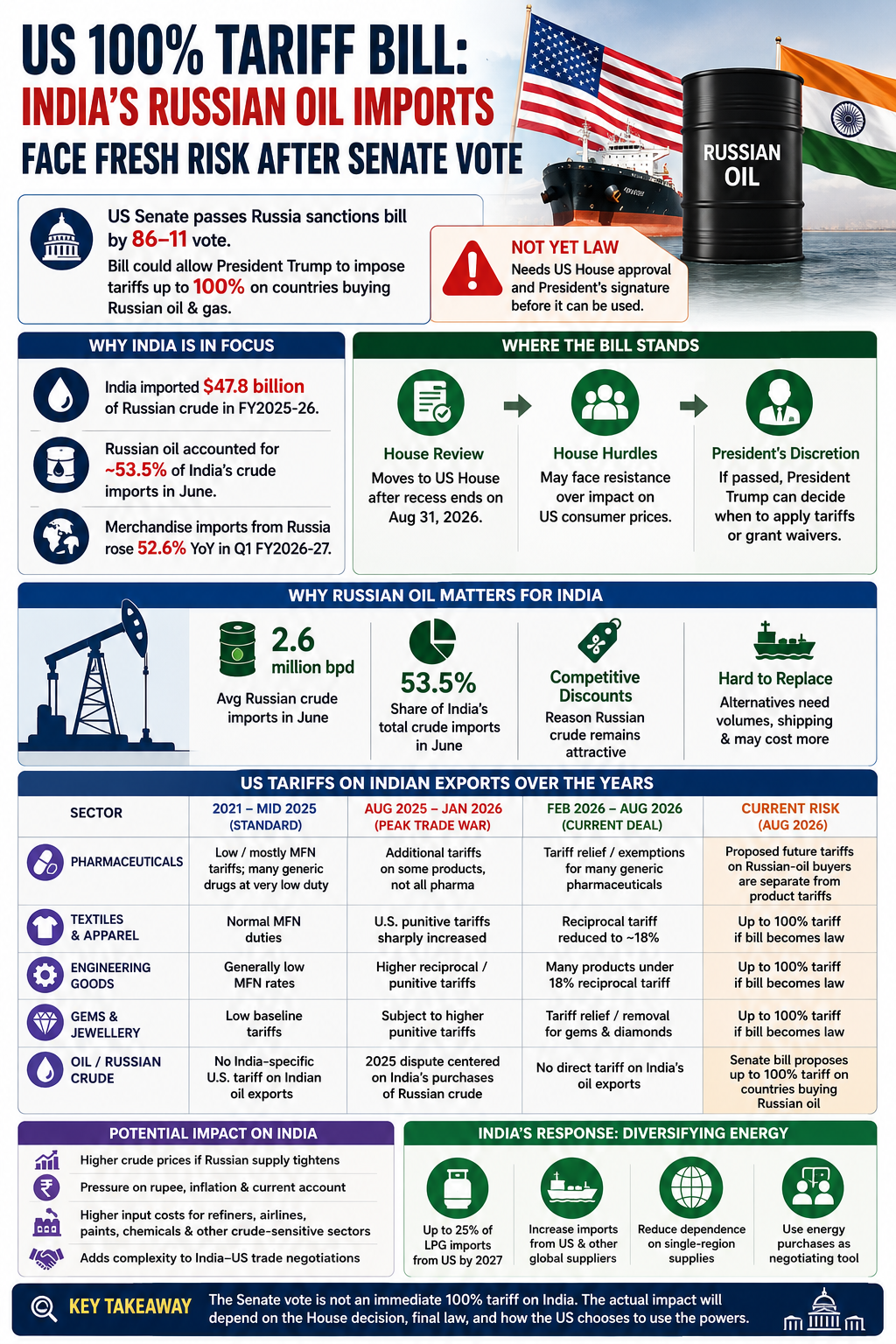
The Senate passed the Lindsey O. Graham Sanctioning Russia and Iran Act of 2026 by an 86-11 vote, giving the legislation strong bipartisan backing. The bill targets major buyers of Russian energy and could expose countries such as India and China to tariffs of up to 100%.
The legislation is aimed at reducing Russia’s energy revenues and increasing pressure over the war in Ukraine. It also contains sanctions targeting Russian officials, financial institutions, oligarchs and entities connected with Russia’s defence sector.
The immediate point for Indian investors is simple: the 100% tariff is a potential power, not an immediate tariff on Indian goods.
Next Steps for the Legislation
- House Review: The bill now moves to the US House of Representatives, where lawmakers will consider it after their summer recess ends on August 31, 2026.
- House Hurdles: Unlike the Senate’s decisive 86-11 vote, the House may face domestic resistance from lawmakers concerned that massive global tariffs will inflate consumer prices inside America.
- Presidential Discretion: If passed by the House, the law grants discretionary power to President Trump. This means he can choose when to apply the tariffs or issue national interest waivers, leaving the door open for diplomatic carve-outs.
Why India Is in Focus
India has become one of Russia’s largest crude oil buyers since 2022 because discounted Russian crude has helped lower import costs.
Key figures:
- India imported about $47.8 billion of Russian crude in FY2025-26.
- Russian oil accounted for roughly 53.5% of India’s crude imports in June.
- Merchandise imports from Russia rose 52.6% YoY in Q1 FY2026-27.
Why Russian oil has become so important for India
India’s exposure is significant because Russian crude has become a critical source of supply for domestic refiners.
Kpler data showed Russian crude imports averaging about 2.6 million barrels per day in June, representing around 53.5% of India’s total crude imports during the period. Full-month imports were expected to exceed 2.35 million barrels per day.
The reason is largely economic. Russian barrels have remained competitive because of discounts and steady refinery demand.
Kpler’s Sumit Ritolia said Russian crude was expected to remain competitive and that Indian imports could stay robust even if US waivers changed.
This makes an immediate switch away from Russian crude difficult. Replacing such volumes would require alternative suppliers, shipping capacity and potentially higher procurement costs.
| Sector | 2021–Mid 2025 | Aug 2025–Jan 2026 | Feb 2026–Aug 2026 | Current Risk (Aug 2026) |
|---|---|---|---|---|
| Pharmaceuticals | Low/mostly MFN tariffs; many generic drugs entered at very low duty | Additional tariffs affected some products, but not all pharma uniformly | Many generic pharmaceuticals received tariff relief or exemptions under the interim U.S.-India trade deal | Proposed future tariffs on Russian-oil buyers are separate from product tariffs. (The White House) |
| Textiles & Apparel | Normal MFN duties | U.S. punitive tariffs sharply increased during trade tensions | Interim agreement reduced reciprocal tariffs to about 18% on originating Indian textile and apparel goods. (The White House) | |
| Engineering Goods | Generally low MFN rates | Higher reciprocal/punitive tariffs during 2025 dispute | Many machinery and engineering products moved to the 18% reciprocal tariff framework. (The White House) | |
| Gems & Jewellery | Low baseline tariffs depending on product | Subject to higher punitive tariffs during 2025 tensions | Gems and diamonds were among products identified for tariff relief/removal under the interim agreement. (The White House) | |
| Oil / Russian Crude | No India-specific U.S. tariff on Indian oil exports | 2025 dispute centered on India’s purchases of Russian crude rather than Indian crude exports | No direct tariff on India’s crude exports; the current risk is the proposed Russia sanctions bill allowing tariffs of up to 100% on countries continuing to buy Russian oil if it becomes law. |
| Sector | 2021–Mid 2025 | Late 2025 | Aug 2026 |
|---|---|---|---|
| Pharmaceuticals | Low (0–5%) | Higher tariffs on some products | Relief for many products; future tariff risk remains |
| Textiles | 5–15% | Up to 50% | 18%* |
| Engineering Goods | 1–5% | 30–50% | 18%* |
| Gems & Jewellery | 0–5.5% | Up to 50% | 18%* |
| Russian Oil Issue | No penalty | 25% additional tariff linked to Russian oil purchases | Senate bill proposes up to 100% tariff if enacted |
The biggest risk could be higher crude prices
The Trump Russia Sanctions Bill could affect India even without a direct 100% tariff.
If tougher restrictions reduce the availability of Russian crude globally, oil prices could rise. For an economy that imports most of its crude requirements, higher oil prices can quickly increase the import bill.
That could put pressure on the rupee, inflation and India’s current account balance.
Indian refiners could also face higher input costs if cheaper Russian barrels are replaced with more expensive supplies from other producers.
For traders, this creates a new set of stocks to watch, particularly oil marketing companies, refiners, airlines, paints, chemicals and other crude-sensitive sectors.
Read More : Apollo Hospitals Q1 FY27 Results on Aug 12: HealthCo Breakeven, Demerger Update Eyed
India is already trying to diversify its energy supplies
The latest US pressure comes as India is already accelerating energy diversification.
New Delhi plans to source up to 25% of its LPG imports from the US in 2027, according to Reuters, partly to reduce dependence on Middle Eastern supplies and support broader trade discussions with Washington.
This strategy could become even more important if geopolitical tensions continue to disrupt traditional energy routes.
The shift also gives India another negotiating tool: buying more US energy could help address Washington’s concerns while allowing New Delhi to avoid an abrupt change in its Russian crude strategy.
India-US trade talks could get another complication
The Trump Russia Sanctions Bill arrives at a sensitive time for India-US trade negotiations.
Washington has previously pressured New Delhi to reduce purchases of Russian oil. The latest legislation could therefore become another issue at the negotiating table.
White House economic adviser Kevin Hassett has indicated that whether the sanctions legislation affects India-US trade talks will ultimately be decided by the negotiating teams.
That leaves room for diplomacy.
India’s strategy could involve increasing purchases of US energy while maintaining access to Russian crude where it remains commercially attractive.
Here’s what happened today and why traders reacted
The Senate vote has raised fresh concerns about India’s exposure to Russian oil, US tariffs and global crude prices.
However, traders should not treat the Senate vote as an immediate 100% tariff announcement. The bill still needs to pass the House and become law, while the actual use and level of tariffs would remain dependent on the US administration.
The immediate market risk is therefore more about uncertainty than an overnight trade shock.
What could the Russia sanctions bill mean for investors?
For Indian investors, the Trump Russia Sanctions Bill creates both sector-specific risks and broader macroeconomic concerns.
Refiners and oil companies: Higher crude procurement costs could pressure margins if discounts on Russian oil disappear.
Airlines and crude-sensitive companies: Higher global oil prices could increase operating expenses.
Rupee-sensitive sectors: A larger oil import bill could increase pressure on the rupee.
Exporters to the US: A potential 100% tariff would be a major risk if the measure is eventually applied to India.
At the same time, companies involved in US energy imports, alternative crude sourcing, logistics and energy infrastructure could benefit if India’s diversification accelerates.
What happens next for India and the markets?
The next major trigger is the US House of Representatives. The bill’s final provisions, its passage and how the Trump administration ultimately uses the powers will determine the actual economic impact on India.
For now, India is unlikely to abandon Russian crude overnight. The bigger story is whether New Delhi can balance cheap Russian energy, higher US energy purchases and its broader trade relationship with Washington.
For investors, the key indicators to watch are Russian crude import volumes, Brent prices, rupee movement, US-India trade negotiations and any amendments to the bill.
The Trump Russia Sanctions Bill has therefore added another layer of uncertainty to Indian markets—but the final impact will depend less on the Senate vote itself and more on what happens in the House and how aggressively Washington chooses to use the new tariff powers.