
Diesel Hits $6.27 a Gallon. Now Putin Has Agreed to Help Trump Bring It Down
US President Donald Trump has claimed that Russia will supply millions of tonnes of diesel to American and global markets, raising hopes of relief from soaring fuel prices. But with energy supplies already under pressure from the Iran conflict and the Russia-Ukraine war, investors will be watching whether the proposed arrangement translates into actual deliveries and lower prices.
Trump said his conversation with Russian President Vladimir Putin was “highly successful” and claimed that the agreement could bring diesel prices down rapidly. The announcement comes at a time when fuel costs have become a major concern for consumers, businesses and financial markets.
For investors, the key question is whether additional Russian diesel supplies can ease the global fuel shortage, reduce inflationary pressure and influence energy stocks in the coming weeks.
Track Live : FII DII Data Today | NSE F&O Lot Size
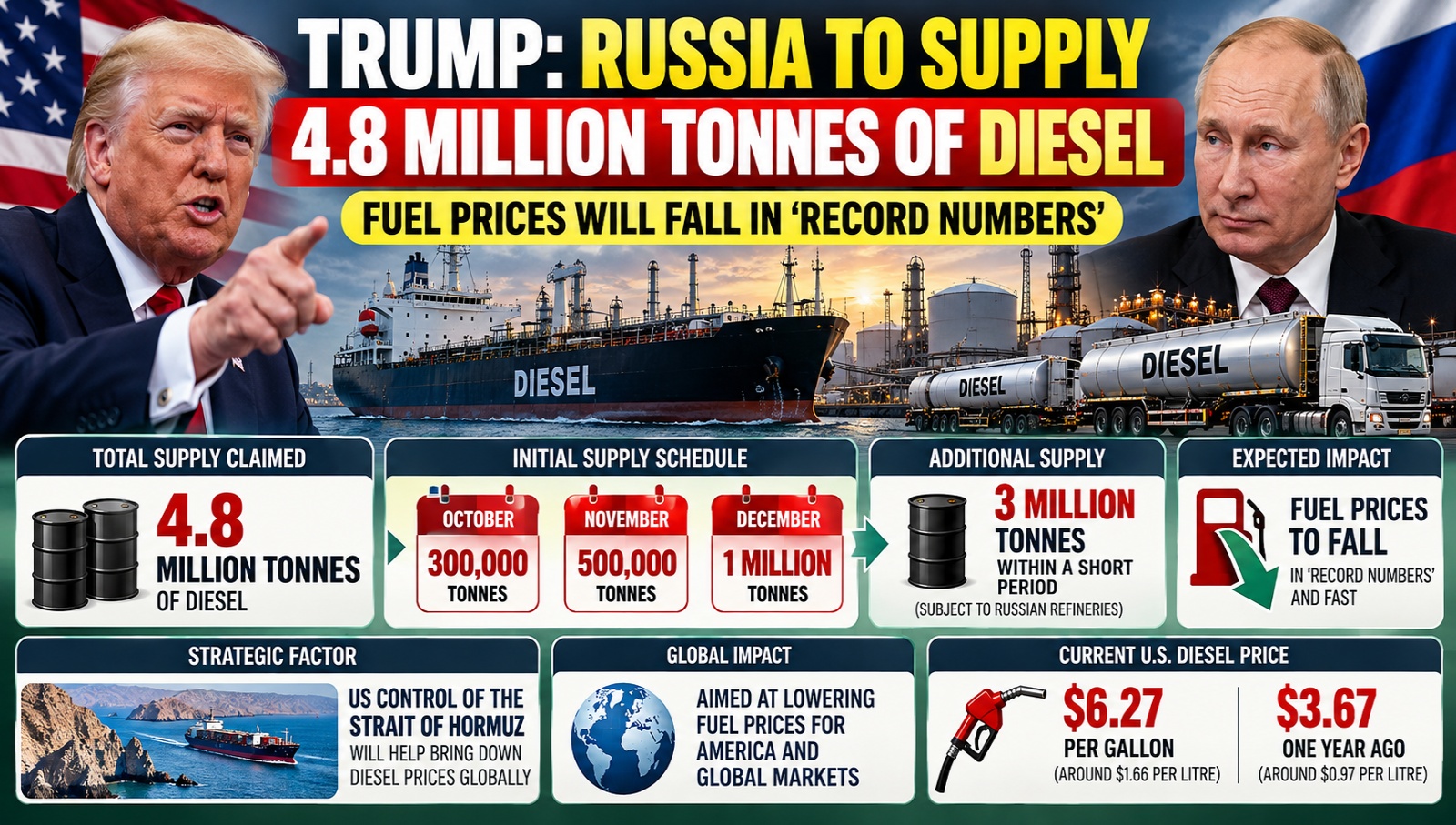
Diesel Hits $6.27 : Why US diesel prices remain under pressure despite the proposed deal
The announcement comes as diesel prices in the United States remain elevated following disruptions to global energy supplies. According to the American Automobile Association (AAA), the national average diesel price stood at around $6.28 per gallon on October 9, compared with approximately $3.68 a year earlier.
The Iran conflict has disrupted energy flows, while the Russia-Ukraine war has added further pressure to fuel markets. The Strait of Hormuz, a critical route for global oil shipments, remains central to concerns about energy security.
Trump argued that Russian energy supplies, combined with US control of the strategic waterway, would bring fuel prices down quickly. However, lower prices will depend on actual deliveries, refining capacity and the broader geopolitical situation.
Why are fuel prices so high?
Three major factors are putting pressure on diesel markets.
-
Iran conflict: Disruptions to energy flows around the Strait of Hormuz have increased concerns about global oil and refined-fuel supplies.
-
Russia–Ukraine war: The conflict and attacks on Russian refineries have added to uncertainty over refining capacity and exports.
-
Tight diesel supplies: Diesel is essential for freight transport, agriculture, construction and industrial activity. When supplies become scarce, higher costs spread throughout the economy.
How the Putin-Trump discussion could influence global energy markets
According to the Kremlin, Putin and Trump discussed the Ukraine conflict, the situation surrounding Iran and bilateral relations. Russia’s envoy Kirill Dmitriev also said that cooperation between Moscow and Washington on diesel and energy could benefit the world.
The announcement followed Putin’s October 8 meeting with Iranian President Masoud Pezeshkian in Turkmenistan. Putin said Moscow was prepared to help resolve the conflict, while Pezeshkian indicated that Iran and the US had exchanged proposals aimed at ending the war and reopening the Strait of Hormuz.
These diplomatic developments could influence crude oil prices, refined fuel costs and investor sentiment. However, progress in negotiations and the restoration of normal energy shipments remain important variables.
Track Live : Gap Up / Gap Down Stocks – Today’s NSE Opening Gaps
How could the deal affect fuel prices?
US consumers and truckers
 Additional diesel supplies could ease shortages and reduce wholesale prices if deliveries arrive promptly and reach buyers at competitive prices.
 Cheaper diesel could lower operating costs for trucking, farming and logistics, potentially reducing some inflationary pressure.
 More exportable fuel could help a tight market, but the effect depends on the size and timing of deliveries relative to worldwide consumption.
Why is the announcement politically significant?
The deal represents a major shift in US policy toward Russian energy exports.
-
Sanctions relaxation: The US Treasury issued a temporary licence permitting specified transactions involving Russian-origin diesel, including sales, delivery and imports, through April 7, 2027.
-
Russia could benefit financially: Export revenues would provide Moscow with additional income while its war against Ukraine continues.
-
Ukraine criticised the move: President Volodymyr Zelenskyy argued that easing restrictions without meaningful progress toward peace would reward Russia. Some US lawmakers also objected.
-
Domestic political pressure: High fuel costs have become an economic and political concern ahead of the November 3 US congressional midterm elections.
Will this reduce diesel prices in India?
Not automatically. The announcement primarily concerns Russian diesel supplies to US and global markets. Any effect on India would depend on wider international fuel prices, trade flows, freight and insurance costs, exchange rates, and domestic fuel-pricing decisions.
India should not be assumed to receive a direct share of the announced shipments. Nor does the announcement establish that petrol or diesel prices at Indian fuel stations will fall.
What the Russian diesel deal means for investors and traders
The proposed Russian diesel supply could affect energy markets and companies that depend heavily on fuel prices. However, the impact will differ across sectors.
-
Energy stocks: Refiners and fuel distributors could face changing margins as diesel prices and supply conditions evolve.
-
Transport and logistics: Lower diesel costs could ease operating expenses for trucking, shipping and other fuel-intensive businesses.
-
Inflation-sensitive sectors: A sustained decline in fuel costs could reduce some transportation and production expenses, potentially supporting consumer-facing businesses.
-
Oil and fuel markets: Traders will monitor diesel futures, crude oil prices and confirmed shipment volumes for signs of a lasting supply improvement.
These are potential effects, not guaranteed outcomes. Investors should also distinguish between crude oil prices and diesel prices, since refining capacity and inventories influence the latter.
Here’s what happened today and why traders reacted
Trump announced that Russia had agreed to supply diesel in stages, starting with more than 300,000 tonnes, followed by 500,000 tonnes in November and one million tonnes thereafter. He also claimed that an additional three million tonnes could arrive within a short period, depending on the condition of Russian diesel refineries.
Russian Deputy Prime Minister Alexander Novak separately confirmed Moscow’s readiness to supply 300,000 tonnes in October, 500,000 tonnes in November and one million tonnes in December. He added that the volume could eventually reach three million tonnes per month.
Trump described the proposed supply as a major development, telling reporters: “That is a big deal. That is massive amounts of oil coming into our country.”
The difference between the announced initial deliveries and the potential longer-term volumes will be important for traders assessing whether the agreement can materially change fuel supply conditions.
What investors should watch in the coming days
The biggest question is whether the announced deliveries will materialise at the stated volumes and on schedule. Investors should watch official supply confirmations, US diesel prices, developments around the Strait of Hormuz and progress in US-Iran negotiations.
The market reaction may change if shipments are delayed or geopolitical tensions intensify. Conversely, confirmed deliveries and improved energy flows could ease some supply concerns.
For now, Trump’s prediction of fuel prices falling in “record numbers” remains a claim about the expected outcome rather than a guarantee of lower prices. Investors should base decisions on verified developments, company fundamentals and changing market conditions.