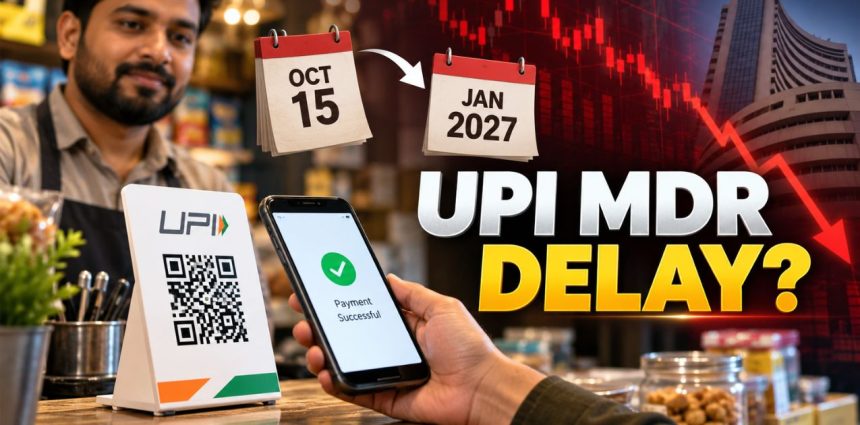
India’s first UPI merchant fee in more than six years is due in a week, and the industry says it cannot yet tell exactly what the fee covers.
Merchant bodies, fintechs and payment companies have asked the National Payments Corporation of India (NPCI) to move the 0.4 per cent merchant discount rate (MDR) from October 15 to January 2027, Moneycontrol reported, citing sources.
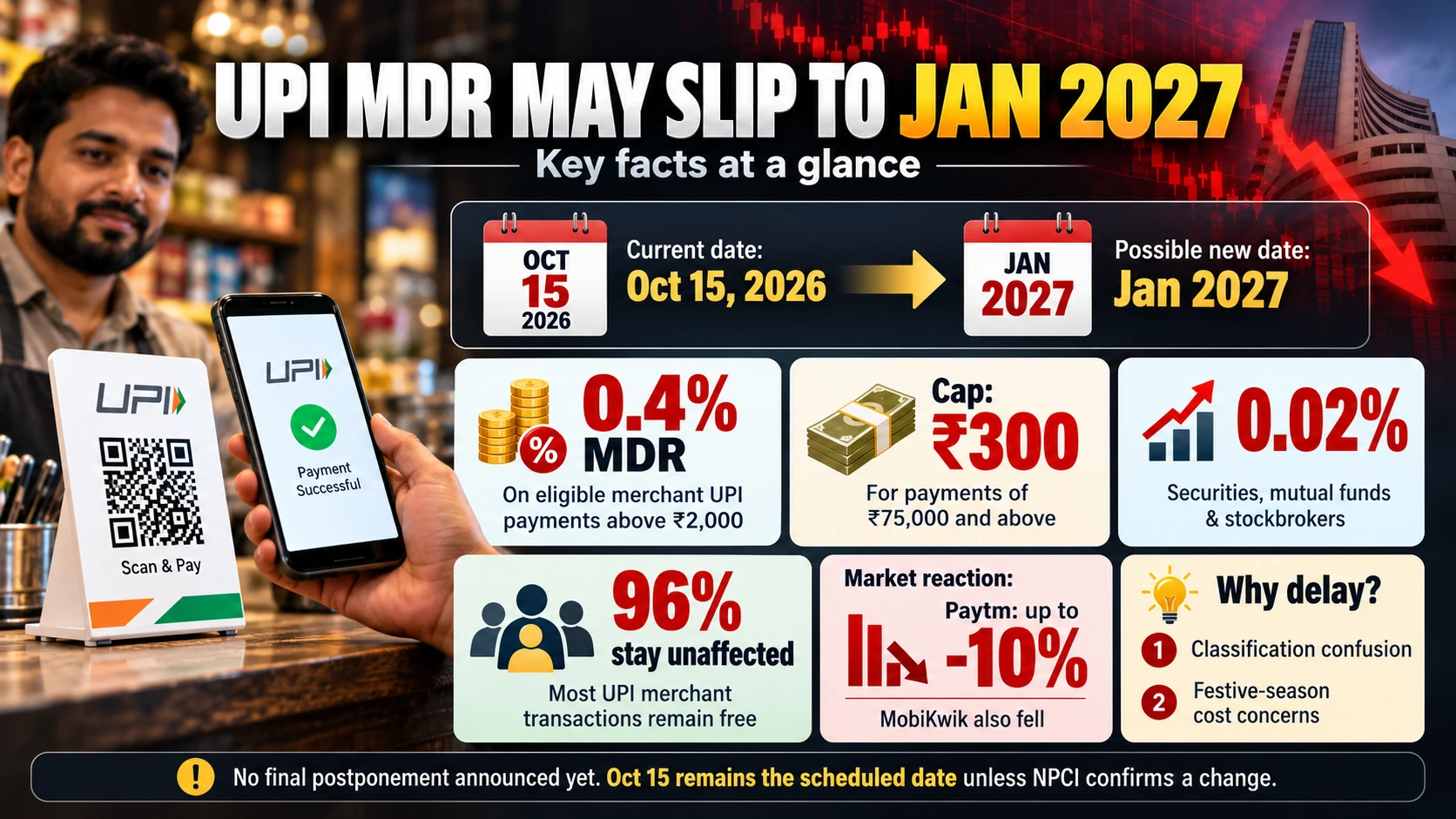
Unless NPCI announces a change, October 15 remains the effective date. Fintech stocks have already reacted. One 97 Communications, Paytm’s parent, fell about 10 per cent in early trade on Thursday.
What Is Happening
NPCI is discussing the requests with the finance ministry and could decide within two days, Moneycontrol’s sources said.
Business Standard, cited by The Week, reported that the UPI Steering Committee, headed by NPCI, discussed the issue on Wednesday and that the fee is likely to be postponed until the festive season ends.
One source told Moneycontrol that the government worries the fee could raise business costs during festive sales while inflation is rising.
What Merchants Would Pay
NPCI’s circular, dated September 15 according to Paytm’s exchange filing, sets a fee of up to 0.4 per cent on person-to-merchant UPI payments above ₹2,000.
The fee is capped at ₹300 for payments of ₹75,000 and above, and securities, mutual fund and stockbroker payments carry a lower 0.02 per cent rate, also capped at ₹300.
Payments up to ₹2,000 and person-to-person transfers stay free. Small merchants receiving up to ₹1 lakh a month through UPI QR directly into their accounts also keep zero MDR. The government says around 96 per cent of UPI merchant transactions will remain free of MDR.
NiftyTrader’s arithmetic on the announced rates:
- ₹5,000 eligible payment: ₹20
- ₹10,000 eligible payment: ₹40
- ₹75,000 or ₹1 lakh payment: ₹300 (the cap)
- ₹5,000 payment in a flat-fee category such as fuel: ₹5
- ₹1 lakh stockbroker payment: ₹20
Also Read: CAIT No UPI Day: Will UPI Stop on October 2? MDR Rules Explained
Why the Industry Wants More Time
The sticking point is classification, according to Moneycontrol. UPI has different rates for utility payments, loan repayments and capital-market transactions, unlike the more uniform card rates. Only loan repayments under autopay mandates attract the ₹5 flat fee.
If a small-ticket autopay debit fails and the customer repays manually, that payment is treated as a financial institution payment attracting 0.4 per cent.
NPCI has clarified that all such repayments carry ₹5, but banks and aggregators still struggle to tell a loan repayment from a regular financial services payment. Brokers have also raised concerns with SEBI. They argue that adding money to a trading account resembles a person-to-person transfer and that they earn nothing on it.
Reports even list the flat-fee categories differently. The Week names bill payments, utilities, education and fuel, while Business Standard names railways, telecom, insurance, fuel and agricultural inputs.
Who Earns the Fee, and Why Stocks Fell
The fee is split 40 per cent to the customer’s bank, 30 per cent to the merchant’s acquirer, 20 per cent to the UPI app and 10 per cent to the app’s sponsor bank. On a ₹10,000 payment, the ₹40 fee breaks down as ₹16, ₹12, ₹8 and ₹4 respectively. A 0.4 per cent fee therefore does not mean Paytm earns 0.4 per cent. The app’s share is 8 basis points of the 40.
The split is not final for everyone. Payment aggregators are reportedly negotiating with sponsor banks to keep 50 to 80 per cent of the acquirer’s 0.12 per cent share. On a ₹10,000 payment, that would be roughly ₹6 to ₹9.60 of the acquirer’s ₹12 (NiftyTrader’s arithmetic).
Brokerages see a large prize. Jefferies estimates the industry could earn ₹15,000 crore to ₹18,000 crore from the fee and Goldman Sachs about ₹20,600 crore. Emkay estimates Paytm’s UPI MDR revenue at ₹1,120 crore in FY28 on a conservative take rate of 10 basis points.
UPI person-to-merchant payments make up 85 per cent of Paytm’s gross merchandise value, of which 35 per cent is eligible for the fee. In early trade, One Mobikwik fell 8 per cent and Pine Labs about 4 per cent. Payment shares had risen when the fee was announced in September, so a delay unwinds part of that bet.
Also Read: UPI MDR Sparks Bullish Brokerage Calls on Paytm, Pine Labs; Up to 35% Upside Seen
Government Holds Its Line
RBI Governor Sanjay Malhotra said on Wednesday that no drop in volumes is visible, that a small fee is unlikely to matter much, and that the decision has already been taken.
The Supreme Court refused to stay the fee on September 28, and the retail traders’ association called off an October 2 “No UPI day” after meeting Finance Minister Nirmala Sitharaman.
NPCI has said merchants cannot pass the fee directly to consumers, but critics fear they eventually will. The RBI also raised the repo rate by 25 bps on Wednesday and lifted its FY27 inflation forecast to 5.2 per cent, which adds weight to the festive-season cost argument.
What a Delay Would Change
Merchants would get time to prepare before festive sales, and customers would see no difference because the fee falls on merchants. Banks and apps would wait longer for the new revenue.
A January start would push the first fee revenue back by at least about two and a half months but would not cancel it. NPCI would also get room to settle the loan-repayment and broker-deposit rules.
What to Watch Next
First is NPCI’s decision within two days. A blanket postponement and a category-by-category phase-in would mean very different outcomes for banks and apps.
Second is whether any delay comes with a final category list, since that is the stated reason for the request.
Third is how brokerages revise payment-stock estimates once a date is fixed. Readers tracking institutional positioning in financials and payment stocks can follow daily data on the NiftyTrader FII-DII Tracker: niftytrader.in/fii-dii-data
Bottom Line
The fee itself looks settled, since the government and RBI have defended it and the Supreme Court declined to stay it. What is open is the start date and the category rulebook.
For Paytm, MobiKwik and Pine Labs, the question is no longer only how much MDR they can earn, but when and after how much negotiation with banks. Until NPCI issues a formal decision, October 15 remains the rollout date.
Read Next: 18% GST Proposed on NBFC Co-Lending: Why the Tax Base Matters for Banks and Lenders
Disclaimer: This article is intended for informational and educational purposes only. It does not constitute investment advice or a recommendation to buy, sell or hold any security. Readers should consult a SEBI-registered investment adviser before making investment decisions.