
The RBI is facilitating SEBI-regulated depositories to include bank-deposit account information in the Consolidated Account Statement through NBFC Account Aggregators. At the same time, Account Aggregators will become interoperable, potentially allowing customers to access financial information through one platform instead of multiple providers. Both measures are expected by December 31, 2026.
Your bank deposits and investment holdings could soon be visible through a more connected financial-information system.
The Reserve Bank of India (RBI) on October 7 announced two related measures: it will facilitate the inclusion of bank-deposit information in the Consolidated Account Statement (CAS) through NBFC Account Aggregators, while also introducing interoperability among NBFC Account Aggregators.
For demat investors, that could mean seeing information relating to their bank deposits and demat holdings in one CAS.
The bigger change, however, is not just the addition of deposits. RBI is also removing a layer of fragmentation in the Account Aggregator ecosystem by allowing customers to access and share financial information across Financial Information Providers through an NBFC-AA of their choice.
Both measures are expected to be implemented by December 31, 2026.
Need to Know
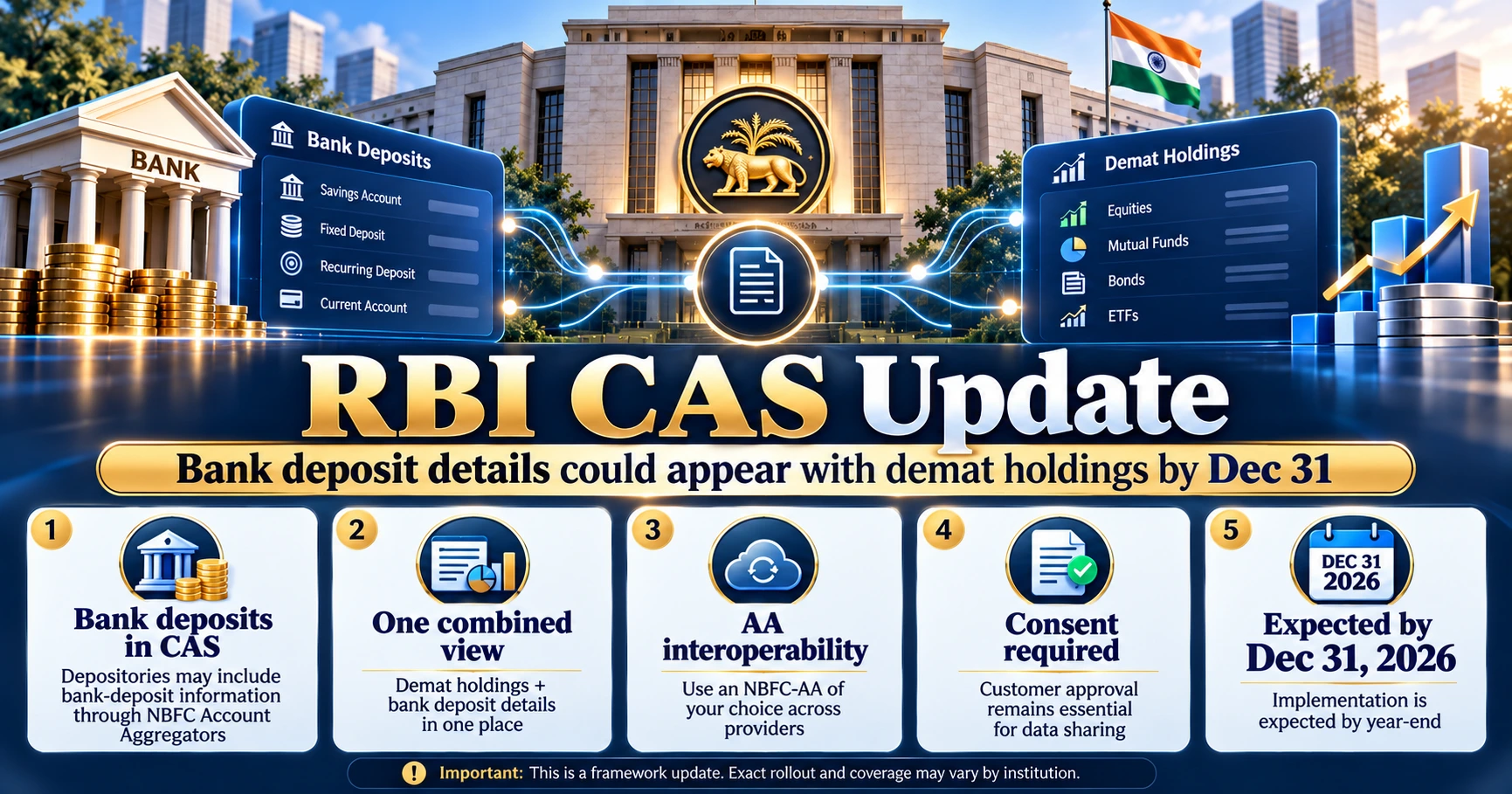
- Bank-deposit information could be added to CAS: RBI is facilitating SEBI-regulated depositories to include information relating to bank deposit accounts through NBFC-AAs.
- Demat investors could get one combined view: CAS could show information relating to demat holdings and bank deposits in one place.
- Account Aggregators will become interoperable: Customers will be able to use an NBFC-AA of their choice to access and share financial information across providers.
- Consent remains essential: The AA framework does not permit unrestricted access to customer financial data.
- December 31 is the target: RBI expects both measures to be implemented by the end of 2026.
What Is RBI Changing in CAS?
The RBI is not replacing the existing Consolidated Account Statement.
Instead, the central bank is facilitating SEBI-regulated depositories to include information related to bank deposit accounts in CAS through the NBFC Account Aggregator framework.
RBI says this will enable demat account holders to view information relating to their demat holdings and bank deposit accounts at one place through CAS.
That creates a potentially simpler financial snapshot.
Today
Bank deposits → bank records
Shares and other demat holdings → demat/CAS
Mutual fund holdings → existing CAS framework
Under the new framework
Bank-deposit information + demat holdings → potentially available together through CAS
The distinction matters: RBI has announced the framework, but the exact format, coverage and user experience will depend on implementation by the relevant institutions.
This Is Bigger Than an FD Update
Several reports have described the move as a way for investors to see FD details in CAS. That is a useful consumer shorthand, but RBI’s announcement uses the broader term “bank deposit accounts.”
That wording leaves an important implementation question open: exactly which deposit information will appear, in what format and across which institutions?
That uncertainty should not be ignored.
The RBI has provided the policy direction and December 31 implementation target, but the operational details will determine what investors actually see.
Also check: FD Interest Rates – Check Current Fixed Deposit Rates online
Why Account Aggregator Interoperability Matters
The second RBI measure could be just as important.
At present, financial data sharing can involve different Account Aggregators and Financial Information Providers. RBI is now moving towards an interoperable system.
Under the new framework, customers will be able to access and share their financial information across different Financial Information Providers through any NBFC-AA of their choice.
In practical terms, customers should not need to be locked into a particular Account Aggregator ecosystem simply because a specific financial institution is connected to it.
This could reduce friction when customers need to share financial information with regulated financial institutions.
What Does This Mean for Investors?
For a demat investor, the most visible potential change is straightforward:
Your securities information and bank-deposit information could become available in one place.
That could make it easier to monitor the split between market-linked assets and bank deposits without checking multiple records.
It could also make financial-information sharing more convenient when a customer needs to provide information to a regulated financial institution.
But investors should not assume that every bank account or every deposit will automatically appear in every CAS immediately after December 31.
The December 31 date is an expected implementation deadline, not a guarantee of identical functionality across every bank, depository and Account Aggregator from that day.
That is the key expectation gap to watch.
What If You Do Not Have a Demat Account?
The wider Account Aggregator framework is not limited to stock-market investors.
RBI said customers without demat accounts can continue to obtain a consolidated view of their financial information and share it through NBFC Account Aggregators.
So there are two connected developments:
For demat holders: Bank-deposit information could be brought into CAS alongside demat holdings.
For other customers: The interoperable AA ecosystem can provide a broader route to consolidate and share financial information.
Your Data Is Not Automatically Open to Account Aggregators
The expansion of connectivity does not mean an Account Aggregator can freely inspect a customer’s bank information.
The Account Aggregator framework is designed around customer consent. Government information on the AA framework states that financial information is not retrieved, shared or transferred through the framework without the customer’s explicit consent.
That remains an important safeguard as more financial information becomes digitally connected.
The bigger challenge ahead is therefore not simply connectivity.
It is whether the system can deliver consistent data, clear consent flows and reliable implementation across institutions.
The AA Network Is Already Large
This is not an infrastructure experiment starting from scratch.
Business Standard reported that 338.04 million accounts were linked through the Account Aggregator framework by August 2026, up 24% from 272.46 million in February.
Cumulative fulfilled consents had reached 566.26 million, while AAs delivered 352.48 million datasets on linked accounts in August.
That scale gives the RBI’s latest interoperability move greater significance.
The question is increasingly shifting from whether financial data can be shared digitally to how seamlessly that data can move across the ecosystem.
What Changes by December 31, 2026?
RBI expects two measures to be implemented by the deadline:
- Interoperability among NBFC Account Aggregators
- Facilitation for bank-deposit information to be included in CAS through NBFC-AAs
For investors, the first visible benefit could be a more consolidated view of financial assets.
But the precise investor experience will depend on how banks, depositories, Account Aggregators and other participating entities implement the framework.
What Does Not Change?
The RBI announcement does not mean:
- Your shares are being moved into a bank account.
- CAS is replacing your bank statement.
- Account Aggregators get unrestricted access to your financial information.
- Every deposit account will necessarily appear in every CAS from December 31.
- Existing securities holdings or ownership arrangements are changing.
The change is primarily about financial-information consolidation and consent-based sharing.
Why This RBI Move Matters Going Forward
The immediate benefit is convenience.
The longer-term significance could be greater.
India’s financial information has traditionally been spread across banks, brokers, mutual funds, depositories, insurers and other institutions.
The RBI is now pushing two pieces of that infrastructure in the same direction: more interoperability in Account Aggregators and a broader information set in CAS.
If implementation works as intended, investors could eventually have a much clearer digital view of their financial assets without repeatedly collecting information from different institutions.
But there is still an implementation risk.
The success of the December rollout will depend on how widely institutions participate, what deposit information is ultimately included and how consistently the new connections work.
That makes December 31 less of an end point than a checkpoint for India’s next phase of connected financial data.
Read Next: H-1B Fraud Bill Proposes $250,000 Penalty and 10-Year Employer Ban
Frequently Asked Questions
What is the RBI CAS update announced on October 7, 2026?
The RBI is facilitating SEBI-regulated depositories to include information relating to bank deposit accounts in CAS through NBFC Account Aggregators.
Will bank deposits appear alongside shares in CAS?
For demat account holders, RBI’s framework is intended to enable information relating to bank deposits and demat holdings to be viewed together in CAS. The exact operational coverage will depend on implementation.
Will FD details be included in CAS?
Fixed deposits are bank deposits, but RBI’s official announcement uses the broader term “bank deposit accounts.” The exact scope and format of deposit information will depend on implementation.
When will the new CAS facility start?
RBI expects the measure to be implemented by December 31, 2026.
What is Account Aggregator interoperability?
It will allow customers to access and share financial information across Financial Information Providers through an NBFC Account Aggregator of their choice.
Can Account Aggregators access my financial information without consent?
No. The AA framework is consent-based and requires customer authorisation for financial-data sharing.
Do I need a demat account to use an Account Aggregator?
No. RBI said customers without demat accounts can continue to obtain and share a consolidated view of their financial information through NBFC-AAs.
Also Read: SEBI CAS Update: 30-Minute VWAP May Return for Derivatives Settlement
Disclaimer
This article is for informational purposes only and does not constitute financial, investment, tax or legal advice. The final scope and operational implementation of the RBI measures may vary across participating institutions.