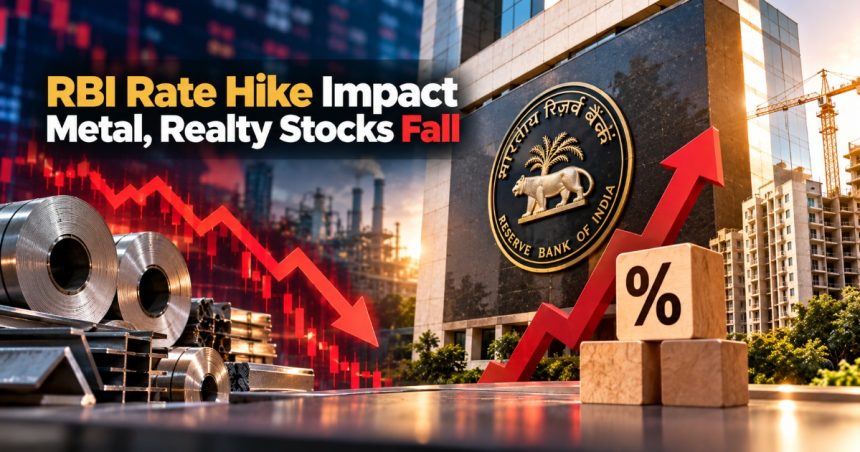
RBI Rate Hike Shock: Metal and Realty Stocks Slide Up to 4%
The RBI rate hike was widely expected, but the central bank’s policy stance caught investors off guard. Metal and real estate stocks came under heavy selling pressure on Wednesday after the Reserve Bank of India raised the repo rate by 25 basis points to 5.50%.
The bigger concern for traders was not the rate hike itself, but the RBI’s shift to “calibrated tightening”, signalling that a rate cut is unlikely in the near term.
Track Live : NSE Option Chain — Live | BSE Option Chain — Live Sensex & Bankex Options Data Today
Realty Stocks Slide: Metal Stocks Lead Sectoral Decline
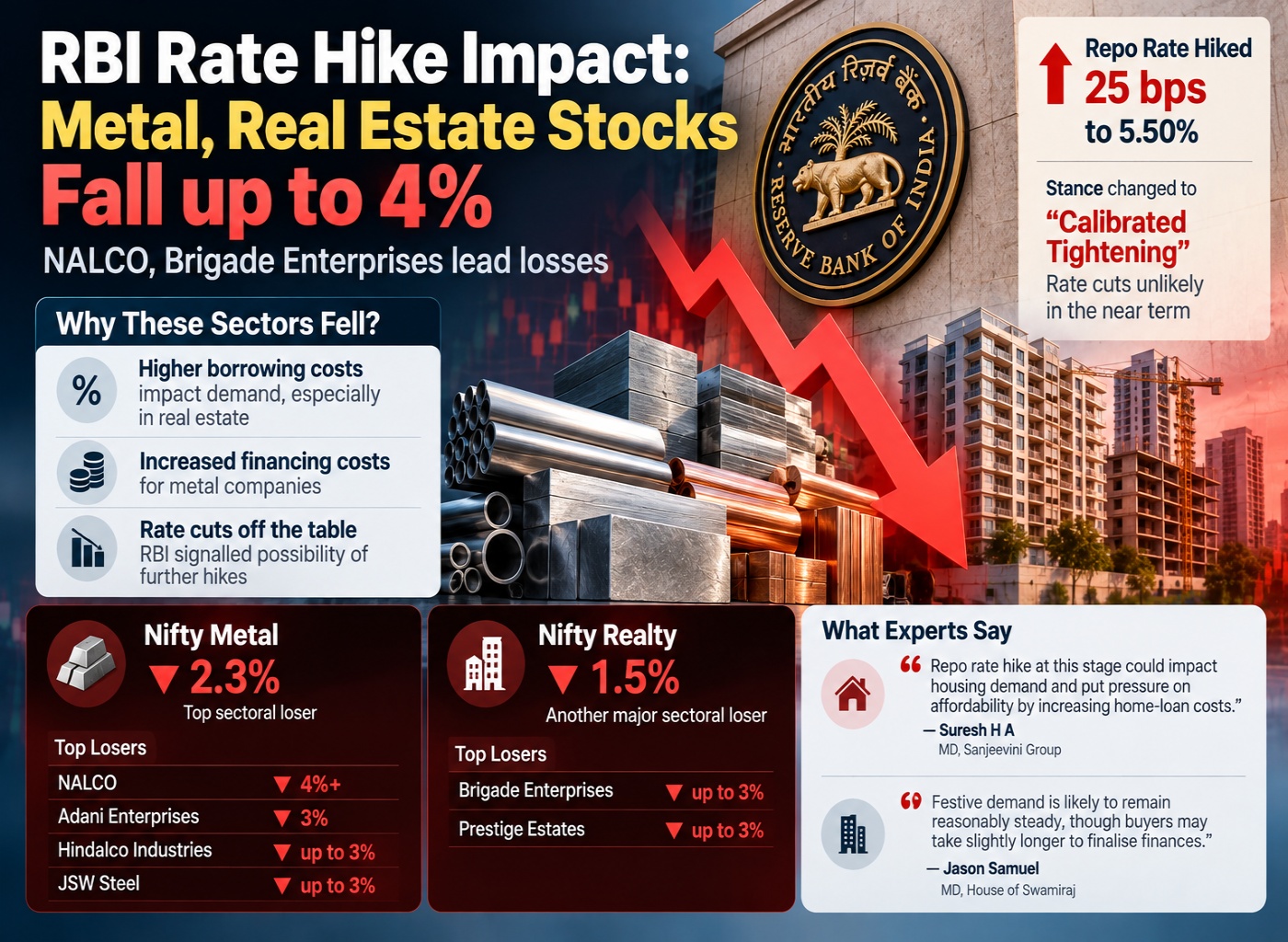
The Nifty Metal index emerged as the worst-performing sectoral index, falling 2.3% and ending a two-session winning streak.
National Aluminium Company (NALCO) led the losses, falling more than 4%. All constituents of the Nifty Metal index traded in the red.
Adani Enterprises declined around 3%, while Hindalco Industries and JSW Steel fell as much as 3%.
Higher interest rates can increase financing costs for metal companies while also potentially slowing economic activity and demand. That combination made metal stocks vulnerable to profit booking after the RBI policy announcement.
Realty stocks feel the pressure as borrowing costs rise
Real estate stocks also came under pressure, with the Nifty Realty index declining up to 1.5% during the session.
Brigade Enterprises and Prestige Estates Projects were among the biggest losers, falling up to 3%.
A higher repo rate can eventually translate into higher borrowing costs for homebuyers. That can affect affordability, particularly for first-time buyers and consumers dependent on home loans.
Suresh H A, Managing Director of Sanjeevini Group, said the RBI rate hike and possibility of further increases could affect housing demand by raising home-loan costs.
However, he noted that banks could retain existing lending rates to support festive consumption and maintain buyer confidence.
Track Live : Opening Price Clues – What Pre-Market Data Says Today
Key market takeaways
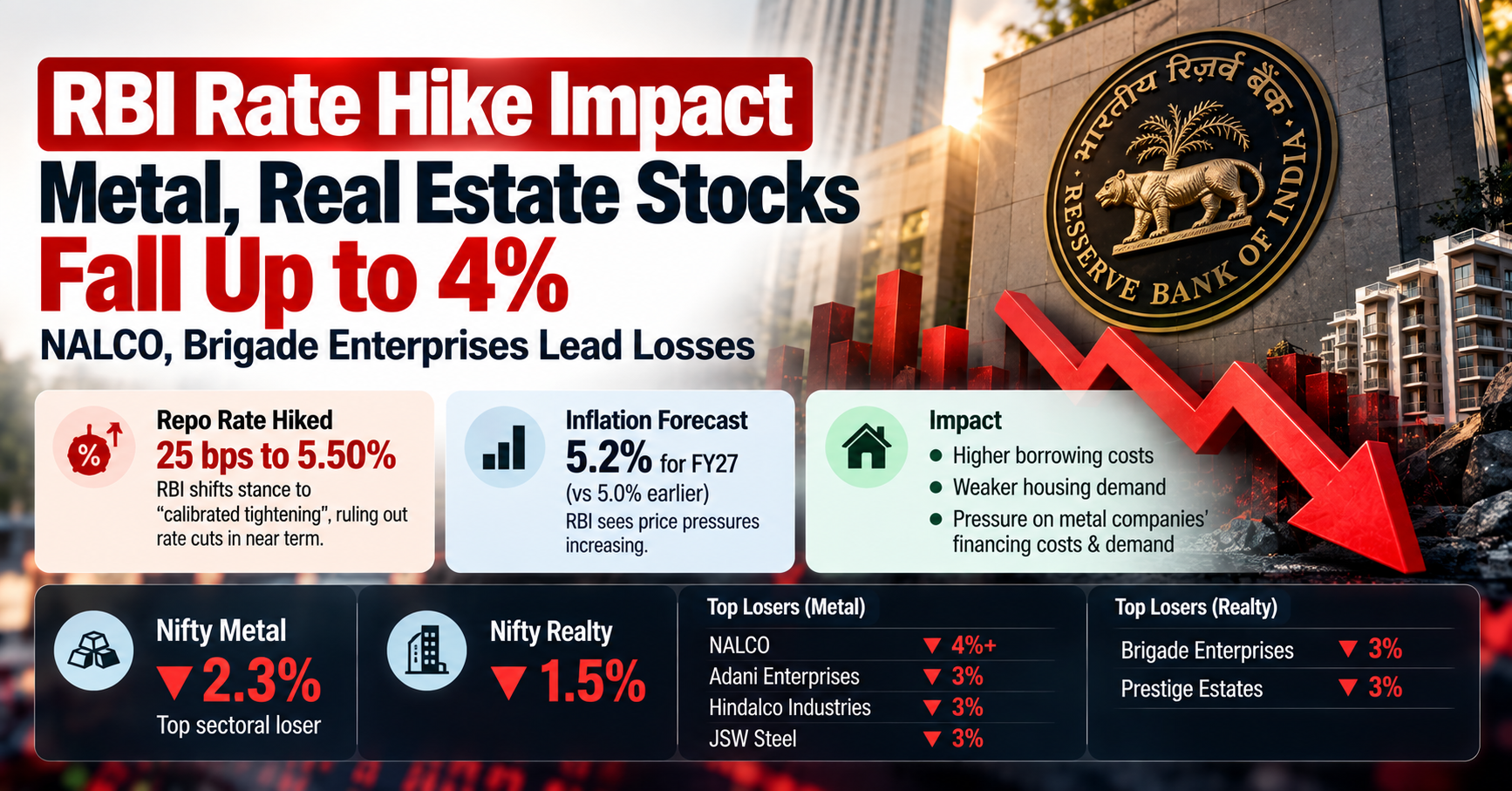
- Nifty Metal falls 2.3%: Metal stocks were among the biggest losers after the RBI raised the repo rate to 5.50%.
- NALCO leads losses: National Aluminium Company fell more than 4%, making it the worst performer in the Nifty Metal index. Adani Enterprises fell around 3%, while Hindalco Industries and JSW Steel declined up to 3%.
- Realty stocks under pressure: The Nifty Realty index declined around 1.5%, with Brigade Enterprises and Prestige Estates among the major losers, falling up to 3%.
- Why real estate is vulnerable: Higher borrowing costs can raise home-loan EMIs, potentially affecting affordability and housing demand. Higher financing costs can also influence developers’ project funding and construction cash flows.
- Why metals fell: Higher rates can increase financing costs and potentially weigh on economic activity and demand. Metals were also affected by broader pressure from the stronger dollar and elevated global commodity prices.
- RBI turns more hawkish: The MPC unanimously raised the repo rate by 25 bps to 5.50% and shifted its stance from neutral to “calibrated tightening.”
- Rate cuts off the table: Governor Sanjay Malhotra indicated that the next policy move can only be a rate hike or a pause, depending on economic conditions.
- GDP outlook remains strong: The RBI raised its FY27 real GDP growth forecast to 7.1%, providing some cushion against the impact of tighter monetary policy.
- Inflation risk has increased: The FY27 CPI inflation forecast was raised to 5.2% from 5.0%, reflecting increased price pressures.
What the RBI rate hike means for investors
The immediate market reaction suggests investors are reassessing sectors that depend heavily on borrowing and economic growth.
Jason Samuel, Managing Director of House of Swamiraj, said festive housing demand could remain reasonably steady, although buyers may take longer to finalise financing decisions.
For investors, the key issue is whether the RBI maintains its calibrated tightening stance for longer. If borrowing costs remain elevated, realty companies could face pressure on financing, project costs and cash flows.
Metal stocks, meanwhile, could remain sensitive to interest rates, economic activity and demand expectations.
Read More : First RBI Rate Hike in 3.5 Years? Why a Falling Rupee Is Forcing the Issue
Here’s what happened today and why traders reacted
The six-member Monetary Policy Committee voted unanimously to raise the repo rate, marking the first increase in nearly four years.
While investors had largely priced in the 25-basis-point RBI rate hike, the change in policy stance triggered a fresh bout of selling in rate-sensitive sectors.
“Rate cuts are off the table in the near term and policy action ahead can only be a rate hike or a pause, depending on the evolving conditions and the outlook,” RBI Governor Sanjay Malhotra said while announcing the MPC decision.
That message immediately changed the market’s near-term interest-rate outlook.
Inflation outlook adds another risk for the market
The RBI also marginally increased its retail inflation forecast for the current fiscal year to 5.2% from 5%, citing growing price pressures.
That adds another layer of uncertainty for traders. If inflation remains elevated, the possibility of additional RBI rate hikes could keep investors cautious toward rate-sensitive stocks.
For now, the RBI rate hike has shifted the market conversation from when rates could fall to how long tighter policy may continue. Investors will be watching inflation, borrowing costs, housing demand and corporate earnings closely in the coming sessions.