
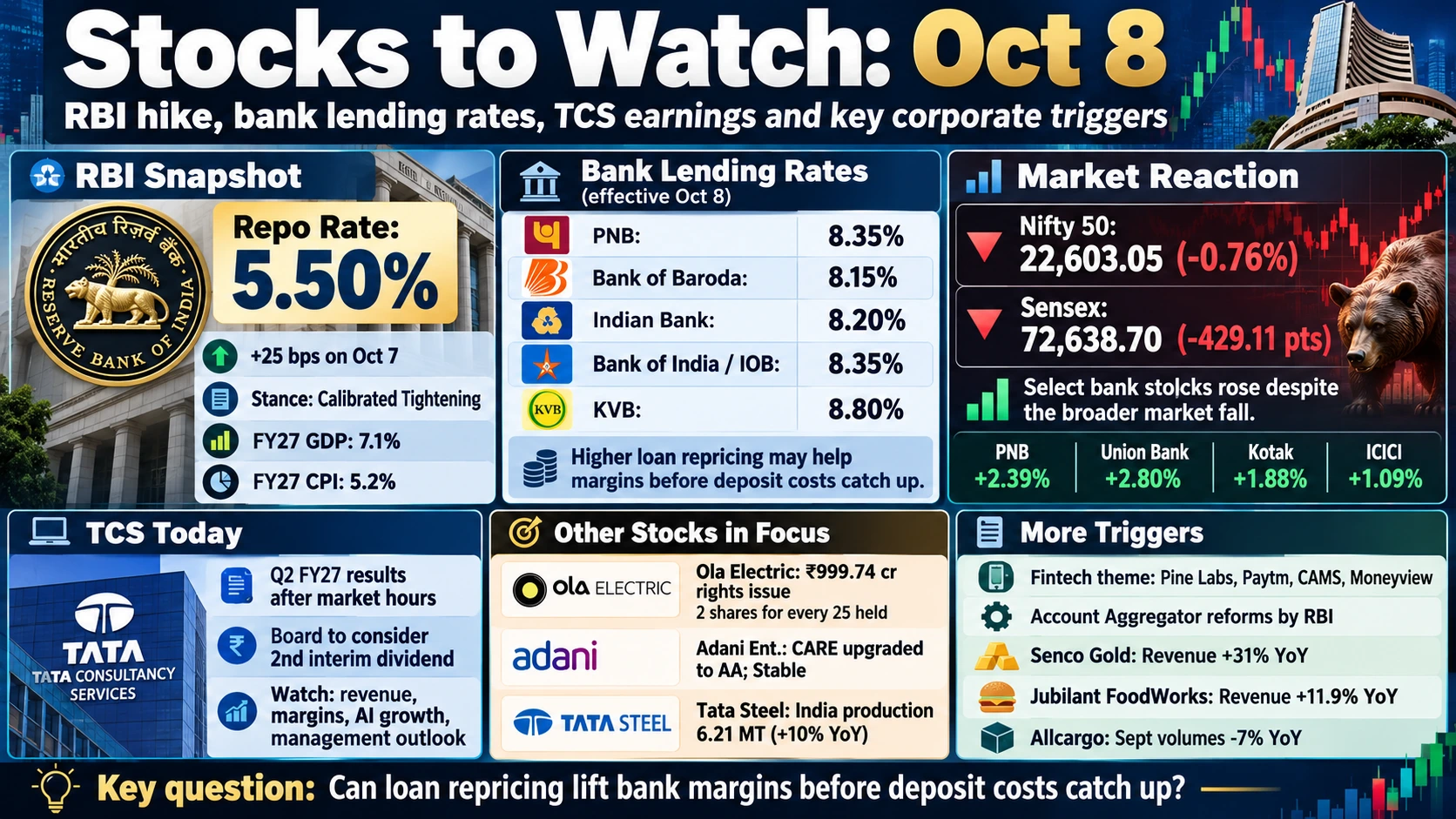
The RBI’s 25-basis-point rate hike is already reaching bank lending benchmarks, while TCS Q2 results, Ola Electric’s ₹999.74-crore rights issue, Adani Enterprises’ rating upgrade and fresh fintech and corporate updates set up a stock-specific trading session.
The RBI raised the repo rate to 5.50%, but bank stocks did not respond like typical rate-sensitive losers.
While the Nifty 50 fell 0.76% on October 7, Punjab National Bank, Kotak Mahindra Bank, ICICI Bank and Union Bank of India gained.
Now, as higher repo-linked lending rates take effect from October 8, investors face a new question: Can faster loan repricing lift bank margins before deposit costs catch up?
The Reserve Bank of India’s first rate increase since February 2023 has already prompted several lenders to raise their lending benchmarks by 25 basis points.
But Thursday’s market action will extend beyond banking stocks.
Tata Consultancy Services (TCS) is scheduled to report its September-quarter results. Ola Electric has finalised the terms of a nearly ₹1,000-crore rights issue, Adani Enterprises has received a credit-rating upgrade, and Tata Steel, Senco Gold and Jubilant FoodWorks have reported fresh operating updates.
A separate RBI policy announcement has also created interest in fintech companies, including Pine Labs, Paytm, CAMS and Moneyview.
These developments could make October 8 a session driven by individual company triggers rather than a single market-wide direction.
Also read: RBI Repo Rate Hiked to 5.5%, First Increase Since 2023
Stocks to Watch Today: Key Triggers for October 8
| Stock | Fresh development |
|---|---|
| PNB, Bank of Baroda, Indian Bank | Repo-linked lending rates increased |
| TCS | Q2 FY27 earnings and dividend consideration |
| Pine Labs, Paytm, CAMS, Moneyview | RBI account-aggregator reforms |
| Ola Electric | ₹999.74 crore rights issue |
| Adani Enterprises | CARE rating upgraded to AA; Stable |
| Tata Steel | India crude steel production rises 10% |
| Senco Gold | Q2 revenue increases 31% |
| Jubilant FoodWorks | Q2 revenue rises 11.9% |
| Allcargo Terminals | September container volumes decline 7% |
1. Bank Stocks: RBI Rate Hike Moves Into Actual Lending Rates
The RBI’s Monetary Policy Committee unanimously increased the repo rate by 25 basis points to 5.50% on October 7, marking its first increase in nearly four years.
The central bank also shifted its policy stance from neutral to calibrated tightening, signalling that additional increases remain possible if inflation pressures persist.
The RBI raised its FY27 inflation forecast to 5.2% from 5.0% and increased its GDP growth projection to 7.1% from 6.7%.
For banking stocks, however, the immediate development is the transmission of higher policy rates into lending benchmarks.
Several lenders have already announced revisions effective October 8.
| Bank | Previous rate | Revised rate |
|---|---|---|
| Punjab National Bank | 8.10% | 8.35% |
| Bank of Baroda | 7.90% | 8.15% |
| Indian Bank | 7.95% | 8.20% |
| Bank of India | 8.10% | 8.35% |
| Indian Overseas Bank | 8.10% | 8.35% |
| Tamilnad Mercantile Bank | 8.25% | 8.50% |
| Karur Vysya Bank | 8.55% | 8.80% |
PNB clarified that its Marginal Cost of Funds-based Lending Rate (MCLR) and base rate remain unchanged.
These revisions apply to the respective lending benchmarks, not automatically to every existing loan.
For eligible borrowers with repo-linked floating-rate loans, the increases could affect interest charges when their loans reset.
But for investors, the bigger question is whether higher lending yields will translate into stronger bank profitability.
2. Why Did Bank Stocks Rise When the Nifty Fell?
The October 7 market reaction was more complicated than a simple response to higher interest rates.
The Nifty 50 declined 173.05 points to close at 22,603.05, while several banking shares gained.
Punjab National Bank rose approximately 2.39%, Union Bank of India advanced 2.80%, Kotak Mahindra Bank gained 1.88%, and ICICI Bank climbed around 1.09% on the NSE.
However, the strength was selective. SBI and Axis Bank finished lower, while the Nifty Bank index also ended marginally negative after recovering from its intraday lows.
Two developments help explain why some lenders attracted buying interest.
Faster loan repricing could initially support margins
Banks earn interest on their loan portfolios while paying interest on deposits and other funding.
When repo-linked loans reprice upward, banks may earn higher yields on those assets relatively quickly.
Deposit rates, however, may take longer to adjust.
That timing difference could temporarily support net interest margins (NIMs).
The important relationship is loan repricing, asset yields, deposit costs and the resulting interest spread.
Higher lending rates alone do not guarantee stronger profits.
If banks subsequently increase deposit rates aggressively to attract or retain funding, the initial benefit could narrow.
RBI avoids an additional CRR increase
The second factor was the RBI’s decision not to introduce another immediate reserve-requirement increase alongside its repo-rate hike.
The central bank left the Cash Reserve Ratio (CRR) unchanged at 3%.
A CRR increase would have required banks to hold a larger share of deposits as reserves with the RBI, adding another direct constraint on available liquidity.
The absence of that measure helped ease immediate liquidity concerns and was among the factors cited in reporting on the banking-sector recovery.
However, it does not mean liquidity conditions will remain comfortable indefinitely.
The RBI can still manage surplus liquidity through bond-market operations, foreign-exchange transactions and other instruments.
For bank investors, the real test is whether lending yields rise faster than funding costs without materially weakening credit growth.
That is why Wednesday’s selective rally should not be interpreted as evidence that every bank will benefit from higher interest rates.
3. What Does the Rate Hike Mean for Existing Borrowers?
The revised lending benchmarks could increase borrowing costs for customers with affected floating-rate loans.
However, an RBI rate hike does not automatically increase every existing home loan EMI on October 8.
The impact depends on the loan benchmark, reset schedule, outstanding balance and lender-specific terms.
Banks may adjust EMIs, repayment tenures or a combination of both, depending on the loan agreement and applicable rules.
For the detailed borrower impact, including EMI calculations and the RBI’s updated inflation outlook, read:
RBI Repo Rate Hiked to 5.5%: EMI Impact and Policy Outlook Explained
For equity investors, the more immediate concern is how these lending-rate changes affect future banking earnings.
4. TCS Q2 Results Today: Revenue Growth Alone May Not Be Enough
Tata Consultancy Services is another major stock in focus on October 8 as India’s September-quarter earnings season gathers momentum.
TCS is scheduled to announce its Q2 FY27 financial results after market hours.
The board will also consider declaring a second interim dividend, with October 14 fixed as the record date if a dividend is approved.
The results arrive during a challenging period for the Indian IT sector.
Global technology spending remains under pressure from cautious client budgets, while artificial intelligence is changing the economics of traditional IT services.
For TCS, investors will focus on four questions:
- Can revenue growth improve despite cautious discretionary spending?
- Are operating margins holding up against pricing and cost pressures?
- Are AI-related deals translating into meaningful commercial growth?
- Does management expect stronger demand over the next two quarters?
The expectation gap could be especially important.
TCS’s share price has faced substantial pressure during 2026, increasing scrutiny of the company’s growth outlook and earnings resilience.
A result that beats revenue expectations but includes cautious management commentary could still disappoint investors.
Conversely, stable margins and stronger demand visibility could improve sentiment even if headline growth remains moderate.
The company’s earnings commentary may also influence how investors assess other large Indian IT services businesses during the results season.
5. RBI Data-Sharing Reform Opens a New Fintech Stock Theme
The RBI’s October policy announcements created another market catalyst beyond interest rates.
The central bank announced plans to introduce interoperability among NBFC Account Aggregators, allowing customers to access and share financial information across participating providers through an Account Aggregator of their choice.
It also announced measures to facilitate the inclusion of bank-deposit information in Consolidated Account Statements issued through SEBI-regulated depositories.
Both initiatives are expected to be implemented by December 31, 2026.
Why fintech companies reacted
Shares of Pine Labs, Paytm, CAMS and Moneyview attracted buying interest following the announcements.
October 7 intraday reporting showed gains of approximately 6% for Pine Labs, 2% for CAMS, 11% for Moneyview and more than 4% for Paytm.
These figures represent reported intraday movements, not necessarily final closing gains.
The potential significance of the reforms lies in improving consent-based financial-data sharing.
Customers may find it easier to access financial information across institutions, while participating financial-service providers could benefit from reduced data-sharing friction.
However, the commercial benefit will vary across individual companies.
Greater financial-data interoperability does not automatically translate into higher revenue for every listed fintech business.
Investors will need to assess which companies have direct exposure to the Account Aggregator ecosystem and whether adoption eventually supports transaction activity, customer acquisition or operating efficiency.
The next important milestone is implementation, rather than the immediate stock-price reaction.
6. Ola Electric: ₹999.74 Crore Rights Issue Gets Final Terms
Ola Electric Mobility will remain in focus after approving the terms of a rights issue aggregating to approximately ₹999.74 crore.
The company plans to offer around 37.03 crore partly paid-up equity shares at ₹27 per share.
The issue carries a rights entitlement ratio of 2 shares for every 25 fully paid-up equity shares held by eligible shareholders on the record date.
Key dates and terms:
| Detail | Announcement |
|---|---|
| Issue size | Approximately ₹999.74 crore |
| Issue price | ₹27 per share |
| Entitlement | 2 shares for every 25 held |
| Record date | October 13, 2026 |
| Issue opens | October 22, 2026 |
| Issue closes | October 30, 2026 |
The rights shares are partly paid-up, meaning shareholders will be required to pay the issue price according to the company’s specified payment schedule.
The fundraising could support debt repayment, business expansion and other corporate requirements.
However, investors will also assess equity dilution and whether fresh capital produces a measurable improvement in operating performance.
Ola Electric has approved the fundraising terms, but the issue has not yet opened for subscription.
The longer-term question is whether the company can convert additional capital into improved financial stability and sustainable business growth.
7. Adani Enterprises: CARE Rating Upgrade Strengthens Credit Profile
Adani Enterprises received a rating upgrade from CARE Ratings on October 7.
The agency raised the company’s long-term rating to CARE AA; Stable from CARE AA-; Stable, while reaffirming its short-term rating at CARE A1+.
The upgrade represents the company’s highest-ever long-term credit rating.
CARE linked the improvement partly to stronger financial flexibility following Adani Enterprises’ ₹15,000-crore qualified institutional placement (QIP) in July 2026 and an investment arrangement involving a 5.54% stake in Adani Airports Holdings.
The airport transaction involves staged investment, so the entire arrangement should not be treated as an already completed stake sale.
In a period of rising interest rates, credit quality and access to financing become particularly relevant for capital-intensive businesses.
A stronger credit profile may support financial flexibility, although actual borrowing costs will depend on market conditions and financing terms.
Investors will watch whether the rating improvement contributes to better funding conditions and greater balance-sheet resilience.
8. Tata Steel: Production Rises 10%, but Profitability Is the Next Test
Tata Steel reported provisional India crude steel production of 6.21 million tonnes in Q2 FY27, up 10% year-on-year and 8% sequentially.
Domestic deliveries reached 5.97 million tonnes, increasing 7% year-on-year and 15% quarter-on-quarter.
The company also reported approximately 1.1 million tonnes of automotive and special-products deliveries, while branded products and retail volumes reached around 2.2 million tonnes.
The stronger production and delivery numbers indicate improving domestic operating activity.
However, steel-company profitability depends on more than volumes.
Selling prices, raw-material costs, product mix and global demand conditions will determine how much of that growth translates into earnings.
For Tata Steel, higher deliveries are encouraging, but stronger margins will be the more important confirmation of business momentum.
9. Senco Gold and Jubilant FoodWorks: Revenue Growth Faces a Margin Test
Two consumer-facing companies have reported encouraging business updates for the September quarter.
Senco Gold: Q2 revenue climbs 31%
Senco Gold reported 31% year-on-year revenue growth in Q2 FY27.
Retail revenue increased 29%, while same-store sales growth reached 19%.
The jewellery retailer benefited from demand across its existing network, with festive and wedding-season spending remaining an important factor in its outlook.
However, elevated gold prices could influence customer affordability, inventory requirements and working capital.
The key question is whether strong sales momentum can translate into sustained profitability.
Jubilant FoodWorks: Q2 revenue rises 11.9%
Jubilant FoodWorks reported consolidated quarterly revenue of ₹2,608.7 crore, up 11.9% year-on-year.
Domino’s India recorded 4.1% like-for-like sales growth, improving from 2.5% in the preceding quarter.
The company added 108 net stores across its group network, including 88 Domino’s India stores.
The improvement in same-store sales is a positive operational development.
But investors will want to see whether stronger demand can offset food costs, operating expenses and other margin pressures.
For both Senco Gold and Jubilant FoodWorks, the next test is the conversion of revenue growth into sustainable earnings.
10. Allcargo Terminals: Falling Volumes Provide a Warning Signal
Not every company entering October 8 has reported improving operating indicators.
Allcargo Terminals recorded September 2026 container volumes of 61,800 TEUs, down 7% from a year earlier and 6% from August.
The decline provides a contrast to the stronger operating updates from Tata Steel and consumer-facing businesses.
Lower logistics volumes may signal softer activity in certain parts of the supply chain, although one month’s data is insufficient to establish a sustained downturn.
For Allcargo, investors will be watching whether the weakness continues and how it affects capacity utilisation and future operating performance.
The decline is a company-specific warning signal, not proof of a broader logistics-sector slowdown.
Market Outlook: What Could Move Stocks on October 8?
Indian equities enter Thursday’s trading session facing a combination of tighter domestic monetary policy and uncertain global conditions.
On October 7:
Foreign institutional selling, higher global bond yields, elevated crude oil prices and currency movements remain important factors for market sentiment.
The RBI’s shift to calibrated tightening has also changed expectations around the future direction of domestic interest rates.
However, another RBI hike is possible, not guaranteed. Future policy decisions will depend on inflation, economic activity and financial conditions.
The immediate market focus is likely to differ by sector.
For banks, the issue is loan repricing versus deposit costs.
For TCS, it is earnings growth versus cautious forward expectations.
For fintech companies, the opportunity is regulatory reform versus uncertain commercial benefits.
For Ola Electric, investors must weigh fundraising against dilution and execution risks.
For Adani Enterprises, the focus is financing flexibility.
For Tata Steel, Senco Gold and Jubilant FoodWorks, stronger business volumes and revenue must eventually translate into sustainable profits.
Allcargo’s weaker volume update offers a reminder that company-specific risks remain important even when broader economic growth is resilient.
Track institutional market activity through the NiftyTrader FII-DII Data page.
What Investors Should Watch Next
The RBI’s October policy has created different implications for borrowers, banks, fintech companies and other listed businesses.
Banks have begun raising lending benchmarks, but any initial margin improvement could narrow as funding costs adjust.
TCS will provide an important test of IT-sector demand and earnings expectations, while the RBI’s fintech measures create potential longer-term opportunities whose financial impact is not yet established.
Meanwhile, operating updates from Tata Steel, Senco Gold, Jubilant FoodWorks and Allcargo show that business conditions are not moving uniformly across sectors.
The central market question on October 8 is not simply whether higher interest rates are good or bad for stocks. It is which companies can protect earnings, manage financing costs and sustain operating performance as monetary conditions tighten.
That distinction could become increasingly important as the September-quarter earnings season unfolds.
Read Next: RBI ₹2 Lakh Crore VRRR Auction: ₹4.99 Lakh Crore Liquidity Surplus Is the Bigger Signal
FAQs
Which stocks are in focus on October 8, 2026?
PNB, Bank of Baroda, Indian Bank, TCS, Ola Electric, Adani Enterprises, Tata Steel, Senco Gold, Jubilant FoodWorks and Allcargo Terminals are among the companies with fresh developments. RBI-related fintech announcements also put Pine Labs, Paytm, CAMS and Moneyview in focus.
Why did some bank stocks rise after the RBI rate hike?
Investors assessed the potential for faster loan repricing to support bank asset yields. The RBI also avoided an additional CRR increase, helping ease immediate liquidity concerns. However, bank-stock performance was mixed, and higher deposit costs could eventually reduce any margin benefit.
What is the biggest event for TCS today?
TCS is scheduled to report Q2 FY27 earnings on October 8. Investors will focus on revenue growth, margins, deal activity, AI-related business and management commentary. The board will also consider a second interim dividend.
Disclaimer: This article is for informational and educational purposes only and does not constitute investment advice or a recommendation to buy, sell or hold securities. Reported market movements and company updates may change. Investors should conduct independent research or consult a SEBI-registered investment adviser before making investment decisions.