Stock Market Crash Today: Sensex Crashes 1,000 Points as Crude and Rate Fears Rattle Investors
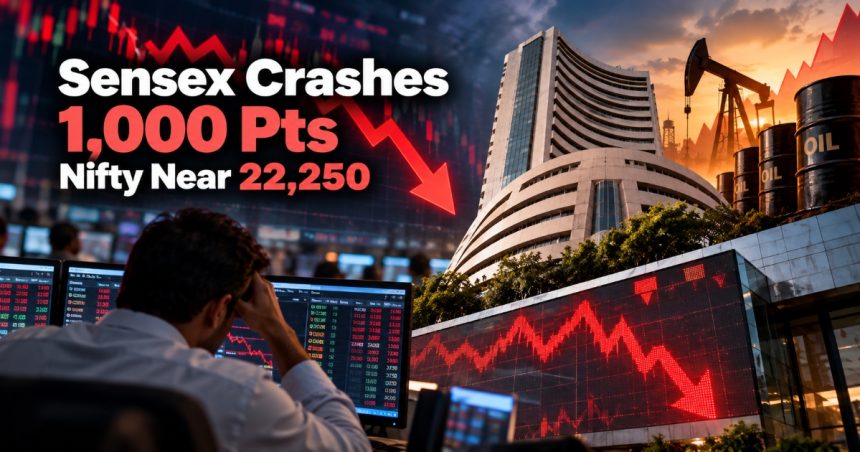
The Indian stock market came under heavy selling pressure on Thursday, with the Sensex crashing nearly 1,000 points and the Nifty falling close to 22,250. But the sharp decline is not being driven by one factor alone. Rising crude oil prices, foreign fund outflows, the RBI’s hawkish stance and weak global cues have combined to unsettle investors.
The bigger question for traders now is whether this is a temporary correction or the beginning of a longer period of consolidation as borrowing costs and geopolitical risks remain elevated.
Track Live : NSE Option Chain — Live | BSE Option Chain — Live Sensex & Bankex Options Data Today
Stock Market Crash Today as Rising crude oil prices add another layer of pressure
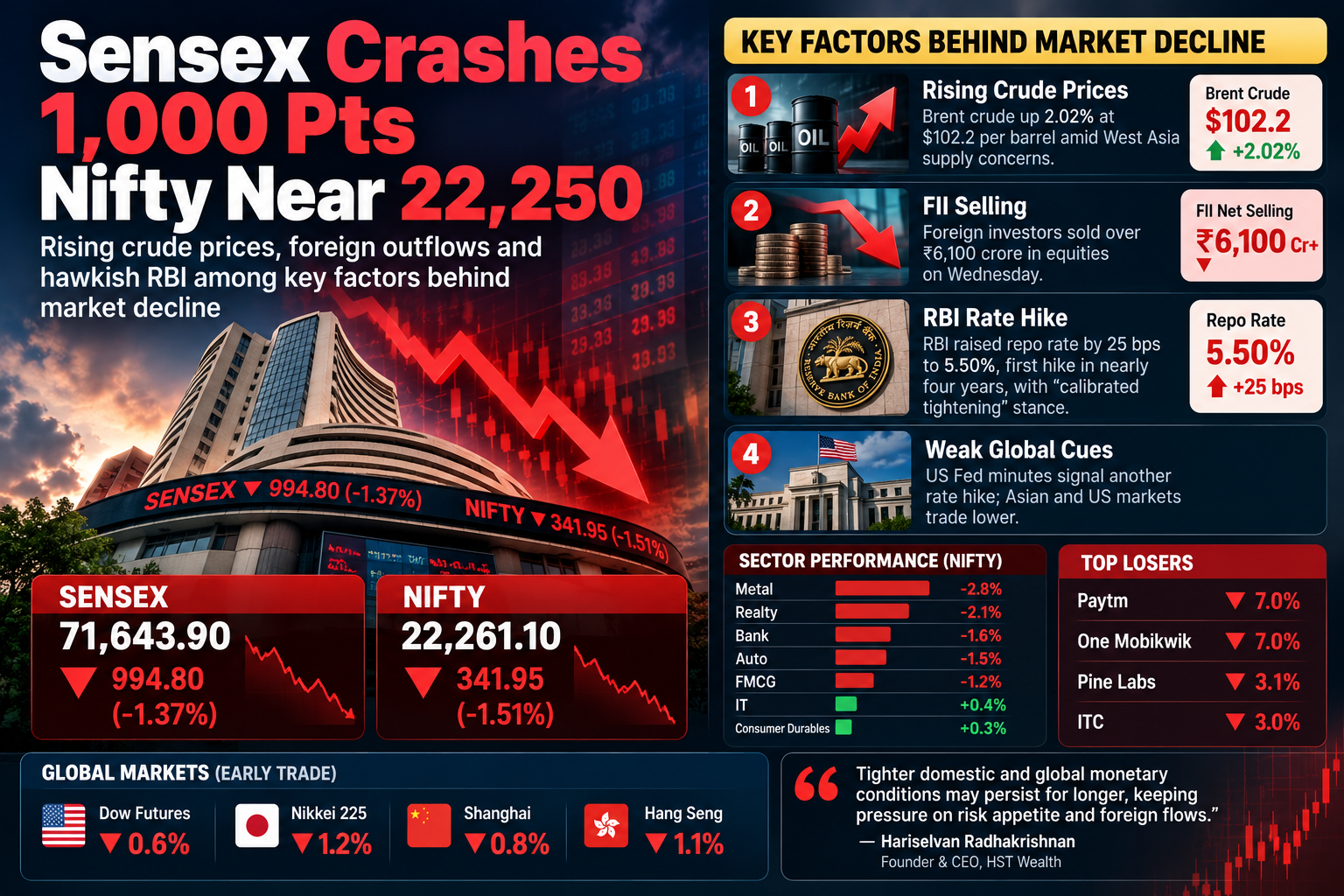
One of the biggest concerns for the Indian stock market is the sharp rise in crude oil prices. Brent crude climbed 2.02% to USD 102.2 per barrel, amid continuing worries over West Asia supplies.
Increased attacks on shipping around the Gulf and the Strait of Hormuz have heightened supply concerns. For India, sustained high crude prices can increase inflationary pressure and put additional pressure on the rupee and corporate costs.
Sensex & Nifty Market Crash Today
Indian equity markets came under heavy selling pressure on Thursday, with both benchmark indices falling more than 1%.
At around 1 PM:
- Sensex: 71,643.90, down 994.80 points (1.37%)
- Nifty 50: 22,261.10, down 341.95 points (1.51%)
- Brent crude: around $102.20 per barrel, up more than 2%
- FII selling: more than ₹6,100 crore in the previous session
- RBI repo rate: raised to 5.50%
- RBI policy stance: shifted from neutral to calibrated tightening
The sell-off also erased roughly ₹9 lakh crore in investor wealth, according to an Economic Times report.
FII selling keeps investors on the defensive
Foreign institutional investor selling is another major concern for traders. Foreign institutional investors sold Indian equities worth more than Rs 6,100 crore on Wednesday, adding to the pressure on domestic stocks.
With global investors already facing uncertainty over interest rates and geopolitical risks, continued FII selling could make it harder for Indian equities to recover quickly.
RBI and US Fed signals raise rate concerns
The RBI’s latest policy decision has become a key market trigger. The central bank not only increased the repo rate to 5.50%, but also shifted its policy stance to “calibrated tightening” from “neutral.”
“The key overhang is no longer the RBI’s rate increase alone, but the growing prospect of tighter domestic and global monetary conditions persisting for longer,” said Hariselvan Radhakrishnan, Founder & CEO of HST Wealth.
US Federal Reserve minutes also indicated that another rate increase may be required this year, further strengthening concerns about prolonged tighter monetary conditions.
Track Live : Opening Price Clues – What Pre-Market Data Says Today
Global markets give Indian equities little support
Weak global cues added to the selling pressure. South Korea’s Kospi, Japan’s Nikkei 225, Shanghai’s SSE Composite and Hong Kong’s Hang Seng all traded lower.
US markets also ended lower on Wednesday, while Wall Street futures pointed towards a weak opening. According to Ponmudi R, CEO of Enrich Money, tighter domestic financial conditions combined with a fragile global backdrop could keep investors defensive.
Paytm, One Mobikwik and ITC face stock-specific pressure
Several stocks also witnessed sharp moves. Paytm and One Mobikwik fell around 7% each, while Pine Labs declined 3.1% after reports suggested that the planned October 15 rollout of merchant fees on certain digital-payment transactions could be delayed.
ITC fell 3% after around 4.4 million shares changed hands through 12 block deals at a discount of 0.6%–3.1% to the previous close.
Read More : Metal, Realty Stocks Slide as RBI Turns Hawkish: NALCO, JSW Steel Fall
Key Market Differentiators & Catalysts
- Monetary Tightening Shock: The RBI surprised markets by unanimously raising the repo rate by 25 basis points to 5.50%, its first hike in nearly four years. More importantly, it shifted its policy stance from “neutral” to “calibrated tightening,” signalling that rate cuts are unlikely in the near term and that another hike remains possible.
- US Rate-Hike Risk: The RBI’s hawkish shift came alongside US Federal Reserve minutes suggesting another rate increase could be required this year. The prospect of tighter monetary policy in both India and the US is increasing concerns about global liquidity, bond yields and equity valuations.
- Surging Crude Pressures: Brent crude climbed above $102 per barrel, with prices supported by concerns over Middle East supplies and attacks on shipping through the Gulf and Strait of Hormuz. For India, sustained high crude prices can increase the import bill, add inflationary pressure and weigh on the rupee and corporate margins.
- Persistent FII Outflows: Foreign institutional investors sold approximately ₹6,121 crore of Indian equities on October 7, while domestic institutions bought around ₹4,597 crore. The scale of foreign selling remains a major overhang for the market, particularly as global bond yields remain elevated.
- Weak Global Risk Appetite: Asian markets, including Japan, South Korea, Hong Kong and China, traded lower as investors reacted to higher crude prices, elevated global borrowing costs and geopolitical uncertainty. This broader risk-off environment is adding to pressure on Indian equities.
- Market Impact: By around 1 PM on October 8, the Sensex had fallen nearly 995 points to 71,643.90, while the Nifty declined 341.95 points to 22,261.10, showing that the initial weakness had developed into a much broader sell-off.
Corporate & Sector Highlights
| Stock / Sector | Price Action | Primary Catalyst |
|---|---|---|
| Paytm / MobiKwik | Fell sharply | Uncertainty over the planned rollout of UPI Merchant Discount Rate (MDR) charges. Reports indicated that the October 15 rollout could be deferred, raising concerns over the timing of expected revenue benefits for digital-payment companies. |
| Pine Labs | Declined | Shares also came under pressure following reports of a possible delay in the MDR rollout. |
| ITC | Declined ~3% | Heavy block-deal activity weighed on the stock. About 36.66 crore shares, or roughly 2.9% of outstanding equity, changed hands in a reported ₹9,437-crore block transaction at an average price of ₹257. |
| IT sector | Outperformed | The IT index bucked the broader market weakness, helped by gains in major technology stocks. TCS also gained ahead of its quarterly results. |
| Small & Midcaps | Under pressure | Both segments declined as investors adopted a more defensive stance amid tighter monetary conditions and weak global cues. |
Here’s what happened today and why traders reacted
At around 1 pm, the Sensex was down 994.80 points, or 1.37%, at 71,643.90, while the Nifty declined 341.95 points, or 1.51%, to 22,261.10.
The sell-off came after both benchmark indices ended their two-session winning run in the previous session. Investor sentiment was already under pressure after the Reserve Bank of India raised the repo rate by 25 basis points to 5.50%, marking its first rate hike in nearly four years.
The pressure was broad-based. All major Nifty sectoral indices declined, except IT and consumer durables, while the Nifty Smallcap 100 and Nifty Midcap 100 fell by up to 1%.
What could the market decline mean for investors?
For investors, the immediate outlook remains cautious. High crude prices, FII selling, RBI tightening and expectations of another US rate hike could continue to influence risk appetite in the coming sessions.
Technically, yesterday’s multiple attacks at 22,574 calls for an extended period of consolidation before a clear direction emerges. Despite the weakness, the 23,100–220 view remains in play, with 22,439 cited as the downside marker.
For traders, volatility may remain elevated. Investors, meanwhile, may want to watch crude oil prices, foreign flows, central-bank signals and global equity trends closely before making aggressive bets.