US PERM Halt Raises Concerns for Indian IT Firms Over Skilled Workers and Business Growth
Why the US PERM Suspension Matters for Indian IT Companies
Indian IT companies could face fresh immigration-related challenges following the suspension of the US permanent labour certification (PERM) process. The move adds uncertainty to an already complicated environment shaped by tighter immigration rules and rising costs of deploying employees in the United States.
Although Indian IT services firms have reduced their dependence on the H-1B visa programme, they still rely on experienced professionals to deliver projects and maintain relationships with US clients.
The key question for investors is whether the suspension will force companies to change their hiring strategies, increase operating costs or reconsider how they deliver technology services in the US market.
Track Live : NSE Option Chain — Live | BSE Option Chain — Live Sensex & Bankex Options Data Today

US PERM Halt Raises : How Indian IT Companies Could Shift Their Delivery Strategies
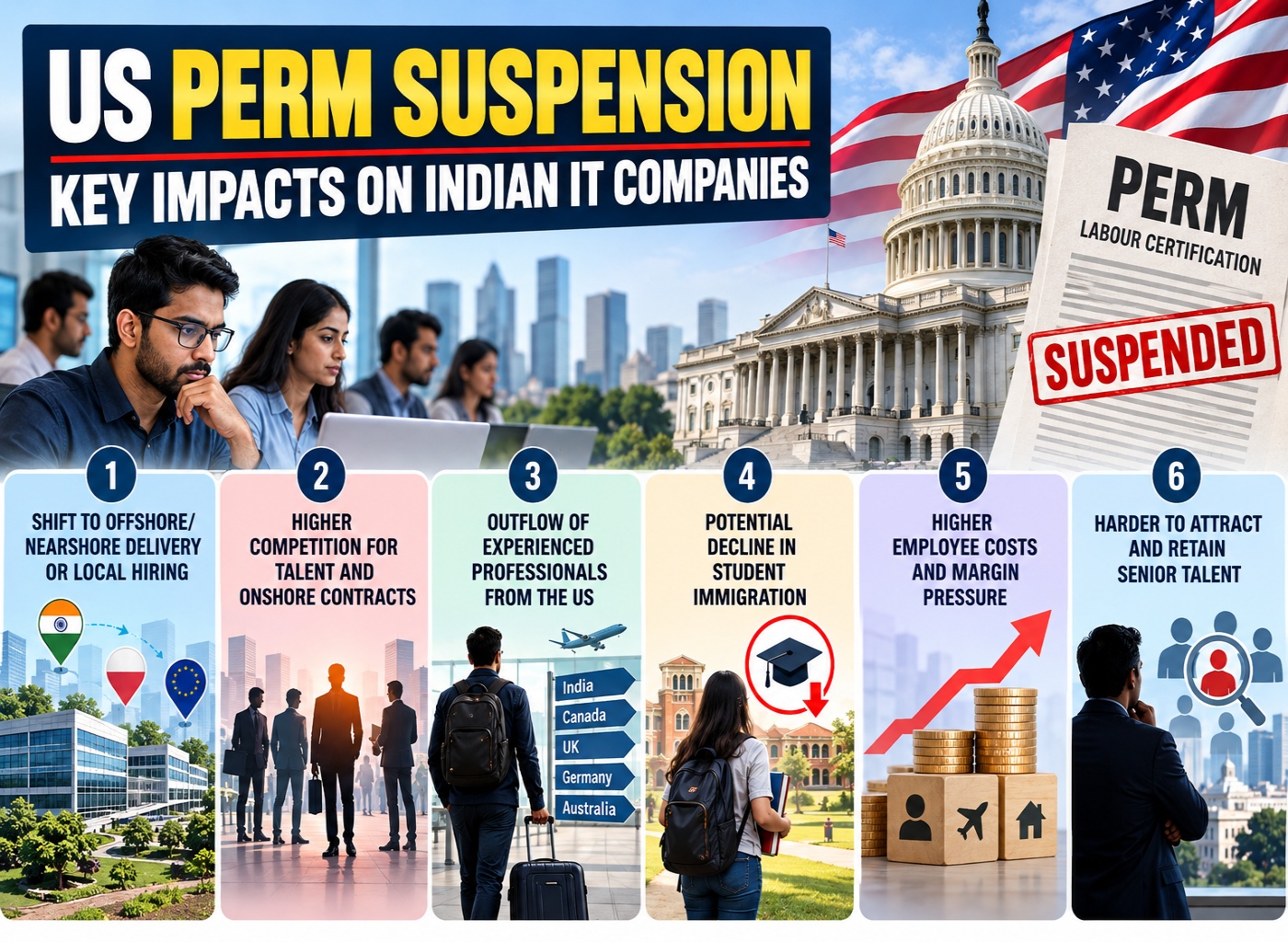
One immediate response could be a faster shift towards offshore delivery centres in India and nearshore locations such as Poland and other parts of Europe. By completing more work outside the US, companies could reduce their dependence on employees who need long-term American immigration pathways.
However, this approach may not suit every project. Some clients require professionals to work on-site, making local hiring in the US another possible option.
For investors, the balance between offshore delivery and onshore staffing will be important. A greater reliance on local employees could increase costs, while shifting work offshore may require changes to project planning and client delivery arrangements.
Affected Tech Giants
- Indian IT Majors: Tata Consultancy Services (TCS), Infosys, Wipro, and HCL Technologies.
- Global & US Behemoths: Microsoft, Adobe, Cognizant, and Capgemini.
Why Competition for US Contracts Could Increase
The PERM suspension could create additional challenges for Indian IT companies competing against global technology services providers.
Companies with larger pools of locally available US talent may find it easier to fulfil contracts that require an on-site workforce. This could put pressure on Indian firms competing for new deals, particularly where clients prioritise immediate staffing availability.
The actual impact will depend on the scope and duration of the suspension, the requirements of individual contracts and how competing companies adjust their recruitment strategies.
Track Live : FII DII Data Today | NSE F&O Lot Size
Financial & Business Impact on Indian IT
- Low PERM Exposure: Indian IT companies accounted for less than 2% of total PERM filings over the preceding year. Firms like TCS stated their PERM filings were in the single digits for the last two years, minimizing disruptions to client delivery.
- De-risked Models: According to India’s tech industry body, Nasscom, these enterprises have systematically reduced their reliance on traditional visa pipelines over the past decade.
- Localized Hiring: Indian firms have heavily ramped up domestic campus recruitment and local hiring within the United States, shifting their operational frameworks to rely more heavily on American citizens and permanent residents
How Immigration Uncertainty Could Affect Experienced IT Professionals
Long-term residency uncertainty could encourage some Indian-origin technology professionals in the US to consider opportunities in India or countries with more predictable immigration pathways.
If experienced employees leave US operations, Indian IT companies could face challenges retaining senior specialists and maintaining continuity on complex client projects.
Recruitment could also become more difficult. Professionals who place a high value on permanent residency may favour employers that can offer clearer long-term career and immigration prospects.
The Real Risk: Skilled Labor & Retention
- Mid-Process Disruptions: The freeze leaves thousands of highly skilled foreign professionals—predominantly Indian nationals on H-1B visas—stuck mid-way through their permanent residency transitions.
- The H-1B “Max-Out” Threat: While existing H-1B visas remain valid, the inability to clear the PERM stage hinders an employee’s capability to secure indefinite H-1B extensions beyond the standard 6-year limit. If the suspension is prolonged, affected workers risk having to leave the country.
- Rising Attrition: Analysts note that long-term immigration uncertainty heavily degrades worker sentiment. Affected senior architects and engineers may migrate to competitors unaffected by the ban, or choose to relocate to friendlier tech hubs like Canada or Europe, draining critical institutional knowledge.
Why Indian Students Could Reconsider Studying in the US
Uncertainty surrounding future employment and permanent residency could influence the decisions of Indian students considering technology degrees in the United States.
Some may explore alternatives such as Canada, the United Kingdom, Germany and Australia. If this trend persists, it could gradually affect the supply of Indian graduates entering the US technology workforce.
For Indian IT companies, the longer-term concern is whether changes in student migration will narrow an important talent pipeline.
Read More : Why Trading With Borrowed Money Is Risky, Even With Small Loans Like smålån
Here’s What Happened Today and Why Traders Reacted
The central development is the suspension of the US PERM process and the uncertainty it introduces for Indian IT companies employing or recruiting professionals for US-based roles.
The potential market implications centre on staffing costs, talent retention, contract competitiveness and operating margins. Companies that depend heavily on on-site delivery could face different challenges from those with established offshore operations.
No company-specific earnings announcements, stock-price movements or trading-session data were provided in the source material. Therefore, the implications for Indian IT stocks should be treated as potential risks rather than evidence of an immediate market reaction.
What the PERM Suspension Could Mean for Indian IT Stocks
Higher employee costs, relocation expenses and increased local hiring could put pressure on operating margins if companies cannot offset them through productivity improvements or pricing.
Investors should monitor management commentary on US staffing, offshore delivery, recruitment expenses, deal wins and margin guidance. The extent of each company’s exposure to on-site projects will also matter.
The suspension could create additional uncertainty, but the overall impact will depend on how long it lasts and how companies adapt.
For Indian IT investors, the key issue is not immigration policy alone. It is whether companies can retain experienced talent, protect profitability and continue winning US contracts while adjusting to changing workforce requirements.