GST Council Meeting 2026: The 57th GST Council has approved major enforcement and compliance reforms, including the removal of GST officers’ arrest powers, raising the prosecution threshold from ₹1 crore to ₹5 crore and no notices for specified monetary amounts below ₹10,000. GST rates remain unchanged, while faster refunds, simpler registration and wider ITC could reduce compliance and working-capital pressure.
The 57th GST Council meeting 2026 has changed the focus of India’s GST reform story without changing the headline tax rates.
Instead of another rate overhaul, the Council has concentrated on how GST is enforced and administered — from arrest powers and prosecution to low-value notices, refunds, registration and input tax credit.
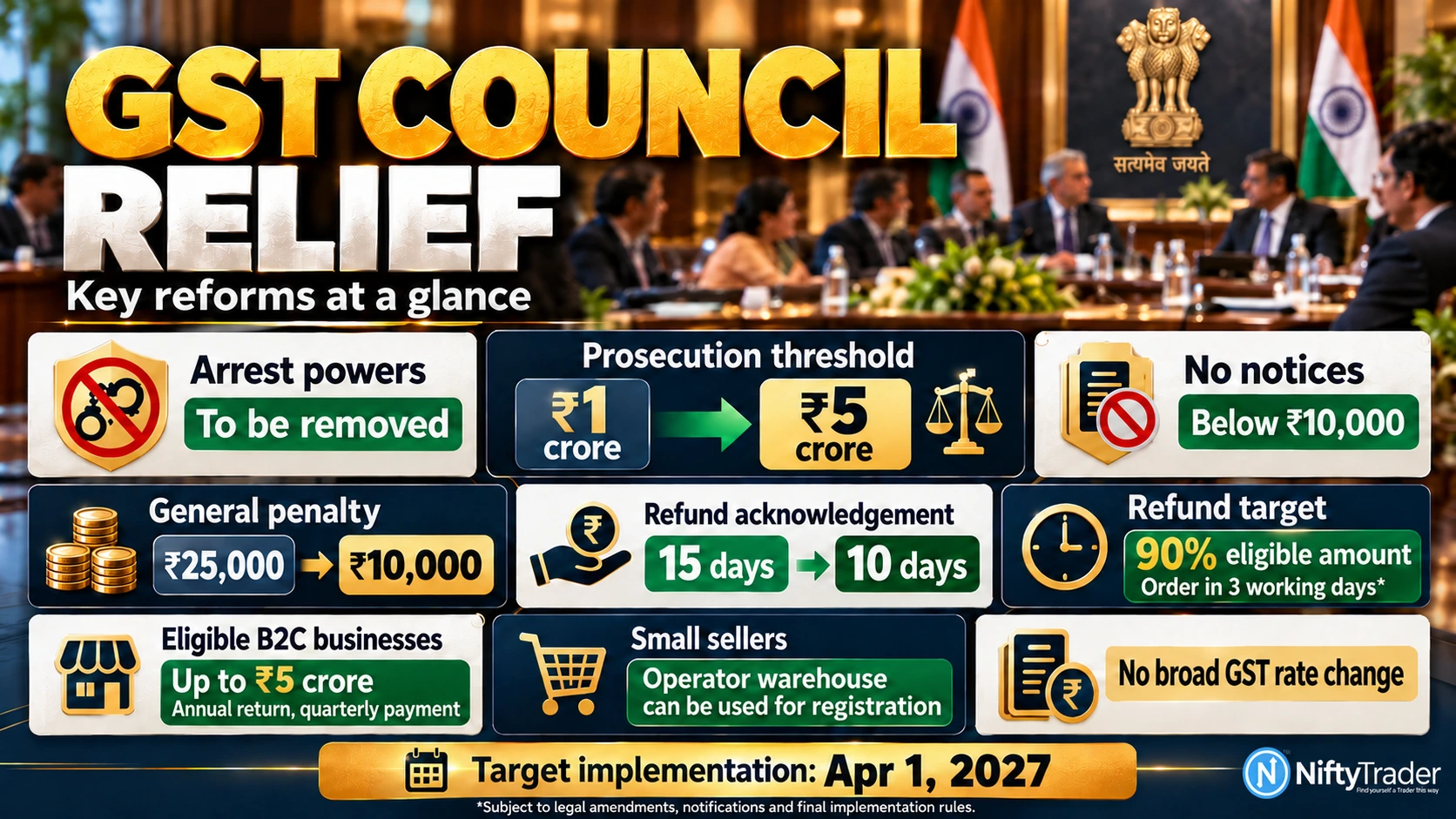
The most significant enforcement decision is the removal of GST officers’ arrest powers, alongside a fivefold increase in the prosecution threshold from ₹1 crore to ₹5 crore. The Council has also reduced the general penalty from ₹25,000 to ₹10,000 and approved a threshold under which specified GST notices will not be issued for monetary amounts below ₹10,000.
The package also includes process reforms for registration, refunds, transit checks and small-business compliance. But an important distinction remains: a Council decision is not the same as every legal provision becoming immediately operative. The required legislation, rules, notifications and administrative changes will determine when taxpayers can actually rely on each measure.
Need to Know
- GST rates: No broad GST rate changes were made at the 57th meeting.
- Arrest powers: The Council approved the removal GST officers’ arrest powers, subject to the required legal process.
- Prosecution threshold: Raised from ₹1 crore to ₹5 crore.
- General penalty: Reduced from ₹25,000 to ₹10,000 where no specific penalty applies.
- GST notices: No notices for specified monetary amounts below ₹10,000, subject to the final framework.
- Refunds: A risk-based automated system is intended to sanction 90% of eligible refund amounts within three working days, subject to prescribed checks and implementation rules.
- Small businesses: An optional annual-return framework has been approved in principle for eligible B2C businesses with turnover up to ₹5 crore.
- E-commerce sellers: Simplified registration measures will allow qualifying small sellers to use an e-commerce operator’s warehouse as their place of business in another state, subject to conditions.
- Implementation: The process reforms are targeted for April 1, 2027, according to post-meeting remarks from Finance Minister Nirmala Sitharaman.
GST Arrest Powers to Go: Biggest Enforcement Change
The most closely watched decision concerns GST arrest powers.
The Council has approved removing the power of arrest under the GST framework, marking a significant change in how tax enforcement is intended to operate. Reuters reported that the move forms part of a broader effort to reduce the punitive nature of GST enforcement.
The policy direction is to distinguish more clearly between ordinary compliance failures and serious tax fraud or evasion.
For routine defaults, the emphasis would shift towards:
tax recovery + interest + proportionate penalties
rather than arrest.
Serious criminal conduct, however, does not disappear from the enforcement framework. Finance Minister Nirmala Sitharaman has said criminality can still be dealt with under the applicable criminal law.
That makes the reform more accurately described as a change in enforcement architecture, rather than the end of GST enforcement.
GST Prosecution Threshold Raised From ₹1 Crore to ₹5 Crore
The Council has raised the prosecution threshold fivefold, from ₹1 crore to ₹5 crore.
That is one of the clearest numerical changes from the meeting.
The higher threshold could keep comparatively smaller disputes outside the criminal-prosecution framework, while retaining stronger consequences for larger cases.
The Council has also removed the minimum punishment provision. Whether a case warrants a fine, imprisonment or both will be left to judicial discretion.
The ₹5 crore threshold should not, however, be treated as a blanket exemption for tax evasion below that amount. The precise offence provisions, exceptions and legal amendments will determine how the revised framework operates.
No GST Notices Below ₹10,000: What Changes for Taxpayers?
Another important decision is the move to stop GST notices for specified monetary amounts below ₹10,000.
This could reduce the administrative burden associated with low-value disputes.
The impact may be more noticeable for MSMEs, where even a relatively small tax dispute can involve accounting work, professional fees, notice responses and repeated follow-up.
The proposed threshold can allow both taxpayers and tax authorities to focus more resources on material disputes.
But there is an important distinction:
A lower notice threshold does not automatically mean that the underlying tax liability disappears.
The final legal framework will determine which provisions are covered, how the ₹10,000 amount is calculated and how pending cases are treated.
Also Read: July GST Numbers Are In: Here’s What the Latest Tax Data Says About India’s Economy
General GST Penalty Cut From ₹25,000 to ₹10,000
The general penalty, where no specific penalty is prescribed, has been reduced from ₹25,000 to ₹10,000.
The change is part of the Council’s broader move towards more proportionate treatment of compliance failures.
For large corporations, the direct monetary impact may be limited.
For smaller businesses, however, lower penalties could reduce the cost of resolving routine procedural mistakes.
The government has also indicated that ordinary defaults such as late filing, mistakes or delayed payment would primarily attract recovery, interest and proportionate penalties, rather than additional punitive treatment.
Faster GST Refunds Could Help Working Capital
Refund reform is another important part of the package.
The Council has reduced the acknowledgement window for refund applications from 15 days to 10 days, with greater use of risk-based processing and automation.
According to post-meeting reporting, the Council approved a risk-based automated system intended to sanction 90% of eligible refund amounts within three working days, subject to prescribed checks and implementation rules. The remaining amount would follow the applicable verification process.
For exporters and other businesses with eligible refund claims, the significance is straightforward: faster refunds can mean faster access to working capital.
The real benefit, however, will depend on how the automated risk-assessment system performs once the new framework is implemented.
ITC Relief: Employee Insurance and Business Infrastructure
The Council has also approved wider input tax credit in selected categories, according to post-meeting reporting.
Measures include relief covering employer-provided insurance and certain business infrastructure such as telecom towers.
For businesses, the potential benefit is straightforward.
When GST paid on a legitimate business expense cannot be recovered as ITC, it becomes part of the effective cost.
Wider credit availability can therefore reduce tax embedded in selected operating and infrastructure expenditure.
The final economic impact will depend on the detailed eligibility conditions attached to each category.
Genuine Buyers and Supplier Defaults: Still an Open Issue
One of the most important unresolved GST issues is the treatment of a genuine buyer when a supplier defaults.
The Council has not granted blanket protection to every buyer.
Instead, it has decided to set up a Committee of Officers to examine how genuine buyers holding proper invoices, receiving the goods and paying the supplier can be protected from losing ITC because of supplier defaults. The committee is expected to complete its study within three months for consideration at the next Council meeting.
This creates an important expectation gap.
Businesses may expect stronger protection for genuine transactions, but the final mechanism is still to be determined.
The challenge will be to protect compliant buyers without creating a route for fraudulent or artificial ITC claims.
Small Businesses May Get One GST Return a Year
The Council has approved in principle an optional compliance framework for eligible businesses with annual turnover of up to ₹5 crore that supply directly to consumers.
Under the proposed framework, qualifying businesses could file an annual GST return while paying GST quarterly.
Economic Times reported that the scheme could benefit around 16 lakh small businesses.
For smaller businesses, the change could reduce the frequency and cost of return filing.
The ₹5 crore threshold should not, however, be interpreted as a universal annual-return rule for every GST-registered business. Eligibility will depend on the final conditions and the nature of supplies.
GST Council Eases Registration for Small E-Commerce Sellers
The Council has also approved process reforms aimed at making GST registration easier for qualifying small sellers using e-commerce platforms.
Under the reported framework, an eligible seller could use an e-commerce operator’s warehouse as its place of business in another state, subject to the prescribed conditions.
This could reduce the compliance and infrastructure burden associated with maintaining separate premises simply to meet state-level GST registration requirements.
For small online businesses, the potential benefit is therefore not a lower tax rate but lower barriers to interstate expansion.
The final registration conditions, platform responsibilities and safeguards will determine how widely the measure can be used.
Fewer Physical Checks on Goods in Transit
The Council has also approved changes aimed at making interstate movement of goods more predictable.
The revised approach is intended to reduce repeated physical checks and move towards intelligence-led verification rather than routine interception. Reports indicate that checks would be concentrated around the originating and destination points under the new framework.
For manufacturers, distributors and logistics companies, fewer unnecessary stoppages could mean more predictable transit times and lower compliance friction.
The financial benefit may be difficult to quantify initially, but lower logistical disruption can improve supply-chain efficiency.
GST Rates Unchanged: Why That Matters
There was no broad GST rate change at the 57th meeting. Reuters reported that the Council left the rate structure unchanged and that rate-related decisions will be considered once a year.
This marks a shift from the previous major GST reform cycle, which focused heavily on rate rationalisation.
The new focus is increasingly on making the GST system work better after the rate structure has been simplified.
For businesses, a more predictable rate-review cycle can make pricing, contracting, inventory planning and capital-expenditure decisions easier.
It also removes one source of uncertainty from GST Council meetings: the expectation of another immediate rate reset.
Also Read: 18% GST Proposed on NBFC Co-Lending: Why the Tax Base Matters for Banks and Lenders
What the GST Council’s Decision Means for Businesses
The clearest takeaway from the 57th GST Council meeting 2026 is that GST reform is moving from rate rationalisation to friction reduction.
Potential beneficiaries include:
MSMEs: lower general penalties, fewer low-value notices and simpler filing.
Exporters: faster processing of eligible refunds can improve working-capital availability.
E-commerce sellers: simpler registration could make interstate expansion easier.
Manufacturers: wider eligible ITC can reduce tax embedded in selected business expenses.
Logistics companies: more targeted physical checks could reduce transit delays.
The impact will not be identical across companies.
A business with large refund claims or blocked ITC may see a greater financial benefit than one with little exposure to either.
What Businesses Should Watch Before April 1, 2027
The biggest risk is now implementation.
The Council has taken major decisions, but businesses still need to track:
- amendments to the CGST framework;
- detailed GST rules and notifications;
- the final scope of the below-₹10,000 notice threshold;
- the mechanics of the ₹5 crore prosecution threshold;
- detailed ITC eligibility conditions;
- refund-processing rules;
- treatment of pending cases; and
- GST portal and technology changes.
Finance Minister Nirmala Sitharaman has indicated that the process reforms will take effect from April 1, 2027.
That makes the period between now and April important for businesses.
The expectation is that the reforms will reduce compliance friction, but the benefit could fall short if implementation is slower than expected, eligibility rules are restrictive or technology systems do not operate smoothly.
Track Live: FII DII DATA| NIFTYTRADER
The Bigger GST Signal for Markets
For investors, the 57th GST Council meeting 2026 sends a different signal from the previous rate overhaul.
The government appears to be prioritising predictability, compliance efficiency and targeted enforcement over another broad tax-rate reset.
That can be positive for the operating environment, particularly for smaller businesses and companies with significant working-capital requirements.
But there is a clear policy tension.
Softer enforcement can reduce compliance friction, but the tax system still has to deter deliberate evasion.
Likewise, faster refunds can free working capital, but the risk-based system must guard against fraudulent claims.
And greater ITC availability can reduce costs, but the final rules need safeguards against artificial credit creation.
The success of the reform package will therefore be judged less by today’s headlines and more by how quickly and accurately the Council’s decisions are converted into working rules.
For businesses and investors, that implementation phase is now the next GST story to watch.
READ NEXT: UPI MDR May Shift to Jan 2027: Paytm Falls 10% as Revenue Hopes Face Delay
FAQs
What did the 57th GST Council meeting decide?
The Council approved major enforcement and process reforms, including removal of GST officers’ arrest powers, a higher prosecution threshold, lower general penalties, no notices for specified amounts below ₹10,000, faster refund processing and simpler compliance.
Has the GST prosecution threshold been raised to ₹5 crore?
Yes. The Council approved raising the threshold from ₹1 crore to ₹5 crore. The relevant legal changes will determine when the revised framework becomes operative.
Can GST officers still arrest taxpayers?
The Council has approved removal of GST officers’ arrest powers, but businesses should not treat the change as immediately operative until the required legal and administrative steps are completed.
What is the new GST notice threshold?
The Council has approved that specified GST notices will not be issued for monetary amounts below ₹10,000, subject to the final legal framework. Qualifying pending notices below the prescribed threshold are also to be withdrawn, subject to implementation rules.
Did GST rates change at the October 2026 meeting?
No broad GST rate changes were made at the 57th meeting. Rate-related decisions are expected to be considered once a year.
What is changing for small businesses?
Eligible businesses with turnover of up to ₹5 crore that make only B2C supplies may get an optional annual-return framework while continuing quarterly tax payments, subject to final rules.
What is changing for small e-commerce sellers?
Qualifying small e-commerce sellers may be able to use an e-commerce operator’s warehouse as their place of business in another state, subject to prescribed conditions.
What is changing in GST refunds?
The acknowledgement period for refund applications is being reduced from 15 days to 10 days. A risk-based automated system is intended to sanction 90% of eligible refund amounts within three working days, subject to prescribed checks and implementation rules.
When will the GST reforms take effect?
The process reforms have been targeted for April 1, 2027, with the necessary legal amendments, notifications and implementation steps required before the revised framework becomes operational.