
F&O Traders Lost Rs.61 Lakh After Missing Market Exit
A missed morning exit turned into a costly trading experience for an Indian derivatives trader. On October 9, Mayank Raj claimed on X that he suffered a loss of ₹61 lakh after failing to wake up on time to manage his open options position.
“I never imagined sleeping in could cost me this much,” Raj wrote, describing how an overnight position in Nifty call options resulted in a substantial loss.
The incident has triggered discussions among traders about overnight positions, risk management and the importance of following a predefined stop-loss strategy in the futures and options (F&O) segment.
Track Live : FII DII Data Today | NSE F&O Lot Size
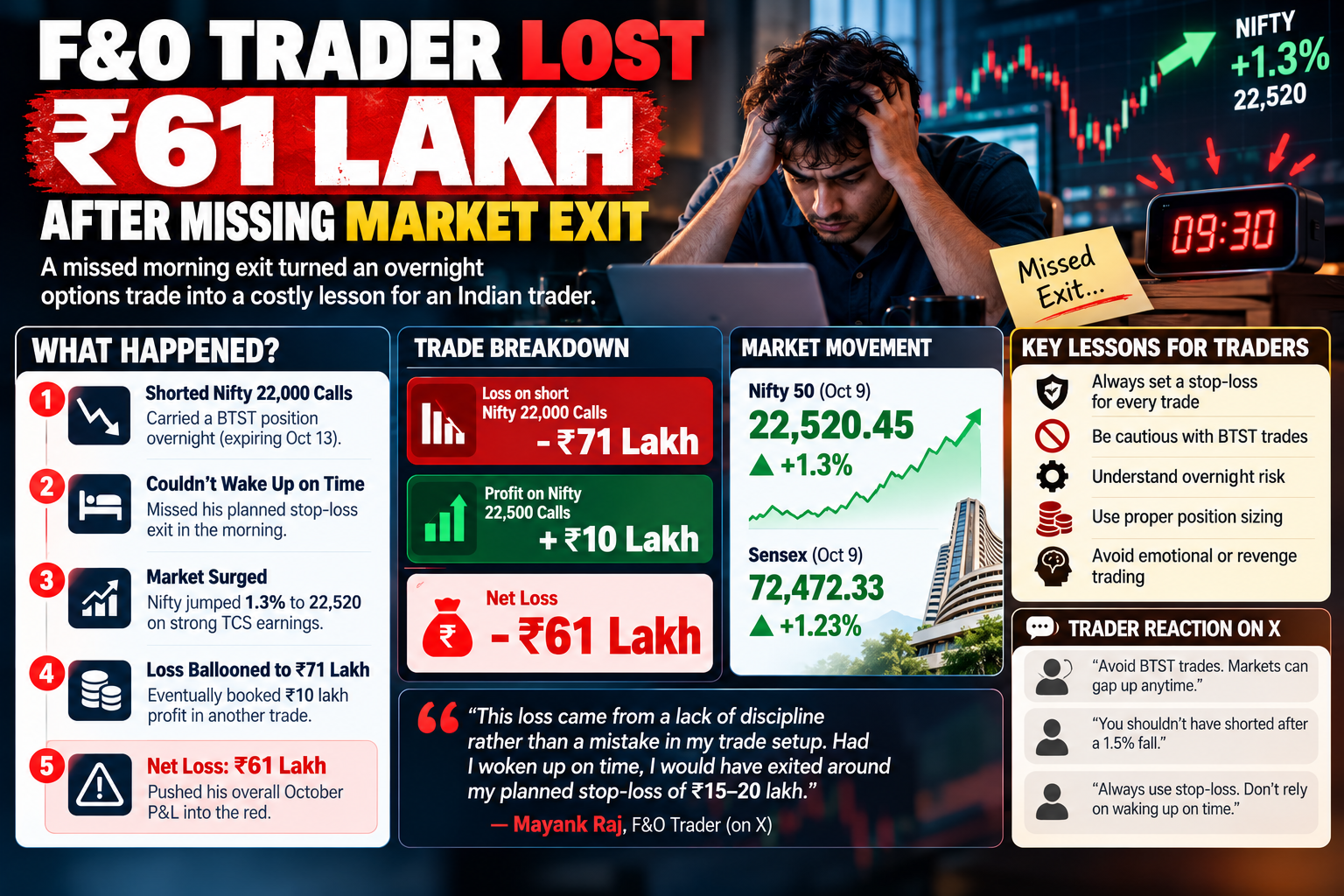
F&O Traders Lost Rs.61 Lakh: How Nifty Options Trading Turned Costly for the Trader
According to Raj’s post, he had shorted call options the previous day but could not wake up on time the following morning. When he eventually checked his open position, the loss had increased significantly.
“This loss came from a lack of discipline rather than a mistake in my trade setup. Had I woken up on time, I would have exited around my planned stop-loss of Rs 15–20 lakh,” he said.
Raj shared a screenshot showing a loss of approximately ₹71 lakh from shorting Nifty 22,000 call options expiring on October 13. He said he reduced the loss by earning ₹10 lakh through buying Nifty 22,500 call options with the same expiry.
He subsequently reported an overall loss of ₹61 lakh from the episode.
The incident highlights how quickly losses can accumulate in options trading, particularly when traders hold positions overnight and cannot respond promptly to market movements.
Here is a quick breakdown of how the discipline lapse resulted in the massive loss:
- The Setup: The trader carried a BTST (Buy Today, Sell Tomorrow) short position overnight, shorting Nifty 22,000 calls expiring on October 13.
- The Market Move: Instead of continuing the previous day’s 1.5% drop, the Indian market surged on Friday. The Nifty 50 jumped 1.3% to close at 22,520.45, fueled by strong TCS earnings.
- The Damage: Because he woke up late and missed his intended Rs 15–20 lakh stop-loss window, his short position ballooned to a Rs 71 lakh loss. He offset this slightly with a Rs 10 lakh profit from October 22,500 calls, bringing the net damage to Rs 61 lakh and pushing his entire October P&L into the red.
Key details at a glance
-
Trader: Mayank Raj, according to the supplied report.
-
Reported loss: ₹61 lakh on October 9.
-
Original position: Short Nifty 22,000 call options expiring on October 13.
-
Planned stop-loss: ₹15–20 lakh, according to the trader.
-
Additional trade: He reportedly earned ₹10 lakh by buying Nifty 22,500 call options, reducing the loss on the short-call position.
-
Social media reaction: Users advised traders to avoid BTST positions or ensure every trade has a defined stop-loss.
How did the trade turn into a ₹61 lakh loss?
The trader’s account describes two positions that moved the overall result:
Loss on short Nifty 22,000 calls −₹71 lakh
Profit on bought Nifty 22,500 calls +₹10 lakh
Reported net loss −₹61 lakh Net loss
The figures reconcile arithmetically: ₹71 lakh minus ₹10 lakh equals ₹61 lakh. The article reports these amounts based on the trader’s post on X.
Why Traders Warned Against BTST Trades and Missing Stop-Losses
Several users on X advised Raj and other market participants to exercise caution with BTST trades, which stands for “buy today, sell tomorrow.” Such positions expose traders to price movements that occur before the next trading session.
Some users also stressed the importance of setting stop-loss orders for every trade rather than relying solely on manual monitoring.
One user questioned the decision to short the market at lower levels after the Nifty had fallen 1.5% on October 8. The comment reflected concerns about taking directional bets after a sharp market decline.
Raj acknowledged the setback but said he had earned decent profits the previous week. The latest loss, however, pushed his overall October profit and loss (P&L) into negative territory.
He added that he would focus on recovering gradually, maintaining discipline and attempting to close the month in positive territory.
Track Live : NSE Option Chain — Live | BSE Option Chain — Live Sensex & Bankex Options Data Today
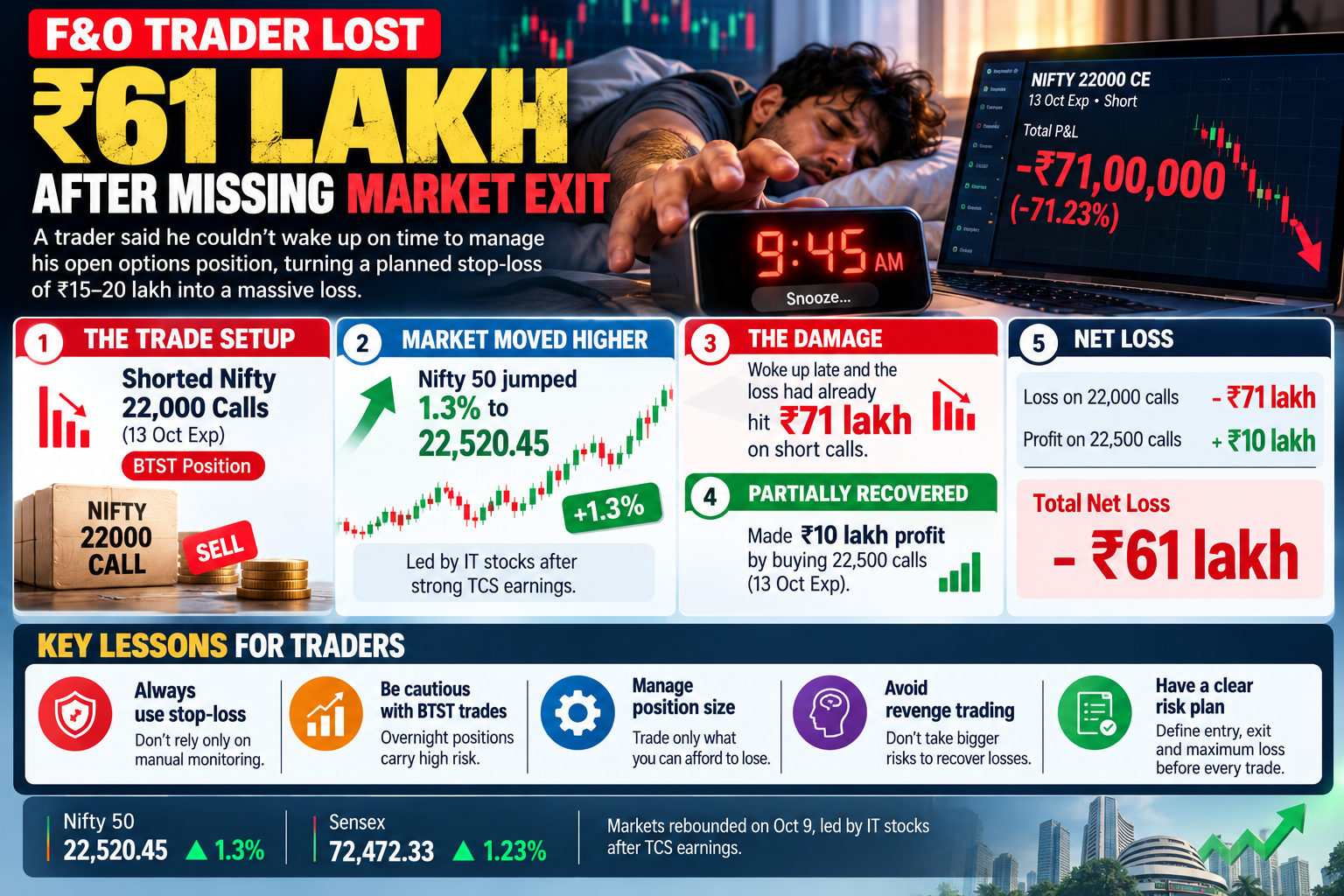
What lessons can retail traders take away?
-
Define risk before entering a trade: Decide the maximum acceptable loss and the conditions for exiting.
-
Understand overnight risk: Markets can move sharply between sessions, and the opening price may be far from the previous close.
-
Do not rely solely on waking up on time: Consider broker-supported risk controls and understand their limitations, including gaps and execution slippage.
-
Be cautious with naked option selling: Losses can grow quickly when the market moves against the position.
-
Avoid revenge trading: Trying to recover a large loss immediately can lead to even riskier decisions.
-
Treat BTST as a risk-bearing strategy: Overnight positions require a plan for adverse moves, not just a prediction about the next session.
Here’s What Happened Today and Why Traders Reacted
Indian equities rebounded on Friday, October 9, ending their longest weekly losing streak in 25 years.
The Nifty 50 climbed 1.3% to 22,520.45, while the BSE Sensex advanced 1.23% to 72,472.33.
IT stocks led the recovery after Tata Consultancy Services (TCS) reported earnings highlighting growing revenue contributions from artificial intelligence-related services and robust international business growth.
The broader market recovery provided a contrasting backdrop to Raj’s reported trading loss. While benchmark indices gained ground, individual derivatives traders could still face substantial losses depending on their positions, entry levels and risk management.
What the Trading Loss Means for Investors in Coming Sessions
Raj’s experience underscores the risks of leveraged F&O trading, where relatively small market movements can have a disproportionate impact on a trader’s capital.
Overnight positions can be particularly risky because global cues, company earnings and other developments may affect prices before the Indian market opens. Short call positions can also generate significant losses if the underlying index rises sharply.
For investors, the key takeaway is to distinguish long-term investing from leveraged derivatives trading. Predefined exit rules, appropriate position sizing and careful monitoring can help manage risk, although they cannot eliminate losses.
The Sensex and Nifty 50 rebound, meanwhile, will keep attention on market sentiment, IT earnings and upcoming corporate results. Whether the recovery continues will depend on fresh earnings signals and broader market developments.