
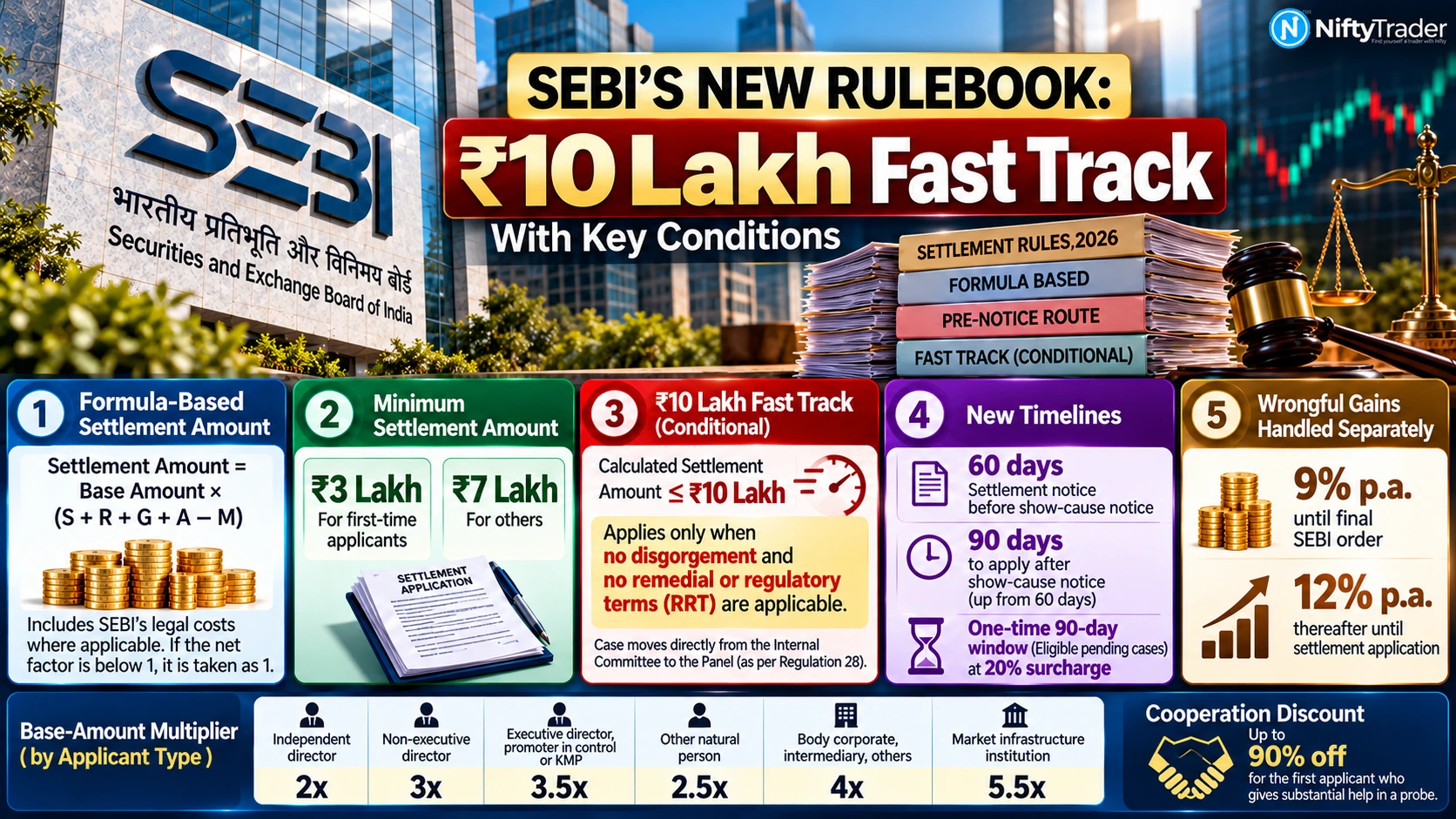
SEBI’s new settlement rulebook brings a formula-driven amount, a pre-notice route and a separate bill for wrongful gains. The ₹10 lakh fast track, however, is open only when no disgorgement or remedial terms apply.
SEBI has notified new settlement rules that replace the 2018 framework. The ₹10 lakh fast track is the headline, but it has a condition that is easy to miss: it applies only where no disgorgement and no remedial or regulatory terms (RRT) are involved. The arithmetic holds a second surprise. For many clean-record applicants, filing early may not lower the bill at all.
The SEBI (Settlement of Administrative and Civil Proceedings) Regulations, 2026, are dated October 6, 2026, and were published in the Gazette of India on October 7. SEBI listed them on its website on October 8. They take effect on the day after the 30th day from Gazette notification, which works out to November 7, 2026.
Need to Know
- Rulebook: replaces the SEBI (Settlement Proceedings) Regulations, 2018, which stand repealed once the new rules begin.
- Formula: Settlement Amount = Base Amount × (S + R + G + A − M), plus the Board’s legal costs where applicable. A net factor below one is taken as one.
- Floor: ₹3 lakh for first-time applicants, ₹7 lakh for others.
- Fast track: the ₹10 lakh route applies only where no disgorgement or RRT is applicable.
- Timelines: a 60-day settlement notice before a show-cause notice, 90 days to apply after one (up from 60), and a one-time 90-day window at 20% extra.
- Wrongful gains: handled separately, with interest of 9% a year, rising to 12% after a final SEBI order.
- Cooperation discount: up to 90% off for the first applicant who gives substantial help in a probe.
Also Read: SEBI CAS Update: 30-Minute VWAP May Return for Derivatives Settlement
When Do the New SEBI Settlement Rules Start, and What Do They Replace?
SEBI’s Board described the overhaul as an attempt to make settlement simpler, less discretionary and more predictable, while keeping deterrence intact. The Panel of Whole Time Members still has the final say. It can accept or reject any application, and for recorded reasons it can set an amount higher or lower than the formula gives.
Settlement terms now have three parts: the settlement amount, disgorgement of wrongful gains where applicable, and RRT. RRT covers conduct and business conditions such as stronger compliance systems, independent reviews, exit from management, clawbacks and refunds. In serious cases it can include voluntary debarment from the market.
What Changes in the Timeline?
Before a show-cause notice: SEBI will send a settlement notice giving the entity 60 days to apply. It will not do so where interim directions or prosecution are contemplated, or where the violation-based fast track applies. The notice gives no right to settle, and SEBI can still change the charges.
After a show-cause notice: the window rises from 60 to 90 days, counted from the later of the show-cause notice or a supplementary one. The cap does not apply once a case is before the Securities Appellate Tribunal or the Supreme Court. SEBI’s power to relax deadlines does not extend either of these two windows.
One-time window: it opens for 90 days from commencement, which is about February 5, 2027. It covers pending proceedings, including appeals before the Tribunal or the Supreme Court. The entity must either never have applied, or have had an application rejected, returned or withdrawn under the 2018 rules. It carries a 20% surcharge, as does refiling after a rejection or withdrawal.
Pending 2018 applications:
- Where the Panel has already approved terms, the 2018 terms stand.
- Where the High Powered Advisory Committee has recommended but the Panel has not approved, the applicant gets 30 days to pick fresh processing or the recommended amount.
- Where the Committee has not yet recommended, a fresh Internal Committee meeting follows.
How Do the SEBI Settlement Rules Calculate the Amount?
The base amount starts from the minimum penalty prescribed by law and is multiplied according to who is applying.
| Applicant type | Base-amount multiplier |
|---|---|
| Independent director | 2 |
| Non-executive director | 3 |
| Executive director, promoter in control or KMP | 3.5 |
| Other natural person | 2.5 |
| Body corporate, intermediary, pooled investment vehicle, others | 4 |
| Market infrastructure institution | 5.5 |
Several rules can raise the base. Separate defaults are added together. A person alleged to be the mastermind or key operator has the base amount doubled. An independent director alleged to have benefited from, or taken part in, a fraud is treated like an executive director. The base also cannot be lower than any penalty already imposed for the same default.
Five factors then adjust the base: stage of proceeding (S), prior regulatory action (R), gravity (G) and aggravating factors (A), less mitigating factors (M).
- Prior record (R): adds 0.10 per administrative warning, 0.20 per settlement order and 0.30 per adverse order. Orders stayed by a court or tribunal still count.
- Gravity (G): applications that do not admit a violation carry 0.25. Insider-trading violations carry 0.50, and violations of SEBI’s fraud and unfair trade practice rules carry 1.50.
- Aggravating and mitigating factors (A and M): each is worth 0.20, capped at five each.
Does Filing Early Actually Lower the SEBI Settlement Amount?
Not always. The stage factor climbs from 0.20 (voluntary) to 1.50 (Supreme Court), so on that factor alone the Supreme Court stage is 7.5 times the voluntary rate. But the rules count any net factor below one as one. For a clean case, the stage factor therefore costs nothing until the total crosses one.
Illustration only. It assumes a hypothetical ₹5 lakh minimum penalty, a body corporate (4×), a clean record, the violation admitted, no aggravating or mitigating factors, and it ignores legal costs.
| Stage when filed | S | Clean case | With a fraud-rules charge (G = 1.50) |
|---|---|---|---|
| Suo motu (voluntary) | 0.20 | ₹20 lakh | ₹34 lakh |
| Before show-cause notice | 0.40 | ₹20 lakh | ₹38 lakh |
| After show-cause notice | 0.60 | ₹20 lakh | ₹42 lakh |
| Pending before the Board or a Designated Member | 0.80 | ₹20 lakh | ₹46 lakh |
| Before the Tribunal | 1.00 | ₹20 lakh | ₹50 lakh |
| Before the Supreme Court | 1.50 | ₹30 lakh | ₹60 lakh |
Nothing in the rules guarantees lower payments. For a body corporate, the multiplier alone is four times the minimum penalty. The ₹3 lakh and ₹7 lakh floors also still apply. A “first-time applicant” is someone with no adverse order and no earlier settlement order.
Why Does the ₹10 Lakh Fast Track Come With a Catch?
Under Regulation 28, a case moves from the Internal Committee straight to the Panel of Whole Time Members, skipping the High Powered Advisory Committee. This happens only if two conditions are met: the calculated amount is up to ₹10 lakh, and neither disgorgement nor RRT applies. RRT attaches to proceedings other than those solely for a penalty, so the track points to penalty-only cases.
Headroom is thin. An applicant who is not a first-timer faces a ₹7 lakh minimum, leaving ₹3 lakh of room under the ceiling. A first-time applicant has ₹7 lakh.
One question is open. The rules say disclosures form part of every settlement term, but they do not say whether that counts as RRT for the ₹10 lakh test. SEBI circulars may settle it.
The second route is violation-based. Under Regulation 27, SEBI can send a fast track notice before starting proceedings for:
- delayed disclosures, including returns and reports;
- non-disclosure by companies listed only on regional exchanges that have exited;
- disclosures in the wrong format;
- delayed compliance with legal requirements or SEBI directions.
The entity has 30 days to apply, pay and comply, extendable by up to 15 days for recorded reasons. Miss the window and settlement is possible only at a later stage, when the stage factor is higher.
What Happens to Wrongful Gains and Interest?
Wrongful gains, losses avoided and losses caused to investors no longer enter the base amount. Where quantified, they are disgorged separately, which SEBI says removes double counting in the earlier method.
Interest runs at 9% a year from the date of the transaction to the settlement application when no final order exists. If a final order has been passed, 9% applies until that order and 12% from then until the application. No interest is charged on interest.
Settlement amounts go to the Consolidated Fund of India. Disgorged sums with interest go to the Investor Protection and Education Fund. The application fee and legal costs go to SEBI’s own General Fund.
Can Accounts Misstatement and Fund Diversion Cases Be Settled?
Yes, with conditions. Where alleged violations affected audited financial statements, the applicant must disclose to stock exchanges. Where the effect continues, the applicant must also add explanatory notes to upcoming annual reports. In diversion or siphoning cases, the applicant must bring the money back to the company with interest from the date of the contravention to the date of application. If the applicant does so, the investor losses from the diversion do not by themselves block settlement.
SEBI Chairman Tuhin Kanta Pandey said siphoned money should come back first, calling that “non-negotiable”, Business Standard reported. Business Today quoted Makarand Joshi of MMJC & Associates as saying serious cases such as misstatement, diversion and fraud need transparency and market-wide deterrence alongside faster remediation.
Who Is Excluded, and Who Gets a Discount?
The rules bar wilful defaulters, fraudulent borrowers and fugitive economic offenders. They also bar cases where an examination, investigation, inspection or audit is pending, except applications seeking confidentiality. Cases with market-wide impact, losses to a large number of investors or damage to market integrity may be declined. SEBI can still consider them if a higher amount and RRT adequately remedy the harm.
On the other side, applicants who give substantial assistance in an examination or investigation can get confidentiality and a discount of up to 90% for the first applicant, up to 50% for the second and up to 25% for the third or later. The route excludes disclosure and reporting defaults.
Why Did SEBI Rewrite the Rules? The Numbers
SEBI’s consultation paper, as summarised by law firm King Stubb & Kasiva, recorded that settlement collections fell from ₹798.9 crore in FY25 to ₹109.8 crore in FY26, a drop of about 86%. Applications declined from 703 to 439, about 38%.
In a study of applications where settlement failed and a penalty followed, the calculated settlement amount averaged roughly eight times the penalty finally imposed, after excluding outliers, according to the paper. The new formula is SEBI’s attempt to make that calculation transparent. Its base is the minimum penalty fixed by law, not the penalty finally imposed.
What Do the SEBI Settlement Rules Mean for Investors and Listed Companies?
Applicants choose whether to admit the findings or to “neither admit nor deny” them. Choosing not to admit adds to the gravity factor. Either way, applicants undertake not to publicly deny SEBI’s findings after the order. Facts established against them, or admitted by them, in other proceedings on the same cause of action in India or abroad are treated as admitted.
Applicants must also undertake not to seek set-off, indemnification, insurance cover or other non-tax reimbursement for what they pay. They waive further rights, including appeal or review before the Tribunal or courts. That matters for directors and companies that expect insurance or indemnity to absorb the cost.
Disclosure timing is the watch-point. SEBI whole-time member Kamlesh Chandra Varshney said companies must disclose show-cause notices, but a settlement notice is not a show-cause notice, so the same requirement may not apply. He said SEBI will examine that aspect, Business Standard reported.
Investors may therefore first see a case at the settlement-order stage. SEBI publishes orders on its website, and settlement terms can include exchange disclosures. Orders in confidentiality matters will not name the applicant. An order can also be revoked, after a hearing, if the applicant breaks its terms or the disclosure was not full and true. Amounts already paid are not refunded.
What Happens Next for the SEBI Settlement Rules?
Five things to watch:
- The start and the close of the one-time window. The rules start on November 7, 2026, and the one-time window closes around February 5, 2027, unless SEBI says otherwise.
- Disclosure. Will SEBI clarify whether listed companies must disclose a settlement notice?
- The fast track. Does a mandatory disclosure count as RRT for the ₹10 lakh test?
- Circulars. SEBI can issue circulars on forms and procedure.
- The first orders. They will show whether the multipliers produce lower or higher payments than the 2018 method.
Read Next: RBI Forex Rules: $5 Million Limit Replaces $100 Million, 20% Cash Reserve Added
FAQs
When do the new SEBI settlement rules take effect?
On the day after the 30th day from Gazette notification. With the Gazette issue dated October 7, 2026, that is November 7, 2026.
How long do entities have to apply for settlement?
60 days from a pre-show-cause settlement notice, and 90 days from service of a show-cause notice (or a supplementary one, whichever is later), up from 60.
What is the minimum settlement amount under the new rules?
₹3 lakh for first-time applicants and ₹7 lakh for others. Disgorgement of wrongful gains is separate. The non-refundable application fee is ₹25,000 for a natural person and ₹35,000 for others.
Does filing early always lower the settlement amount?
No. A net factor below one is counted as one, so in a clean, non-fraud case, filing at any stage up to the Board stage gives the same base-driven amount.
Does every case below ₹10 lakh get the fast track?
No. The calculated amount must be up to ₹10 lakh, and neither disgorgement nor RRT can apply. The Panel can still reject the application.
Disclaimer: This article is for informational purposes only and is not legal or investment advice. Details are based on information available as of October 10, 2026 and may change, so please check SEBI’s official notifications before taking any decision.