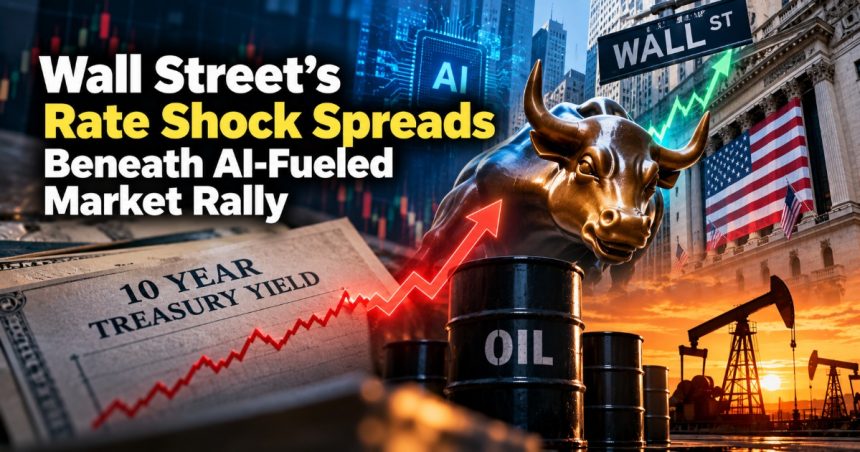
Wall Street Near Record Highs, but Most Companies Are Quietly Losing Ground
Wall Street’s record-breaking stock market rally is showing signs of weakness beneath the surface. While artificial intelligence (AI) stocks continue to support major US indexes, rising Treasury yields, expensive oil and deteriorating market breadth are raising concerns about how long the rally can last.
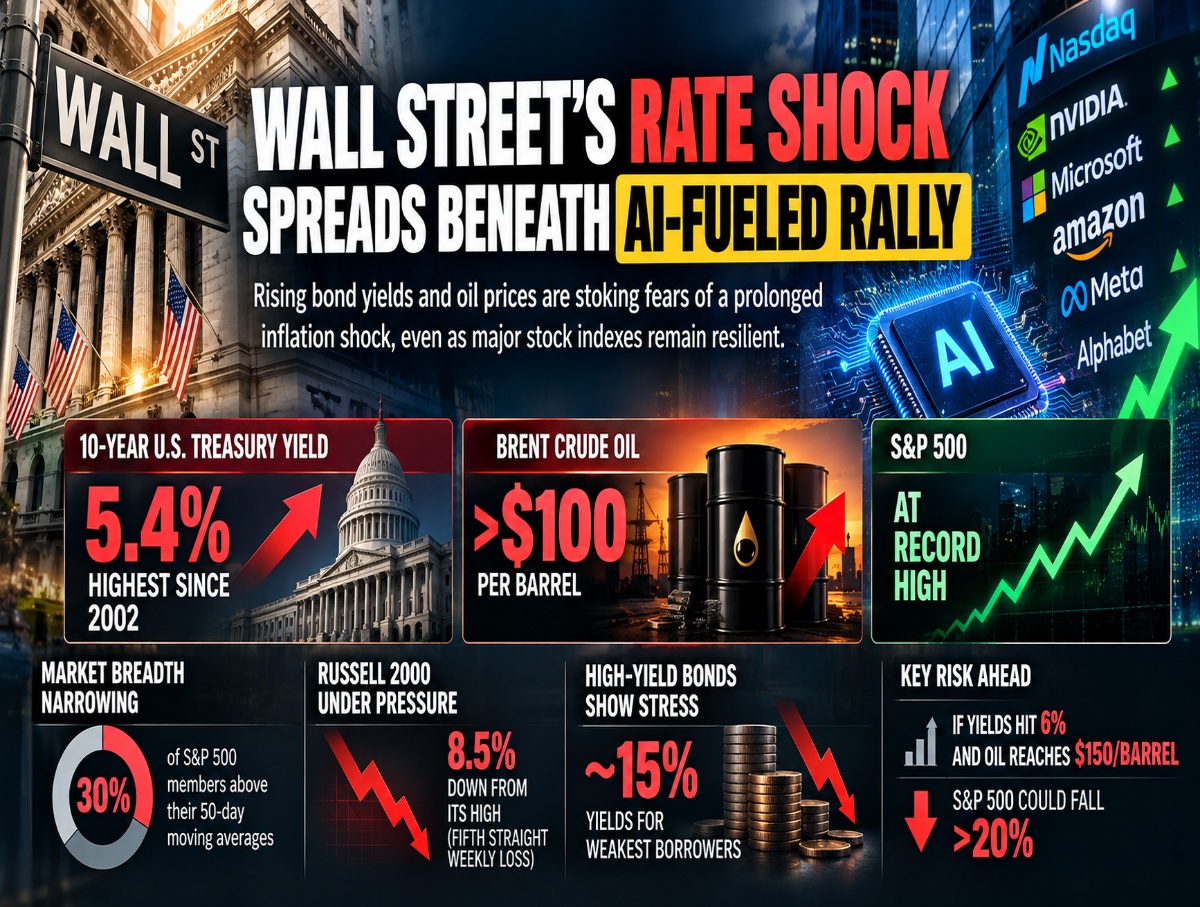
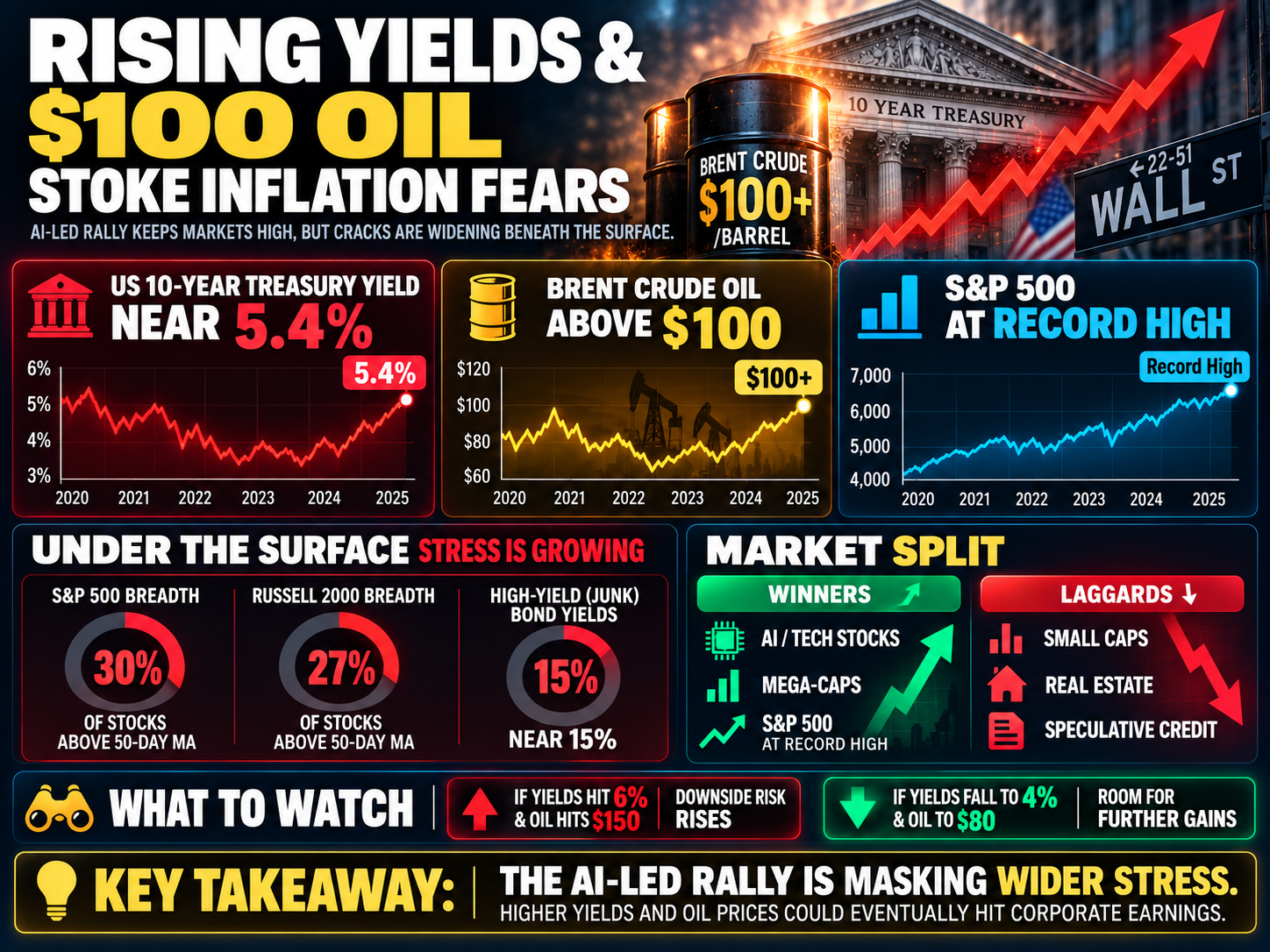
The 10-year US Treasury yield approached 5.4%, its highest level since 2002, while Brent crude oil remained above $100 a barrel. Together, these developments have renewed fears that inflation could remain elevated, keeping borrowing costs high and putting pressure on corporate profits.
For investors, the biggest concern is that the strength of the S&P 500 may not reflect the condition of the broader stock market. A relatively small group of technology giants is helping the index stay near its record, even as smaller companies, property stocks and riskier corporate bonds face mounting pressure.
Track Live : FII DII Data Today | NSE F&O Lot Size
Wall Street Near Record Highs : Why rising Treasury yields and oil prices threaten Wall Street
Higher Treasury yields are creating a difficult environment for stocks, particularly companies that depend on borrowing or whose valuations rely on future earnings growth. When bond yields rise, investors can demand better returns from equities, putting pressure on expensive stocks.
Brent crude above $100 a barrel adds another challenge. Higher energy costs can increase transportation and production expenses, potentially weakening corporate margins while keeping inflation elevated.
The pressure is also spreading internationally. UK borrowing costs have reached a 19-year high, while French government debt faces additional strain. These developments point to tighter financial conditions even without another Federal Reserve rate increase.
The key numbers to know
10-year US Treasury yield 5.36%
Highest since 2002, during the week’s peak
Brent crude oil $100+
Per barrel, raising inflation concerns
S&P 500 breadth 30%
Members above their 50-day moving average on the record-setting day
Russell 2000 breadth 27%
Small-cap members above their 50-day moving average
Why is the stock market rising despite the rate shock?
The main reason is the dominance of large technology companies benefiting from artificial intelligence.
The S&P 500 is weighted by market capitalization, meaning the largest companies have the greatest influence on its performance. When major AI-linked stocks rise, they can lift the index even if many smaller companies are declining.
This creates a misleading impression of market strength:
-
Large AI companies continue to attract investment on expectations of future earnings growth.
-
Smaller companies face greater pressure from borrowing costs and refinancing needs.
-
Investors can remain optimistic about the index while becoming more cautious about individual stocks and credit markets.
How weakening market breadth and credit stress affect investors
The retreat extends beyond smaller stocks. US high-yield corporate bond spreads have widened, while bonds issued by weaker borrowers are yielding around 15%. Such financing costs can make refinancing difficult for companies with substantial debt.
A high-yield bond exchange-traded fund has also fallen toward levels last seen during the previous spring’s tariff-related selloff. Real estate stocks have suffered an extended losing streak, while plans for several high-profile stock market listings have been delayed amid higher interest rates.
James St. Aubin of Ocean Park Asset Management warned that the headline index is concealing underlying weakness.
“The bond market is effectively imposing tighter financial conditions even without help from the Fed,” he said, cautioning that an energy shock could eventually become an earnings problem.
For investors, this means monitoring credit spreads, corporate debt and earnings guidance alongside the S&P 500. A rising index alone may not adequately reflect portfolio risk.
Track Live : GIFT Nifty Live – Today Price, Chart, Timings and Nifty Opening Signal
Rising Treasury yields a warning sign?
US Treasury yields influence borrowing costs across the economy. When yields rise, investors can earn more from government bonds, making riskier assets such as stocks relatively less attractive.
Higher yields can affect markets in several ways:
-
Lower stock valuations: Future corporate earnings are discounted at higher rates, putting pressure on valuations, especially for growth stocks.
-
More expensive corporate debt: Companies must pay more to borrow or refinance existing obligations.
-
Pressure on property and small businesses: Interest-sensitive sectors can struggle with higher financing costs.
-
Greater government debt concerns: Rising yields increase the cost of servicing newly issued government debt and refinancing maturing obligations.
Are oil prices making the situation worse?
Brent crude above $100 a barrel raises the risk of a prolonged inflation shock.
Higher oil prices increase the cost of transport, manufacturing, electricity generation in some markets and the production of goods. Businesses may pass these costs on to consumers, keeping inflation elevated.
That creates a difficult situation for the Federal Reserve:
-
If inflation remains high, interest rates may need to stay elevated or rise further.
-
If borrowing costs stay high, corporate investment and consumer spending may weaken.
-
If growth slows while prices remain elevated, the economy could experience stagflationary pressure.
Which parts of the market are showing the most stress?
| Market segment | What the article signals | Why it matters |
|---|---|---|
| AI mega-cap stocks | Major indexes remain resilient | A narrow group of winners can conceal broader weakness |
| Russell 2000 small caps | Fifth consecutive weekly loss | Smaller companies are generally more sensitive to financing costs |
| High-yield corporate bonds | Spreads are widening | Investors demand greater compensation for default risk |
| Real estate stocks | Extended losing streak | Higher rates increase financing costs and pressure valuations |
| IPO market | Several prominent delays | Higher borrowing costs can weaken demand for new listings |
The Russell 2000 was reportedly about 8.5% below its high, approaching the commonly used 10% correction threshold. Meanwhile, the article says yields on the weakest corporate borrowers were around 15%, illustrating the severe cost of financing for riskier companies.
The Illusion of Market Health: Why a Record-High S&P 500 May Be Misleading
The key takeaway is that a rising stock-market index does not necessarily mean the broader market is healthy. When a small group of large technology companies drives gains while most other stocks struggle, the headline index can conceal growing weakness underneath.
Three warning signs investors should watch
1. Narrow market breadth 30%
 S&P 500 constituents above their 50-day moving average on the reported record-high day.
If only a small fraction of companies participate in a rally, the index becomes increasingly dependent on a handful of heavyweight stocks.
 Russell 2000 decline from its recent high, alongside a fifth consecutive weekly loss.
Small companies often have less financial flexibility and greater sensitivity to borrowing costs. Only 27% of Russell 2000 constituents were above their 50-day moving averages.
 Real estate stocks are facing sustained pressure, while some high-profile IPOs have been delayed amid rising interest rates.
These developments suggest that expensive financing is affecting more than just the stock-market index.
Bear Case: Risks of a Market Crash
-
Treasury Yields: Could rise to 6%, increasing borrowing costs.
-
Oil Prices: Could surge to $150 per barrel, fuelling inflation.
-
Market Impact: The S&P 500 could fall over 20% next year if tech earnings weaken.
-
Credit Risk: Highly leveraged companies could face refinancing stress.
Bull Case: Potential Market Recovery
-
Treasury Yields: Could retreat toward 4%.
-
Oil Prices: Could fall to $80 per barrel.
-
Market Impact: Lower financing costs and stronger tech earnings could support further gains.