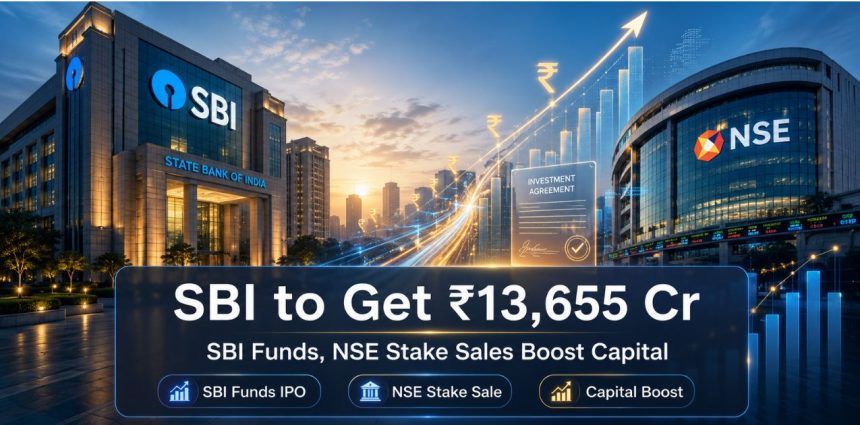
State Bank of India (SBI) could unlock approximately ₹13,655 crore from partial stake sales in SBI Funds Management (SBIFM) and the National Stock Exchange (NSE), giving India’s largest lender additional capital to support loan growth and manage future provisioning requirements. The proceeds, routed through other income, would strengthen the bank’s net worth and capital base, cushion its provisioning requirements, and support loan growth as SBI works to sustain a return on assets (RoA) above 1%, analysts said.
Where the Rs 13,655 Crore Could Come From
The estimated payout breaks down across three transactions — one already completed, one in progress, and one still projected. Of the total, only ₹1,655 crore has actually been realised so far; the rest depends on how the two public offers are eventually priced.
| Source | Estimated Amount | Status |
|---|---|---|
| SBIFM pre-IPO placement | ₹1,655 crore | Completed |
| SBIFM main IPO (at lower end of price band) | ~₹7,000 crore | Public issue opens Tuesday |
| NSE offer for sale | At least ₹5,000 crore | Analyst estimate |
| Total potential proceeds | ₹13,655 crore | Part realised, part projected |
SBI Funds Management IPO Opens Today
SBI is diluting approximately 6.3% of its holding in SBIFM, India’s largest asset management company, through an IPO valued at ₹9,813 crore that opened for bidding on Tuesday, July 14, with the price band set at ₹545–574 per share.
Ahead of the issue, SBI had already banked ₹1,655 crore through a pre-IPO placement to institutional investors earlier this month. Public filings show the bank stands to collect at least another ₹7,000 crore from the main offering even at the lower end of the price band. The transaction is an offer for sale, so proceeds go to the selling shareholders rather than to SBIFM itself.
Check Live: SBI Funds Management IPO
NSE Stake Sale: SBI’s Next Potential Payday
SBI is also expected to be the single largest selling shareholder in the proposed NSE IPO, offering around 24.75 million shares as part of an issue that could be worth roughly ₹30,000 crore, likely India’s largest ever, during the current financial year.
The price band has not yet been fixed, and analysts estimate SBI could receive at least ₹5,000 crore from the offer for sale. The final proceeds will depend on NSE’s eventual valuation, issue structure and offer price, so this figure remains an estimate rather than a confirmed receipt.
Check Live: State Bank of India (SBI) Open Interest: Live OI Data
Capital Position Already Comfortable
SBI’s capital adequacy ratio (CAR) stood at 15.40% as of March 2026, well above the 12.30% regulatory requirement, including the additional buffers mandated for the bank’s systemically important status. Asset quality is similarly strong: gross NPA was at 1.39%, a two-decade low, while the provision coverage ratio (including technically written-off accounts) stood at 92%.
Analysts Expect Possible Front-Loaded Provisioning
With capital already ample, analysts believe SBI could use the windfall to accelerate provisioning for expected credit losses (ECL) rather than spread it out.
Under the Reserve Bank of India’s new ECL framework, lenders can phase in these provisions over four years starting FY28, but Nitin Aggarwal of Motilal Oswal Securities said SBI has consistently viewed its ECL-related provisioning as manageable, and that the fresh capital could give the bank flexibility to front-load provisions instead of spacing them out as originally planned.
SBI has not announced any such decision, and front-loading remains an analyst assessment rather than a confirmed plan.
Yuvraj Choudhary of Anand Rathi Securities estimates the combined inflows could lift SBI’s capital adequacy by 27–30 basis points.
He expects the ECL transition to be manageable across the sector given controlled slippages and non-performing assets, and believes SBI could direct part of the proceeds toward loan growth that outpaces the broader banking system.
A senior SBI official echoed that the new ECL norms are unlikely to materially impact the bank, though front-loading provisions remains an option. SBI did not respond to an email seeking comment.
Key Takeaways
- SBI could see a combined ₹13,655 crore accretion from stake sales in SBI Funds Management and NSE this year, though only ₹1,655 crore is realised so far.
- The SBIFM IPO (opened July 14) could add ~₹7,000 crore more at the lower end of its price band.
- SBI is expected to sell 24.75 million NSE shares, with analysts pegging proceeds at ₹5,000 crore-plus.
- CAR stood at 15.40% as of March 2026, comfortably above the 12.30% requirement.
- Gross NPA is at a two-decade low of 1.39%; provision coverage ratio is 92%.
- Front-loading of ECL provisions is an analyst view, not a confirmed SBI decision.
Read Next: GIFT Nifty Slips 165 Points; HCL Tech, Biocon Stocks in Focus
FAQ
Q1. How much could SBI’s stake sales add to its capital this year?
Up to ₹13,655 crore combined from the SBI Funds Management IPO and the proposed NSE offer for sale — though most of this is still an estimate.
Q2. How much has SBI actually received so far?
₹1,655 crore, via a completed pre-IPO placement. The remaining amounts depend on final IPO pricing.
Q3. How many NSE shares is SBI expected to sell?
Around 24.75 million shares, as the largest selling shareholder in the proposed NSE IPO.
Q4. What is SBI’s current capital adequacy ratio?
15.40% as of March 2026, against a regulatory requirement of 12.30%.
Q5. Has SBI confirmed it will front-load ECL provisions?
No. Analysts believe SBI’s surplus capital gives it the option to accelerate provisioning, but the bank has not announced any such decision.
Track live institutional flows around these IPOs with NiftyTrader’s FII-DII Dashboard.
Disclaimer: This article is for informational purposes only and should not be construed as investment advice. Stock market investments are subject to market risks. Readers are advised to consult a certified financial advisor before making any investment decisions. NiftyTrader.in does not take responsibility for any losses incurred based on the information provided here.