South Korea’s Kospi Plunges 6.6% as AI Stocks Slide, Rate Hike Adds Pressure Across Asian Markets
Asian markets traded mostly lower on Thursday as investors booked profits in artificial intelligence (AI)-linked stocks, while geopolitical tensions between the United States and Iran kept market sentiment cautious.
Although oil prices edged lower during early trade, they remained elevated due to concerns over disruptions in Middle East energy supplies. Meanwhile, US stock futures traded slightly higher after Wall Street ended the previous session on a positive note.
Is This Just Profit Booking or the Start of a Bigger Market Correction?
Technology stocks have been leading global markets for months, but Thursday’s sharp sell-off has raised fresh questions. Is this simply a temporary correction in AI-related shares, or are investors preparing for a more volatile phase as interest rates, earnings and geopolitical risks collide?
South Korea’s Kospi Suffers Biggest Blow
South Korea witnessed the sharpest decline among major Asian markets after the Bank of Korea (BOK) surprised investors with its first interest rate hike since 2023.
The Kospi index tumbled 6.6% as higher borrowing costs and inflation concerns weighed heavily on investor sentiment.
Technology stocks led the losses:
- SK Hynix plunged 11.2%
- Samsung Electronics declined 8.2%
The rate hike was aimed at containing inflationary pressures arising from the ongoing Iran conflict and rising energy costs.
Read More : Nifty IT Index Rebounds 1.8% as US Inflation Boosts Rate Cut Hopes and Investors Buy the Dip
Japan’s AI and Semiconductor Stocks Extend Losses
Japanese equities also remained under pressure as investors sold AI and semiconductor-related stocks.
The Nikkei 225 fell 2.9%, while major technology companies recorded steep declines.
Among the biggest losers:
- Kioxia fell 13.5%
- Tokyo Electron dropped 5.2%
- Advantest declined 5.6%
- SoftBank Group lost 6.4%
The weakness reflected investor caution ahead of more global technology earnings.
Track Live : GIFT Nifty Live – Today Price, Chart, Timings and Nifty Opening Signal
Global Market
| Market | Performance |
|---|---|
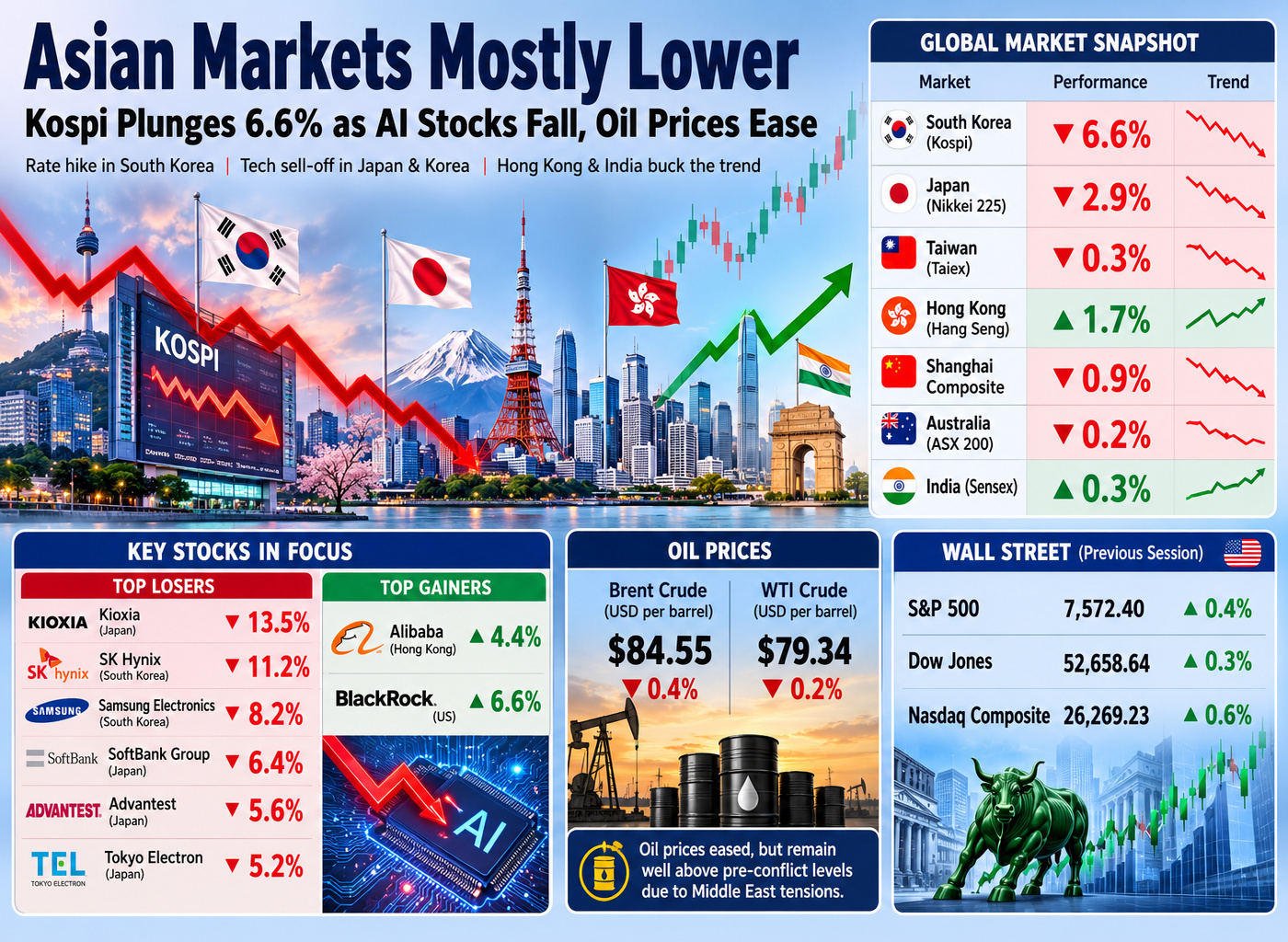
| South Korea (Kospi) | ▼ 6.6% |
| Japan (Nikkei 225) | ▼ 2.9% |
| Taiwan (Taiex) | ▼ 0.3% |
| Hong Kong (Hang Seng) | ▲ 1.7% |
| Shanghai Composite | ▼ 0.9% |
| Australia (ASX 200) | ▼ 0.2% |
| India (Sensex) | ▲ 0.3% |
Taiwan Waits for TSMC Earnings
Taiwan’s Taiex index slipped 0.3% ahead of quarterly earnings from Taiwan Semiconductor Manufacturing Company (TSMC).
TSMC’s results are closely watched because the company is regarded as a global barometer for semiconductor demand and artificial intelligence investment.
Strong guidance from TSMC could influence sentiment across global technology markets in the coming sessions.
Key highlights
- South Korea: The Kospi plunged about 6.4%-6.6%, marking one of its sharpest declines this year after the Bank of Korea raised interest rates for the first time since 2023 to combat inflationary pressures linked to the Iran conflict.
- AI stocks under pressure: Memory chip giant SK Hynix tumbled more than 11%, while Samsung Electronics dropped over 8%. In Japan, Tokyo Electron, Advantest, Kioxia and SoftBank Group also posted steep losses as investors continued reducing exposure to AI-linked shares.
- Japan: The Nikkei 225 fell nearly 3%, dragged lower by semiconductor and technology stocks.
- Taiwan: The Taiex edged lower ahead of earnings from TSMC, which investors view as a key indicator of global semiconductor demand and AI spending.
- Hong Kong: The Hang Seng Index bucked the regional trend, rising more than 1% after Alibaba gained following approval for Apple Intelligence to launch in China using Alibaba’s Qwen AI model.
- China & Australia: Shanghai and Australian equities also ended lower, reflecting cautious sentiment across the region.
- India: India’s Sensex traded modestly higher, outperforming several Asian peers despite global uncertainty.
Hong Kong Outperforms as Alibaba Rallies
Hong Kong stood out as the region’s strongest performer.
The Hang Seng Index climbed 1.7%, supported by a sharp rally in Alibaba, whose Hong Kong-listed shares gained 4.4%.
The rally followed China’s cyberspace regulator approving Apple Intelligence for use in China, with Alibaba confirming that its Qwen AI model will be integrated into Apple’s AI platform.
Meanwhile, China’s Shanghai Composite Index declined 0.9%, while Australia’s S&P/ASX 200 slipped 0.2%.
India’s Sensex bucked the broader regional trend and traded 0.3% higher.
Oil Prices Ease but Remain Elevated
Oil prices edged lower during Thursday’s session but remained significantly above pre-conflict levels.
- Brent crude fell 0.4% to $84.55 per barrel
- WTI crude slipped 0.2% to $79.34 per barrel
Before the Iran conflict escalated, Brent crude was trading near $72 per barrel in late February.
According to ING commodities strategists Warren Patterson and Ewa Manthey, “Oil prices managed to eke out a third day of gains amid few signs of de-escalation between the US and Iran.”
They also noted that tanker traffic through the Strait of Hormuz, one of the world’s most important oil shipping routes, continues to face significant disruption.
nalysts said ongoing US-Iran hostilities and continued disruptions to tanker traffic through the Strait of Hormuz are keeping energy markets on edge despite Thursday’s modest pullback.
Wall Street overnight
US markets closed higher on Wednesday, supported by softer-than-expected June inflation data and strong corporate earnings.
- S&P 500: +0.4%
- Dow Jones: +0.3%
- Nasdaq Composite: +0.6%
BlackRock surged after reporting better-than-expected quarterly results, helping lift overall market sentiment despite geopolitical concerns.
Key Stocks in Focus
The biggest market moves on Thursday were concentrated in technology, semiconductor and financial stocks. Asian chipmakers witnessed heavy selling amid concerns over AI valuations and rising interest rates, while a handful of company-specific developments helped lift Alibaba and BlackRock.
| Stock | Move | Key Reason |
|---|---|---|
| Kioxia (Japan) | ▼ 13.5% | Biggest loser as chip stocks faced heavy profit-taking |
| SK Hynix (South Korea) | ▼ 11.2% | Sharp sell-off in AI memory-chip stocks |
| Samsung Electronics (South Korea) | ▼ 8.2% | Weighed down by weakness across the semiconductor sector |
| SoftBank Group (Japan) | ▼ 6.4% | Pressure on AI and technology investments |
| Advantest (Japan) | ▼ 5.6% | Weak sentiment toward semiconductor equipment makers |
| Tokyo Electron (Japan) | ▼ 5.2% | Broad-based selling in chip manufacturing stocks |
| Alibaba (Hong Kong) | ▲ 4.4% | Boosted by Apple Intelligence partnership in China |
| BlackRock (US) | ▲ 6.6% | Strong quarterly earnings lifted investor confidence |
What Drove the Biggest Stock Moves?
- Semiconductor stocks bore the brunt of the sell-off. Japan and South Korea’s leading chip companies came under intense pressure as investors reduced exposure to AI-related stocks. Kioxia recorded the steepest decline at 13.5%, followed by SK Hynix (-11.2%) and Samsung Electronics (-8.2%), while SoftBank, Advantest, and Tokyo Electron also posted sizeable losses.
- A few stocks bucked the trend. Alibaba rose 4.4% after China’s regulator approved Apple Intelligence for use in China with Alibaba’s Qwen AI model, boosting Hong Kong markets. In the US, BlackRock climbed 6.6% after reporting stronger-than-expected quarterly revenue and profit, helping support Wall Street sentiment.
Here’s What Happened Today and Why Traders Reacted
Several developments influenced market sentiment on Thursday:
- South Korea unexpectedly raised interest rates.
- AI and semiconductor stocks witnessed heavy profit booking.
- Investors awaited TSMC’s quarterly earnings.
- US-Iran tensions continued to support higher crude oil prices.
- Elevated oil prices kept inflation concerns alive.
Together, these factors prompted investors to reduce exposure to risk assets across several Asian markets.
What Impact Did Today’s Market Move Have?
The sell-off highlighted how sensitive global markets remain to interest rate decisions, technology earnings and geopolitical developments.
Technology-heavy indices experienced the biggest declines, while energy markets remained supported by supply concerns despite a modest fall in crude prices.
What Does It Mean for Traders and Investors?
For traders, volatility is likely to remain elevated as markets react to corporate earnings, central bank decisions and developments in the Middle East.
For long-term investors, the focus should remain on upcoming earnings from global technology companies, particularly semiconductor firms, as they are expected to provide fresh insights into AI demand and future business spending.
The direction of oil prices and geopolitical developments will also remain key factors influencing global equity markets over the coming weeks.