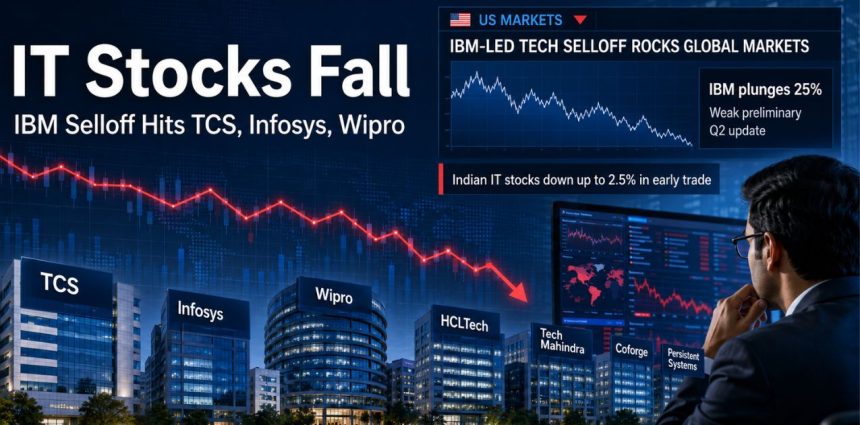
Shares of TCS, Infosys, Wipro, HCLTech, Tech Mahindra, Persistent Systems and Coforge fell by as much as 2.5% in early trade on Wednesday after IBM suffered a historic 25.21% overnight collapse. IBM’s weaker preliminary quarterly update raised concerns about delayed technology deals and a shift in enterprise spending from software towards servers, storage and memory.
Key Takeaways
- TCS fell 2.5% in early trade, while Infosys, HCLTech, Tech Mahindra, Persistent Systems and Coforge declined by around 2%.
- IBM closed 25.21% lower at $217.07 after releasing weaker-than-expected preliminary quarterly results.
- Infosys ADR fell 3.91%, while Wipro ADR declined 3.16% in US trading.
- IBM said clients redirected spending towards servers, storage and memory during the final weeks of June.
- Wipro’s June-quarter results are due on July 16, followed by IBM’s complete quarterly results on July 22.
Shares of major Indian IT companies came under pressure on July 15 as a sharp selloff in IBM spread across global technology stocks.
TCS fell 2.5% to ₹2,144 in early trade, while Infosys slipped nearly 2%. HCLTech and Tech Mahindra declined around 2%, and Wipro lost more than 1%. Persistent Systems and Coforge also fell by as much as 2%, according to market data reported by The Economic Times.
The immediate trigger came from Wall Street, where IBM closed 25.21% lower at $217.07 on Tuesday after falling by around 26% intraday. The decline followed selected preliminary second-quarter results that missed market expectations and highlighted weaker execution across parts of IBM’s software and infrastructure businesses.
Why Did IBM Shares Crash?
IBM reported preliminary quarterly revenue of $17.2 billion, representing growth of 1% from the previous year but falling below analysts’ expectations of approximately $17.9 billion.
Operating earnings came in at $2.93 per share, compared with the Street estimate of around $3.02. GAAP earnings stood at $2.27 per share.
| IBM Q2 Preliminary Metric | Reported Performance |
|---|---|
| Revenue | $17.2 billion, up 1% YoY |
| Operating EPS | $2.93 |
| GAAP EPS | $2.27 |
| Software revenue | Up 5% |
| Consulting revenue | Flat; up 1% in constant currency |
| Infrastructure revenue | Down 7% |
IBM CEO Arvind Krishna said customers changed their spending priorities during the final weeks of June. Clients redirected quarterly capital expenditure towards servers, storage and memory purchases to secure supply-constrained infrastructure before anticipated price increases.
IBM had expected some supply-chain disruption but underestimated the scale of this spending reprioritisation. Krishna also said rapidly evolving cybersecurity concerns distracted clients and that several large transactions failed to close within the timelines anticipated by the company.
Why Are TCS, Infosys and Wipro Shares Falling?
IBM’s update matters for Indian IT exporters because they derive a substantial part of their business from the technology budgets of large overseas enterprises, particularly in North America.
IBM’s numbers do not automatically indicate that every Indian IT company will report weaker results. IBM has a different business mix spanning mainframes, infrastructure, consulting and enterprise software.
However, its commentary has raised a broader concern: are global companies temporarily delaying software projects while prioritising expenditure on computing infrastructure?
The negative sentiment was also visible in the US-listed shares of Indian IT companies. Infosys ADR closed 3.91% lower at $11.05, while Wipro ADR declined 3.16% to $1.84.
Why Persistent Systems Is Also in Focus
Persistent Systems remained under additional scrutiny because of its reported IBM exposure.
Business Today, citing a July note from BNP Paribas, reported that material weakness at IBM—described in the note as a top Persistent Systems client—was identified as a risk to Persistent’s valuation.
This is a company-specific factor and should be considered separately from the broader sentiment-driven decline across Indian IT shares.
What Should Investors Track Next?
| Company or Event | What the Market Will Watch |
|---|---|
| Wipro results on July 16 | Revenue guidance, deal activity and client-spending commentary |
| IBM results on July 22 | Full-year expectations and updates on delayed deals |
| Infosys and other IT earnings | Discretionary spending, project ramp-ups and margins |
| Persistent Systems | Company-specific updates and reported IBM exposure |
| Indian IT sector | Whether infrastructure spending delays software-services demand |
Wipro will announce its June-quarter results after Indian market hours on July 16. Its management discussion will be closely followed for commentary on client budgets, large deals and near-term revenue expectations.
IBM will release its complete second-quarter results on July 22. The company has said it will provide more details and discuss its full-year expectations during the scheduled earnings call.
Check Live: Wipro Option Chain (WIPRO) — Live OI, IV, Greeks & PCR
Bottom Line
The decline in Indian IT stocks is currently being driven mainly by weak global technology sentiment and fresh uncertainty over enterprise spending priorities.
The more important signal will come from upcoming earnings calls. Investors will look for clarity on whether delayed deals are merely a short-term timing issue or evidence of a wider shift in corporate technology budgets from software and services towards servers, storage and other infrastructure.
Until company-specific results provide more evidence, IBM’s preliminary update should be treated as an important warning signal for the technology sector—not as confirmation that every Indian IT exporter faces the same level of weakness.
Read Next: Fairfax Reportedly Selected for 60.72% IDBI Bank Stake Sale in ₹53,000 Crore Deal
Disclaimer: This article is intended solely for informational and educational purposes and does not constitute investment advice. Market conditions can change rapidly. Readers should conduct independent research or consult a SEBI-registered investment adviser before making financial decisions.