Planning to Retire at 55? This Rs 1.6 Crore Compounding Trap Could Catch You Off Guard
Can retiring just five years early cost you ₹1.6 crore?
Retiring early sounds like a dream—more freedom, less stress and time to enjoy life. But there’s a financial reality that many investors underestimate.
If you plan to retire at 55 instead of 60, you could end up sacrificing nearly ₹1.6 crore in retirement savings. The reason isn’t just fewer years of investing. It’s the loss of the most powerful phase of wealth creation—compounding.
Here’s why those final five years could make all the difference to your retirement.
Track Live : Nifty PCR Today – Live Put Call Ratio Chart
Why retiring at 55 can significantly reduce your retirement corpus
The biggest cost of Retiring at 55 is losing both five years of fresh SIP investments and five years of compounding.
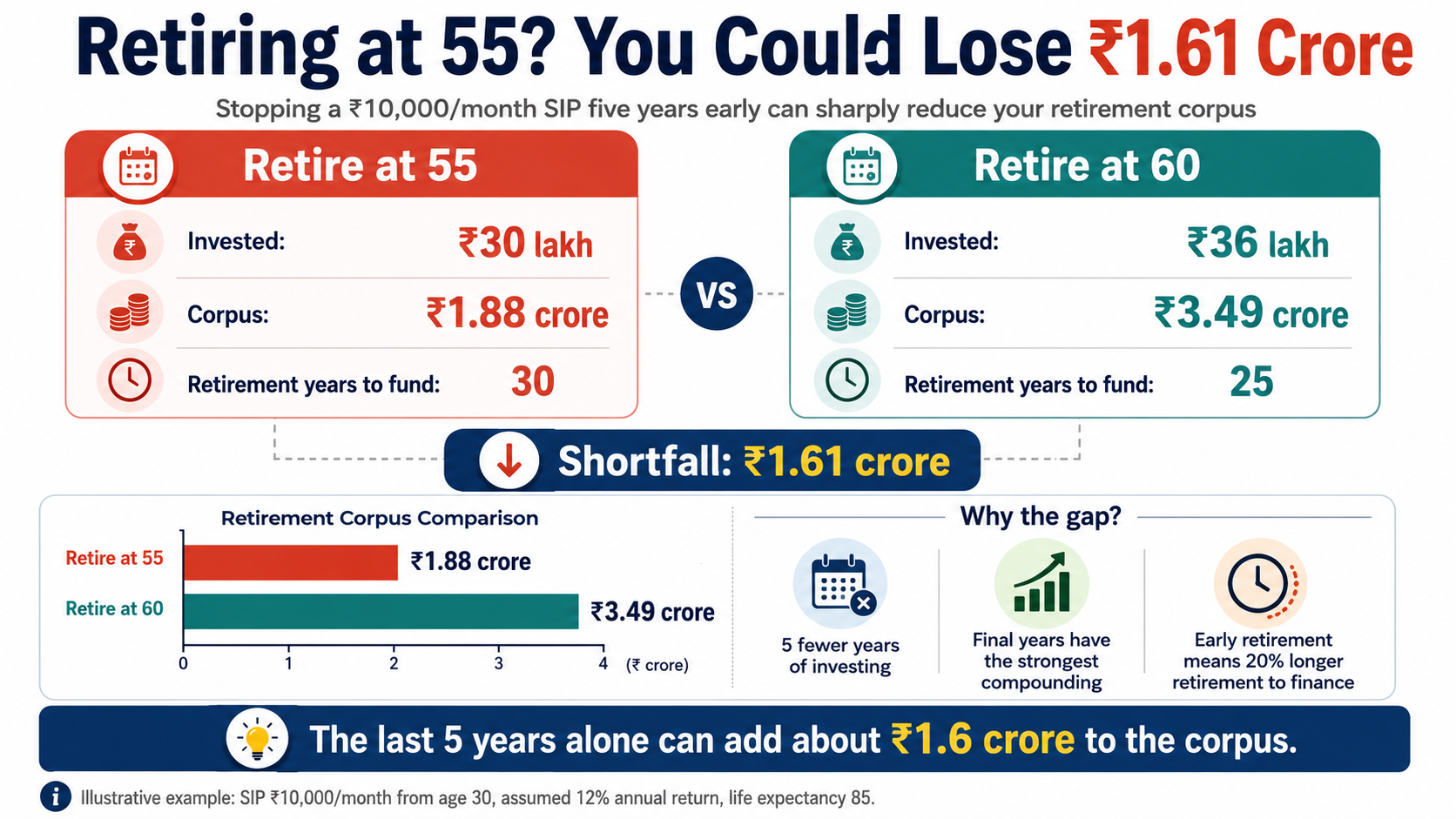
According to Madhupam Krishna, SEBI-registered Investment Adviser (RIA) and Founder of WealthWisher Financial Planners and Advisors, an investor contributing ₹10,000 every month from age 30 to 60, assuming 12% annual returns, invests a total of ₹36 lakh but builds an estimated retirement corpus of around ₹3.49 crore.
However, if the same investor stops investing at 55, the total investment falls to ₹30 lakh, while the retirement corpus drops sharply to nearly ₹1.88 crore.
“If you initially planned to invest ₹10,000/month from age 30 to 60 in a SIP with returns of 12%, you would invest ₹36 lakh and get around ₹3.5 crore. But suppose you cut short your investment horizon by five years by retiring at 55; your SIP of ₹30 lakh will only make ₹1.9 crore,” Krishna said.
That translates into a shortfall of nearly ₹1.61 crore.
How retirement savings grow with every additional year
The impact of staying invested becomes clearer when comparing different retirement ages.
Stop your SIP at 55 instead of 60, and your corpus could shrink by Rs 1.61 crore. Here’s the math
Retirement Age Comparison
| Retirement Age | Investment Duration | Total Amount Invested (Rs) | Estimated Corpus (Rs) | Wealth Gained (Return) | Corpus as Multiple of Investment | Shortfall vs Retiring at 60 (Rs) |
|---|---|---|---|---|---|---|
| 35 | 5 years | 6 lakh | 8.25 lakh | 2.25 lakh | 1.4x | 3.41 crore |
| 40 | 10 years | 12 lakh | 23.23 lakh | 11.23 lakh | 1.9x | 3.26 crore |
| 45 | 15 years | 18 lakh | 50.46 lakh | 32.46 lakh | 2.8x | 2.99 crore |
| 50 | 20 years | 24 lakh | 99.92 lakh | 75.92 lakh | 4.2x | 2.49 crore |
| 55 | 25 years | 30 lakh | 1.88 crore | 1.58 crore | 6.3x | 1.61 crore |
| 60 | 30 years | 36 lakh | 3.49 crore | 3.13 crore | 9.7x | 0 |
Note
The table is for illustrative purposes only. Calculations assume a monthly SIP of Rs 10,000, starting at age 30, with returns compounded monthly at an assumed 12% CAGR throughout the investment period.
Source: Moneycontrol Research
Read More : 21 Nifty-500 Firms See Foreign Promoter Stake Increase Even as FPIs Sell ₹1.8 Lakh Crore
Things to Consider Before Retiring at 55
- Ensure your retirement corpus can support 30+ years of expenses.
- Account for inflation and rising healthcare costs.
- Have multiple income sources such as pension, rental income, dividends or SWPs.
- Maintain adequate health insurance.
- Base your retirement plan on realistic return assumptions rather than optimistic projections.
Stocks vs Fixed Deposits: Which Is Better for Retirement Planning?
| Investment | Long-Term Growth Potential | Inflation Protection |
|---|---|---|
| Equity Mutual Funds | High | Better |
| Index Funds | High | Better |
| Fixed Deposits (FDs) | Moderate | Limited |
| Savings Account | Low | Weak |
Note: Equity mutual funds and index funds offer market-linked returns that are not guaranteed. Their value can fluctuate in the short term, but they have historically delivered stronger long-term wealth creation than traditional savings instruments. Fixed deposits, on the other hand, provide fixed returns and capital stability but may struggle to beat inflation over long investment horizons.
The power of compounding is strongest near retirement
Many investors assume that the early years of investing generate the biggest gains. In reality, the opposite is true.
As your investment corpus grows, the returns begin generating returns of their own. This “returns on returns” effect accelerates sharply during the final years.
Krishna explained that without adding even a single additional SIP, the accumulated corpus can continue growing rapidly because of compounding alone.
“The last five years alone add roughly ₹1.6 crore to the corpus.”
This is why exiting investments too early can significantly reduce long-term wealth.
Early retirement also means funding more years of life
Retiring at 55 doesn’t only reduce your savings—it also increases the number of years those savings must support you.
Assuming life expectancy reaches 85 years, retiring at 60 requires financing about 25 years after retirement. Retiring at 55 extends that period to 30 years, increasing retirement duration by 20%.
That also means dealing with:
- Higher inflation over a longer period.
- Rising healthcare expenses.
- Greater uncertainty about future living costs.
A smaller retirement corpus combined with a longer retirement period creates additional financial pressure.
Can you still retire at 55?
Yes—but only if your financial plan supports it.
According to Amol Joshi, Founder of PlanRupee Investment Services, early retirement should be based on careful planning rather than emotion.
“Five years of early retirement also means lower corpus; be sure that it meets your corpus requirement and proceed only once sure.”
Experts recommend considering:
- A sufficiently large retirement corpus.
- Conservative return assumptions.
- Comprehensive health insurance.
- Multiple income sources such as rent, dividends or pension.
- A retirement plan that accounts for inflation and increasing longevity.
What does this mean for investors?
For investors, the biggest takeaway is that Retiring at 55 should not be viewed only as leaving work earlier—it is a long-term financial decision.
Those final five years of investing often generate the largest increase in wealth because compounding reaches its strongest phase. Exiting too early could mean giving up a substantial portion of your retirement corpus while simultaneously increasing the number of years your savings must last.
As Krishna aptly summed it up:
“Don’t retire early just because you can stop working. Retire because your finances are strong enough to support a longer life, and because you have something meaningful to retire to, not merely something to retire from.”