Can Paytm’s first-ever bonus share issue become the next trigger for its stock? Here’s why investors are watching today’s board meeting closely.
After delivering its first annual profit and witnessing record domestic institutional participation, Paytm bonus share issue has become one of the most closely watched corporate announcements in the market today. Along with its Q1 FY27 earnings, the fintech giant’s board is expected to decide on its maiden bonus issue, a move that could significantly boost investor sentiment.
More than 7.5 lakh retail shareholders are now waiting for clarity on the bonus ratio and record date, making today’s announcement one of the biggest events for the stock.
Paytm bonus share issue takes centre stage ahead of Q1 FY27 earnings
One 97 Communications, the parent company of Paytm, will announce its June quarter (Q1 FY27) results after its board meeting on Monday.
Along with the earnings, the board will also consider approving the company’s first-ever Paytm bonus share issue, subject to necessary approvals.
The company had informed exchanges on July 15 that its Board of Directors would consider both the quarterly financial results and the proposal for issuing bonus equity shares.
Investors are now closely tracking two major announcements:
- Bonus share ratio
- Record date for eligible shareholders
Track Live : Nifty Open Interest (OI) Live
Key Highlights
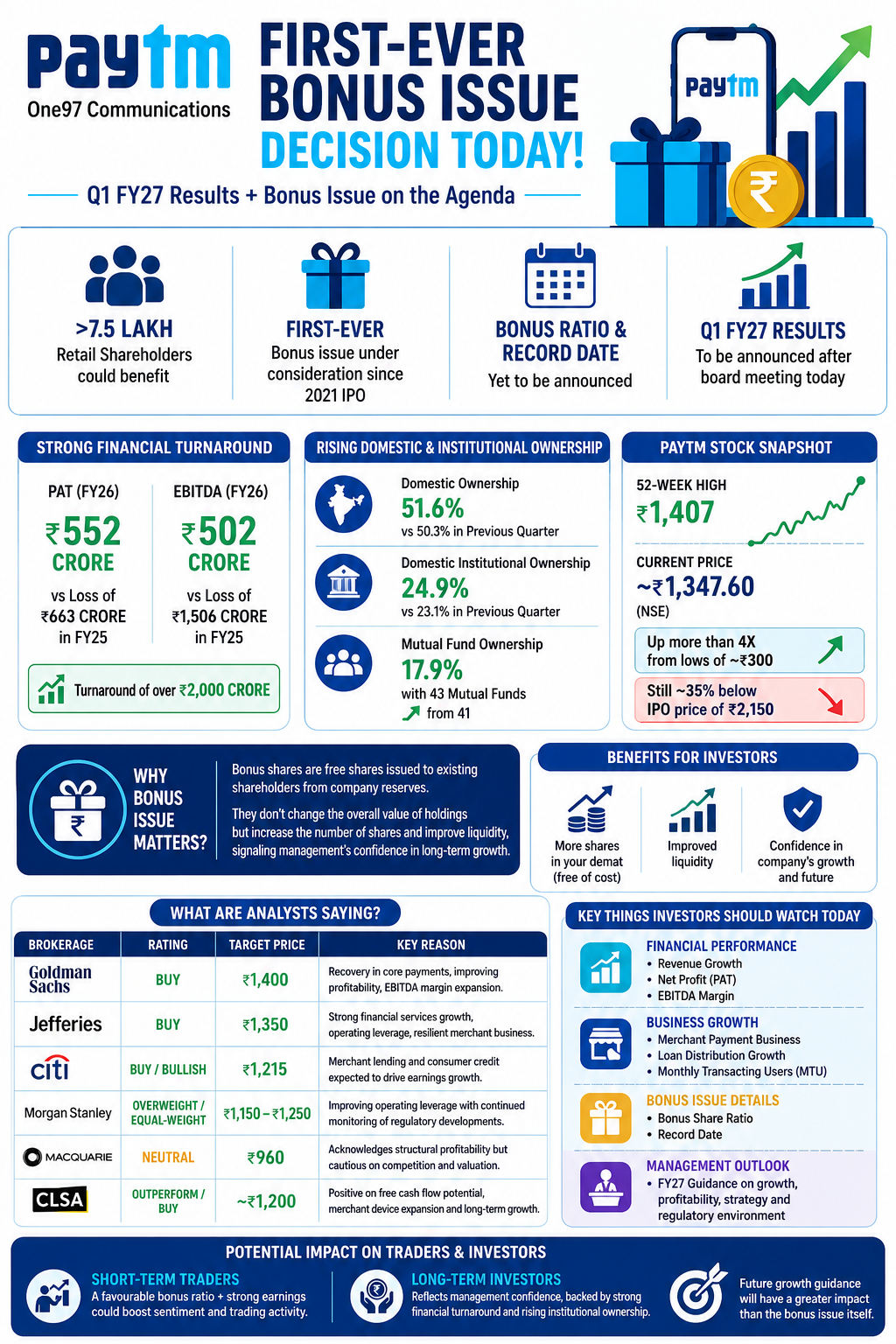
- First-ever bonus issue under consideration since Paytm’s 2021 IPO.
- Q1 FY27 earnings to be announced after the board meeting today.
- More than 7.5 lakh retail shareholders could benefit if the proposal is approved.
- Bonus ratio and record date are yet to be announced.
- Domestic ownership has increased to 51.6%, reinforcing Paytm’s Indian-Owned and Controlled Company (IOCC) status.
- Mutual fund ownership rose to 17.9%, with 43 mutual funds holding the stock.
- Paytm reported its first full-year profit in FY26 with ₹552 crore PAT and ₹502 crore EBITDA, marking a major turnaround from FY25.
- The stock recently touched a 52-week high of ₹1,407, although it remains below its IPO price of ₹2,150.
Why the Bonus Issue Matters
A bonus issue is the allotment of free shares to existing shareholders from the company’s reserves. While it does not change the total value of an investor’s holdings, it increases the number of shares owned and generally improves liquidity. Companies often announce bonus issues to signal confidence in their financial position and long-term growth prospects.
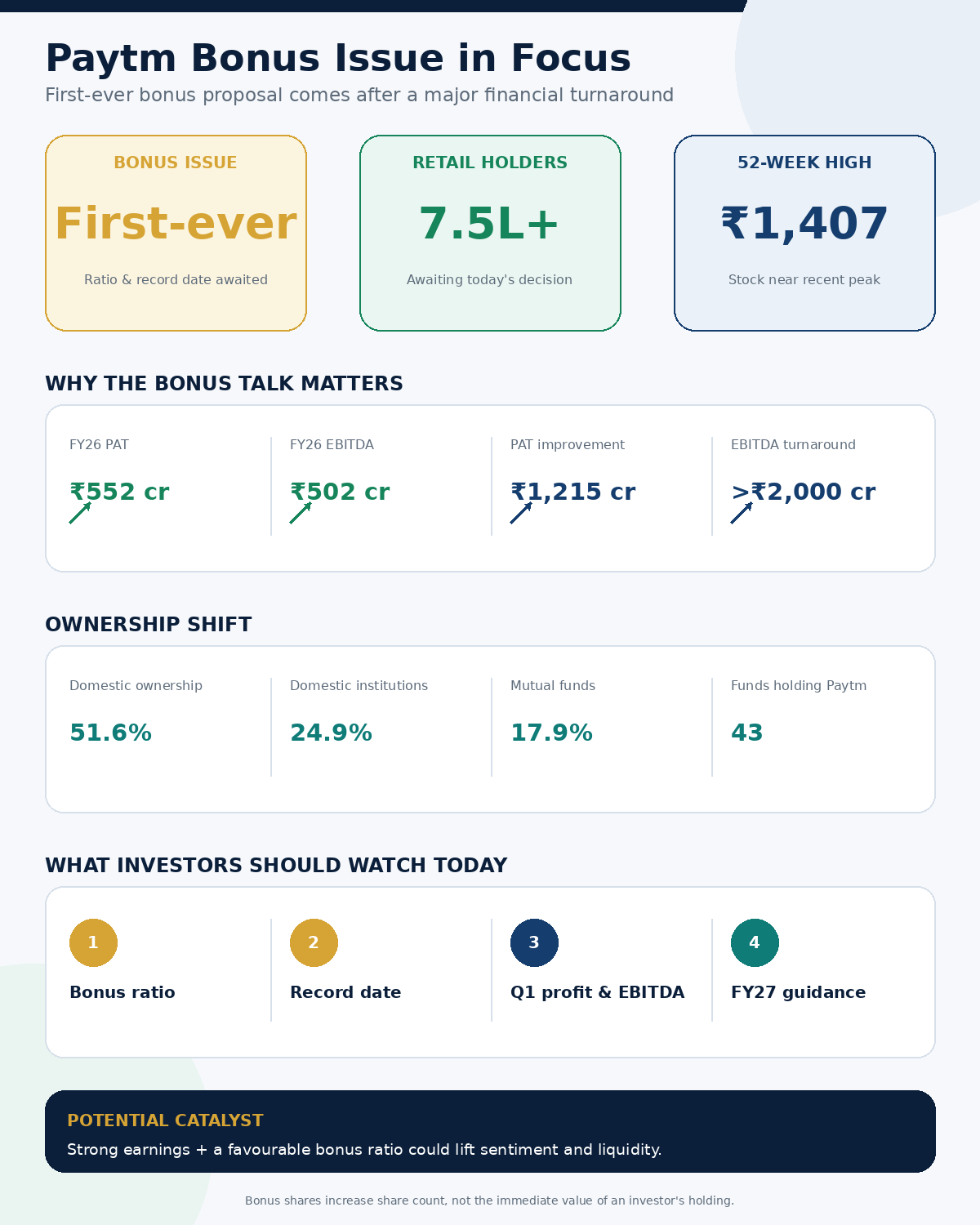
What does a Paytm bonus share issue mean for investors?
A Paytm bonus share issue allows existing shareholders to receive additional shares free of cost in proportion to their existing holdings.
Although a bonus issue does not change the overall value of an investor’s holdings immediately, it increases the number of shares owned and generally improves stock liquidity.
Companies usually announce bonus shares when management is confident about long-term business growth and strong financial health.
For many investors, such announcements also improve market sentiment and increase retail participation.
Read More : Kospi Plunges 4.5% as Middle East Conflict and Hyundai Strikes Shake Asia-Pacific Markets
Strong financial turnaround strengthens the bonus case
The proposed Paytm bonus share issue comes after the company reported its strongest financial performance since listing.
In FY26, Paytm posted its first-ever full-year profit after tax (PAT) of ₹552 crore, compared to a loss of ₹663 crore in the previous year.
The company improved profitability by nearly ₹1,215 crore year-on-year.
Its EBITDA also turned positive at ₹502 crore, compared to a loss of ₹1,506 crore a year earlier, marking a turnaround of more than ₹2,000 crore.
These numbers have strengthened investor confidence in the fintech company’s long-term growth story.
Domestic investors continue increasing their stake in Paytm
Another major positive for the company has been rising domestic ownership.
According to the latest shareholding pattern, domestic investors increased their holding to 51.6% during the June quarter from 50.3% in the previous quarter.
This further strengthens Paytm’s status as an Indian-Owned and Controlled Company (IOCC), a milestone it achieved in March 2026.
Domestic institutional investors also increased their ownership to a record 24.9%, up from 23.1% in the previous quarter.
Mutual fund ownership climbed to 17.9%, while the number of mutual funds investing in Paytm increased from 41 to 43.
More than 7.5 lakh retail shareholders await today’s decision
The proposed Paytm bonus share issue is particularly important for retail investors.
As of June 30, 2026, the company had more than 7.5 lakh small shareholders, who collectively own over 8% of the company.
This will be the first time since Paytm’s 2021 stock market listing that shareholders could receive bonus shares.
However, retail investors have been gradually reducing their holdings for the ninth consecutive quarter even as institutional ownership has continued rising.
Paytm stock remains near a 52-week high
Ahead of the board meeting, Paytm shares traded nearly flat at around ₹1,347.60 on the NSE during Monday’s session.
The stock has recovered sharply from its record lows of nearly ₹300, rising more than fourfold after the company improved profitability and addressed regulatory concerns.
Earlier this month, the stock also touched a fresh 52-week high of ₹1,407.
Despite the strong recovery, Paytm shares still trade around 35% below their IPO issue price of ₹2,150.
What Are Analysts Saying About Paytm?
Global brokerages remain largely constructive on One 97 Communications (Paytm), citing improving profitability, stronger merchant payments, financial services growth, and better operating leverage. While most firms maintain Buy recommendations, some remain cautious on valuation and competitive intensity.
| Brokerage | Rating | Target Price | Key Reason |
|---|---|---|---|
| Goldman Sachs | Buy | ₹1,400 | Recovery in core payments, improving profitability, EBITDA margin expansion. |
| Jefferies | Buy | ₹1,350 | Strong financial services growth, operating leverage, resilient merchant business. |
| Citi | Buy / Bullish | ₹1,215 | Merchant lending and consumer credit expected to drive earnings growth. |
| Morgan Stanley | Overweight / Equal-Weight | ₹1,150–₹1,250 | Improving operating leverage with continued monitoring of regulatory developments. |
| Macquarie | Neutral | ₹960 | Acknowledges structural profitability but remains cautious on competition and valuation. |
| CLSA | Outperform / Buy | ~₹1,200 | Positive on free cash flow potential, merchant device expansion and long-term growth. |
Key Things Paytm Investors Should Watch Today
As One97 Communications announces its Q1 FY27 results and considers its first-ever bonus issue, investors should focus on these key metrics rather than just the headline numbers.
Financial Performance
- Revenue Growth – Is Paytm maintaining strong top-line momentum?
- Net Profit (PAT) – Has the company sustained profitability after reporting its first full-year profit in FY26?
- EBITDA Margin – Is operational efficiency and profitability improving?
Business Growth
- Merchant Payment Business – Growth in merchant subscriptions, Soundboxes, POS devices and payment volumes.
- Loan Distribution Growth – Expansion in merchant loans, personal loans and postpaid business.
- Monthly Transacting Users (MTU) – Growth in active users and customer engagement.
Bonus Issue Details
- Bonus Share Ratio – Number of free shares to be issued for every existing share.
- Record Date – The cut-off date to determine shareholder eligibility for the bonus shares.
Management Outlook
- FY27 Guidance – Commentary on payments growth, financial services, regulatory environment, profitability and long-term growth strategy.
What impact could this have on traders and investors?
For short-term traders, today’s board outcome could become the biggest catalyst for Paytm shares. A favourable bonus ratio, combined with strong quarterly earnings, may improve market sentiment and increase trading activity.
For long-term investors, the proposed Paytm bonus share issue reflects management’s confidence following a major financial turnaround. Rising institutional ownership, improving profitability and stronger domestic participation also support the company’s long-term investment case.
However, investors will closely examine both the quarterly earnings and management commentary, as future growth guidance could ultimately have a greater impact on the stock than the bonus announcement itself.