
Kospi Plunges 4.5% as Middle East Conflict Oil Crosses $90 Before Big Tech Earnings
Can rising oil prices derail the stock market rally? Will Alphabet, Tesla and Intel earnings revive investor confidence? And why are global markets suddenly becoming more volatile? Here’s what every investor and trader should know before the next trading session.
This week could shape the direction of global equities as Wall Street today battles rising geopolitical risks, soaring crude oil prices and one of the biggest earnings weeks of the quarter.
Wall Street today remains under pressure as Middle East Conflict
Wall Street today opened the week on a cautious note after all three major U.S. indices ended last week in the red. While futures traded mixed, investors remained defensive as tensions between the United States and Iran intensified.
S&P 500 futures edged 0.04% higher, Nasdaq-100 futures gained 0.14%, while Dow Jones Industrial Average futures slipped around 59 points.
The market is now closely watching whether geopolitical risks or corporate earnings become the bigger driver for stocks.
Track Live : GIFT Nifty Live – Today Price, Chart, Timings and Nifty Opening Signal
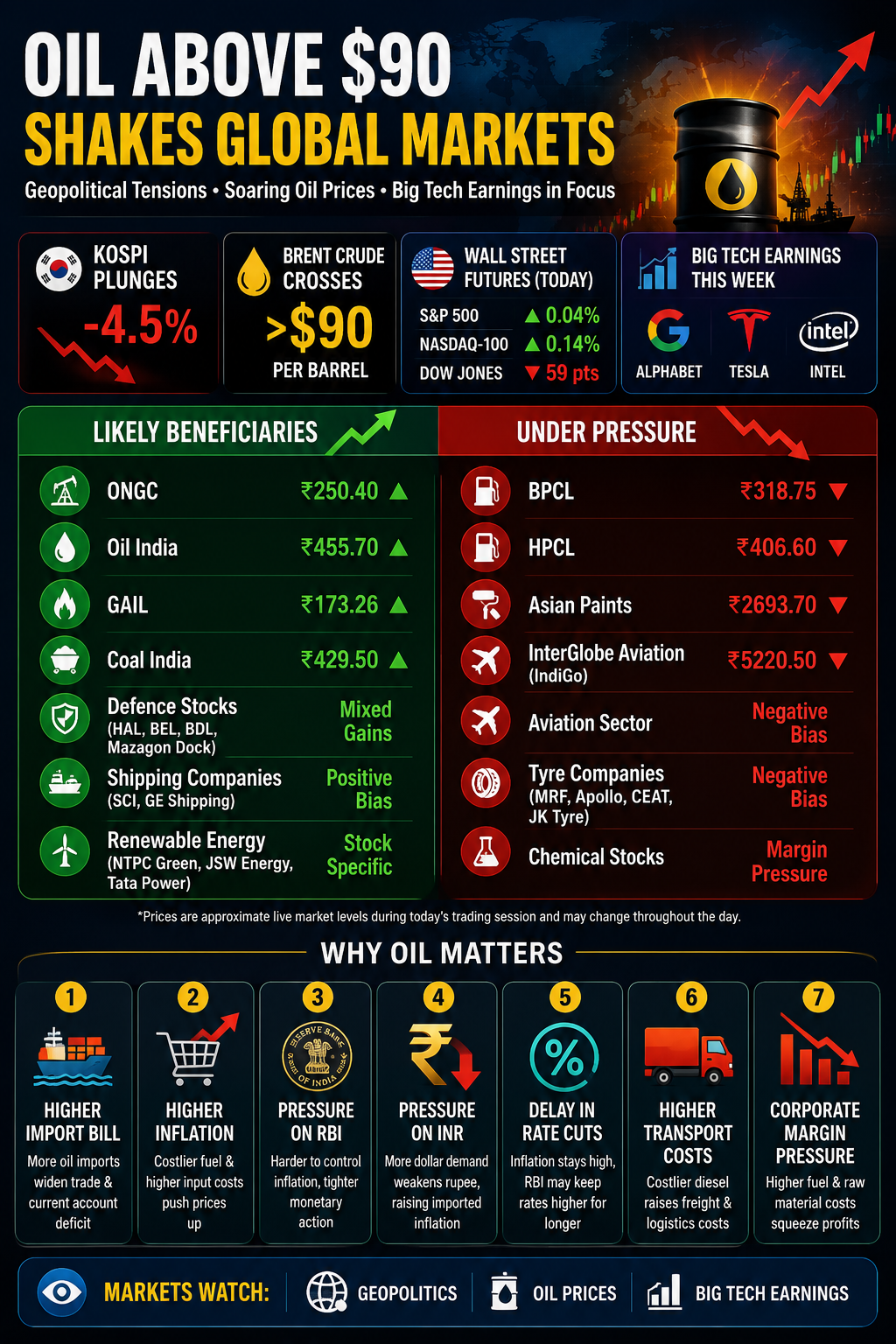
Brent crude crosses $90 after fresh U.S.-Iran escalation
The biggest trigger for Wall Street today was the sharp rise in oil prices.
Brent crude climbed above $90 per barrel, while WTI crude approached $85, after the U.S. military carried out another round of strikes against Iran.
The conflict has increased concerns over possible disruptions in the Strait of Hormuz, one of the world’s most important oil shipping routes.
Higher crude prices generally increase inflation risks and raise operating costs for businesses worldwide.
Read More : From 89,000 Containers to Just 11,592: How Afghanistan – Pakistan Trade Fell Apart
| Likely Beneficiaries | Current Price* | Under Pressure | Current Price* |
|---|---|---|---|
| ONGC | ₹250.40 | BPCL | ₹318.75 |
| Oil India | ₹455.70 | HPCL | ₹406.60 |
| GAIL | ₹173.26 | Asian Paints | ₹2693.70 |
| Coal India | ₹429.50 | InterGlobe Aviation (IndiGo) | ₹5220.50 |
| Defence Stocks (HAL, BEL, BDL, Mazagon Dock) | Mixed gains | Aviation Sector | Negative bias |
| Shipping Companies (SCI, GE Shipping) | Positive bias | Tyre Companies (MRF, Apollo, CEAT, JK Tyre) | Negative bias |
| Renewable Energy (NTPC Green, JSW Energy, Tata Power) | Stock-specific | Chemical Stocks | Margin pressure |
*Prices are approximate live market levels during today’s trading session and may change throughout the day.
Why these sectors react this way:
- Beneficiaries: Upstream oil producers like ONGC and Oil India realize higher crude prices. Defence stocks may gain amid geopolitical uncertainty, while shipping firms can benefit from higher freight rates.
- Under Pressure: Oil marketing companies (BPCL, HPCL), airlines (IndiGo), paint manufacturers (Asian Paints), tyre makers, and chemical companies face higher input and fuel costs, which can squeeze margins if they cannot pass on the increase to customers.
1. Higher Import Bill
India relies heavily on imported crude oil. As global oil prices rise, the country has to spend significantly more on the same quantity of oil, increasing the import bill and widening the current account deficit. Every sustained increase in crude prices puts additional pressure on India’s external finances.
2. Higher Inflation
Crude oil is a key input across the economy. Costlier crude raises petrol, diesel, LPG, and aviation fuel prices while increasing production costs for industries such as chemicals, paints, plastics, fertilizers, and consumer goods. Businesses eventually pass part of these higher costs to consumers, pushing inflation higher.
3. Pressure on the RBI
The Reserve Bank of India targets inflation at around 4%. Rising oil prices make controlling inflation more difficult and may require the RBI to intervene in currency markets or maintain tighter monetary conditions to preserve macroeconomic stability.
4. Pressure on the Indian Rupee (INR)
Oil imports are paid for in U.S. dollars. As crude prices climb, Indian refiners need more dollars to purchase oil, increasing demand for the U.S. currency and putting downward pressure on the rupee. A weaker rupee then makes all other imports more expensive, adding to imported inflation. Recent market moves have already seen the rupee weaken alongside rising oil prices.
5. Possible Delay in Interest Rate Cuts
If inflation remains elevated because of expensive crude oil, the RBI may postpone expected repo rate cuts. Higher interest rates for longer keep borrowing costs elevated for businesses and consumers, slowing investment, housing demand, and economic growth.
6. Higher Transportation and Logistics Costs
Diesel powers most of India’s trucking, freight, and logistics network. When fuel costs increase, transport companies raise freight charges, pushing up the prices of food, consumer goods, and industrial products across the country.
7. Corporate Margin Pressure
Higher crude prices increase raw material, fuel, and shipping costs, squeezing profit margins for oil-dependent industries such as airlines, oil marketing companies, paints, tyres, chemicals, and automobiles. Companies must either absorb these costs or pass them on to consumers, both of which can hurt earnings and demand.
Alphabet, Tesla and Intel earnings become the next market catalyst
The focus is now shifting from geopolitics to corporate earnings.
This week, investors will closely track results from:
- Alphabet
- Tesla
- Intel
These companies are expected to provide fresh updates on artificial intelligence investments, cloud demand, semiconductor recovery and consumer spending.
Because technology stocks have led much of this year’s rally, their earnings could decide the next move for Wall Street today.
Chip stocks remain under pressure
Semiconductor stocks continue to weaken after heavy selling over the past few weeks.
The VanEck Semiconductor ETF has fallen nearly 9% over the last month, marking its third weekly decline in four weeks.
Jonathan Krinsky, Chief Market Technician at BTIG, said:
“They could certainly bounce here in the short term, but we don’t yet see signs of the kind of washout that usually marks a durable bottom.”
His comments indicate that investors should remain cautious before expecting a sustained recovery in chip stocks.
Global markets react differently to rising uncertainty
Asian markets witnessed sharp volatility.
South Korea’s Kospi plunged 4.5%, while the Kosdaq dropped 5.3% as Samsung Electronics, SK Hynix and Hyundai Motor declined sharply.
The Korea Exchange even activated a temporary trading halt after the steep sell-off.
China, however, outperformed.
The CSI 300 gained 1.5%, while Hong Kong’s Hang Seng rose more than 2%. Alibaba shares advanced after unveiling its latest AI model, Qwen 3.8 Max, boosting optimism around China’s artificial intelligence sector.
European markets also opened cautiously, with investors balancing higher oil prices against political developments in the United Kingdom.
Company-specific news also influenced sentiment
Ryanair reported a 34% decline in quarterly profit as higher fuel costs and weaker travel demand hurt earnings.
The airline warned that European carriers could face a difficult winter if fuel prices remain elevated. Its shares fell nearly 6% after the announcement.
Meanwhile, China’s Zhongji Innolight gained after receiving approval for a major Hong Kong listing expected to attract strong investor interest.
Here’s what happened today and why traders reacted
Several major events shaped Wall Street today:
- Brent crude surged above $90 after fresh U.S.-Iran tensions.
- Investors turned cautious ahead of Alphabet, Tesla and Intel earnings.
- Semiconductor stocks remained under selling pressure.
- South Korean markets recorded one of their biggest declines this year.
- Alibaba’s AI announcement lifted Chinese technology shares.
- Ryanair’s weak earnings highlighted the impact of rising fuel costs.
These developments increased market volatility and encouraged investors to reduce risk exposure.