From 89,000 Containers to Just 11,592: How Afghanistan – Pakistan Trade Fell Apart
Afghanistan-Pakistan Transit Trade Crashes as Kabul Turns to Iran, Raising New Regional Questions
A trade corridor once worth billions of dollars is rapidly losing relevance. As Afghanistan increasingly reroutes its imports through Iran instead of Pakistan, the dramatic collapse in Afghanistan-Pakistan Transit Trade is reshaping regional trade dynamics, reducing Islamabad’s strategic influence and creating fresh economic challenges for Kabul.
Afghanistan – Pakistan trade fell records one of its steepest declines
The Afghanistan-Pakistan Transit Trade has declined sharply during FY26, highlighting a major shift in regional trade routes.
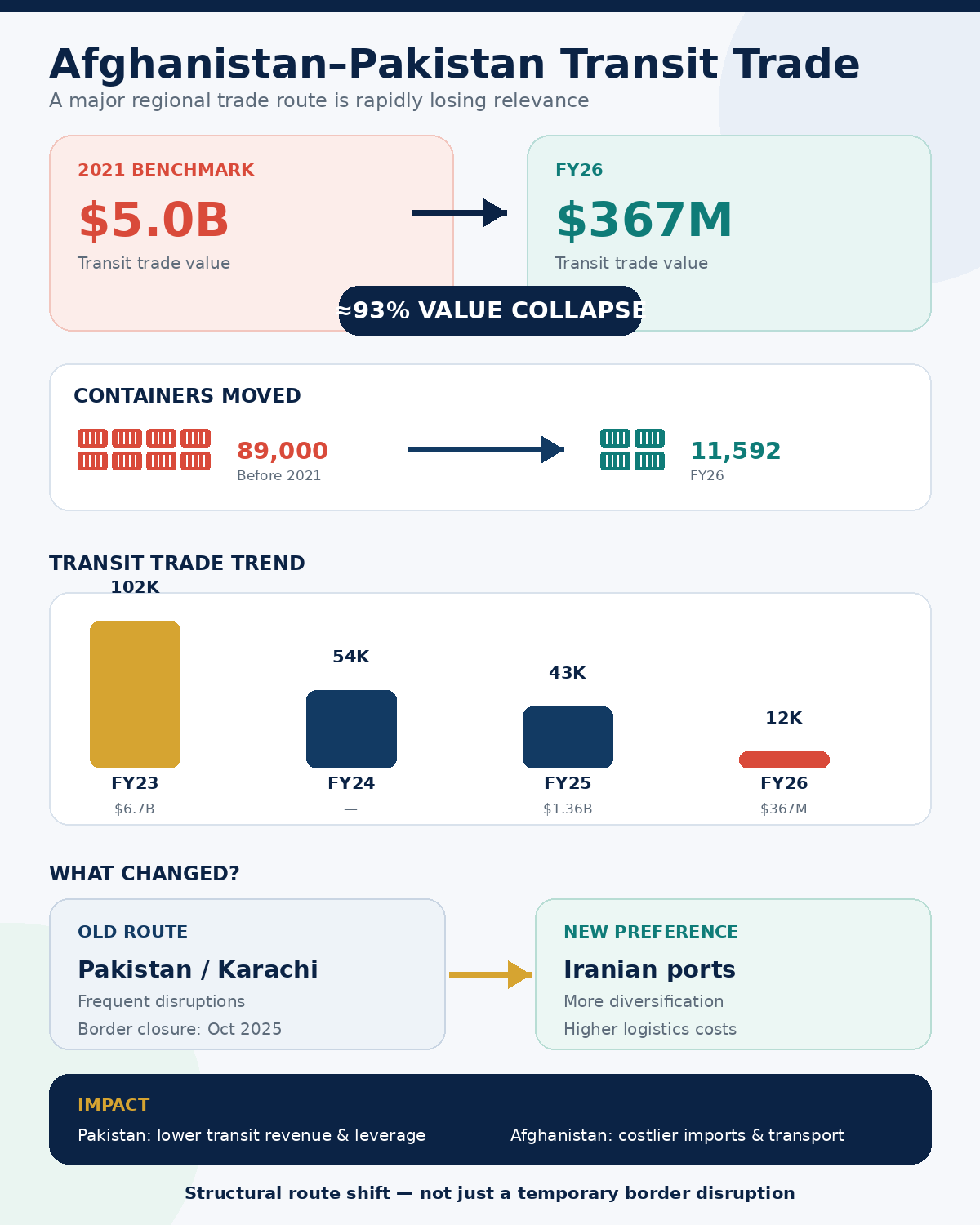
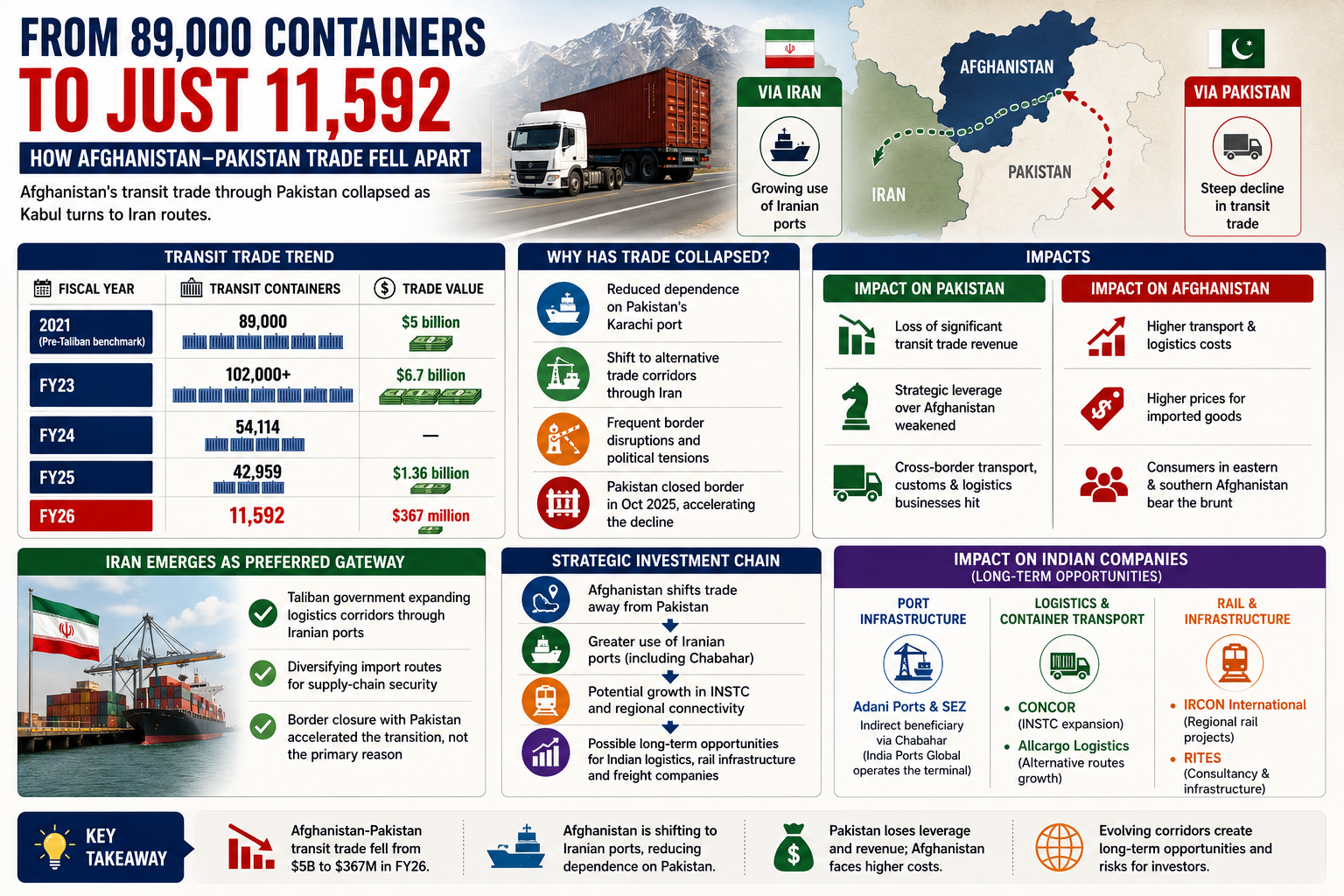
According to a Dawn report, transit trade fell to just USD 367 million during the outgoing fiscal year, compared with nearly USD 5 billion before the Taliban returned to power in 2021.
Transit volumes also dropped significantly to 11,592 containers, one of the steepest declines recorded in recent years.
Before 2021, nearly 89,000 containers moved through Pakistan under the transit trade arrangement, supporting billions of dollars in cross-border commerce.
Key Highlights
- Transit trade value: Fell from ~$5 billion (2021) to $367 million (FY26).
- Transit containers: Dropped to 11,592 in FY26 from nearly 89,000 before the Taliban returned to power.
- Peak activity: Trade had climbed to over 102,000 containers worth $6.7 billion in FY23 before entering a steep decline.
- FY24: 54,114 containers.
- FY25: 42,959 containers worth $1.36 billion.
- Pakistan closed its Afghanistan border in October 2025 over security concerns, accelerating an already ongoing decline.
Read More : Bank Q1 Results: PNB, Axis, Kotak Post Strong Profit Growth, But Margins Under Pressure
Why Has Trade Collapsed?
According to trade analysts, the decline began well before the border closure.
Major reasons include:
- Afghanistan has been reducing dependence on Pakistan’s Karachi port.
- The Taliban government has developed alternative trade corridors through Iran, including greater use of Iranian ports.
- Frequent border disruptions and political tensions made Pakistani routes less reliable.
- Pakistan’s border closure in late 2025 further accelerated the shift.
Trade slowdown began well before border closure
Although Pakistan closed its border with Afghanistan in October 2025 over security concerns, analysts say the decline had already started much earlier.
Trade data shows that transit volumes peaked in FY23 at more than 102,000 containers worth USD 6.7 billion.
Transit Trade Trend
| Fiscal Year | Transit Containers | Trade Value |
|---|---|---|
| 2021 (Pre-Taliban benchmark) | 89,000 | $5 billion |
| FY23 | 102,000+ | $6.7 billion |
| FY24 | 54,114 | — |
| FY25 | 42,959 | $1.36 billion |
| FY26 | 11,592 | $367 million |
Impact on Pakistan
- Pakistan has lost a significant portion of its transit trade revenue.
- Its strategic leverage over Afghan trade has weakened.
- Cross-border transport, customs, and logistics businesses have been adversely affected.
Impact on Afghanistan
While alternative routes have reduced dependence on Pakistan, they have also created new challenges:
- Higher transportation and logistics costs.
- Increased prices for imported goods.
- Consumers, especially in eastern and southern Afghanistan, face higher costs.
- Recent disruptions around Iran and the Strait of Hormuz have also exposed the risks of relying heavily on western routes.
Iran emerges as Afghanistan’s preferred trade gateway
Trade analysts quoted in the report said the Taliban administration has steadily expanded alternative logistics corridors through Iranian ports.
Rather than relying on Karachi and other Pakistani gateways, Afghanistan has increasingly diversified its import routes to improve supply-chain security and reduce geopolitical risks.
The border closure with Pakistan accelerated this transition, but it was not the primary reason behind the strategic shift.
Pakistan loses leverage while Afghanistan faces higher costs
The changing trade pattern carries consequences for both countries.
For Pakistan, declining Afghanistan-Pakistan Transit Trade reduces its long-standing strategic importance as Afghanistan’s principal gateway to international markets.
For Afghanistan, however, the shift comes at a cost.
Analysts say routing cargo through Iran has increased transportation and logistics expenses, resulting in higher prices for imported goods.
Those additional costs are ultimately being passed on to Afghan consumers.
Border communities face the biggest impact
The economic impact has been particularly severe in eastern and southern Afghanistan, where businesses and local communities have traditionally depended on cross-border trade with Pakistan.
Reduced commercial activity has disrupted supply chains and weakened local trade networks that had developed over decades.
While alternative routes improve long-term diversification, they may not fully replace the efficiency and proximity of Pakistan’s land corridors in the near term.
Impact on Indian Companies
Potential Long-Term Beneficiary Sectors
Port Infrastructure
- Adani Ports and Special Economic Zone
- India’s largest private port operator.
- India Ports Global (a government-backed entity), not Adani Ports, operates the Shahid Beheshti terminal at Chabahar under the current long-term agreement. Therefore, any benefit to Adani Ports would be indirect rather than from operating Chabahar itself.
Track Live : Nifty Open Interest (OI) Live
Logistics & Container Transport
- Container Corporation of India
- Well positioned if cargo volumes on the International North-South Transport Corridor (INSTC) expand.
- Allcargo Logistics
- Could benefit if alternative international shipping routes see sustained growth.
Rail & Infrastructure
- IRCON International
- Could participate if regional rail connectivity projects linked to Iran and Central Asia accelerate.
- RITES
- Potential beneficiary of consultancy and transport infrastructure opportunities.
Strategic Investment Chain
Afghanistan shifts trade away from Pakistan
⬇️
Greater use of Iranian ports (including Chabahar)
⬇️
Potential growth in INSTC and regional connectivity
⬇️
Possible long-term opportunities for Indian logistics, rail infrastructure and freight companies
Here’s what happened today and why traders reacted
Markets and trade observers focused on fresh data showing the sharp collapse in Afghanistan-Pakistan Transit Trade.
The report highlighted Afghanistan’s growing reliance on Iranian ports and confirmed a structural shift in regional trade patterns rather than a temporary disruption caused solely by border closures.
The development also underscores how geopolitical tensions are increasingly influencing supply chains across South and Central Asia.
What does this mean for investors and businesses?
The sharp decline in Afghanistan-Pakistan Transit Trade signals changing trade dynamics that could reshape logistics, infrastructure and regional connectivity over the coming years.
For Pakistan, lower transit volumes may reduce revenue from trade-related services and weaken its role as a regional transport hub.
For Afghanistan, greater reliance on Iranian ports improves route diversification but also increases logistics costs, potentially keeping import prices elevated.
Investors tracking logistics, port infrastructure, regional trade and cross-border transport should closely monitor future developments, as evolving trade corridors could create both new opportunities and fresh risks across the region.