
Rupee Sinks to 96.52, Weakest Since May, as Hormuz Fears Grip Markets
Will the rupee weaken further if oil prices keep rising? Here’s why currency traders are closely watching Brent crude, RBI intervention and the West Asia conflict.
The Rupee today remained under pressure as geopolitical tensions in West Asia pushed crude oil prices close to $90 per barrel, increasing concerns over India’s import bill and inflation outlook. Although the Reserve Bank of India (RBI) stepped in to limit losses, the domestic currency still ended at its weakest level in two months.
With crude oil, interest rate expectations and global risk sentiment moving together, investors are now watching whether the rupee can stabilize in the coming sessions.
Rupee today settles at a two-month low despite RBI intervention
The Rupee today closed at 96.4450 per US dollar, down nearly 0.2% from its previous close.
During the session, the currency weakened to 96.5250, its lowest level since mid-May, before recovering some losses in late trade.
According to market participants, the RBI sold US dollars through state-run banks, helping slow the rupee’s decline. A pullback in Brent crude prices during the afternoon also supported the currency before the close.
Read More : Paytm Board to Weigh Historic Bonus Share Move as 7.5 Lakh Investors Await Q1 Earnings
Key Market
- Rupee closed at: ₹96.4450/$
- Intraday low: ₹96.5250/$ (weakest since mid-May)
- Brent crude: Briefly crossed $90/barrel
- RBI intervened by selling dollars through state-run banks to limit the rupee’s fall.
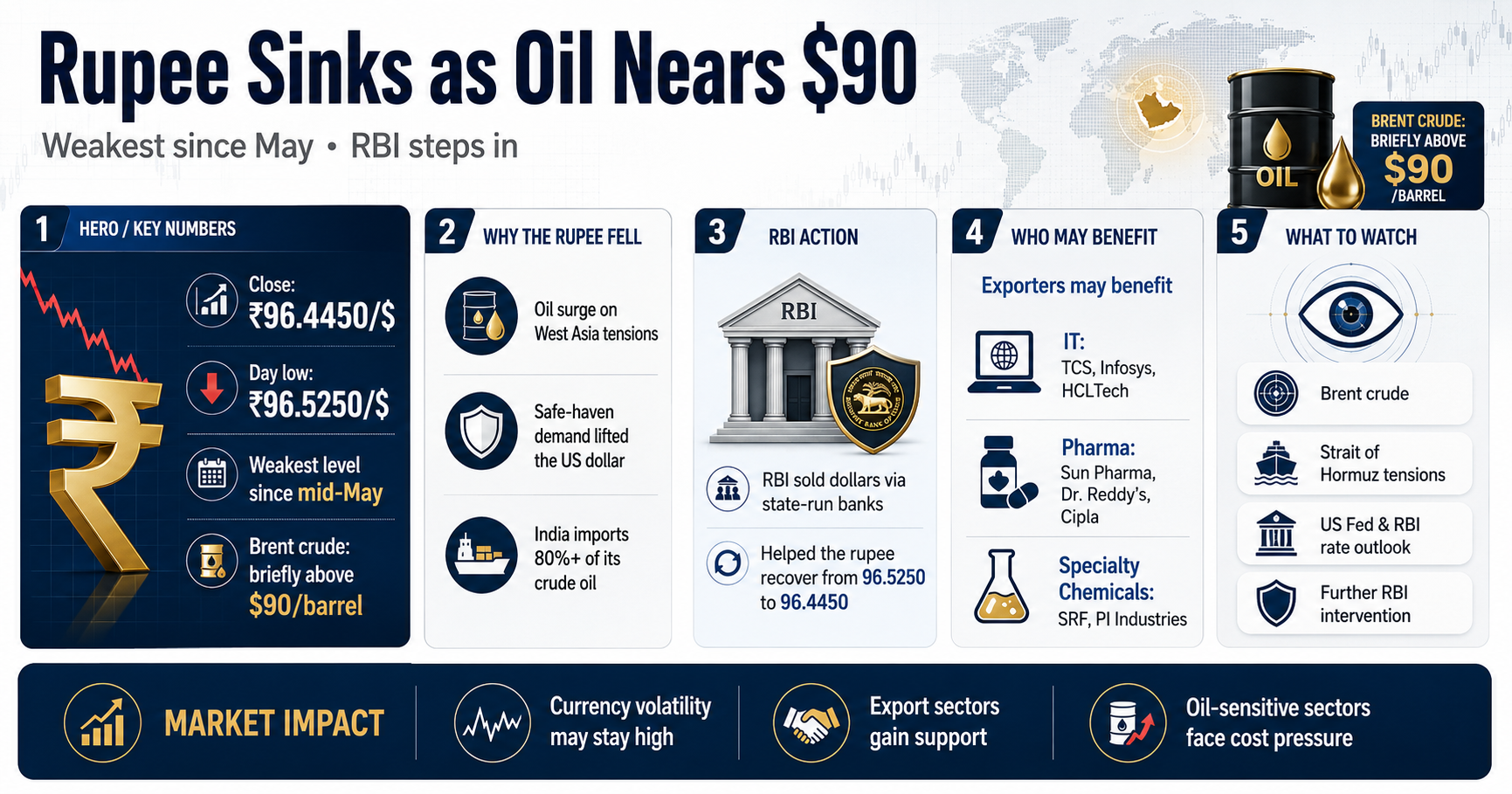
Brent crude near $90 keeps pressure on the rupee
The biggest reason behind the weakness in the Rupee today was the sharp rise in global crude oil prices.
Brent crude briefly traded above $90 per barrel after the United States continued military operations against Iran for the ninth consecutive day, raising concerns over oil supplies through the Strait of Hormuz.
Oil prices eased slightly after Iran indicated that negotiations with the United States could still continue if they aligned with national interests.
However, the market remains cautious after reports that two oil tankers were damaged near the strategic shipping route.
For India, which imports more than 80% of its crude oil requirements, higher oil prices directly increase the country’s import bill and put downward pressure on the rupee.
Global interest rate expectations add another challenge
Apart from rising oil prices, interest rate expectations also influenced the Rupee today.
The US Dollar Index remained largely stable around 100.7, while traders continued assessing future policy moves by the US Federal Reserve and the RBI.
Markets are currently pricing in nearly 36 basis points of additional rate hikes by the Federal Reserve over the next year.
In India, swap markets are expecting around 70 basis points of rate hikes by the RBI during the same period.
Analysts at ING said:
“Higher energy prices mean that the Federal Reserve will have to remain alert, and in this environment we struggle to see that any investors already owning dollars will be inclined to sell.”
The stronger dollar environment continues to put pressure on emerging market currencies, including the rupee.
Why Did the Rupee Fall?
1. Oil Prices Surged
Brent crude climbed above $90 per barrel after fresh U.S.-Iran hostilities raised concerns over oil supply disruptions through the Strait of Hormuz, one of the world’s busiest energy shipping routes. Higher crude prices increase India’s import bill, putting pressure on the rupee.
2. Safe-Haven Dollar Demand
Geopolitical uncertainty pushed investors toward the U.S. dollar. Analysts noted that elevated energy prices could keep the Federal Reserve cautious, supporting the dollar and weighing on emerging-market currencies like the rupee.
3. India’s Oil Dependence
India imports over 85% of its crude oil requirements, making the economy highly vulnerable to oil price spikes. Higher oil prices increase dollar demand from oil importers, weakening the rupee.
RBI Stepped In
The Reserve Bank of India sold dollars through state-run banks to prevent excessive volatility.
Without intervention:
- USD/INR could have moved even closer to its record high.
- RBI’s action helped the rupee recover from ₹96.5250 to ₹96.4450 by the close.
Indian Stocks That Could Benefit From a Weak Rupee
A weaker rupee generally benefits companies that earn a significant share of their revenue in U.S. dollars or other foreign currencies, as overseas earnings translate into more rupees. Export-oriented IT, pharmaceutical and specialty chemical companies are among the key beneficiaries.
Track Live : Nifty Open Interest (OI) Live
| Sector | Stock | Current Price* | Why It Benefits |
|---|---|---|---|
| IT Services | TCS | ₹2251.10 | Large share of revenue from overseas clients |
| Infosys | ₹1087.10 | Higher dollar revenue boosts margins | |
| HCLTech | ₹1221.30 | Strong export-oriented business | |
| Wipro | ₹176.38 | Dollar earnings translate into higher rupee revenue | |
| Tech Mahindra | ₹1576.40 | Global telecom & enterprise exposure | |
| Pharma Exporters | Sun Pharma | ₹227.51 | Strong U.S. and global pharmaceutical exports |
| Dr. Reddy’s | ₹1223.10 | Higher export realization | |
| Cipla | ₹1441.60 | Significant international sales | |
| Lupin | ₹2478.50 | U.S. formulations business | |
| Aurobindo Pharma | ₹1559.60 | Export-driven revenue | |
| Specialty Chemicals | SRF | ₹2871.70 | Global chemicals and refrigerant exports |
| PI Industries | ₹2657.40 | Export-focused agrochemicals | |
| Navin Fluorine | ₹7861.50 | Specialty fluorochemicals exports |
*Prices are approximate live market prices during today’s trading session and may change throughout the day.
Why These Stocks Benefit
- Higher export earnings when foreign currency revenue is converted into rupees.
- Better operating margins for companies with predominantly rupee-based costs and dollar-based income.
- Improved competitiveness in global markets due to a relatively weaker rupee.
- Potential earnings upgrades if the rupee remains weak over multiple quarters.
Note: While a weak rupee is generally positive for exporters, company-specific factors such as deal wins, demand trends, regulatory developments and management guidance remain key drivers of stock performance. Recent earnings showed mixed trends across the IT sector despite the currency tailwind.
What impact could this have on traders and investors?
For currency traders, volatility is likely to remain elevated as geopolitical developments and oil prices continue to influence the rupee.
For equity investors, a weaker rupee could benefit export-oriented sectors such as IT and pharmaceuticals, where companies earn a significant portion of their revenue in US dollars.
However, sectors that depend heavily on imported crude oil—including aviation, paints, chemicals, oil marketing companies and logistics—could face higher input costs if Brent crude remains near or above $90 per barrel.
For the broader market, sustained weakness in the Rupee today may increase imported inflation, widen India’s current account deficit and keep the RBI cautious on future monetary policy.
Investors will now closely watch oil prices, diplomatic developments in West Asia and RBI actions, as these factors are expected to determine the rupee’s direction over the coming days.