Key Takeaways
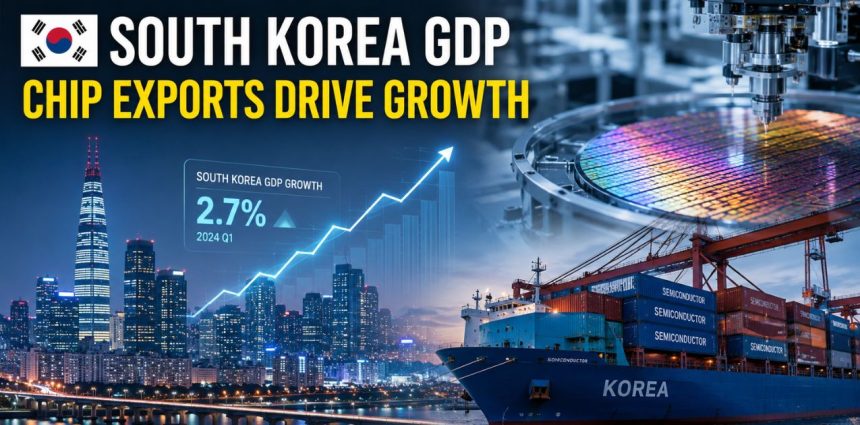
- South Korea’s GDP grew 0.6% QoQ (vs 0.4% est.) and 3.7% YoY in Q2 2026, led by semiconductor exports
- Exports rose 1.4% QoQ; construction investment fell 0.2% amid a weak property sector
- Samsung and SK Hynix are ramping HBM output for AI demand, backed by a combined ~$518 billion new-fab commitment announced in June
- BOK sees ~3% annual growth possible in 2026 if momentum holds; its 2.6% forecast is due for an August revision
- Reuters poll sees the BOK policy rate reaching 3.00% by end-2026 and 3.25% by Q1 2027 on elevated inflation
- India’s Semiconductor Mission has approved 12 projects worth ₹1.64 lakh crore; the Tata-PSMC Dholera fab targets first silicon by December 2026
- India’s GDP grew 7.7% in FY26; FY27 growth is seen at 6.4–6.8%, with the Q1 FY27 print due August 31, 2026
Why This Matters Today
- Strong global chip demand remains intact, powered by the AI memory (HBM) upcycle
- Positive read-through for semiconductor, EMS and electronics manufacturing stocks
- Reinforces the long-term case for India’s Semiconductor Mission and self-reliance push
- Keeps AI infrastructure spending, and its chip-demand knock-on effects, in focus through 2026
South Korea’s economy grew faster than expected in the second quarter of 2026, and the reason comes down to one industry: semiconductors. Chip exports offset a slump in construction investment, underscoring how central the AI-linked memory chip boom has become to global growth this year.
For India, which has already committed roughly ₹1.64 lakh crore to build its own semiconductor ecosystem, the South Korea GDP data offers a real-time signal of just how strong global chip demand remains.
South Korea Q2 GDP Data: Key Numbers
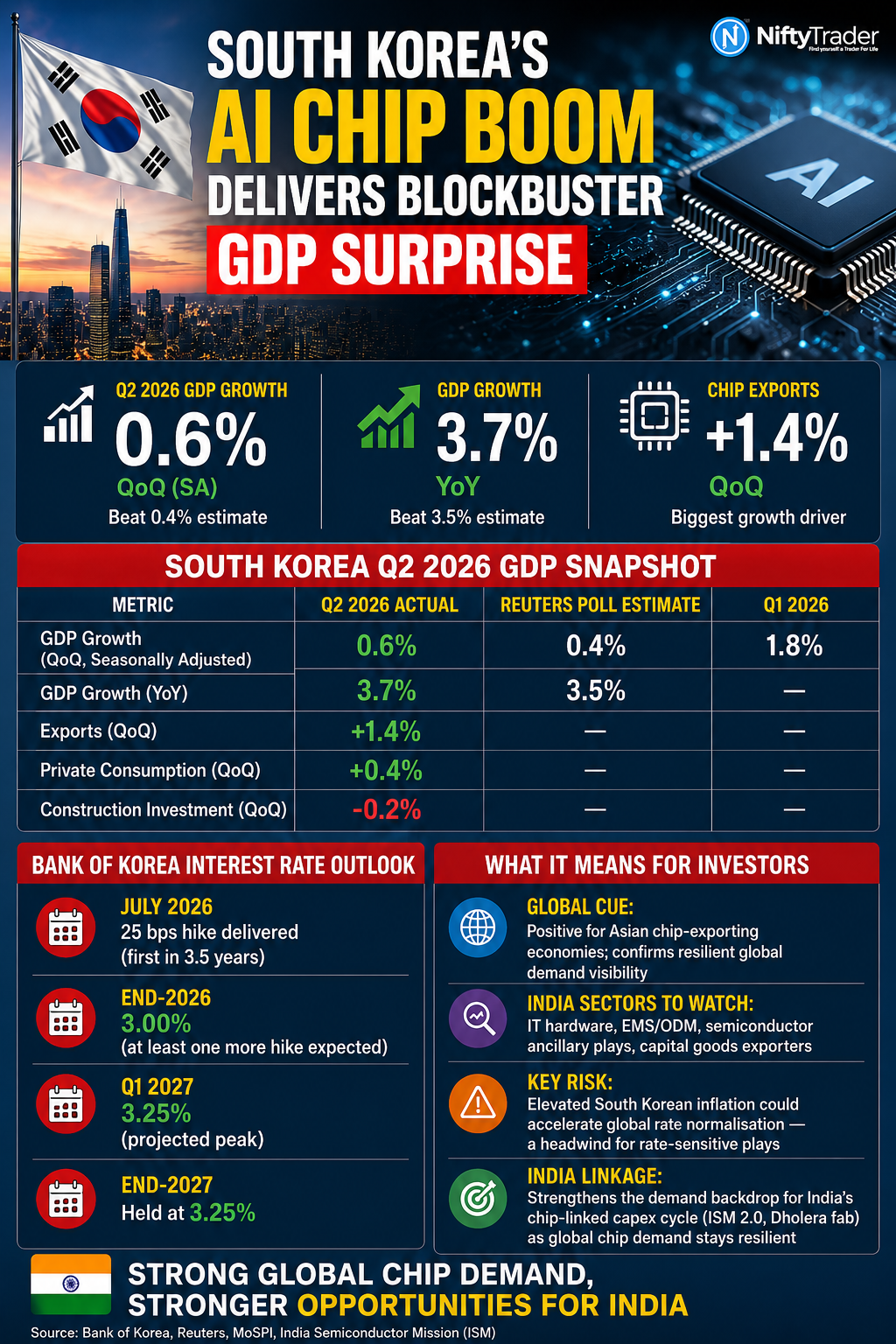
Advance estimates released by the Bank of Korea (BOK) on Thursday showed gross domestic product expanded 0.6% in the April-June quarter from the previous three months on a seasonally adjusted basis.
That was ahead of the 0.4% growth forecast by economists in a Reuters poll, though it marked a sharp deceleration from the 1.8% expansion recorded in the first quarter of 2026.
On a year-on-year basis, the South Korea GDP print came in at 3.7%, also beating the median estimate of 3.5%.
Exports rose 1.4% from the previous quarter, led by shipments of semiconductors, machinery and equipment. Private consumption increased 0.4%. Construction investment, however, declined 0.2%, reflecting persistent weakness in the domestic property sector.
BOK officials said at a post-release briefing that if quarterly growth stays above a modest threshold through the rest of the year, the economy could still achieve around 3% annual growth for 2026 — a scenario that would validate the central bank’s own upgraded forecast.
South Korea Q2 2026 GDP Snapshot
| Metric | Q2 2026 Actual | Reuters Estimate | Q1 2026 |
|---|---|---|---|
| GDP Growth (QoQ, Seasonally Adjusted) | 0.6% | 0.4% | 1.8% |
| GDP Growth (YoY) | 3.7% | 3.5% | — |
| Exports (QoQ) | +1.4% | — | — |
| Private Consumption (QoQ) | +0.4% | — | — |
| Construction Investment (QoQ) | -0.2% | — | — |
Source: Bank of Korea, Reuters
Semiconductors Power the Growth Engine
The headline number underlines a theme that has held through much of 2026: Korea’s chip exporters are doing the heavy lifting while domestic demand stays soft.
Strong global appetite for memory chips and AI-linked semiconductors has kept order books full at Samsung Electronics and SK Hynix, even as higher borrowing costs weigh on construction and consumer-facing sectors.
The Bank of Korea had raised its 2026 growth forecast to 2.6% back in May, and is expected to revise that outlook again in August.
Whether the central bank nudges the number higher will depend largely on whether the semiconductor export cycle, the same cycle now feeding India’s own component demand, holds through the second half of the year.
For a market like India that imports a large share of its semiconductor requirement, a resilient South Korea GDP trajectory is a reasonable proxy for how strong global chip demand remains heading into 2027.
AI Demand: The Force Behind the Chip Boom
The broader backdrop helps explain why South Korea’s chip exports have stayed this strong through 2026. Samsung Electronics and SK Hynix have been racing to scale up production of high-bandwidth memory chips used in AI servers and data centers, with SK Hynix established as a leading HBM supplier to Nvidia while Samsung invests to narrow the gap with its domestic rival.
In late June, the two companies committed a combined 800 trillion won, roughly $518 billion, toward new fabrication plants in southwestern South Korea, the centerpiece of a broader national AI and semiconductor push unveiled by President Lee Jae-myung.
That scale of investment underscores how central AI-linked memory demand has become to Korea’s export economy, the same engine behind this quarter’s South Korea GDP beat, and it is the same demand pool that Indian component makers, EMS players and chip-packaging units are increasingly trying to plug into as global supply chains diversify.
Bank of Korea Rate Hike Outlook
The stronger South Korea GDP print complicates the inflation picture. South Korea’s headline inflation is running at a two-and-a-half-year high, and the BOK has already delivered a 25-basis-point rate hike this month, its first increase in roughly three and a half years.
A majority of economists polled by Reuters expect at least one more rate hike before the end of 2026, taking the benchmark policy rate to 3.00%. The median forecast sees the rate rising further to 3.25% in the first quarter of 2027, where it is expected to hold through the rest of that year.
That combination of resilient growth plus a hawkish central bank is a pattern Indian market watchers have seen before, and one that typically keeps rate-sensitive sectors under pressure even as export-facing names outperform.
Bank of Korea Interest Rate Outlook
| Period | Policy Rate Outlook |
|---|---|
| July 2026 | 25 bps rate hike delivered (first hike in 3.5 years) |
| End-2026 | 3.00% (at least one more rate hike expected) |
| Q1 2027 | 3.25% (projected peak policy rate) |
| End-2027 | Expected to remain at 3.25% |
Source: Reuters Poll, Bank of Korea
Stock Market Impact: Chip and Export Stocks in Focus
The stronger-than-expected South Korea GDP print is likely to support sentiment toward South Korean semiconductor and export-oriented names, particularly Samsung Electronics and SK Hynix, given the data’s confirmation of resilient global chip demand. Industrial and capital goods stocks could also see a lift from the pickup in machinery exports.
Gains may be capped, though, by the prospect of further monetary tightening. Rate-sensitive sectors such as construction, real estate and domestic consumption plays face a tougher setup if the BOK follows through on additional hikes.
For Indian markets, the read-through is indirect but relevant: global semiconductor demand strength tends to flow through to IT hardware, electronics manufacturing services, and component-linked stocks that are increasingly part of India’s own export basket.
India Semiconductor Angle: What This Means for Indian Investors
South Korea’s chip-led GDP beat arrives at a moment when India is scaling up its own presence in the same supply chain. Under the India Semiconductor Mission, the government has approved 12 projects with a combined investment pipeline of approximately ₹1.64 lakh crore, spanning a semiconductor fabrication unit, compound semiconductor units and packaging facilities.
The flagship project, the Tata Electronics-PSMC fab in Dholera, Gujarat, carries a total investment of Rs 91,000 crore and is targeting first silicon by December 2026, covering the 28nm-110nm process range used in automotive chips, industrial microcontrollers and IoT devices.
On the macro side, India’s own growth momentum remains among the strongest globally: the economy expanded 7.7% in FY26, per provisional full-year data published by the Ministry of Statistics and Programme Implementation on June 5, 2026.
Growth is projected to moderate to a 6.4%-6.8% range in FY27, per a spread of estimates from the IMF, ADB, Deloitte and RBI published in July 2026, with the official Q1 FY27 GDP print due on August 31, 2026.
Put together, a resilient South Korea GDP number is less a direct trigger for Indian stocks and more a signal that the global semiconductor cycle, the one India is investing billions to plug into, still has legs.
Indian Companies in the Chip and Electronics Value Chain
Several India-listed companies sit at different points of the same value chain highlighted by the South Korea GDP print.
Tata Electronics is building India’s first advanced logic fab at Dholera, partnering with Taiwan’s PSMC. CG Power runs a semiconductor packaging joint venture with Japan’s Renesas, focused on automotive-grade chips.
Kaynes Technology is building its own assembly and packaging facility in Sanand, Gujarat, alongside its existing electronics manufacturing business.
Dixon Technologies is India’s largest listed electronics manufacturing services company, and Syrma SGS Technology manufactures semiconductor modules and precision electronics, both positioned to benefit as India’s chip ecosystem matures.
MosChip Technologies operates further upstream, focused on ASIC and chip-design services.
These names span fabrication, packaging, design and assembly, not investment recommendations, but useful context for tracking how India’s semiconductor buildout is being expressed on Indian exchanges.
South Korea vs India: The Chip Story
| Aspect | South Korea | India |
|---|---|---|
| Global Position | Established global leader in memory semiconductors (DRAM & NAND) | Emerging semiconductor manufacturing hub focused on fabrication and packaging |
| Key Companies | Samsung Electronics, SK Hynix | Tata Electronics, Dixon Technologies, Kaynes Technology, CG Power, Syrma SGS Technology, MosChip Technologies |
| Government Support | Decades of industrial policy and a mature semiconductor ecosystem | India Semiconductor Mission (ISM) with fiscal support of up to 50% for eligible projects |
| Manufacturing Stage | Advanced-node, high-volume chip fabrication | Chip packaging underway; first commercial fab at Dholera targets initial silicon by December 2026 |
| Recent Economic Growth | GDP: 3.7% YoY (Q2 2026) | GDP: 7.7% (FY26); FY27 growth estimated at 6.4%–6.8% |
Source: Bank of Korea, Ministry of Statistics and Programme Implementation (MoSPI), India Semiconductor Mission (ISM), Reuters
What to Watch Next
- Bank of Korea’s revised 2026 growth forecast, due in August
- Samsung Electronics and SK Hynix Q2 earnings for confirmation of chip demand strength
- Progress on India’s Semiconductor Mission projects, including the Tata-PSMC Dholera fab’s first-silicon milestone (targeted December 2026)
- India’s official Q1 FY27 GDP print, due August 31, 2026
- Any further BOK rate action as South Korean inflation stays elevated
NiftyTrader Desk View
| Aspect | Assessment |
|---|---|
| Global Market Cue | Positive for Asian semiconductor-exporting economies, reinforcing resilient global demand for AI and advanced chips. |
| India-Linked Sectors to Watch | IT hardware, Electronics Manufacturing Services (EMS), Original Design Manufacturing (ODM), semiconductor ecosystem players, and capital goods exporters. |
| Key Risk | Persistent inflation in South Korea could prompt additional interest rate hikes, potentially creating headwinds for interest rate-sensitive sectors globally. |
| India Outlook | Reinforces the long-term investment case for India’s semiconductor ecosystem, including the India Semiconductor Mission (ISM) and the upcoming Dholera semiconductor fabrication plant, as global chip demand remains strong. |
Source: Reuters, Bank of Korea, India Semiconductor Mission (ISM)
Track how FIIs and DIIs are positioning around global cues like this one — check live flow data on NiftyTrader’s FII-DII Dashboard.
Disclaimer: This article is for informational purposes only and should not be construed as investment advice. Investments in the securities market are subject to market risks. Please consult a SEBI-registered investment advisor before making any investment decisions. NiftyTrader does not guarantee the accuracy, completeness, or timeliness of the third-party data referenced above. Company names mentioned are for informational context only and are not stock recommendations.