Need to Know
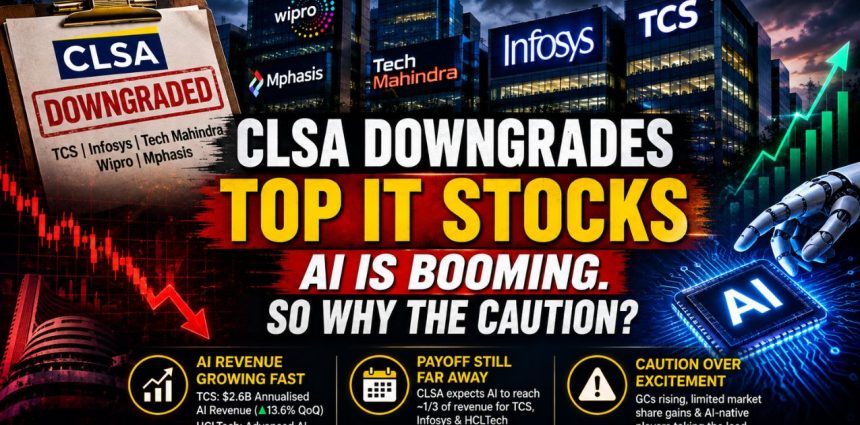
CLSA downgraded TCS, Infosys and Tech Mahindra to Hold from Outperform, and cut Wipro and Mphasis to Underperform from Hold, in a note dated Wednesday, August 19.
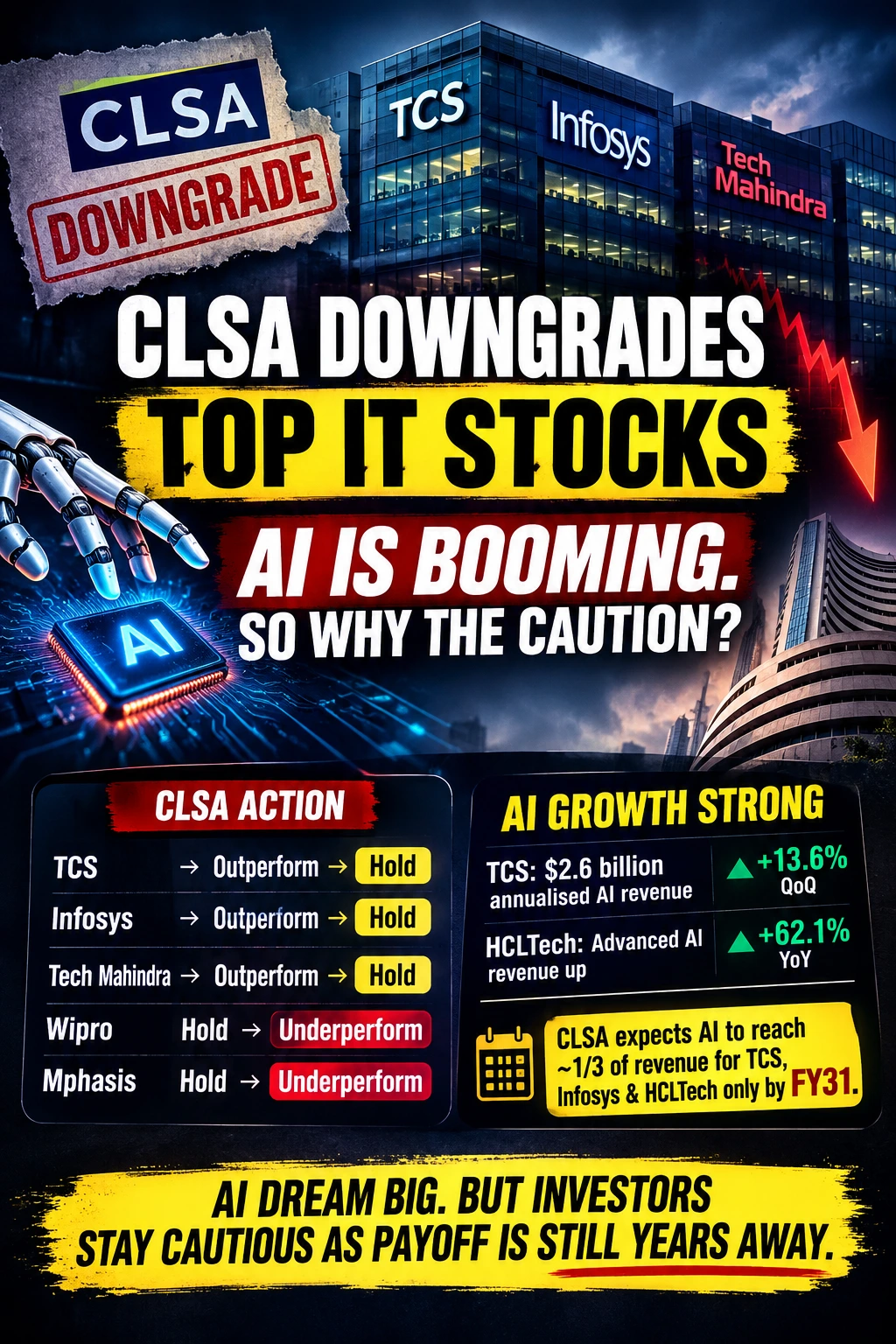
The call lands even as TCS discloses $2.6 billion in annualised AI revenue, up 13.6% sequentially, and HCLTech’s Advanced AI revenue grows 62.1% YoY to $171 million — CLSA’s caution is about the pace of the payoff, not whether the AI opportunity is real.
CLSA still raised its TCS target to ₹2,326 and Infosys target to ₹1,147, but both stocks have already rallied close to those levels, leaving just 1–3% upside — why they land in Hold rather than Sell.
Wipro and Mphasis face the sharpest downside on CLSA’s own math: roughly 15% and 14.5% respectively from Tuesday’s close.
CLSA kept High Conviction Outperform on Persistent Systems and Coforge, and Outperform on Hexaware and LTIMindtree, implying 13–30% upside, the widest spread in the note. Coforge separately disclosed that 86% of its Q1 revenue came from AI-led engineering, data and integration, and cloud services, a notably high AI-linked mix for an Indian IT services company.
CLSA doesn’t expect AI to reach a third of TCS, Infosys and HCLTech’s revenue until FY31, meaning largecap growth stays muted for several more years even as AI bookings accelerate.
TCS’s AI business is now at a $2.6 billion annualised run rate, up 13.6% sequentially. HCLTech’s Advanced AI revenue has jumped 62.1% YoY. Yet CLSA has downgraded TCS, Infosys and Tech Mahindra, and turned even more cautious on Wipro and Mphasis.
The contradiction is the real story: AI demand is growing rapidly, but CLSA doubts that growth will translate into broad-based revenue acceleration quickly enough.
What CLSA Changed
In a note dated Wednesday, August 19, CLSA cut TCS, Infosys and Tech Mahindra to Hold from Outperform, and pushed Wipro and Mphasis further down, to Underperform from Hold.
The brokerage flagged three structural pressures on Indian IT: the rise of Global Capability Centres as clients build in-house teams instead of outsourcing, limited market-share gains against global peers, and AI-native software and hardware players capturing spend that used to flow to services vendors.
| Stock | New Rating | Old Rating | New Target (₹) | Old Target (₹) |
|---|---|---|---|---|
| TCS | Hold | Outperform | 2,326 | 2,165 |
| Infosys | Hold | Outperform | 1,147 | 1,109 |
| Tech Mahindra | Hold | Outperform | 1,634 | 1,634 (unch.) |
| Wipro | Underperform | Hold | 152 | 157 |
| Mphasis | Underperform | Hold | 2,113 | 2,113 (unch.) |
| Persistent Systems | High Conviction Outperform | — | 6,246 | 6,166 |
| Coforge | High Conviction Outperform | — | 2,170 | 2,170 (unch.) |
| Hexaware | Outperform | — | 730 | 727 |
| LTIMindtree | Outperform | — | 5,534 | 4,570 |
The Real Story: What CLSA’s Own Targets Imply
CLSA raised targets on five of the nine stocks, including TCS and Infosys, two of the three largecaps it just downgraded. That’s not a contradiction; it reflects how far the stocks have already run.
Based on August 18 closing prices and CLSA’s revised targets, NiftyTrader’s calculation, not published in the brokerage note itself, gives a cleaner read on where real value sits.
| Stock | CMP (Aug 18 close) | CLSA Target | Implied Upside/Downside |
|---|---|---|---|
| TCS | ₹2,296.20 | ₹2,326 | +1.3% |
| Infosys | ₹1,121.50 | ₹1,147 | +2.3% |
| Tech Mahindra | ₹1,592.80 | ₹1,634 | +2.6% |
| Wipro | ₹179.73 | ₹152 | -15.4% |
| Mphasis | ₹2,472.70 | ₹2,113 | -14.5% |
| Persistent Systems | ₹5,522.50 | ₹6,246 | +13.1% |
| Coforge | ₹1,784.90 | ₹2,170 | +21.6% |
| Hexaware | ₹561 | ₹730 | +30.1% |
| LTIMindtree | ₹4,660 | ₹5,534 | +18.8% |
The largecap Hold calls barely clear 1–3% upside, technically bullish, not worth chasing here. Wipro and Mphasis are the only two names CLSA sees falling further. The real gap opens on the midcap side, where Hexaware’s target implies over 30% upside and Coforge’s implies close to 22%.
The AI Paradox: Growth Is Already Showing Up
This is where CLSA’s caution gets harder to square with the numbers largecap IT is actually reporting.
TCS’s Q1 FY27 results, verified against its official press release, show annualised AI revenue of $2.6 billion, up 13.6% sequentially, on total quarterly deal bookings (TCV) of $9.5 billion that included an $800 million AI-led transformation deal with SKF.
HCLTech’s Q1 FY27 filing shows Advanced AI revenue up 62.1% YoY to $171 million, alongside plans to invest up to ₹3,500 crore in AI data centres.
Coforge doesn’t publish a standalone dollar-value “AI revenue” line, but CEO Sudhir Singh told the company’s Q1 FY27 earnings call that AI-led engineering, data and integration, and cloud services account for 86% of the firm’s revenue, alongside a next-12-month signed order book of $2.23 billion, up 44% YoY.
| Company | Reported AI-Linked Metric (Q1 FY27) | Growth | Additional Context |
|---|---|---|---|
| TCS | $2.6 Bn annualised AI revenue | +13.6% QoQ | $9.5 Bn TCV, incl. $800M SKF deal |
| HCLTech | $171 Mn Advanced AI revenue | +62.1% YoY | ₹3,500 cr planned AI data centre capex |
| Coforge | 86% of revenue from AI-led engineering, data & integration, and cloud services | — | $2.23 Bn order book, +44% YoY |
That is the paradox investors need to watch: the fastest-growing AI businesses may not necessarily be the ones delivering the fastest total-revenue growth, because AI can simultaneously create new workloads and reduce the amount clients pay for existing work.
Why CLSA Still Sees a Multi-Year Wait
If AI revenue is growing this fast, why is CLSA still cautious on the stocks generating it? Because AI-linked productivity gains can work against IT services’ traditional billing model.
If clients get the same output for fewer billed hours, revenue growth can lag deal-value growth even as AI adoption climbs, an effect CLSA expects to keep offsetting new AI revenue for years.
| Company | FY27 AI Revenue Share | FY31E AI Revenue Share | FY27E Growth | FY31E Growth |
|---|---|---|---|---|
| TCS | 10% | 33% | 2.5% | 6.1% |
| Infosys | 9% | 32% | 1.9% | 5.6% |
| HCLTech | 6% | 31% | 2.8% | 6.4% |
Even after AI scales to roughly a third of revenue, CLSA still pegs FY31 growth for these three at just 5.6–6.4%, a level that would have counted as a soft quarter a decade ago. That’s the crux of the largecap downgrade: not that the AI business is failing, but that the re-rating catalyst is still years out even as headline AI numbers look strong today.
Where CLSA Still Sees Upside: Midcap IT
Coforge and Persistent retain CLSA’s highest-conviction rating in the sector, alongside fresh Outperform tags on Hexaware and LTIMindtree. All four carry double-digit implied upside on CLSA’s own math.
The common thread: a leaner base of legacy managed-services revenue lets these vendors pivot faster into AI-linked digital engineering, cloud and platform work, visible in Coforge’s 86% AI-linked revenue mix, without unwinding as large a back-book of low-margin contracts, the same legacy exposure CLSA says is weighing on TCS, Infosys and HCLTech’s growth math above.
CLSA’s Call Lands After Two Sessions of IT Selling
Nifty IT closed down 1.75% on Monday, August 17, at 30,807.80, then fell a further 1.93% on Tuesday, August 18, to settle at 30,213.45.
Infosys featured among the top decliners on both sessions, joined by HCL Technologies and TCS on Monday, and by Mphasis and LTIMindtree on Tuesday. Dealers cited profit-booking after the index’s roughly 24% rally to its August 11 high, alongside elevated crude prices and unresolved US-Iran geopolitical risk.
The brokerage call therefore arrives after two sessions of weakness in the IT index, making the market’s reaction to the downgrade particularly important, and the same note stays constructive on the midcap pack even as it turns cautious on the largecaps.
What Would Prove CLSA Wrong
CLSA’s own numbers leave room for this call to age badly in either direction. If enterprises move from AI pilots to production-scale deployment faster than expected, TCS’s $9.5 billion Q1 TCV and 13.6% sequential AI-revenue growth could translate into billed revenue well ahead of CLSA’s FY31 timeline, a re-rating catalyst arriving years early. HCLTech’s 62.1% YoY jump in Advanced AI revenue points the same direction.
But the downside scenario is just as real: if clients capture more of the AI productivity gain through lower pricing than new AI-linked work replaces, the growth drag CLSA is pricing in could stretch even longer than FY31.
Five numbers will likely settle which scenario plays out over the next few quarters: how fast AI revenue actually scales quarter to quarter, whether large AI deal TCVs convert into billed revenue on schedule, whether productivity savings get passed to clients as price cuts, how quickly legacy managed-services revenue shrinks, and whether margins hold up as AI reshapes the delivery model.
Investors tracking TCS on NiftyTrader and Infosys on NiftyTrader through Q1 FY27 earnings season will get the first real read on all five.
Read Next: Crude, Yields Pressure Nifty: 10 Stocks With Fresh Triggers Today
FAQs
Which IT stocks did CLSA downgrade on August 19, 2026?
CLSA downgraded TCS, Infosys and Tech Mahindra to Hold from Outperform, and Wipro and Mphasis to Underperform from Hold.
Why is CLSA downgrading TCS and Infosys even as their AI revenue is growing fast?
Because AI-linked productivity gains can offset billed-revenue growth in the near term, and CLSA doesn’t expect AI to reach a third of these companies’ revenue until FY31 — the stocks have also already rallied close to CLSA’s price targets, capping near-term upside.
What is CLSA’s new target price for TCS and Infosys?
CLSA raised its TCS target to ₹2,326 from ₹2,165, and its Infosys target to ₹1,147 from ₹1,109.
Which IT stocks does CLSA prefer among midcaps?
CLSA holds High Conviction Outperform on Persistent Systems and Coforge, and Outperform on Hexaware and LTIMindtree, with targets implying 13–30% upside.
How much did Nifty IT fall on August 17 and 18?
Nifty IT fell 1.75% on Monday, August 17, and a further 1.93% on Tuesday, August 18, closing at 30,213.45.
Disclaimer: This article is for informational purposes only and does not constitute investment advice. Stock market investments are subject to market risks. Please consult a registered financial advisor before making investment decisions. Brokerage price targets are estimates based on the issuing firm’s own models and are not guarantees of future performance.