
Persistent Systems’ board has cleared a plan to raise up to $1.25 billion through debt and equity-linked instruments, a move that lands barely two months after the IT firm took on a Barclays-arranged bridge loan to fund its biggest-ever acquisition. The approval, cleared at a board meeting on September 2, puts Persistent Systems shares back in focus on Thursday, with investors now watching how the company splits the raise between debt and equity and what it signals about the financing plan behind the Nagarro buyout.
NEED TO KNOW
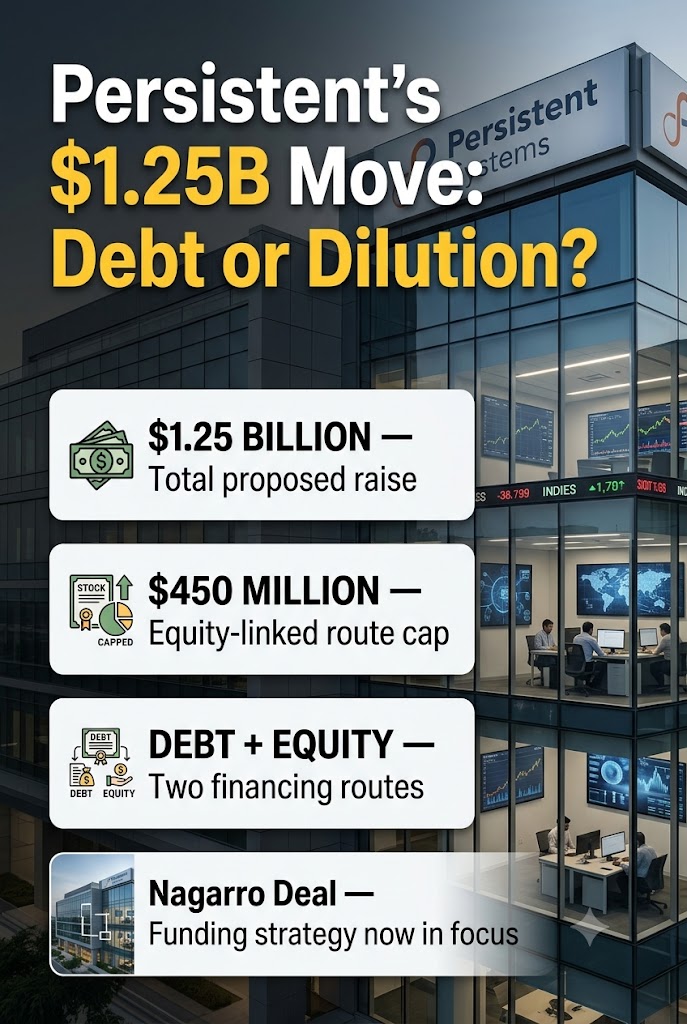
- Persistent Systems’ board approved raising up to $1.25 billion via debt (ECBs, NCDs) and equity-linked instruments on September 2, with the equity-linked portion capped at $450 million.
- Directors also amended Article 12 of the Articles of Association (“Further Issue of Shares”), the legal mechanism that would let the equity-linked route actually happen.
- The move comes about two months after Persistent’s €1.4 billion Barclays bridge loan for its €1.27 billion Nagarro SE acquisition, which carries an 18-month repayment term.
- Q1 FY27 revenue rose 16.1% YoY to $452.4 million on record $1.15 billion bookings, but profit fell 8.7% sequentially on a ₹105 crore forex loss.
- The stock closed near ₹5,690 on September 2 (market cap ~₹89,760 crore), up nearly 20% over six months but down about 9% for CY2026 so far.
Check Live: PERSISTENT SYSTEMS Options Chart | Nifty Trader
WHAT THE BOARD ACTUALLY APPROVED
Persistent Systems’ board approved raising funds through long-term debt instruments, including External Commercial Borrowings (ECBs) and Non-Convertible Debentures (NCDs), and, separately, through equity-linked instruments such as equity shares, convertible securities, Foreign Currency Convertible Bonds (FCCBs), a Preferential Issue, or a Qualified Institutional Placement (QIP).
Importantly, the two routes are not additive. The combined amount raised through debt and equity-linked instruments will not exceed $1.25 billion (roughly ₹11,000 crore at current exchange rates), of which up to $450 million (nearly ₹4,000 crore) can come through the equity-linked route.
The proposal now needs shareholder and regulatory approval before Persistent can actually draw down funds.
According to the exchange filing, the board meeting itself ran from 7:45 PM to 9:58 PM IST on September 2.
Alongside the fundraise, directors also cleared an amendment to Article 12 of the company’s Articles of Association, governing the “Further Issue of Shares” — a change that, once ratified by shareholders, is what would actually give Persistent Systems the legal room to issue fresh equity or convertible instruments if it opts for that route over pure debt.
Fundraise structure at a glance:
| Route | Instruments | Cap | Approval status |
|---|---|---|---|
| Debt | ECBs, NCDs, other long-term instruments | Within $1.25 bn combined cap | Board-approved; regulatory approval pending |
| Equity-linked | Equity shares, convertible securities, FCCBs, Preferential Issue, QIP | Up to $450 million | Board-approved; shareholder + regulatory approval pending |
Also Check: PERSISTENT SYSTEMS Ltd Futures—Live Price, OI & Basis
WHY THE TIMING MATTERS: THE NAGARRO CONNECTION
This isn’t happening in isolation. In late June, Persistent Systems’ board approved a €1.27 billion (roughly $1.45 billion) all-cash offer to acquire Munich-based digital engineering firm Nagarro SE at €81 a share, a nearly 140% premium to Nagarro’s undisturbed price.
That deal is being funded entirely through debt: a €1.4 billion bridge financing facility led by Barclays, carrying an 18-month term, backed by a Persistent corporate guarantee of up to €1.54 billion.
The deal came at a striking valuation gap. Persistent is effectively paying around 19 times Nagarro’s estimated CY2026 earnings, well below its own roughly 29-times multiple, after Nagarro’s stock had already fallen 46% since the start of 2026, twice Persistent’s own decline over the same stretch.
The market’s initial verdict was split: Persistent Systems shares fell as much as 10% intraday to a 52-week low of ₹4,312 on the day the deal was announced, even as Nagarro’s Frankfurt-listed stock surged roughly 90%, a sign investors were more worried about Persistent overpaying and gearing up its balance sheet than excited about the strategic logic.
The deal also landed at an already rough moment for the sector, the Nifty IT index was 2026’s worst-performing sector gauge at the time, having shed close to $26 billion in market value in a single week after TCS and Infosys results disappointed and stoked fears that agentic AI could disrupt the broader $315 billion Indian IT services industry.
An 18-month bridge loan is, by design, temporary financing. It typically needs to be repaid or refinanced with longer-term debt or equity well before it matures, and as of early July, analysts had flagged that Persistent had not yet disclosed a long-term plan for taking out that bridge facility.
Thursday’s board approval doesn’t explicitly say it’s a Nagarro refinancing, but the timing, structure (long-term debt plus an equity option), and scale all line up with what a company typically does after signing a large bridge-financed acquisition: lock in cheaper, longer-duration capital before the bridge loan’s clock runs out.
The Nagarro deal itself is expected to close in Q4 CY2026 or Q1 CY2027, creating a combined entity with an annualised revenue run rate of about $2.9 billion and over 46,000 employees, which would make it the world’s second-largest digital engineering company by revenue.
Q1 FY27 SCORECARD: RECORD BOOKINGS, FOREX-HIT PROFIT
The fundraise call comes right after Persistent Systems posted its June-quarter results, which showed strong momentum on the top line but a sequential profit dip.
| Metric (consolidated) | Q1 FY27 (Apr–Jun 2026) | Q1 FY26 (Apr–Jun 2025) | Change |
|---|---|---|---|
| Revenue | ₹4,303.23 crore | ₹3,333.59 crore | +29% YoY |
| Revenue (USD) | $452.4 million | — | +16.1% YoY, +3.8% QoQ |
| Net profit (PAT) | ₹483.04 crore | ₹424.93 crore | +13.67% YoY, -8.7% QoQ |
| Order bookings (TCV) | $1,146.2 million | — | Highest-ever quarterly TCV |
| Order bookings (ACV) | $536.8 million | — | — |
| Employees | 28,640 | 25,340 | +13% YoY |
Revenue marked Persistent Systems’ 25th straight quarter of sequential growth, CEO Sandeep Kalra noted, helped by a record $1.15 billion in quarterly order bookings, including a 6.5-year strategic services agreement worth more than $650 million with a large global technology client. EBIT grew 32.7% year-on-year, with margins improving to 16%.
The profit story was more mixed. Net profit rose nearly 14% from a year earlier, but fell 8.7% sequentially, largely due to a disclosed ₹105 crore foreign-exchange loss during the quarter.
Cash conversion also softened: billed days sales outstanding (DSO) rose from 53 to 61 days, and utilisation (including trainees) slipped from 88% to 86.5%, both metrics worth tracking as the Nagarro integration approaches.
Also Read: Persistent Systems Q1 FY27 on Aug 3: Will Nagarro Deal Overshadow?
STOCK PRICE AND VALUATION CHECK
Persistent Systems stock has been choppy heading into the announcement. Shares slipped over 3% intraday on August 31 as the market priced in the prospect of dilution ahead of the board meeting, before closing near ₹5,690 apiece on September 2, taking the company’s market capitalisation to roughly ₹89,760 crore.
Even after the recent pullback, Persistent Systems stock is still up close to 20% over the past six months, although it remains down about 9% for calendar year 2026 so far.
It trades within a 52-week range of ₹4,244.50 to ₹6,599, at a price-to-earnings multiple of around 54x, a beta of 0.92, and an RSI near 69, just short of overbought territory.
WHAT THIS MEANS FOR INVESTORS
Three things are worth watching from here.
First, the debt-versus-equity split: a heavier tilt toward NCDs and ECBs would keep the balance sheet debt-funded without diluting shareholders, while leaning on the $450 million equity-linked window (via QIP, preferential issue, or FCCBs) would raise near-term dilution risk for existing holders, including the mutual funds that own about 21% of the company.
Second, the cost of capital: Persistent’s bridge loan for Nagarro reportedly carries interest in the 4.1–4.8% range, and where the new long-term debt prices relative to that will shape FY27 interest costs and, by extension, EPS.
Third, the read-through for the broader sector: Persistent joins Coforge and Cognizant in leaning on debt to fund acquisitions rather than the traditionally debt-light model Indian IT majors have favoured, a shift worth tracking across the Nifty IT pack as more mid-cap IT firms chase inorganic growth.
The shareholder meeting and instrument-level details, once disclosed, will likely be the next trigger for stock movement, alongside any update on Nagarro’s regulatory clearances in Germany.
Read Next: 3 Sep Stocks to Watch: ICICI Bank’s ₹1,470-Cr Deal, SAIL Stake Cut, Meesho Block in Focus
FREQUENTLY ASKED QUESTIONS
1. How much has Persistent Systems’ board approved raising, and through what instruments?
Persistent Systems’ board approved up to $1.25 billion combined through long-term debt (ECBs, NCDs, and other instruments) and equity-linked instruments (equity shares, convertible securities, FCCBs, Preferential Issue, QIP), with the equity-linked portion capped at $450 million.
2. Is this fundraise linked to the Nagarro acquisition?
The company hasn’t explicitly stated so, but the timing follows Persistent’s €1.4 billion Barclays bridge loan for the Nagarro buyout, which has an 18-month term and would typically need refinancing with longer-term capital. Persistent Systems shares had fallen as much as 10% to a 52-week low of ₹4,312 when the Nagarro deal was first announced in late June, reflecting investor unease about the debt-funded structure, unease this fundraise may be aimed at easing.
3. Will existing shareholders face dilution?
Only if Persistent uses the equity-linked route (up to $450 million). The debt portion (ECBs/NCDs) would not dilute shareholding. The final split isn’t public yet.
4. What approvals are still pending?
Shareholder approval and applicable regulatory clearances are required before the fundraise, or any specific instrument within it, can proceed.
5. How did Persistent Systems shares react to the news?
Persistent Systems shares had already slipped over 3% on August 31 amid speculation ahead of the board meeting and closed near ₹5,690 on September 2, though the stock remains up nearly 20% over six months.
Disclaimer: This article is for informational purposes only and should not be construed as investment advice. Please consult a registered financial advisor before making investment decisions.