
Most taxpayers think of the Annual Information Statement as a record of bank interest and mutual fund transactions. The law behind it already reaches further, into GST returns, off-market share transfers, and even other people’s tax returns, and a new report suggests the department is preparing to close what gaps remain.
Key Takeaways
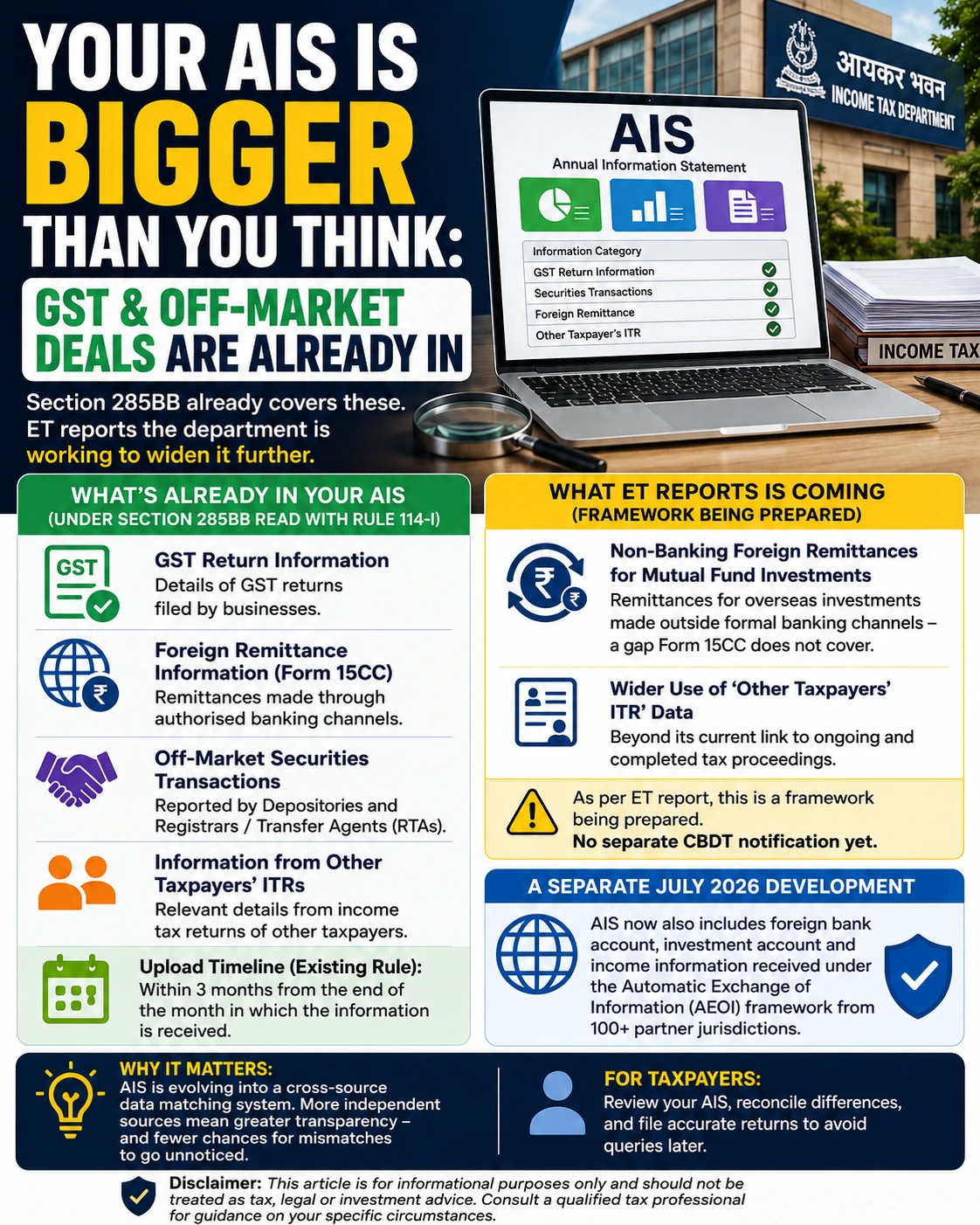
- Section 285BB of the Income-tax Act, read with Rule 114-I, already requires AIS to include GST return data, Form 15CC foreign remittance information, off-market securities transactions reported by depositories/RTAs, and information drawn from other taxpayers’ ITRs, confirmed on the Income Tax Department’s own AIS guidance page.
- The department is already required to upload these categories within three months of month-end receipt, an existing rule, not a new proposal.
- A report by The Economic Times, citing a senior official, says the department is working to close two specific gaps: foreign remittances for mutual fund investment made outside formal banking channels (not covered by Form 15CC) and a wider use of “other taxpayers’ ITR” data beyond its current link to tax proceedings.
- This ET-reported expansion is described as a framework still being prepared; no separate CBDT notification confirming these specific additions had been issued at the time of this report.
- The development sits alongside a separate July 2026 CBDT move that began showing foreign asset and account data received under the Automatic Exchange of Information (AEOI) framework from over 100 partner jurisdictions.
What’s Already Legally in Your AIS
The legal basis for AIS is broader than most taxpayers assume. Per the Income Tax Department’s own guidance, Section 285BB read with Rule 114-I already lists information relating to GST returns, foreign remittance data reported in Form 15CC, off-market securities transactions reported by depositories and registrars/transfer agents (RTAs), dividend and mutual fund purchase data from RTAs, and information drawn from the income tax returns of other taxpayers, among other categories.
The same framework already obliges the Director General of Income Tax (Systems) to upload this data within three months from the end of the month it’s received.
Also Read: How to Check Income Tax Refund Status in 2026
What ET Reports Is Changing
A report by The Economic Times, citing a senior official, describes the department preparing to close specific gaps that remain within this existing structure.
Two stand out: foreign remittances made for mutual fund investment outside formal banking channels, a category Form 15CC doesn’t capture, since it only covers remittances processed by authorised banking dealers, and a wider use of “ITR of other taxpayers” data, extending beyond its current application to ongoing and completed tax proceedings.
According to the report, the goal is visibility into money moved into overseas derivative markets and unlisted foreign companies through brokers and overseas agents rather than domestic banks.
A senior official cited by ET said the wider dataset would sharpen the department’s ability to cross-verify declared income against transactions picked up elsewhere, making mismatches more likely to surface during routine compliance checks.
As of this report, no separate CBDT notification detailing these two additions had been issued; the description rests on ET’s account of a framework still “being prepared.”
Why the AIS Expansion Matters
The bigger story isn’t a single new form being added to AIS. It’s that the statement has steadily moved from summarising a taxpayer’s own reported transactions to cross-referencing an expanding set of independent sources—banks, depositories, RTAs, GSTN, other taxpayers’ returns, and potentially non-banking remittance channels—against what an individual declares.
Each additional source narrows the room for a transaction to stay unreported simply because it didn’t pass through a bank or a domestic broker.
For readers tracking how tightening compliance norms are shaping capital flows, NiftyTrader’s FII-DII Tracker offers a real-time read on institutional activity in Indian markets: niftytrader.in/fii-dii-data
A Separate July Move on Foreign Assets
This reported expansion is distinct from, though consistent with, a separate CBDT initiative from July 2026, when the department began displaying foreign bank account, investment account, and income information received under the AEOI framework, drawing on data India receives from more than 100 partner jurisdictions.
That rollout set its own 90-day, month-end-linked upload timeline and was framed as a facilitation tool rather than a conclusive record of a taxpayer’s overseas holdings.
The AEOI rollout and the GST/off-market/cross-taxpayer expansion ET has reported are separate moves within the same broader pattern of widening AIS through 2026.
What It Means for Taxpayers and Investors
For retail investors and family offices routing money overseas outside standard banking transfers or transacting in unlisted or pre-listing shares off-exchange, the expanded data architecture gives the department additional transaction-level information that can be cross-checked against taxpayer declarations.
For businesses, GST return data sitting inside AIS creates a more direct link between indirect-tax filings and income-tax scrutiny, raising the stakes for consistency between GST turnover reported to GSTN and income reported in ITRs.
The stated purpose, as with the AEOI rollout, is taxpayer facilitation, letting people reconcile discrepancies before filing rather than after a notice.
But the same data that helps a taxpayer self-correct also gives the department a sharper basis for follow-up queries where mismatches persist.
Bottom Line
Section 285BB and Rule 114-I already give AIS a broader reach than many taxpayers assume, including GST return data, off-market transactions, and other taxpayers’ ITR information, all subject to an existing three-month upload rule.
What remains unconfirmed is the specific expansion ET has reported, non-banking foreign remittances, and wider use of cross-taxpayer ITR data, described as a framework still being prepared.
Taxpayers with GST filings, overseas investments routed outside banking channels, or off-market share transfers should check their AIS entries against their own records once any formal notification follows.
Read Next: India’s 7.8% GDP Has One More Test: Can the New Data Earn Trust?
Disclaimer: This article is for informational purposes only and should not be treated as tax, legal, or investment advice. Readers should consult a qualified tax professional or chartered accountant for guidance on their specific AIS entries and compliance obligations.