RBI Faces Liquidity Glut as India Gets $127 Billion From Its Diaspora, Giving RBI a New Headache
India has received a record $127 billion in inflows from its vast diaspora, giving the Reserve Bank of India (RBI) a much bigger foreign-exchange cushion to support the rupee. But the record inflow has created another problem that policymakers now need to solve: too much cash in the banking system.
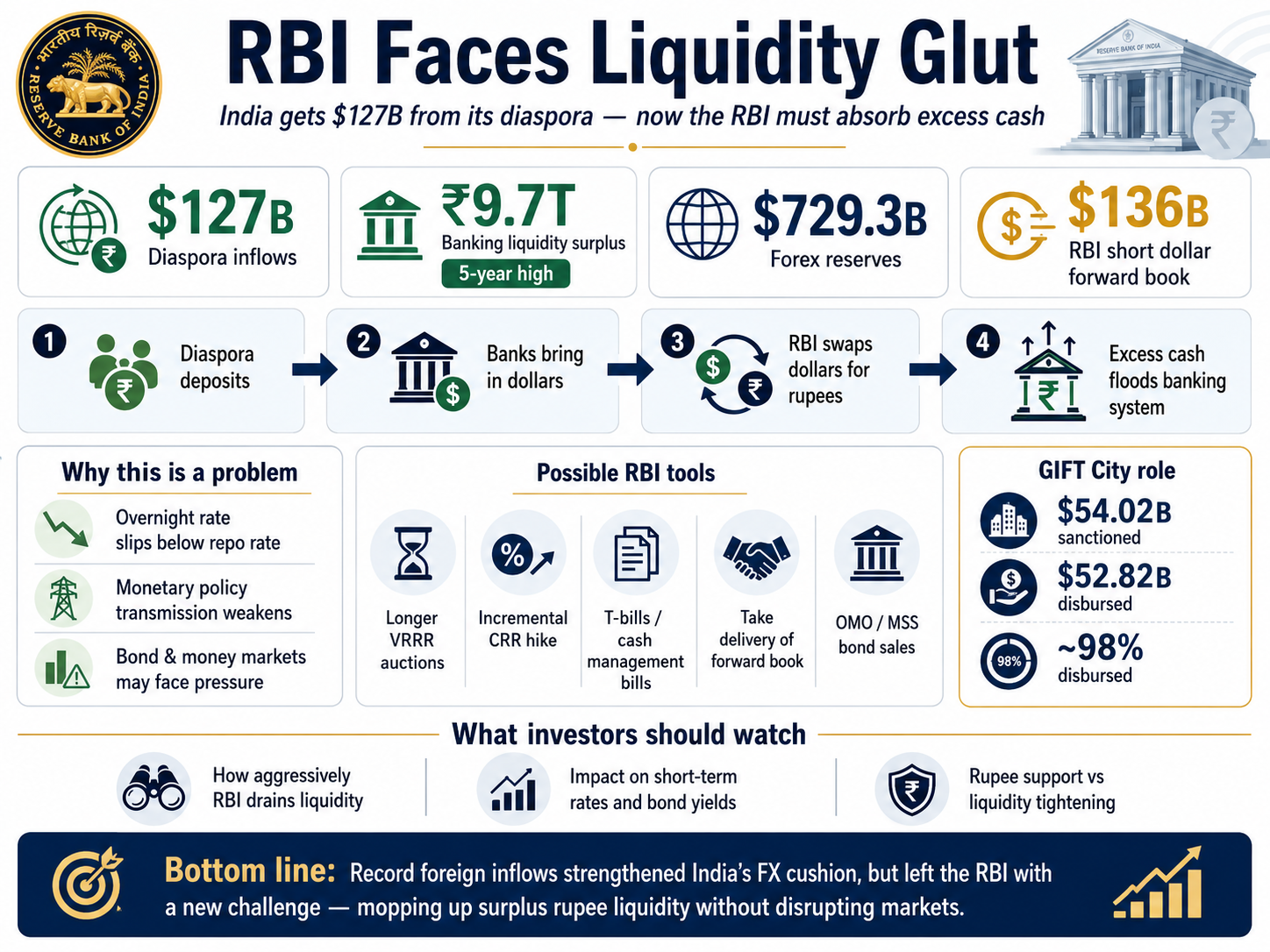
The surge in foreign currency inflows has pushed surplus banking-system liquidity close to Rs 10 trillion ($106 billion), a five-year high. Banks received rupees after swapping dollars with the RBI, leaving the financial system awash with cash.
For investors and traders, the issue is no longer simply whether India has enough dollars to defend the rupee. The focus is shifting to how the RBI will absorb excess rupee liquidity without creating fresh pressure in the bond and money markets.
Track Live : Opening Price Clues – What Pre-Market Data Says Today
Why Record Diaspora Inflows Mean RBI Faces Liquidity Glut
The large inflows have increased the amount of rupee liquidity available with Indian banks.
That has already had a visible impact on money-market conditions. The overnight rate has slipped below the RBI’s benchmark policy rate, potentially weakening the transmission of monetary policy.
The RBI is now considering how to bring liquidity conditions back towards a level consistent with its policy stance.
The central bank is scheduled to meet select lenders on Thursday to discuss liquidity management measures, according to people familiar with the development.
An RBI spokesperson did not immediately respond to an email seeking comment.
The Core Problem: A Multi-Year Liquidity Glut
- Five-Year High in Cash Surplus: As banks collected foreign currency from the diaspora, they swapped those dollars with the RBI for domestic currency. This mechanism pushed surplus banking system liquidity to an all-time peak of ₹9.7 trillion ($103 billion) as of September 3.
- Monetary Policy Dilution: This historic cash glut has driven the daily overnight lending rate well below the RBI’s benchmark policy repo rate. When overnight money market rates decouple from the official corridor, it severely undermines the central bank’s ability to control inflation and manage credit conditions.
How the RBI Plans to Mop Up the Excess Cash
- Longer Variable Reverse Repos (VRRRs): The RBI could hold longer-term auctions (up to 56 days) to lock up bank funds. However, banks have shown limited interest in locking up cash for long periods.
- Incremental Cash Reserve Ratio (I-CRR) Hike: The RBI could force banks to temporarily set aside a higher percentage of their new deposits. This has an immediate impact and was previously used during the ₹2,000 note withdrawal in 2023.
- Taking Delivery of Short Forward Book: The RBI’s short-dollar book is at a record $136 billion. Since liquidity is high, the RBI might comfortably take delivery of its one-year maturing forward contracts to suck out rupee liquidity.
- Cash Management & Treasury Bills: The RBI could increase the issuance of short-term government treasury bills before the end of the month to absorb cash.
- Sell/Buy Forex Swaps: The RBI could sell dollars to banks to take out rupees, reversing the process later. However, global uncertainties make the RBI cautious about reducing its FX reserves.
- OMO & MSS Bond Sales: Open Market Operations (OMO) or Market Stabilization Scheme (MSS) bond sales can mop up liquidity cleanly, but they risk pushing up bond yields during a global bond selloff.
Cash management bills and treasury bills offer another route
The RBI could also use cash management bills with shorter maturities or increase the issuance of treasury bills to remove excess liquidity.
Upasna Bhardwaj, Chief Economist at Kotak Mahindra Bank, expects such measures could potentially be announced before the end of the month.
For bond-market investors, the choice of instrument will matter because increased government-bill supply can influence short-term yields and overall money-market conditions.
RBI could consider an incremental cash reserve ratio hike
Another possible solution is an incremental Cash Reserve Ratio (CRR) increase on additional deposits accumulated by banks during a specified period.
The RBI used a similar approach in 2023 to absorb surplus liquidity after Rs 2,000 notes returned to the banking system.
The advantage is speed. Increasing the reserve requirement can immediately lock away a portion of banks’ additional deposits.
However, Radhika Rao, Senior Economist at DBS Bank, noted that such a move could be viewed as reversing the RBI’s earlier decision to exclude these deposits from statutory reserve requirements.
The amount banks would need to set aside could be linked to the increase in their net deposits.
Track Live : Gap Up / Gap Down Stocks – Today’s NSE Opening Gaps
GIFT City emerges as a major channel for RBI’s $127 billion foreign-currency mobilisation
GIFT City is rapidly emerging as an important bridge between overseas capital and India’s banking system, with its International Banking Units (IBUs) handling a substantial share of the RBI’s record FCNR(B) swap facility.
As of August 31, 2026, 20 IBUs at GIFT-IFSC had sanctioned $54.02 billion under the RBI’s special FCNR(B) swap facility, of which approximately $52.82 billion had already been disbursed.
That means roughly 98% of the amount sanctioned had already been disbursed, underscoring how quickly the facility has moved from mobilisation to actual foreign-currency deployment.
The scale-up has been particularly rapid. Sanctions rose from $28.60 billion on August 14 to $37.26 billion on August 21, before reaching $54.02 billion by the end of August.

RBI’s forward dollar book has reached a record
The liquidity issue is also connected to the RBI’s foreign-exchange operations.
The central bank’s short-dollar forward book has climbed to a record $136 billion, largely because of future dollar obligations associated with the diaspora deposit inflows.
This creates another potential avenue for managing the situation.
“The RBI may be comfortable now taking delivery of its forward book which is due for maturity in one year given the liquidity influx,” the analysis noted.
Taking delivery of the forward contracts could help the RBI manage the large inflow of dollars and the corresponding liquidity implications.
Sell-buy forex swaps could drain rupee liquidity
The RBI can also conduct sell-buy foreign-exchange swaps.
Under such transactions, the central bank sells dollars to banks and absorbs rupees from the financial system. At the end of a predetermined period, the transaction is reversed.
This provides the RBI with a way to remove rupee liquidity while simultaneously managing its foreign-exchange position.
However, the central bank may remain cautious about using this tool immediately because global uncertainty makes it important to preserve adequate foreign-exchange reserve buffers.
Read More : BSE Shares Surge 4.5% After CEO Rules Out NSE Self-Listing Post-IPO
Bond sales could solve liquidity but create another market risk
The RBI could also use open-market operation (OMO) bond sales or the Market Stabilisation Scheme (MSS) to absorb surplus liquidity.
These measures can remove cash from the banking system without directly distorting the foreign-exchange forward curve.
But there is a trade-off.
Large bond sales could push government bond yields higher at a time when global bond markets are already facing selling pressure. That could increase borrowing costs and create volatility for fixed-income investors.
What the RBI’s liquidity moves mean for investors
For equity investors, the immediate issue is less about the record diaspora inflows themselves and more about how the RBI responds to the resulting liquidity surplus.
A gradual approach could keep financial conditions supportive for equities, while aggressive liquidity absorption could tighten short-term financial conditions.
For bond traders, the RBI’s choice will be even more important. VRRR auctions, treasury-bill issuance, CRR changes and OMO sales can each affect short-term rates and government bond yields differently.
For currency traders, the record inflows strengthen India’s external position and could support the rupee, but the RBI’s management of its dollar and forward positions will remain critical.
The central bank therefore faces a delicate balancing act: use the record diaspora inflows to strengthen India’s external buffers while preventing the resulting rupee liquidity glut from disrupting monetary policy and financial markets.