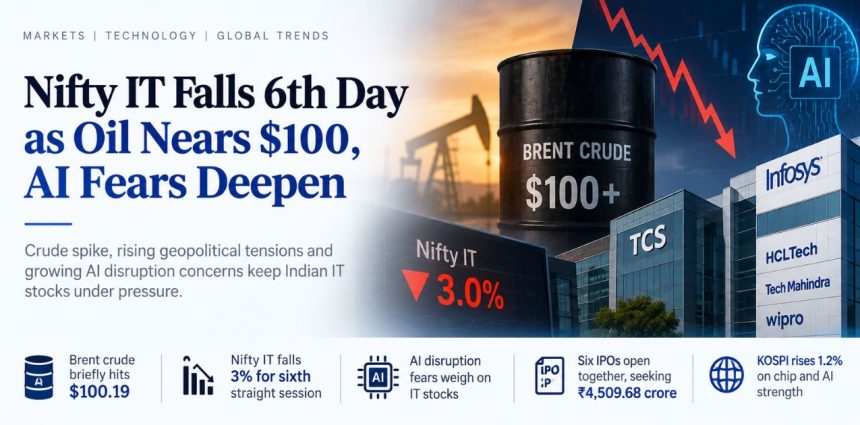
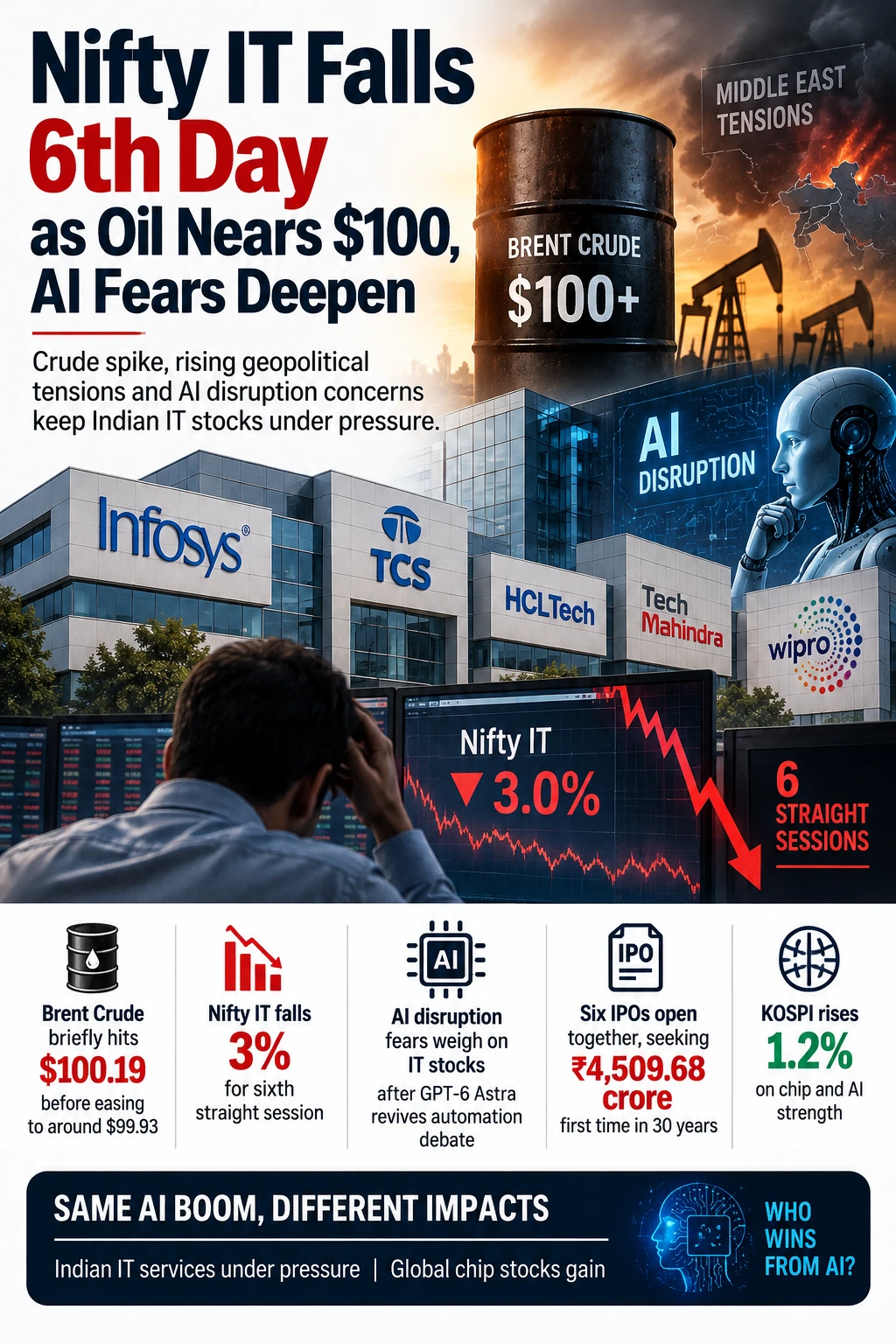
Three headwinds, one sector: Nifty IT fell about 3% on Wednesday, September 9, extending its losing streak to a sixth straight session as crude oil moved toward $100 a barrel and investors piled fresh macro risk onto an already-running AI disruption trade. Reuters reported the IT index fell 3% as Indian equities came under pressure from rising geopolitical tensions and crude prices.
The immediate trigger was not a fresh AI announcement. Brent crude briefly crossed $100 a barrel, touching $100.19 before easing to around $99.93, as Middle East tensions intensified. The jump revived concerns over inflation, growth, and the monetary-policy outlook.
But the bigger question for IT investors is now harder to ignore: is this simply a risk-off correction, or is the market beginning to reprice the traditional IT-services model because of increasingly capable AI agents?
Check Live: Nifty IT Sector Analysis: Live Performance & Drivers
Key Takeaways
| Trigger | What changed | Why IT stocks care |
|---|---|---|
| Nifty IT | Fell about 3% on September 9 | Sixth consecutive losing session |
| Brent crude | Briefly crossed $100, reaching $100.19 | Raises inflation, growth, and rate concerns |
| AI disruption | GPT-6 Astra revived automation fears | Investors are reassessing future IT-services demand |
| US yields | Remain elevated | Higher discount rates can pressure technology valuations |
| IT breadth | Major IT stocks declined | Shows sector-wide pressure rather than one-stock weakness |
| Coforge | Fell as much as 8.7% intraday | Adds company-specific governance risk |
| IPO activity | Six mainboard IPOs opened together | ₹4,509.68 crore is being raised from the market |
Today’s Move: Oil, Not a Fresh AI Shock
Wednesday’s sharp IT decline came as crude became the newest catalyst for an already fragile market.
Brent crude briefly crossed $100 a barrel, reaching $100.19 before easing to around $99.93. The move came as Middle East tensions intensified, adding fresh inflation and growth concerns for oil-importing economies such as India.
Reuters reported that India’s benchmark Nifty 50 fell 0.67% and the Sensex declined 0.83% on Wednesday, with 12 of the 16 major sectors ending lower. IT was among the weakest sectors, falling 3%.
Oil does not hit software companies in the same direct way it hits airlines, transport companies or manufacturers.
The bigger transmission mechanism is:
Higher oil → inflation risk → higher-for-longer rates → higher yields → valuation pressure.
That matters because technology stocks tend to be sensitive to changes in discount rates and expectations for future growth.
So Wednesday’s move should not be labelled an AI-only selloff.
It is better described as:
AI disruption fears + oil shock + rates pressure + broader risk-off sentiment.
Six Sessions of Selling Show This Is Bigger Than One Bad Day
The important detail is the duration.
Nifty IT has now fallen for six consecutive sessions, turning what began as an AI-related technology concern into a broader sector-level risk event.
Investors are now dealing with several overlapping questions:
Can US technology spending remain strong?
Can Indian IT companies protect growth and margins as AI increases productivity?
Does higher crude keep global rates elevated for longer?
Are investors beginning to rotate capital away from traditional technology services?
Those questions are likely to matter more than the next single daily candle.
Infosys, TCS and Other IT Stocks Feel the Pressure
The selling has been broad across large Indian IT names.
Infosys, TCS, HCLTech, Tech Mahindra and Wipro all came under pressure as investors reduced exposure to the sector.
The breadth is important because it suggests the market is not simply reacting to one company’s earnings.
Instead, investors are reassessing the risk premium attached to traditional IT services.
For Indian IT companies, the longer-term concern is whether AI can reduce the number of human hours required to deliver software, testing, support and other technology services.
Coforge Has a Separate Company-Specific Risk
Coforge became the sector’s biggest company-specific casualty. The stock plunged as much as 8.7% on September 9, its biggest intraday percentage drop in more than a year, after Chairman Om Prakash Bhatt resigned following concerns identified in an internal audit of the board-evaluation process.
According to the company’s disclosures, the internal review identified concerns over how the Board Evaluation Report had been handled and presented to the board, including material information relating to the chairman’s performance. Bhatt resigned before the board completed its review of his explanation.
Coforge therefore has a separate governance-risk component on top of the broader IT-sector weakness.
The distinction matters:
Coforge = sector risk + governance risk
Infosys/TCS and other majors = primarily sector, macro and valuation pressure
Not every IT stock is falling for exactly the same reason.
Check Live: COFORGE Options Chart | Nifty Trader
Six IPOs Open at Once as Primary Market Gets Crowded
There is another unusual development in India’s market on September 9.
Six mainboard IPOs opened for subscription on the same day, seeking a combined ₹4,509.68 crore. ETMarkets reported that this was the first time exactly six IPOs had opened together on a single day in 30 years; the previous such occurrence was October 14, 1996.
The six issues are:
Rentomojo, Asset Reconstruction Company (India), Manipal Payment & Identity Solutions, Steamhouse India, LCC Projects and Karamtara Engineering.
That does not mean IPO activity directly caused IT stocks to fall.
The more defensible interpretation is that a crowded primary-market calendar can compete for investor capital and attention when sentiment in the secondary market is already weak.
Reuters also cited continued IPO and QIP activity as an additional source of pressure on Indian equities.
Track Live: IPO – Latest & Upcoming IPOs List 2026 | Check Live BSE NSE IPOs
The Underlying Driver: AI, Not an Earnings Shock
The AI concern predates Wednesday’s oil spike.
OpenAI’s GPT-6 Astra launch has intensified investor debate over how increasingly capable AI systems could change software development, research, computer-based workflows, and other professional tasks.
For Indian IT investors, the important question is not simply whether AI can write code.
It is:
How many human hours will companies need to deliver the same amount of technology work?
That creates two very different possible outcomes.
If AI makes Indian IT companies dramatically more productive while creating new demand for implementation, integration and transformation, it could ultimately support margins.
But if clients primarily use AI to reduce external service requirements, traditional revenue pools could come under pressure.
The market is pricing that uncertainty before there is definitive evidence of a structural earnings decline.
The Expectation Gap: Same AI Boom, Opposite Trades
This is arguably the most interesting part of the current market.
Indian IT services are being treated as potential AI-disruption victims, while Korean memory-chip and AI-infrastructure stocks are being treated as beneficiaries of the same technology boom.
Reuters reported that South Korea’s KOSPI rose 1.2% on September 9, helped by gains in chip and AI stocks even as broader Asian markets remained cautious amid the oil shock.
That creates a striking divergence.
| AI exposure | Market interpretation |
|---|---|
| Memory chips | Higher AI computing demand |
| AI infrastructure | Rising capital expenditure |
| Data centres | Increasing computing requirements |
| Semiconductor supply chain | AI growth beneficiary |
| Traditional IT services | Potential automation risk |
The market is not necessarily saying:
“AI is bad for technology.”
It is asking:
“Who captures the economic value created by AI?”
That is a much bigger investment question.
Why the AI Trade Looks So Divided
The contrast becomes even clearer when looking at global technology markets.
Reuters reported that US software stocks weakened on September 8 as investors worried about AI competition, while semiconductor companies such as Intel and Qualcomm moved higher.
So investors are increasingly separating AI beneficiaries from businesses that could be disrupted by AI.
That does not prove the long-term winners and losers.
But it does show how the market is currently positioning.
Where AI is viewed as a demand accelerator, money is flowing toward the trade.
Where AI is viewed as a substitution threat, valuations are coming under pressure.
Oil Is Making the AI Debate More Painful
Without the crude shock, investors could focus mainly on the long-term AI question.
With Brent crossing $100, they now have to price macroeconomic risk at the same time.
That creates a difficult combination for growth stocks.
AI creates uncertainty around future revenue.
Higher yields create uncertainty around valuations.
Higher crude creates uncertainty around inflation and monetary policy.
And weaker market sentiment reduces investors’ willingness to absorb uncertainty.
That helps explain why IT stocks can fall sharply without a fresh earnings warning from every company in the sector.
The Six-Session Selloff Is Not Just an AI Trade
The sequence is important.
September 3: GPT-6 Astra reignites the AI-disruption debate.
September 7-8: Global technology and risk assets come under pressure amid rates, oil and geopolitical concerns.
September 9: Brent crosses $100 while Indian IT falls for a sixth straight session.
The result is a collision between a short-term macro shock and a long-term structural technology question.
That is what makes the current selloff more significant than a routine sector decline.
What Traders Should Watch Next
The next phase of the IT selloff will depend on whether the underlying triggers persist.
1. Brent Crude
A sustained move around or above $100 could keep inflation and rate concerns alive.
A meaningful decline in crude would remove one of the newest macro pressures facing Indian equities.
2. US Treasury Yields
If US yields continue climbing, technology valuations could remain under pressure even without new AI headlines.
This creates two separate risks:
AI-driven earnings uncertainty + higher discount rates.
3. US Technology Spending
Indian IT companies remain heavily exposed to overseas technology budgets.
Investors will want to know whether clients are:
reducing traditional outsourcing budgets,
shifting spending toward AI,
demanding greater productivity,
increasing AI implementation spending,
or delaying discretionary technology projects.
4. Enterprise AI Adoption
The critical test will be whether increasingly capable AI systems actually move from demonstrations into large-scale enterprise workflows.
If adoption leads to greater AI implementation and transformation spending, Indian IT companies could capture part of the opportunity.
If adoption primarily reduces external service requirements, the traditional outsourcing model could face greater pressure.
5. Indian IT Management Commentary
The next earnings cycle could become especially important.
Investors will be watching for evidence of:
AI-led productivity gains
lower demand for routine work
pricing pressure
higher-value transformation demand
faster enterprise AI adoption
The market ultimately needs evidence rather than demonstrations.
Two Possible Futures for Indian IT
The sector is now being priced against two very different scenarios.
Scenario 1: AI becomes a productivity accelerator
Indian IT companies automate repetitive work, serve more clients with fewer people, improve revenue per employee and build new AI-related services.
Margins improve.
AI-related demand grows.
The sector eventually regains investor confidence.
Scenario 2: AI becomes a substitute
Clients need fewer external workers for coding, testing, support, documentation and routine technology work.
Pricing pressure rises.
Headcount growth slows.
Traditional revenue growth weakens faster than new AI-related business can replace it.
The uncomfortable part is that the market does not yet know which scenario will dominate.
But investors are no longer waiting for complete certainty before repricing the risk.
What the September 9 Selloff Really Means
The simplest interpretation is that Indian IT stocks are falling because AI is becoming more powerful.
The evidence points to something more complicated.
Today’s acceleration is primarily a macro shock layered onto an existing structural concern.
Oil crossing $100 and escalating Middle East tensions created the fresh catalyst. Higher yields added valuation pressure. Continued IPO and QIP activity added to the broader liquidity strain. And the AI debate remains the deeper question hanging over traditional technology services.
The market is now pricing three variables simultaneously:
AI productivity vs. AI substitution
Lower rates vs. persistent inflation
Technology spending growth vs. macroeconomic slowdown
That is a much harder equation for IT investors than it was only weeks ago.
Bottom Line
Nifty IT’s sixth straight losing session is not simply an AI selloff.
The immediate September 9 catalyst was a fresh surge in crude that pushed Brent above $100 as Middle East tensions intensified, alongside broader risk-off pressure in Indian equities.
But underneath that move is a bigger structural debate.
Investors are trying to determine whether increasingly capable AI systems will expand the opportunity for Indian IT companies through productivity and AI-led services, or shrink the traditional outsourcing work that has powered the sector for years.
That answer will not come from one trading session.
It will come from enterprise AI adoption, client technology budgets, pricing trends, employee productivity, and management commentary over the next few quarters.
For now, the market’s message is increasingly clear:
AI is not being treated as a universal technology winner. Investors are asking which parts of the technology ecosystem capture the upside and which parts face disruption.
Read Next: ₹1.10 Lakh Cr DAC Approval Hits Defence Stocks: Where Could Orders Flow Next?
Disclaimer: This article is for informational purposes only and does not constitute investment advice. Stock market investments are subject to market risks. Readers should consult a SEBI-registered investment adviser before making investment decisions.