Income Tax 2026-27: Before Paying Capital Gains Tax, Check Whether You Have an Unused Exemption
If your total income is below Rs 12 lakh, it does not automatically mean your capital gains tax bill will be zero. For investors earning short-term capital gains (STCG) or long-term capital gains (LTCG), the tax calculation can work differently because these gains may be taxed at special rates.
There is, however, an important benefit that resident individuals and Hindu Undivided Families (HUFs) can use. The basic exemption limit can be used against eligible capital gains after normal-rate income has been adjusted.
That distinction could make a significant difference to the final tax liability of investors in Tax Year 2026-27.
Track Live : Opening Price Clues – What Pre-Market Data Says Today
Income Tax 2026-27: Why income below Rs 12 lakh does not always mean zero tax
The Rs 12 lakh threshold is closely associated with the Section 87A rebate under the new tax regime. However, capital gains that are taxable at special rates, including specified STCG and LTCG, do not simply become tax-free because total income falls below Rs 12 lakh.
The Income Tax Department confirms that resident individuals can claim the Section 87A rebate subject to the applicable conditions and income limits.
This is where the basic exemption limit becomes important for investors.
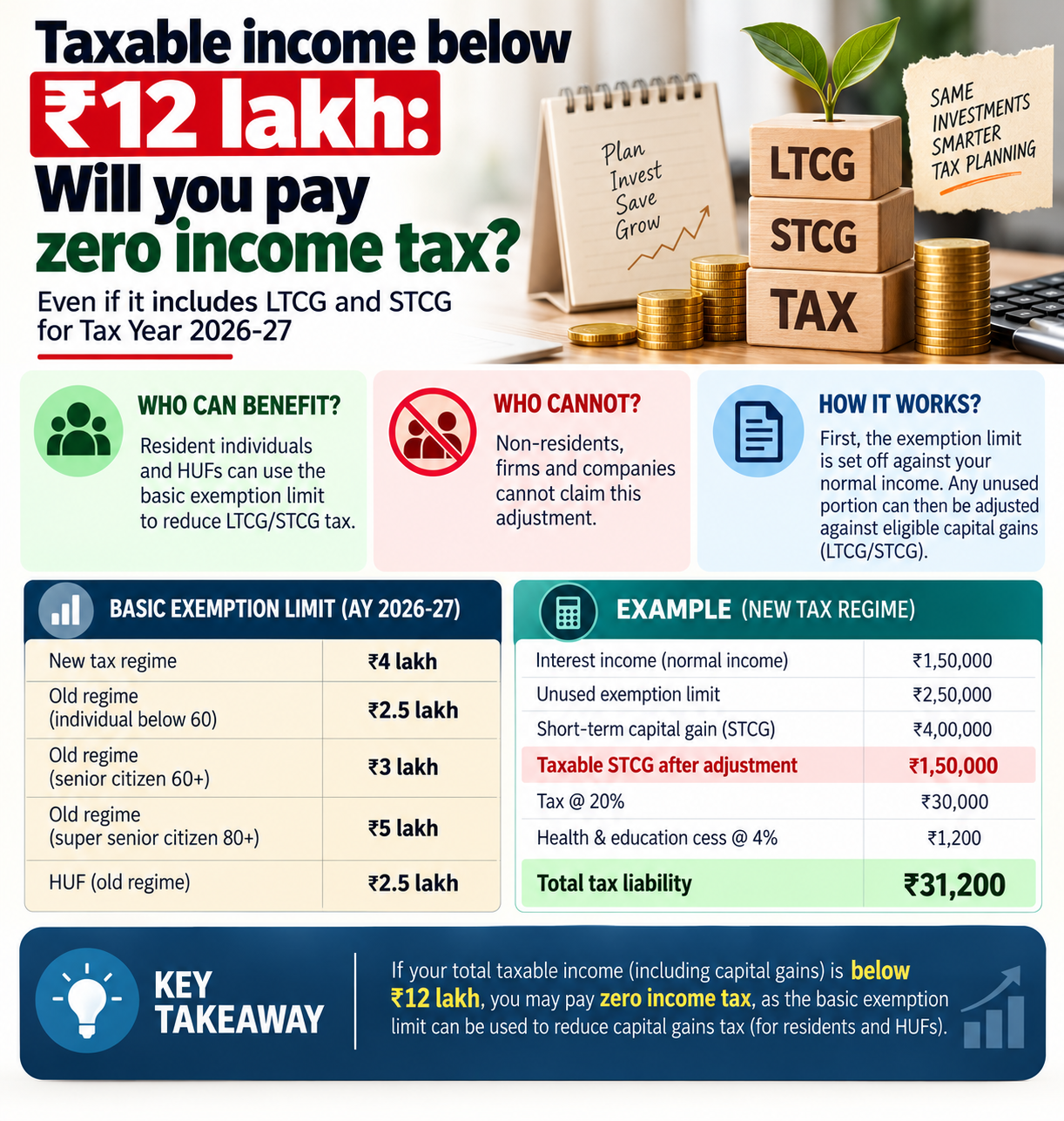
Under the rules described for capital gains, a resident individual or resident HUF can use any unused portion of the basic exemption limit against certain capital gains that are otherwise taxable at special rates.
The benefit is available under the new and old tax regimes
The basic exemption limit differs depending on the regime and taxpayer category.
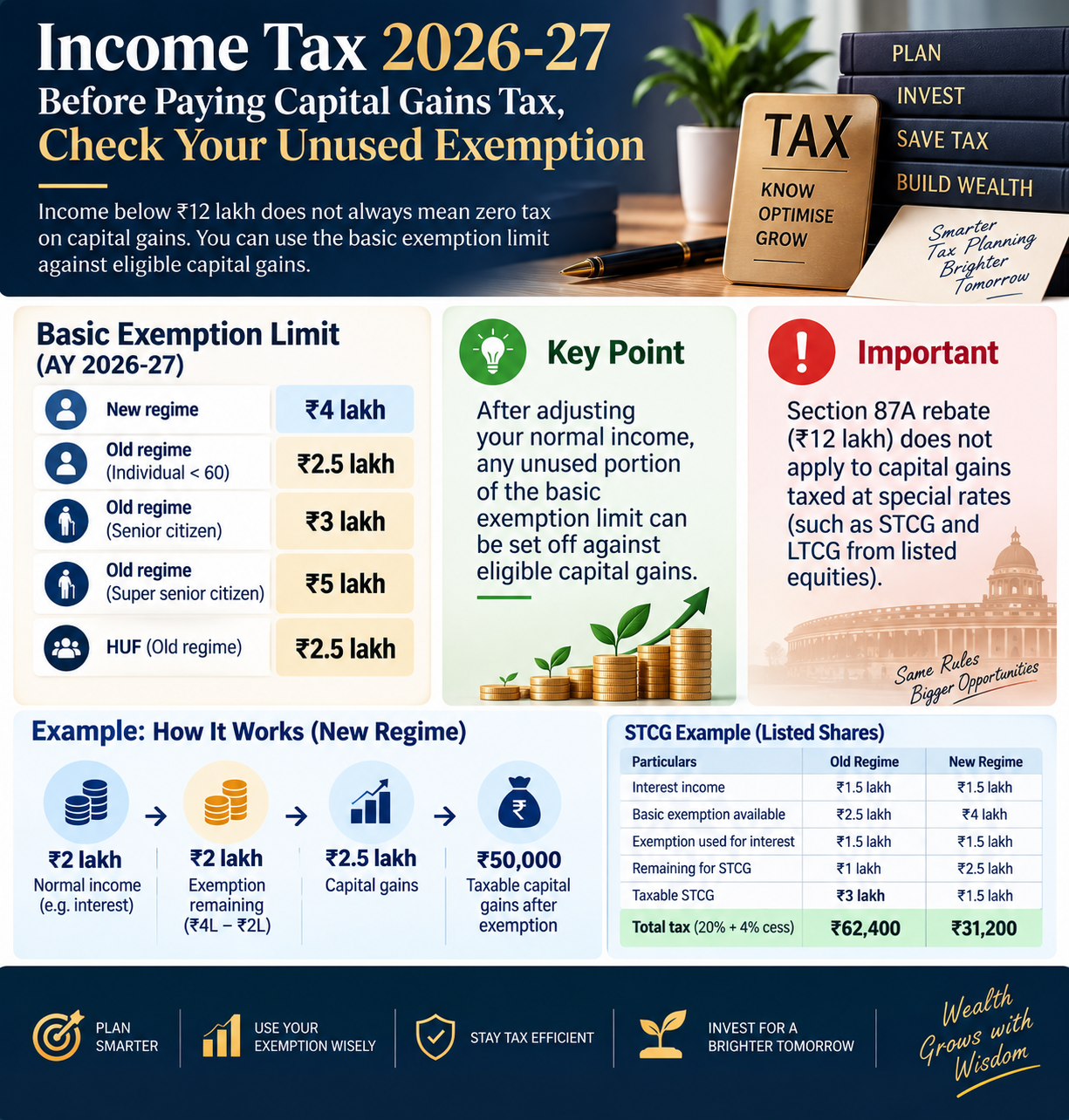
For AY 2026-27:
| Tax regime/category | Basic exemption |
|---|---|
| New regime | ₹4 lakh |
| Old regime – individual below 60 | ₹2.5 lakh |
| Old regime – resident senior citizen | ₹3 lakh |
| Old regime – resident super senior citizen | ₹5 lakh |
| HUF | ₹2.5 lakh under the old regime |
The Income Tax Department’s current AY 2026-27 material confirms the ₹4 lakh threshold under the default regime and the ₹2.5 lakh/₹3 lakh/₹5 lakh thresholds under the old regime.
How the basic exemption limit can reduce capital gains tax
The calculation starts with income that is not subject to the special capital-gains rate.
As tax partner Shanmuga Prasad of EY explained, a common misconception is that capital gains taxed at special rates can never benefit from the basic exemption limit.
“Resident taxpayers can utilise any unabsorbed portion of the basic exemption limit against eligible capital gains,” Prasad said, according to the information provided.
In simple terms, the basic exemption limit is first used against normal income. If part of that limit remains unused, the balance can then reduce eligible capital gains.
For example, suppose an Indian resident has Rs 2 lakh of interest income and Rs 2.5 lakh of eligible capital gains, while the applicable basic exemption limit is Rs 4 lakh.
The first Rs 2 lakh of the exemption is used against interest income. The remaining Rs 2 lakh can then be adjusted against the capital gains.
That leaves only Rs 50,000 of capital gains taxable at the applicable special rate.
Track Live : Gap Up / Gap Down Stocks – Today’s NSE Opening Gaps
What happens when an investor has STCG from listed shares
Consider another example involving a 35-year-old resident individual.
Suppose Mr A earns Rs 1.5 lakh in interest income and Rs 4 lakh in short-term capital gains from listed equity shares covered by Section 111A.
Under the old tax regime, the basic exemption limit is Rs 2.5 lakh. After adjusting the Rs 1.5 lakh interest income, Rs 1 lakh remains available.
The taxable STCG would therefore fall from Rs 4 lakh to Rs 3 lakh. At a 20% special rate, the income tax would be Rs 60,000, with an additional 4% health and education cess, taking the total to Rs 62,400.
Under the new regime, using the Rs 4 lakh basic exemption limit, Rs 2.5 lakh would remain unused after adjusting the interest income.
The taxable STCG would then fall to Rs 1.5 lakh. At 20%, the tax would be Rs 30,000, and with 4% cess, the total would be Rs 31,200.
The example shows why the basic exemption limit can be particularly valuable for investors with modest normal income but taxable capital gains.
Read More : Zomato Cash on Delivery Fee Added — Charges Vary From Rs 5 to Rs 20
Income Tax Act 2025 keeps this capital gains benefit available
CA Suresh Surana said Sections 196(2), 197(2) and 198(3) of the Income-tax Act, 2025 provide this benefit, corresponding to Sections 111A, 112 and 112A of the earlier Income-tax Act.
Surana said: “Resident individuals or a resident Hindu Undivided Family (HUF) can use the unused basic exemption limit” against the relevant special-rate capital gains, subject to the conditions.
The new Income-tax Act continues to apply the relevant framework, while the Income Tax Department’s current guidance also distinguishes tax treatment for residents and non-residents.
Who can use the exemption against capital gains
The benefit is not available to every taxpayer.
The taxpayer must generally be a resident individual or resident HUF and the capital gains must fall under the relevant special-rate provisions.
The income other than the eligible capital gains must also be below the applicable basic exemption limit. Only the unused portion can be adjusted.
If normal income has already consumed the entire exemption limit, there is no remaining exemption to set off against capital gains.
Non-residents, firms and companies cannot claim this specific adjustment.
1. Income Below ₹12 Lakh Does Not Always Mean Zero Tax
- A resident individual can get a Section 87A rebate of up to ₹60,000 under the new tax regime.
- The ₹12 lakh limit applies to eligible taxable income.
- Special-rate capital gains are not covered by this rebate.
- So, STCG or LTCG can still result in tax even when total income is below ₹12 lakh.
2. ₹4 Lakh Basic Exemption Can Reduce Capital Gains Tax
- The new tax regime has a ₹4 lakh basic exemption limit for AY 2026-27.
- A resident individual or resident HUF can use the unused portion of this exemption against eligible capital gains.
- This can reduce the amount of capital gain on which tax is charged.
3. How the ₹4 Lakh Exemption Works
For example:
- Interest income: ₹1.5 lakh
- STCG: ₹4 lakh
- Basic exemption: ₹4 lakh
Calculation:
₹4 lakh − ₹1.5 lakh = ₹2.5 lakh unused exemption
Then:
₹4 lakh STCG − ₹2.5 lakh = ₹1.5 lakh taxable STCG
At 20%:
Tax = ₹30,000
So, the unused basic exemption can reduce the taxable capital gain.
4. Section 87A Cannot Remove Special-Rate Capital Gains Tax
- Section 87A is a tax rebate, not a ₹12 lakh tax exemption.
- STCG and certain LTCG are taxed separately at special rates.
- The rebate cannot simply be used to cancel the tax charged on those gains.
- However, the rebate can apply to eligible normal-rate income after the special-rate tax is separated.
5. ₹4 Lakh and ₹12 Lakh Are Two Different Benefits
₹4 lakh basic exemption
- Covers the initial portion of income.
- Unused amount can potentially reduce eligible capital gains.
₹12 lakh Section 87A limit
- Determines eligibility for the enhanced rebate.
- It does not make special-rate capital gains automatically tax-free.
6. Who Can Use the Unused Basic Exemption?
The benefit is available, subject to conditions, to:
- Resident individuals
- Resident HUFs
Non-residents generally cannot use this adjustment in the same way.
7. Normal Income Is Adjusted First
The calculation generally works like this:
Basic exemption
− Normal income
= Unused exemption
The unused amount can then be adjusted against eligible capital gains.
Example
₹4 lakh exemption − ₹2 lakh normal income = ₹2 lakh unused exemption
If capital gains are ₹2.5 lakh:
₹2.5 lakh − ₹2 lakh = ₹50,000 taxable gain
8. STCG on Listed Shares Is Taxed at 20%
- Eligible STCG from listed equity and specified securities is currently taxed at 20%.
- The applicable conditions must be satisfied.
- A resident individual or HUF may first use an available unused basic exemption against eligible STCG.
9. LTCG on Listed Equity Is Taxed at 12.5%
- Eligible listed-equity LTCG is taxed at 12.5%.
- The rate applies to gains exceeding the ₹1.25 lakh threshold under Section 112A.
- Section 87A cannot be used to wipe out the tax on this special-rate LTCG.
10. Not Every Capital Gain Has the Same Tax Treatment
The tax depends on the asset and applicable rules.
Examples:
- Listed equity STCG: 20%
- Listed equity LTCG: 12.5% above ₹1.25 lakh
- Other capital gains: May be taxed differently
- Some gains may be taxed at normal slab rates.
11. You Can Earn Below ₹12 Lakh and Still Pay Tax
Example:
- Normal income: ₹2 lakh
- STCG: ₹4 lakh
- Total income: ₹6 lakh
Basic exemption:
₹4 lakh − ₹2 lakh = ₹2 lakh unused
Taxable STCG:
₹4 lakh − ₹2 lakh = ₹2 lakh
Tax at 20%:
₹40,000
So, ₹6 lakh total income can still result in capital-gains tax.
12. Capital-Gains Tax Can Also Become Zero in Some Cases
Example:
- Normal income: ₹1 lakh
- Eligible capital gains: ₹2 lakh
- Basic exemption: ₹4 lakh
Unused exemption:
₹4 lakh − ₹1 lakh = ₹3 lakh
Since the capital gain is only ₹2 lakh:
₹2 lakh − ₹2 lakh = ₹0 taxable gain
So, in certain cases, the basic exemption can completely absorb the eligible capital gain.
13. HUF and Section 87A Should Not Be Confused
- HUFs can benefit from the basic exemption adjustment where applicable.
- Section 87A is a rebate available to resident individuals.
- Therefore, do not describe the ₹12 lakh Section 87A benefit as a general HUF benefit.
14. Simple Tax Calculation Order
Follow these steps:
- Calculate normal income
- Calculate STCG/LTCG
- Apply the basic exemption to normal income
- Find the unused exemption
- Adjust eligible capital gains
- Calculate tax on the remaining capital gains
- Apply Section 87A to eligible normal-rate tax
15. Key Takeaway for Taxpayers
- Below ₹12 lakh does not automatically mean zero tax.
- ₹4 lakh is the basic exemption under the new regime.
- ₹12 lakh is the Section 87A rebate threshold.
- Special-rate capital gains do not get the full Section 87A benefit.
- Unused basic exemption can reduce eligible capital gains for resident individuals/HUFs.
- The final tax depends on the type and composition of income, not just the total income.