India Faces $74 Billion Trade Deficit With BRICS as Oil Imports Dominate
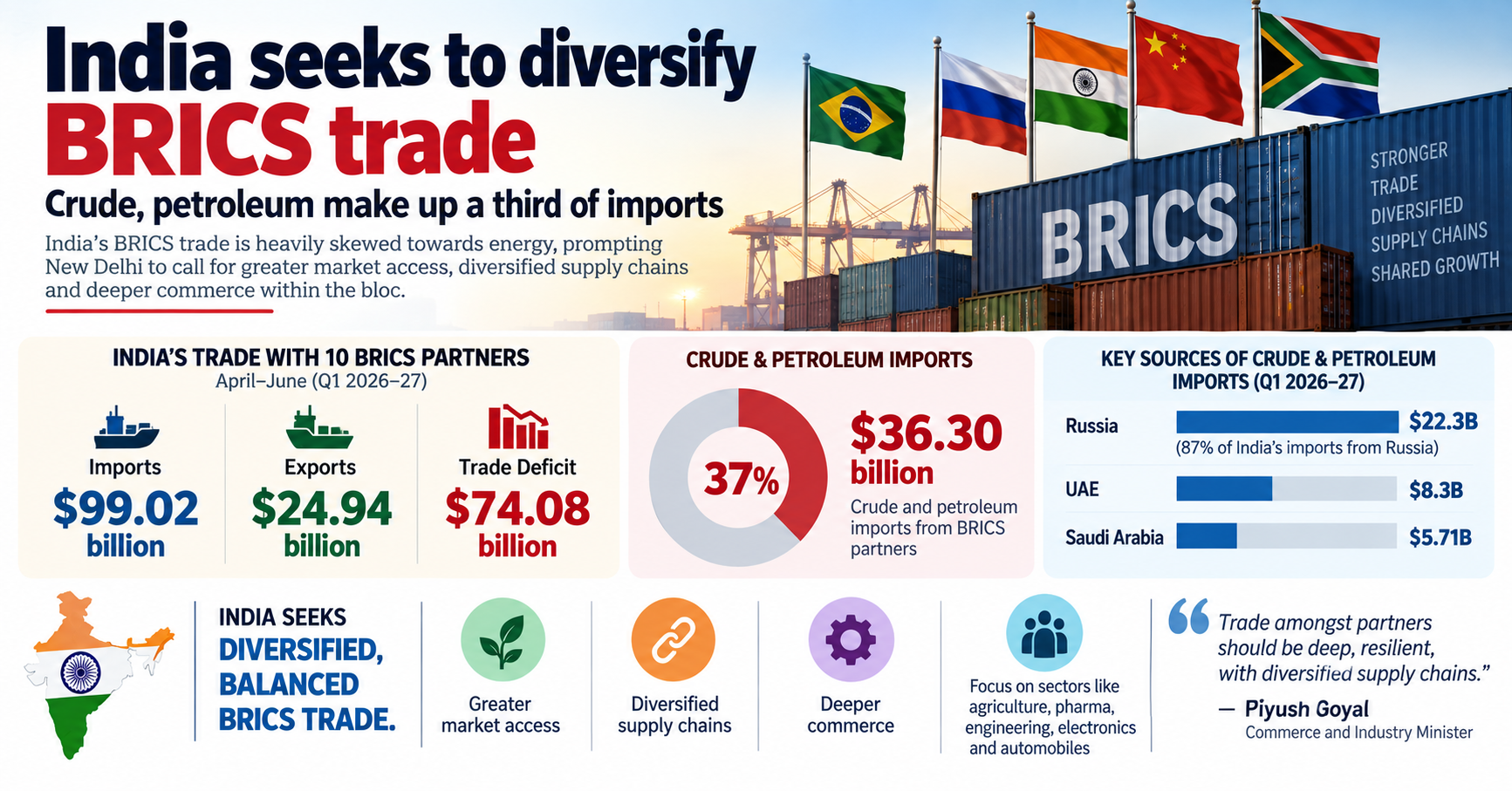
India’s BRICS trade deficit is becoming harder to ignore. In the first quarter of FY2026-27, India imported goods worth $99.02 billion from 10 BRICS partner countries but exported only $24.94 billion, leaving a massive $74.08 billion trade deficit.
The striking part is what India is buying. Crude oil and petroleum alone accounted for $36.30 billion, or nearly 37% of total BRICS imports during April-June.
That imbalance explains why New Delhi is pushing for more diversified trade, wider market access and stronger supply-chain links as leaders gather for the 18th BRICS Summit in New Delhi.
Track Live : GIFT Nifty Live – Today Price, Chart, Timings and Nifty Opening Signal
India Faces $74 Billion Trade : Crude oil dominates India’s BRICS import bill
Energy remains at the centre of India’s trade with several BRICS partners.
India imported around $25.6 billion of goods from Russia during the quarter. Of this, approximately $22.3 billion came from crude oil and petroleum products, meaning energy accounted for nearly 87% of India’s imports from Russia.
The UAE was another major source of crude and petroleum, with imports of about $8.3 billion. Saudi Arabia followed with approximately $5.71 billion.
Overall imports from the UAE stood at around $15.02 billion, while imports from Saudi Arabia were approximately $7.56 billion.
The numbers underline why energy diversification has become an important part of India’s BRICS trade strategy.
Trade Imbalance Numbers
- Total Trade: Rose from $203.1 billion in FY2021 to $417.5 billion in FY2025–26.
- Imports vs. Exports: While exports grew by 48.8% (to $95.7 billion), imports jumped by 131.8% (to $321.8 billion).
- Widening Deficit: The overall trade deficit with the bloc more than tripled from $74.5 billion to $226.1 billion over a five-year span. In early fiscal windows like April–June 2026 alone, the deficit touched approximately $74 billion.
China remains India’s biggest BRICS import source
China presents a very different picture.
India imported approximately $38.04 billion worth of goods from China during April-June, making it the largest BRICS import source overall.
Unlike Russia and the Gulf producers, however, India’s imports from China are not primarily driven by crude oil. The trade relationship is much broader, covering manufactured goods and other products.
For investors, this distinction matters because the composition of imports can influence sectors ranging from oil and gas to manufacturing, electronics, chemicals and engineering.
Track Live : Gap Up / Gap Down Stocks – Today’s NSE Opening Gaps
Breakdown of Key Import Partners
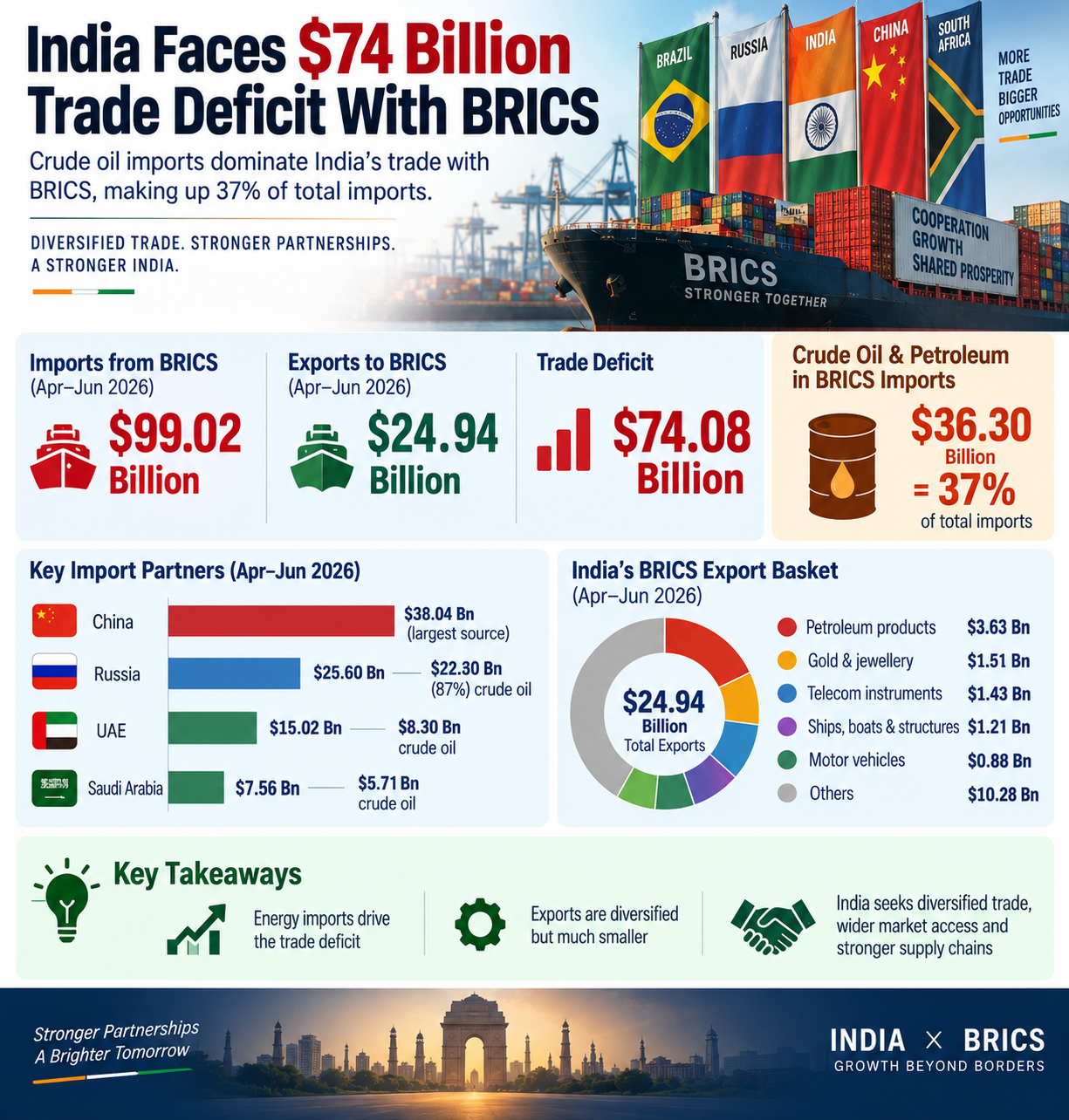
- China: $38.04 billion (Non-energy dominant; primarily manufactured goods).
- Russia: $25.60 billion total imports — $22.30 billion (87%) was crude oil and petroleum.
- UAE: $15.02 billion total imports — $8.30 billion was crude and petroleum.
- Saudi Arabia: $7.56 billion total imports — $5.71 billion was crude and petroleum.
India’s BRICS exports are more diversified but much smaller
India exported goods worth $24.94 billion to the 10 BRICS partners during the quarter.
Petroleum products were the largest individual export category at $3.63 billion, followed by gold and other precious-metal jewellery at $1.51 billion.
Telecom instruments contributed around $1.43 billion, while ships, boats and floating structures accounted for about $1.21 billion.
India also exported around $875 million of motor vehicles and cars, while drug formulations and biologicals stood at $608 million.
Copper and copper products were worth about $594 million, precious and semi-precious stones $585 million, organic chemicals $566 million and buffalo meat $551 million.
This shows that India’s BRICS export basket extends beyond petroleum into pharmaceuticals, electronics, automobiles, chemicals and engineering-related products.
The problem is scale. Export flows remain substantially smaller than India’s import bill.
Also Read : Income Tax 2026-27: Before Paying Capital Gains Tax, Check Whether You Have an Unused Exemption
India’s Diversified Export Basket
- Petroleum Products: $3.63 billion (14.6% of total exports)
- Gold & Precious Jewellery: $1.51 billion
- Telecom Instruments: $1.43 billion
- Ships, Boats & Floating Structures: $1.21 billion
- Motor Vehicles & Cars: $875 million
- Pharma (Drug Formulations & Biologicals): $608 million
- Copper and Organic Chemicals: $1.16 billion combined
Which sectors could benefit from deeper BRICS trade
Goyal has identified several areas where India could expand its BRICS exports, including agriculture, pharmaceuticals, engineering, electronics, automobiles and auto components, services, startups and emerging technologies.
That could create opportunities for Indian companies with exposure to export markets.
Pharmaceutical companies, engineering firms, auto-component manufacturers, electronics businesses and technology companies could benefit if improved market access translates into higher orders.
Simpler regulatory procedures and faster customs clearances could also reduce trade friction for exporters.
The Federation of Indian Export Organisations has similarly argued that BRICS should translate political engagement into measurable gains in exports, investment, technology and resilient supply chains.
The Strategy Forward
- Market Access: Pushing partners to open up to Indian agriculture, pharmaceuticals, engineering, and electronics.
- Regulatory Easing: Requesting simpler customs procedures, faster clearances, and fewer non-tariff barriers.
- Financial Integration: Linking digital payment systems and boosting trade settlements in local currencies.
1. Crude Oil Makes Up Nearly 37% of India’s BRICS Imports
- India imported $99.02 billion worth of goods from 10 BRICS partners during April–June 2026.
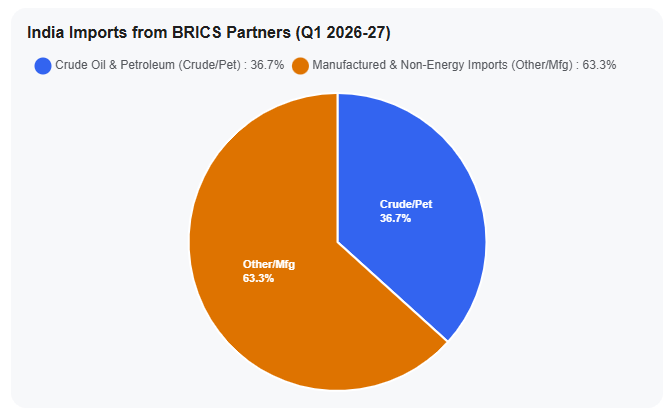
- Crude oil and petroleum alone accounted for $36.30 billion.
- That is around 36.7% of total BRICS imports.
- In simple terms, nearly ₹37 out of every ₹100 India spent on imports from BRICS partners went towards crude and petroleum.
2. India Faces a $74.08 Billion BRICS Trade Deficit
- India’s imports from the 10 BRICS partners stood at $99.02 billion.
- Exports to these countries were only $24.94 billion.
- This created a trade deficit of approximately $74.08 billion.
- The gap highlights India’s dependence on imports from the expanded BRICS grouping.
3. Russia Trade Is Dominated by Energy Imports
- India imported around $25.6 billion worth of goods from Russia.
- About $22.3 billion came from crude oil and petroleum products.
- Energy therefore accounted for roughly 87% of India’s imports from Russia.
- This makes Russia one of the clearest examples of India’s energy-heavy BRICS trade.
4. Gulf Countries Are Also Major Sources of Oil
- The UAE supplied around $8.3 billion worth of crude and petroleum.
- Saudi Arabia supplied approximately $5.71 billion.
- India’s total imports from the UAE were about $15.02 billion.
- Imports from Saudi Arabia stood at around $7.56 billion.
5. China Is India’s Biggest BRICS Import Source
- China accounted for approximately $38.04 billion of India’s imports during the quarter.
- Unlike Russia and Gulf producers, China’s exports to India are not primarily driven by energy.
- The trade relationship with China is much more focused on manufactured goods and other products.
6. India’s BRICS Exports Are More Diversified
India exported $24.94 billion worth of goods to the 10 BRICS partners.
Major export categories included:
- Petroleum products: $3.63 billion
- Gold and precious-metal jewellery: $1.51 billion
- Telecom instruments: $1.43 billion
- Ships and boats: $1.21 billion
- Motor vehicles and cars: $875 million
- Drug formulations and biologicals: $608 million
- Copper and copper products: $594 million
- Precious and semi-precious stones: $585 million
- Organic chemicals: $566 million
- Buffalo meat: $551 million
7. Petroleum Products Are India’s Biggest BRICS Export Category
- Petroleum products were India’s largest individual export category to BRICS partners.
- They were worth around $3.63 billion.
- This represented approximately 14.6% of India’s total BRICS exports.
- However, India’s export basket also includes pharmaceuticals, automobiles, telecom equipment, chemicals and engineering products.
8. India Wants More Balanced BRICS Trade
- Commerce Minister Piyush Goyal has called for deeper and more balanced trade within BRICS.
- India wants trade flows to become more diversified and two-way.
- Goyal said supply chains should be resilient and should “run both ways.”
- India is seeking greater market access for its products across BRICS economies.
9. India Wants BRICS Markets Opened Further
Goyal has called for BRICS countries to:
- Open markets to each other’s products
- Improve access to raw materials and critical minerals
- Simplify regulatory procedures
- Speed up customs clearances
- Reduce non-tariff barriers
- Make cross-border trade easier
10. India Wants to Expand Non-Oil Exports
India is looking at several sectors to reduce its dependence on energy-heavy trade.
Key areas include:
- Agriculture
- Pharmaceuticals
- Engineering
- Electronics
- Automobiles
- Auto components
- Services
- Startups
- Emerging technologies
11. India Is Pushing for Local-Currency Trade
- Goyal has urged BRICS members to increase trade using local currencies.
- India also wants BRICS countries to link their payment systems.
- The aim is to make cross-border payments faster, cheaper and more accessible.
- Goyal highlighted India’s UPI infrastructure as a potential foundation for greater digital-payment cooperation.
- He said UPI is already accepted in 11 countries.
12. BRICS Trade Has Grown Rapidly
- Trade among BRICS countries has expanded significantly over the past two decades.
- India’s Commerce Secretary Rajesh Agrawal said intra-BRICS trade increased from $84 billion in 2003 to nearly $1.2 trillion in 2024.
- The rapid expansion makes reducing trade barriers and improving payment connectivity increasingly important.
13. Non-Tariff Barriers Are Another Challenge
- India is also concerned about non-tariff measures that make exports more expensive.
- Goyal said such measures can impose export costs greater than tariffs in many countries.
- India wants simpler regulations and faster clearance procedures across BRICS markets.
What this means for investors and the Indian market
The immediate takeaway is that India’s BRICS trade deficit remains heavily influenced by energy imports.
For oil-sensitive sectors, crude prices and India’s import bill will remain important market variables. At the same time, stronger BRICS market access could benefit Indian export-oriented businesses if trade diversification becomes a reality.
The opportunity is particularly relevant for pharmaceuticals, engineering, electronics, automobiles, chemicals and technology companies.
The next few days could therefore bring greater attention to trade agreements, payment-system cooperation, market-access measures and supply-chain announcements from the summit.
India’s objective is becoming clearer: turn BRICS from an energy-heavy import relationship into a broader trade and investment opportunity. Whether that can narrow the $74.08 billion deficit will depend on how quickly India’s export capabilities translate into actual demand across BRICS markets.