India’s foreign-exchange reserves are already off their peak, while BNP Paribas warns that the foreign-currency inflows supporting part of the recent liquidity boost are likely to reverse over the next three to five years.
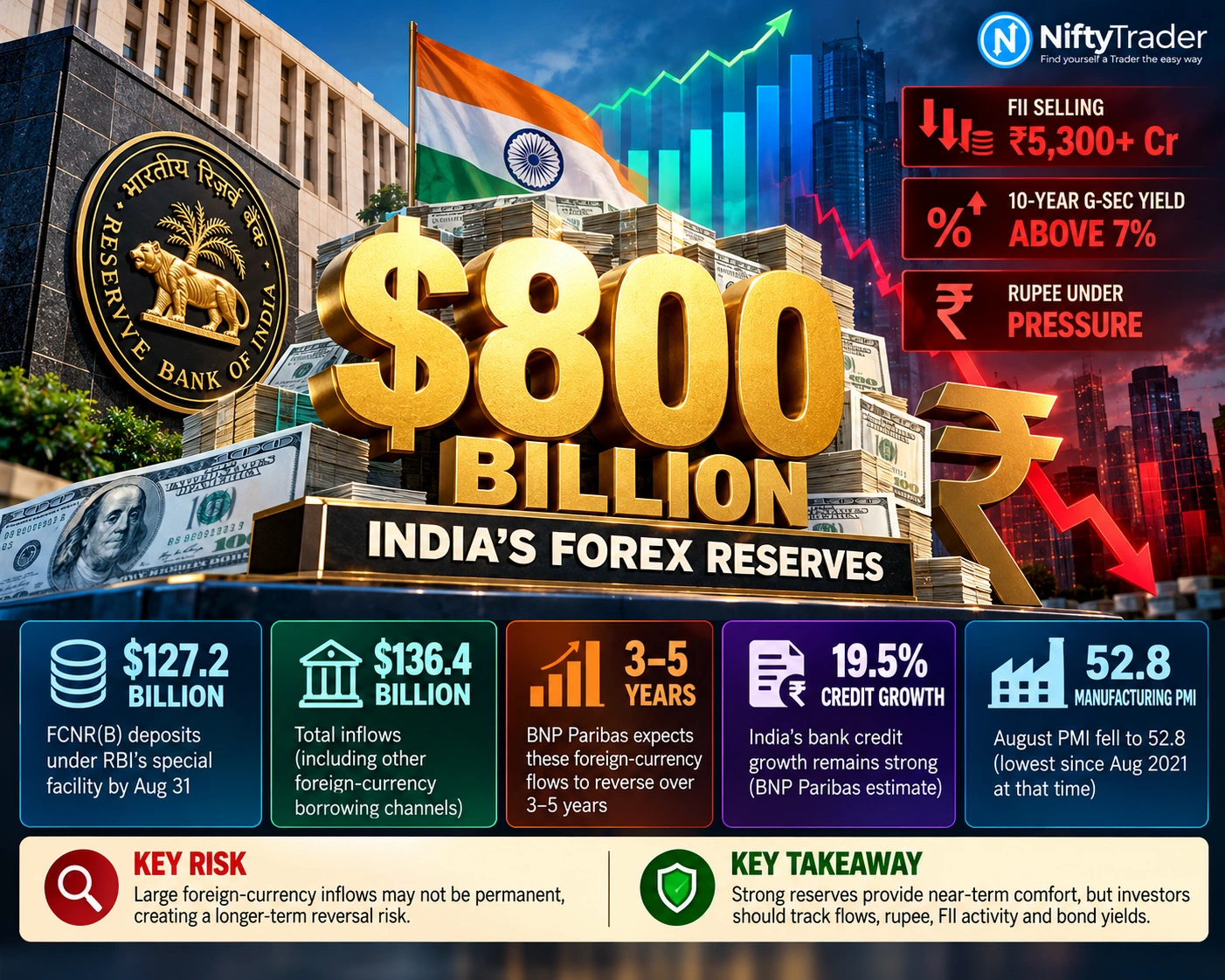
BNP Paribas India says roughly $127 billion of FCNR(B) flows has helped strengthen India’s external buffers, and it cites reserves of about $800 billion. The RBI’s latest weekly data are lower. The warning comes as the rupee has weakened about 1% over two weeks, foreign investors have resumed selling Indian equities and the 10-year government bond yield has moved above 7%.
RBI data show reserves at $765.90 billion in the week ended September 18, down $14.88 billion from $780.78 billion a week earlier and below the record $785.71 billion reached on September 4. The latest figure remains $74.79 billion above end-March levels.
Why the India Forex Reserves Headline Needs Context
BNP Paribas’ concern is about duration, not adequacy.
The RBI said on September 2 that banks had mobilised a little over $127 billion through FCNR(B) deposits by August 31 under its special swap facility. A September 21 update raised the FCNR(B) figure to $132.98 billion as of September 18, because banks were allowed to swap deposits raised up to August 31 until September 11. Including overseas foreign-currency borrowings and external commercial borrowings, total inflows under the facility reached $143.6 billion.
The deposits carry three-to-five-year tenors, and the RBI absorbed the hedging cost on the principal. Under the swap, banks sell the dollars to the RBI and receive rupees, and the foreign-currency leg is reversed later. The inflows therefore add to reserves and liquidity today but create a maturity obligation for the central bank, which the gross weekly reserve figure does not net off. Counting three-to-five-year tenors from June 2026, the money falls due between roughly 2029 and 2031.
S&P Global Ratings has called the mobilisation broadly positive for banks. It equals about 4.5% of the banking system’s deposits at March 31, 2026, S&P said, and the long tenor improves funding stability. The reserve headline therefore offers a large cushion today, while the tenor of the inflows sets a longer-term test.
Also Read: India’s Forex Reserves Hit $740.8 Billion—Here’s What Drove the Jump
$127 Billion FCNR Boost Meets a Tougher Global Backdrop
The maturity question is arriving against a harder global backdrop. BNP Paribas says India’s macro outlook has weakened in recent weeks as Brent crude rose above $100 a barrel and US 10-year Treasury yields moved towards 5%. It says the RBI now has less room to keep interest rates unchanged.
The ECB and the Bank of Japan have each raised rates by 25 basis points, which BNP says raises capital-flight risks for India.
Kunal Vora, head of India equity research at BNP Paribas India, said the outlook is sensitive to oil prices and that the latest Middle East escalation is a negative.
FII Selling Adds to the Pressure
FIIs net sold ₹5,353.22 crore of Indian equities on September 28 on provisional exchange data, their biggest single-day outflow in September, according to Moneycontrol. DIIs bought ₹5,189.02 crore. FIIs were net sellers in four of the five sessions in the week ended September 25, with buying only on September 23, before selling again on Monday, their third straight session of net selling.
The Nifty 50 fell 1.56% to 22,780.25, near a six-month low, and the Sensex declined 1.52%. The rupee ended near ₹96 per dollar, and Brent climbed to around $108 at one point in the session.
Track daily institutional flows on NiftyTrader’s FII-DII data page: niftytrader.in/fii-dii-data
Growth Signals Are Mixed
RBI data show bank credit growth at 18.1% year-on-year as of September 15, down from 19.1% at end-August. Deposit growth was 17.3%, compared with 17.8% at end-August.
Manufacturing has shown a sharp change in direction. The HSBC India manufacturing PMI fell to 52.8 in August from 53.5 in July, its weakest reading since August 2021. The September flash PMI then rebounded to 55.7, a seven-month high. The final September reading is due on October 1.
BNP Paribas also points to inflation, falling urban wages, weaker rural indicators and reduced crop sowing. At the same time, it lists strong credit growth, auto sales, improving jobs data and large food-grain holdings as cushions.
What to Watch Next
Investors will watch the next weekly RBI reserves print for signs of whether the September 18 fall continues, along with FCNR(B) flows and maturities, USD/INR, FII activity and the 10-year yield around 7%. The final September PMI on October 1 and the RBI’s October policy meeting are the next scheduled tests.
Bottom Line
India still has a substantial external reserve cushion, but the market question is shifting from the size of the buffer to the durability of the flows behind it. BNP Paribas expects the FCNR(B) support to reverse over three to five years, while higher oil prices, global yields and renewed FII selling are creating nearer-term pressure. The September PMI rebound offers a counterpoint, leaving a mixed picture rather than a one-way signal.
BNP’s warning is not that India’s reserves are inadequate today. It is that part of the recent liquidity boost comes from foreign-currency deposits with a finite tenor, which makes the maturity cycle an important longer-term risk to watch.
Read Next: FEMA Rules From Oct 1: RBI Keeps Export Deadline at 9 Months
Disclaimer: This article is for informational purposes only and does not constitute investment advice. Market conditions and economic data can change, and investors should verify information before making financial decisions. (Swap in your standard SEBI disclaimer block before publishing.)