
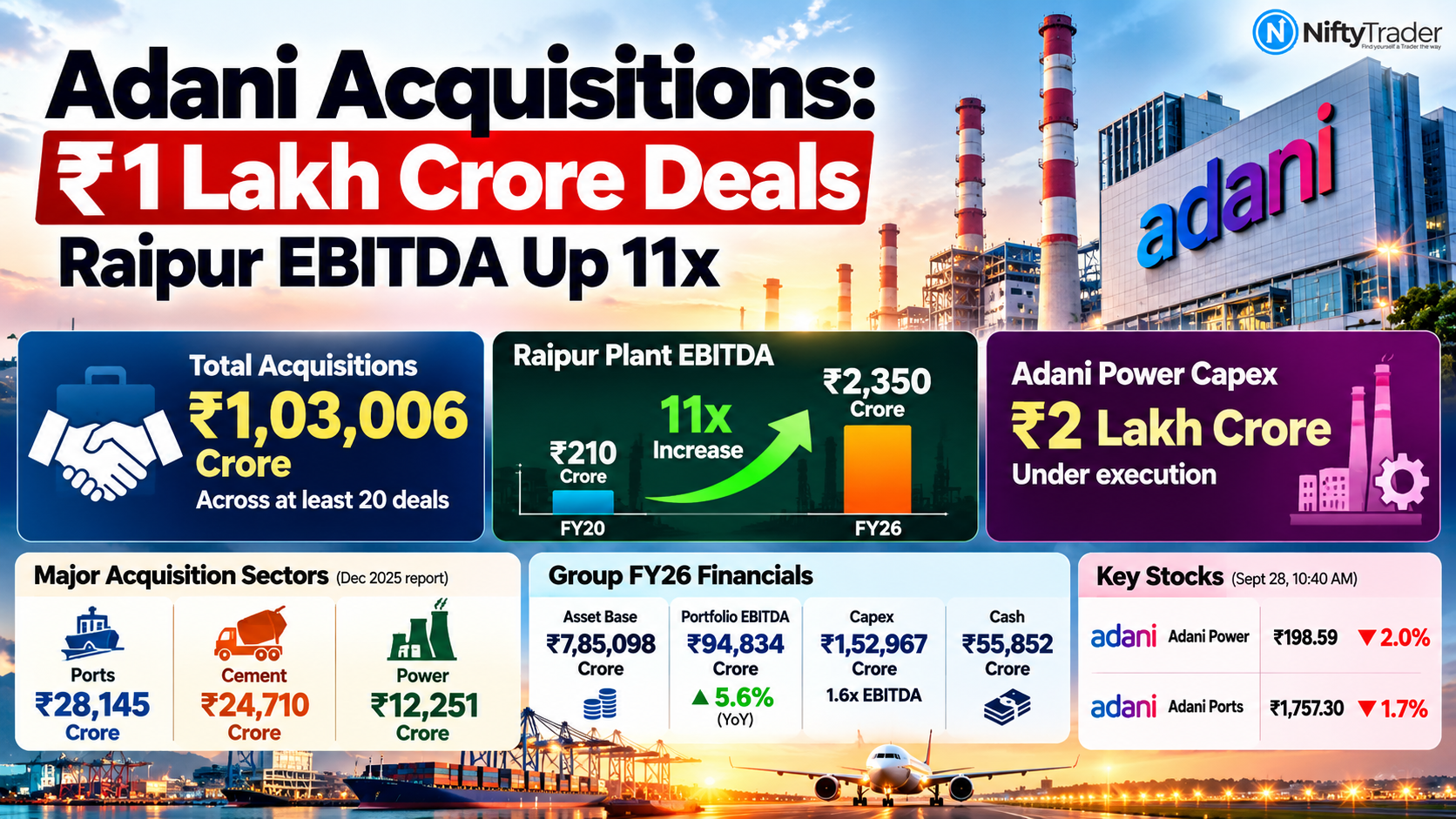
Adani Group’s acquisition spree has crossed ₹1 lakh crore across at least 20 deals, and three stressed power plants show why it kept buying. Raipur’s EBITDA rose from ₹210 crore in FY20 to about ₹2,350 crore in FY26, more than 11 times, according to ETMarkets.
The harder question is what comes next. Adani Power is executing a capex programme of about ₹2 lakh crore, and the group’s FY26 capex of ₹1,52,967 crore was already about 1.6 times its portfolio EBITDA of ₹94,834 crore.
Adani stocks traded lower on September 28. Around 10:40 am IST, Adani Power was down about 2% at ₹198.59, while Adani Ports was down about 1.7% at ₹1,757.30, according to INDmoney data.
TRACK LIVE: ADANI POWER Options Chart | Nifty Trader
What the ₹1.03 Lakh Crore Figure Actually Covers
The ₹1,03,006 crore figure is an analyst estimate of a mixed acquisition basket, cited by ETMarkets. It includes insolvency-led resolutions, deleveraging-driven sales and strategic platform purchases. It should not be read as 20 distressed assets.
Totals also change with the counting window. A December 2025 Outlook Business report, citing market data and company sources, put 33 acquisitions since January 2023 at about ₹80,000 crore. Ports accounted for ₹28,145 crore, cement ₹24,710 crore and power ₹12,251 crore. The two tallies differ in scope and time window, so they are not directly comparable.
Also Check: ADANI PORTS AND SPECIAL ECONOMIC ZONE Options Chart
Three Power Plants Carry the Turnaround Case
The clearest evidence sits in Adani Power’s acquired thermal assets, according to Prabhudas Lilladher, cited by ETMarkets.
Raipur: EBITDA of ₹210 crore in FY20 to about ₹2,350 crore in FY26, more than 11x.
Raigarh: a loss of about ₹100 crore in FY20 to about ₹1,110 crore in FY26.
Mahan: about ₹550 crore in FY22 to about ₹1,600 crore in FY26, nearly 3x.
Adani Power’s inorganic thermal portfolio totals 7.45 GW. Its latest investor presentation splits this into 4.37 GW of rapidly turned-around capacity at Udupi, Raipur, Raigarh and Mahan, and 3.08 GW of more recent additions at Korba, Mutiara, Dahanu, Butibori and Churk.
Prabhudas Lilladher takes a broader view, saying more than 7 GW has been turned around. The gap matters because the newer 3.08 GW has a shorter operating record under Adani ownership.
Why Brownfield Changes the Math
Adani Power is adding new units at Raipur, Raigarh, Mahan and Korba, which lets it reuse land, transmission connections and plant infrastructure. About 60% of planned capacity is brownfield, according to the company’s presentation.
Operating capacity of 18.33 GW plus 23.72 GW of locked-in projects gives 42.05 GW. Management’s broader target is 45 GW, which adds about 3 GW of proposed capacity. On the July 23 earnings call, the CEO described that 3 GW as planning for future state bids, with capex and equipment orders not yet firmed up. Commissioning is targeted around FY32.
Offtake is the key variable. Long-term PPAs cover 13.32 GW, about 56% of the 23.72 GW expansion, which leaves roughly 10.4 GW still to be contracted. By contrast, 95% of operating capacity is tied up under long and medium-term PPAs, management said. The CEO said state tenders of about 13 GW are in the market.
Timelines have already moved. The 1,320 MW Korba Phase 2 is due before December but has no PPA yet. Even if one is signed this year, management said it would likely sell merchant power for a year or two first. Mahan Phase II (1,600 MW) is now scheduled for commercial operation in the first quarter of FY28.
On the April call, management said it was deferring commissioning by about six months on average, citing labour availability and supply disruptions linked to the geopolitical situation. A Jefferies analyst noted on that call that planned FY27 additions had fallen from 2.9 GW to 1.32 GW.
Funding and the EBITDA Payoff
Management guided Adani Power capex to about ₹23,000 crore in FY27, above ₹30,000 crore in FY28 and ₹33,000-35,000 crore a year after that. Net debt was ₹47,643 crore on June 30, 2026. Management said net debt to EBITDA was slightly above 2x and would not cross 3x. The board has also sought shareholder approval for a QIP as an enabling provision, with no timeline announced.
The payoff case rests on EBITDA. The CEO said ₹50,000 crore could come conservatively by 2031, against reported FY26 EBITDA of ₹23,431 crore.
The Same Playbook in Ports, Airports and Grids
ETMarkets reports port deal values of ₹705 crore for Dighi, ₹13,675 crore for Krishnapatnam, ₹1,485 crore for Karaikal and ₹3,080 crore for Gopalpur. Together these add up to about ₹18,945 crore.
Adani acquired Mumbai International Airport in 2021 in a deal reported at ₹15,000 crore. The airport business now spans eight airports and handled 95.3 million passengers in FY26, according to the group.
ETMarkets also reported a primary equity raise of about $1 billion, or roughly ₹9,800 crore, for Adani Airport Holdings. It cited a roughly ₹1.7 lakh crore valuation estimate from Motilal Oswal, which is a broker estimate and not an audited figure.
Adani Energy Solutions reported a ₹71,779 crore transmission pipeline and 1 crore smart meters installed. Adani Green added about 5.1 GW in FY26, taking operational capacity to 19.3 GW.
The Group-Level Scoreboard
Adani’s FY26 portfolio disclosure shows an asset base of ₹7,85,098 crore, portfolio EBITDA of ₹94,834 crore (up 5.6%) and cash of ₹55,852 crore. Net debt to EBITDA was 3.3x against guidance of 3.5x.
That is tighter than Adani Power’s own leverage. Capex ran at about 1.6 times EBITDA, and capex usually precedes earnings by years. A 5.6% EBITDA rise is therefore not a verdict on the new projects, but it shows how much of the payoff still lies ahead.
What to Watch
Adani has shown it can lift earnings at selected acquired assets. The next phase carries project delays, financing costs, approvals, offtake gaps and utilisation risk. Broker projections, including those from Jefferies and Prabhudas Lilladher, are external estimates rather than company guidance.
Four markers will show whether the model scales: commissioning dates at Korba and Mahan, PPA coverage for the remaining 10.4 GW, leverage against guidance, and incremental EBITDA per rupee of new capex.
To see how institutions are positioning in Adani stocks, use NiftyTrader’s FII-DII Tracker at niftytrader.in/fii-dii-data.
Bottom Line
The ₹1.03 lakh crore was the entry ticket. Raipur, Raigarh and Mahan show the model can work on assets with existing land and grid access. Whether it repeats at 42 to 45 GW depends on timely commissioning, contracted offtake and a balance sheet that stays inside its own guardrails.
Read Next: Tax Audit Due Date Sept 30: 4 Form 3CD Disclosures That Could Alter Your Tax Position
Disclaimer: This article is for informational and educational purposes only. It is not investment advice or a recommendation to buy, sell or hold any security. Investments in securities markets are subject to market risks. Company targets, broker estimates and reported valuations are forward-looking or third-party assessments and may differ from actual outcomes. Please consult a SEBI-registered investment adviser before making investment decisions.