SEBI found a ₹46.50 crore funding trail linked to Omaxe shares in 2013 OFS deals and restrained the company for three months, while five others face one-year market restrictions.
Need to Know
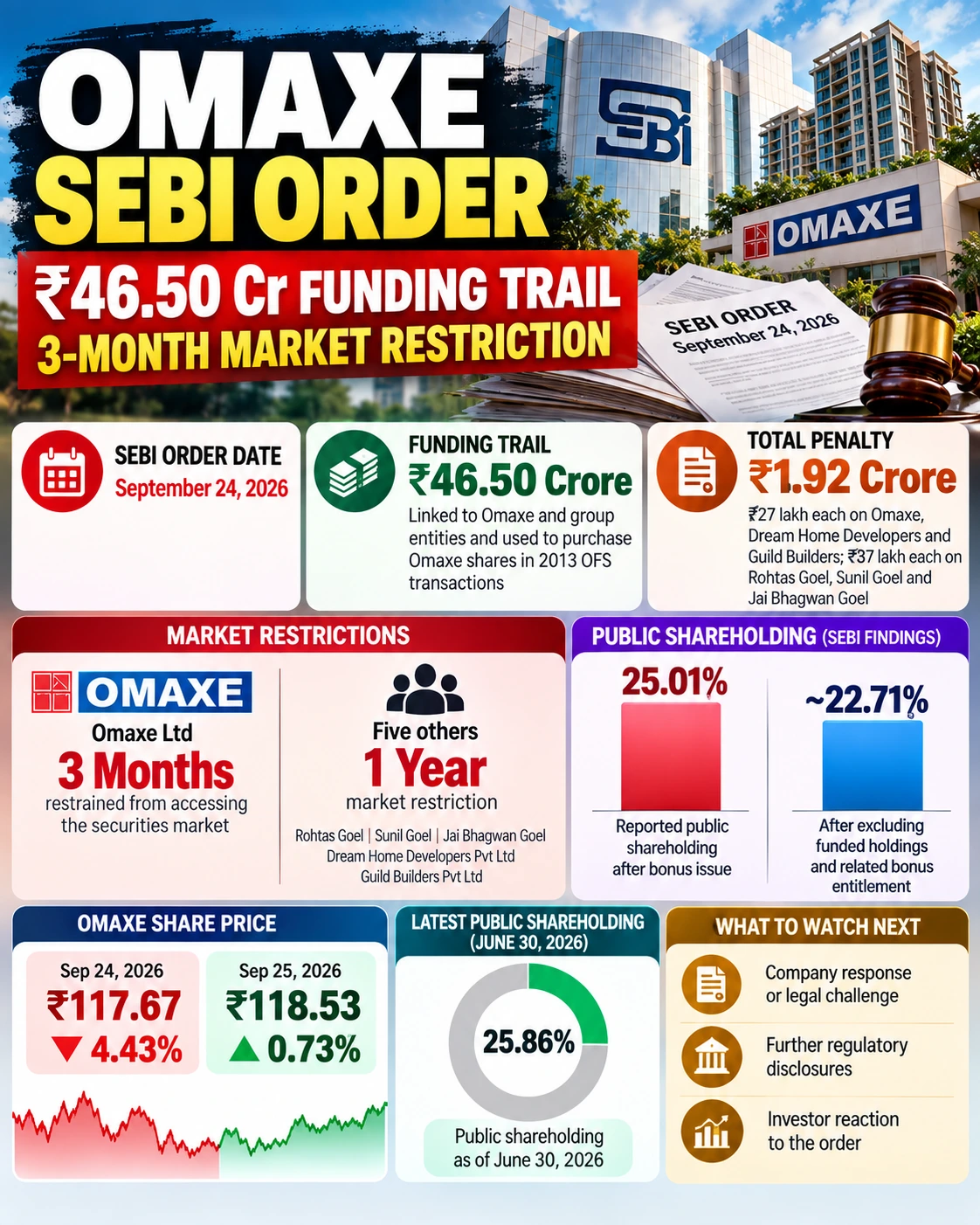
- The Securities and Exchange Board of India (SEBI) passed its order on September 24, 2026, in a case concerning Omaxe Ltd’s historical compliance with minimum public shareholding (MPS) requirements.
- SEBI restrained Omaxe from accessing the securities market for three months. Rohtas Goel, Sunil Goel, Jai Bhagwan Goel, Dream Home Developers Pvt Ltd and Guild Builders Pvt Ltd were restrained for one year.
- The regulator imposed a combined ₹1.92 crore penalty — ₹27 lakh each on Omaxe, Dream Home Developers and Guild Builders, and ₹37 lakh each on Rohtas Goel, Sunil Goel and Jai Bhagwan Goel.
- SEBI said ₹46.50 crore originating from Omaxe and group entities was routed through DVM Realtors Pvt Ltd, Garv Buildtech Pvt Ltd and Jeet Builders Pvt Ltd and ultimately used to fund purchases of Omaxe shares during two 2013 Offer for Sale (OFS) transactions.
- The regulator said that after a subsequent bonus issue, the reported 25.01% public shareholding would have been about 22.71% after excluding the funded holdings and associated bonus entitlement.
Omaxe SEBI Order: Why the ₹46.50 Crore Trail Matters
The latest SEBI action goes back more than a decade, but its central issue is straightforward: whether Omaxe’s reported public shareholding genuinely represented independent public ownership.
According to SEBI, money originating from Omaxe and related group entities was routed through multiple companies and eventually used to acquire Omaxe shares during the June 3, 2013 and October 29, 2013 OFS windows. The entities receiving the shares were subsequently disclosed as public shareholders.
SEBI said the transactions could not be viewed as isolated fund transfers or independent acquisitions because the funding trail ultimately led back to Omaxe or group entities. The regulator concluded that the arrangement created the appearance of independent public shareholding while the underlying funding indicated otherwise.
This was not a conventional company share buyback. The issue relates specifically to how shares were acquired in Omaxe’s OFS transactions and then reflected in the company’s public-shareholding disclosures.
The MPS Expectation Gap: 25.01% vs 22.71%
Minimum public shareholding rules require listed companies to maintain the prescribed public ownership threshold. In Omaxe’s case, SEBI examined whether the reported holdings used to meet that requirement were genuinely independent.
The difference becomes clearer when the regulator’s calculations are placed side by side:
| Historical stage | Reported public shareholding | Figure after excluding funded holdings |
|---|---|---|
| After June 3, 2013 OFS | 16.21% | ~14.57% |
| After October 29, 2013 OFS | 20.97% | ~19.04% |
| After subsequent bonus issue | 25.01% | ~22.71% |
Source: SEBI findings as reported from the September 24 order.
The final comparison is the key expectation gap in the case. On the reported numbers, Omaxe’s public shareholding reached 25.01% after the bonus issue. SEBI said that excluding the funded holdings and the consequential bonus entitlement would have reduced that figure to around 22.71%.
How the ₹46.50 Crore Funding Trail Worked
SEBI said Omaxe and group entities routed ₹46.50 crore through:
- DVM Realtors Pvt Ltd (DRPL)
- Garv Buildtech Pvt Ltd
- Jeet Builders Pvt Ltd (JBPL)
The funds were ultimately used to finance acquisitions of Omaxe shares during the two 2013 OFS transactions.
A separate analysis of the SEBI order reported that the identified entities received a total of 33.42 lakh Omaxe shares across the two OFS tranches — 28.50 lakh shares in June 2013 and another 4.92 lakh shares in October 2013.
That detail helps explain why SEBI focused on the substance of the shareholding rather than simply the percentage disclosed on paper.
Who Has Been Barred by SEBI?
| Party | Market restriction | Penalty |
|---|---|---|
| Omaxe Ltd | 3 months | ₹27 lakh |
| Rohtas Goel | 1 year | ₹37 lakh |
| Sunil Goel | 1 year | ₹37 lakh |
| Jai Bhagwan Goel | 1 year | ₹37 lakh |
| Dream Home Developers Pvt Ltd | 1 year | ₹27 lakh |
| Guild Builders Pvt Ltd | 1 year | ₹27 lakh |
| Total | — | ₹1.92 crore |
SEBI’s directions also prohibit the named parties from buying, selling or otherwise dealing in securities, including mutual fund units, directly or indirectly, during their respective restraint periods.
Importantly, the order does not amount to an exchange trading suspension of Omaxe shares.
Omaxe Share Price: What Happened After the SEBI Order?
The stock reaction has so far been mixed rather than one-directional.
Omaxe shares closed at ₹117.67 on September 24, 2026, down 4.43%, according to historical market data. On September 25, the stock recovered to ₹118.53, up 0.73%, after trading between ₹116 and ₹122.70.
| Date | Close | Change |
|---|---|---|
| September 23, 2026 | ₹123.13 | +5.69% |
| September 24, 2026 | ₹117.67 | -4.43% |
| September 25, 2026 | ₹118.53 | +0.73% |
The immediate price response therefore does not provide a clear market conclusion. The stock’s movement across September 24 and 25 shows some market tension, but it is too early to determine whether the SEBI order will become a sustained overhang.
Omaxe’s Latest Shareholding: Public Holding Still Above 25%
The SEBI case concerns historical transactions, so it should not be confused with the company’s latest disclosed shareholding position.
As of June 30, 2026, Omaxe reported 74.14% promoter holding and 25.86% public shareholding. FII/FPI ownership stood at 5.33%, while institutional investors held 6.73%.
The current disclosed structure is therefore above the 25% threshold. The September 24 order instead examines whether the historical public shareholding used to demonstrate compliance during the relevant period represented genuinely independent ownership.
This distinction matters for investors because the regulatory finding is about historical MPS compliance, not a statement that Omaxe’s June 2026 disclosed public shareholding was 22.71%.
Omaxe FY26 Financials Add Another Pressure Point
The regulatory development comes against a weak FY26 financial backdrop.
According to Omaxe’s audited consolidated results, revenue from operations fell to ₹1,253.40 crore in FY26 from ₹1,560.99 crore in FY25, a decline of about 19.7%. The company reported a consolidated net loss of ₹696.80 crore, compared with a ₹685.40 crore loss in FY25. Loss before tax stood at ₹899.12 crore.
| FY | Revenue from operations | Net loss |
|---|---|---|
| FY25 | ₹1,560.99 crore | ₹685.40 crore |
| FY26 | ₹1,253.40 crore | ₹696.80 crore |
The financial picture adds another layer to the market’s assessment of the regulatory action. The ₹1.92 crore penalty itself is relatively small compared with the company’s reported annual loss, but the regulatory findings, legal response and future disclosures could matter more for investor sentiment.
Earlier SEBI Litigation Is a Separate Case
The latest MPS order is also separate from an earlier SEBI matter involving Omaxe.
The Securities Appellate Tribunal (SAT) delivered its order on September 1, 2026 in an appeal involving Omaxe and others against an earlier SEBI proceeding. The case was separate from the September 24 MPS order and involved a different regulatory dispute.
That distinction is important because readers could otherwise assume the September action is a continuation of the same proceeding.
What Does the SEBI Order Mean for Omaxe Investors?
For shareholders and traders, three developments deserve attention.
First, the three-month market-access restriction on the company is a direct regulatory consequence and is separate from the day-to-day exchange trading of the stock.
Second, the historical MPS issue goes beyond a simple percentage shortfall. SEBI’s finding focused on the source of funds used to acquire shares that were later counted as public holdings.
Third, the stock’s recent movement shows that the market has not yet produced a clear, lasting response. Omaxe fell 4.43% on September 24 and recovered 0.73% on September 25, leaving uncertainty over how investors will weigh the regulatory action against the company’s existing financial position.
What Happens Next?
The most important forward-looking risk is the company’s response to the SEBI order.
Any subsequent regulatory disclosure, legal challenge, clarification or related exchange filing could change how investors interpret the action. The company’s financial performance also remains relevant because FY26 revenue declined while the consolidated loss widened slightly.
For the market, the immediate question is not simply whether Omaxe can continue trading. It is how the company addresses the findings, whether further proceedings follow and whether the regulatory action affects investor confidence over a longer period.
Omaxe SEBI Order: The Bigger Picture
The September 24 order highlights the difference between reported public shareholding and independent public shareholding.
SEBI found that funds originating from Omaxe and group entities were used through multiple entities to finance Omaxe share purchases in the 2013 OFS transactions. The regulator said this created the appearance of independent public ownership and concluded that the arrangement violated securities-market and MPS requirements.
For investors, the most important numbers are clear: ₹46.50 crore in the funding trail, a 25.01% reported public holding versus about 22.71% after SEBI’s adjustment, a three-month restraint for Omaxe, one-year restrictions for five others and ₹1.92 crore in penalties.
The longer-term market impact remains uncertain and will depend on the company’s response, any further regulatory or legal developments and how investors assess the issue alongside Omaxe’s financial performance.
Read Next: RBI Bulletin: 7.8% GDP Growth, But Forex Reserves Slide $14.9 Billion
FAQ
What did SEBI find in the Omaxe case?
SEBI found that certain entities disclosed as public shareholders had acquired Omaxe shares using funds originating from Omaxe and its group entities. The regulator said this affected the genuineness of the company’s historical minimum public shareholding compliance.
How much money was involved in the Omaxe funding trail?
SEBI identified a ₹46.50 crore funding trail routed through DVM Realtors, Garv Buildtech and Jeet Builders and ultimately used to finance Omaxe share acquisitions during the June and October 2013 OFS transactions.
How long is Omaxe barred from the securities market?
Omaxe has been restrained from accessing the securities market for three months. Five other named parties have been restrained for one year.
Is Omaxe share trading suspended?
No exchange-wide trading suspension is stated in the September 24 SEBI order. Omaxe shares continued to trade, closing at ₹118.53 on NSE on September 25, 2026.
What is Omaxe’s latest public shareholding?
As of June 30, 2026, Omaxe reported 25.86% public shareholding, with promoters holding 74.14%. FII/FPI ownership was 5.33%.