Rs.1.12 Lakh Crore Erased in Financial Stocks: Bajaj Finance, PB Fintech Among Key Losers
The Indian stock market came under fresh selling pressure on Thursday, September 24, as financial stocks took a major hit. A regulatory proposal on insurance commissions added to investor concerns already building around higher global bond yields and rising crude oil prices.
The sharpest question for investors now is whether the pressure on financial stocks is a one-day reaction or the beginning of a broader earnings concern.
Track Live : Nifty Levels Today | Sensex Levels Today
Rs.1.12 Lakh Crore Erased in Financial Stocks
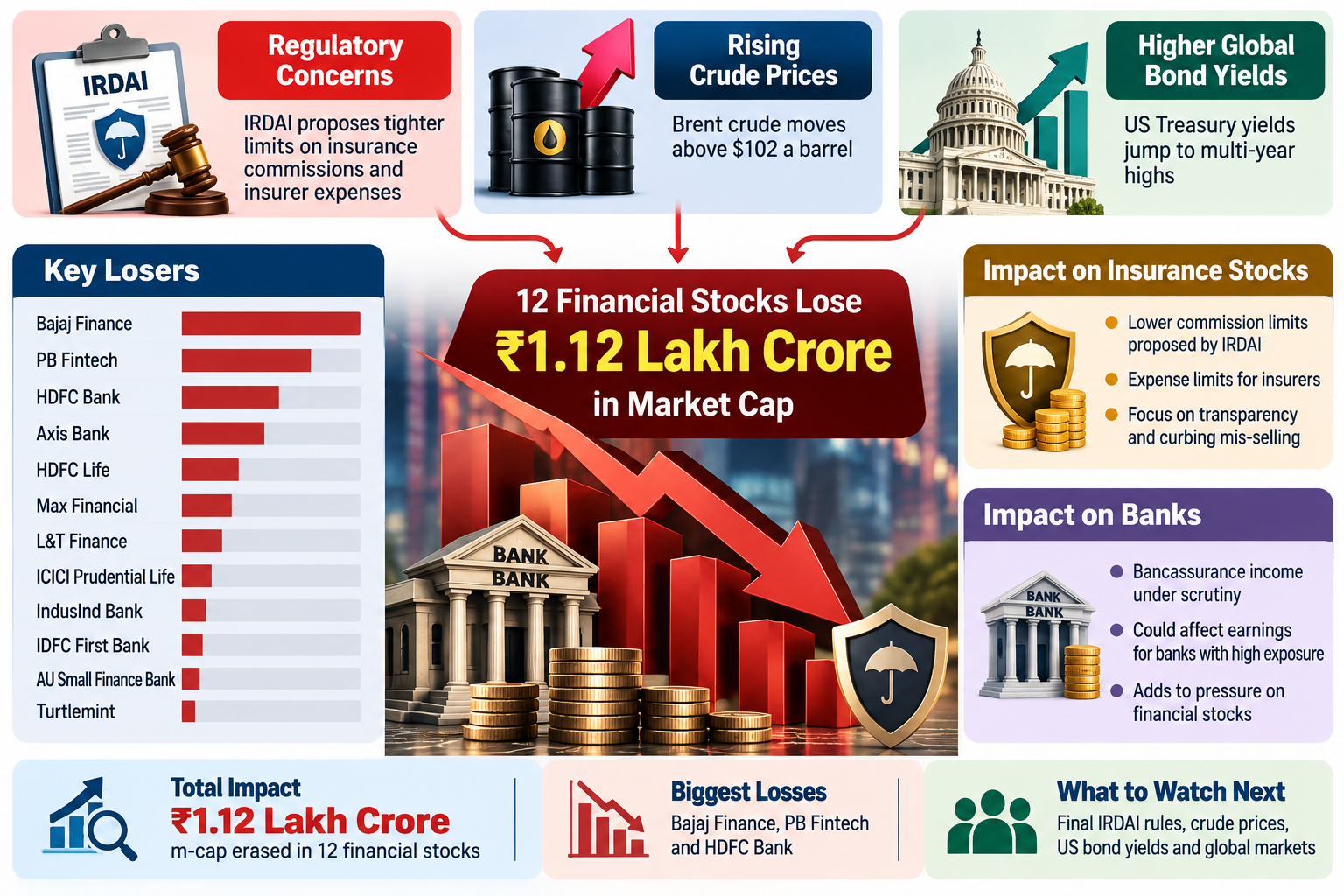
Twelve financial stocks together lost around Rs 1.12 lakh crore in market capitalisation during the intraday session.
Bajaj Finance recorded the biggest erosion at around Rs 29,000 crore, followed by PB Fintech at nearly Rs 20,000 crore and HDFC Bank at around Rs 15,000 crore.
Axis Bank lost nearly Rs 14,000 crore, while L&T Finance shed around Rs 6,200 crore.
Among insurance-linked companies, HDFC Life lost around Rs 7,600 crore, Max Financial about Rs 6,800 crore and ICICI Prudential Life nearly Rs 3,000 crore.
Turtlemint also lost around Rs 802 crore in market value.
The 12 stocks and estimated market-cap erosion
| Stock | Approx. m-cap erosion |
|---|---|
| Bajaj Finance | ₹29,000 crore |
| PB Fintech | ₹20,000 crore |
| HDFC Bank | ₹15,000 crore |
| Axis Bank | ₹14,000 crore |
| HDFC Life | ₹7,600 crore |
| Max Financial Services | ₹6,800 crore |
| L&T Finance | ₹6,200 crore |
| ICICI Prudential Life | ₹3,000 crore |
| IndusInd Bank | ₹3,000 crore |
| IDFC First Bank | ₹3,000 crore |
| AU Small Finance Bank | ₹3,000 crore |
| Turtlemint | ₹802 crore |
These figures are reported as approximate intraday market-cap changes. The individual numbers add to roughly ₹1.114 lakh crore, which is broadly consistent with the reported ₹1.12 lakh crore after rounding.
Why IRDAI’s proposal triggered the sell-off
The Insurance Regulatory and Development Authority of India has proposed a significant restructuring of insurance distribution economics through its consultation paper on “Recalibrating Economics of Insurance Distribution.” The proposals cover commissions, insurers’ expenses, distribution channels, transparency and mis-selling.
One of the biggest changes is a proposed effort-based commission framework. Instead of applying a broad uniform approach, commission limits would vary according to factors such as:
- insurance segment
- product type
- distribution channel
- product complexity
- effort required to sell and service the policy
IRDAI has also proposed greater disclosure of commission structures and stronger safeguards against mis-selling.
In simple terms, the regulator wants tighter limits on how much insurers can spend and how much distributors can earn from selling insurance products.
The proposed commission structure would vary depending on the insurance product, distribution channel and level of servicing involved.
For life insurers, the expense-of-management limit is proposed to move towards 12.5% within five years, while the corresponding limit for general insurers is proposed at 20%.
The consultation paper is open for stakeholder feedback until October 25, 2026.
Track Live : NSE Option Chain — Live | BSE Option Chain — Live Sensex & Bankex Options Data Today
Why PB Fintech is particularly sensitive
PB Fintech is one of the stocks most directly exposed to changes in insurance distribution economics because of its insurance-distribution business.
Brokerage commentary cited in market reports indicates that the proposed commission changes could materially affect distributor economics. Bernstein described the proposed cuts as more severe than expected and identified PB Fintech as particularly exposed.
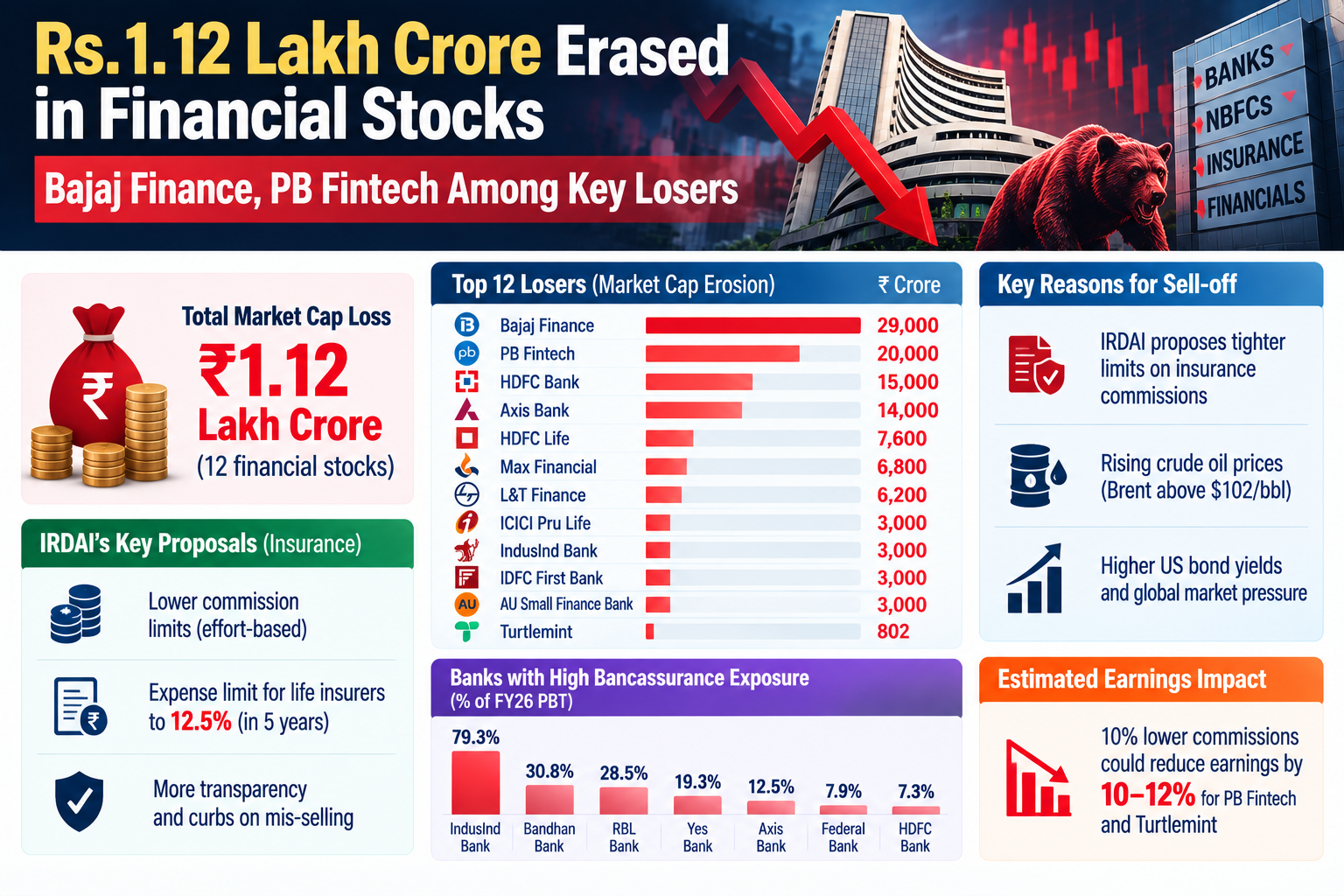
Jefferies, meanwhile, estimated that a 10% reduction in commission rates could translate into a 10–12% earnings decline for PB Fintech and Turtlemint, illustrating why the market reacted sharply to the consultation paper. This is a brokerage estimate, not a confirmed earnings impact.
Banks with bancassurance exposure also face scrutiny
The proposed insurance changes could affect banks that generate income through bancassurance.
According to IIFL Research, IndusInd Bank has the highest bancassurance income exposure among the banks tracked at 79.3% of FY26 profit before tax.
Bandhan Bank follows at 30.8%, RBL Bank at 28.5%, Yes Bank at 19.3%, Axis Bank at 12.5%, Federal Bank at 7.9% and HDFC Bank at 7.3%.
This explains why the regulatory proposal has become relevant beyond pure insurance stocks.
Read More : NSE Stock Set for Additional Listing on Metropolitan Stock Exchange of India Starting September 24
Why banks were also caught in the sell-off
The impact isn’t limited to insurers and insurance distributors.
Banks that generate meaningful income through bancassurance could also face changes in their economics if commission structures are revised.
IIFL Research data cited by Moneycontrol put bancassurance income exposure at:
- IndusInd Bank: 79.3% of FY26 PBT
- Bandhan Bank: 30.8%
- RBL Bank: 28.5%
- Yes Bank: 19.3%
- Axis Bank: 12.5%
- Federal Bank: 7.9%
- HDFC Bank: 7.3%
Direct impact on earnings
Jefferies estimates that a 10% cut in new-business commission rates could translate into a 10–12% decline in earnings for PB Fintech and Turtlemint. The estimate is based on the proposed IRDAI framework and is not a confirmed impact under final rules.
Macquarie separately estimates that a 200-basis-point compression in PB Fintech’s take rate could reduce EBITDA by around 25%, all else being equal.
The actual impact will depend on the final commission caps, implementation timeline and whether distributors can offset lower rates through higher volumes or cost savings.
Here’s what happened today and why traders reacted
The insurance regulation news was only one part of the market sell-off.
Higher US Treasury yields have raised concerns that inflation and interest rates could remain elevated for longer. At the same time, Brent crude moved above $102 a barrel, increasing pressure on oil-importing economies such as India.
That combination created a difficult backdrop for financial stocks already facing a sector-specific regulatory shock.
What investors should watch after the sell-off
For investors, the next major trigger will be the feedback process on the IRDAI proposals and whether the final framework changes from the consultation draft.
PB Fintech, insurers and banks with meaningful bancassurance exposure could remain sensitive to further regulatory developments.
Meanwhile, traders will also need to track Brent crude, US bond yields, the rupee and global equity markets. A combination of elevated crude and yields could continue to influence sentiment across Indian financial stocks in the coming sessions.