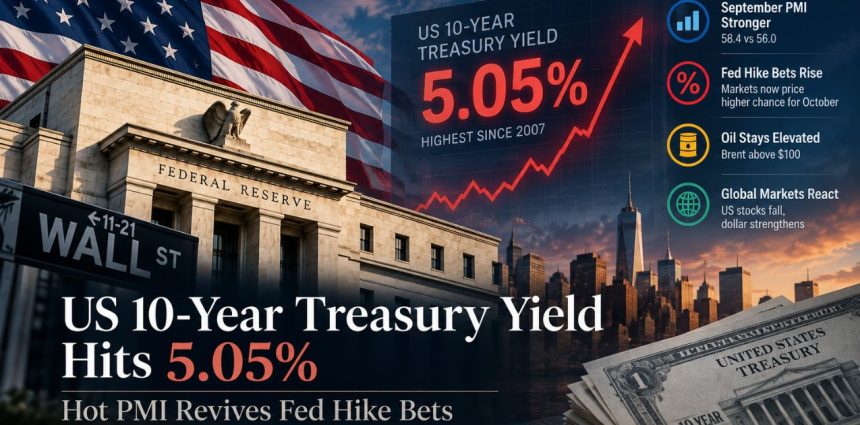
The US 10-year Treasury yield jumped above 5% on Wednesday after a stronger-than-expected September business activity report pushed markets to reassess the outlook for Federal Reserve interest rates. With US growth accelerating, input-price pressures rising and oil still elevated, traders are now pricing a higher chance of another Fed rate hike in October.
US 10-Year Treasury Yield Crosses 5% Again
The benchmark US 10-year Treasury yield rose 8.7 basis points to 5.054% on September 23, its highest level since 2007. The closely watched 2-year Treasury yield climbed 8.49 basis points to 4.862%, its highest level since June 2024.
The move was significant because the 10-year yield had only recently been trading below the 5% threshold. Crossing that level again signals that investors are demanding higher yields as they reassess the path of US inflation, growth and monetary policy.
But the Treasury market reaction was not driven by the yield level itself.
The immediate trigger was a surprisingly strong September US Composite PMI.
Hot PMI Changed the Rate Conversation
S&P Global’s flash US Composite PMI jumped to 58.4 in September from 56.0 in August, the highest reading since July 2021. The increase was driven by stronger activity across both services and manufacturing, with new orders also accelerating sharply.
The details were particularly important for markets.
The services PMI rose to 58.7, while the manufacturing PMI increased to 57.0. New orders climbed to 58.2 from 55.2, the highest level since March 2022.
The data suggest that the US economy is entering the final part of the third quarter with substantial momentum.
S&P Global said the PMI was consistent with economic growth at around a 5% annualised pace, although that estimate should be treated as a survey-based indication rather than a confirmed GDP figure.
For bond traders, however, the most important number was not 58.4.
It was 66.4.
Why Input Prices Are Worrying Bond Traders
The PMI input-price index jumped to 66.4 from 59.9, its highest level since October 2022. Supply-chain delays also became more widespread, adding another layer to the inflation concern.
That creates a difficult combination for the Federal Reserve:
Stronger demand + stronger business activity + rising input costs
Normally, faster growth is positive for risk assets.
The problem is that an economy growing rapidly while businesses face increasing costs can keep inflation elevated for longer. That reduces the room for the Fed to ease monetary policy quickly.
The bond market is therefore reacting to a change in expectations.
The signal is not simply that the US economy is strong.
The signal is that strong growth may be making inflation harder to control.
The Fed Has Already Hiked. Now October Is in Focus
The Federal Reserve already raised its benchmark rate by 25 basis points in September, taking the federal funds target range to 3.75%–4.00%. The September decision was unanimous.
That means Wednesday’s market move was not about the September decision.
It was about what comes next.
Reuters reported that Fed funds futures were pricing 73% odds of an October rate hike, up from 53% earlier. Fed Governor Michael Barr also said further rate increases would likely be needed as the central bank works to bring inflation back towards its 2% target.
The rise in Treasury yields therefore reflects a broader repricing of the Fed’s policy path.
The market is increasingly asking whether the recent inflation and growth pressures could force the central bank to keep rates higher for longer.
Also Read: Fed Rate Hike Impact on India: Why Oil and RBI Matter in October
The Fed’s Own Projections Add to the Uncertainty
The September Federal Reserve projections put the median federal funds rate at 4.1% at the end of 2026, compared with 3.8% in the June projections.
That projection does not guarantee another rate increase at the October meeting.
It does show that the Fed’s own outlook remains consistent with a relatively restrictive policy setting.
That creates an important distinction for investors.
October hike pricing is a market expectation.
The Fed’s 4.1% year-end projection is an official policy projection.
Neither one guarantees the eventual policy outcome.
Future inflation, labour-market data, oil prices and economic activity will determine how the Fed responds.
Why the 2-Year Treasury Yield Matters
The 10-year Treasury yield is the most widely followed US government bond benchmark, but the 2-year yield often provides a sharper signal about near-term Fed expectations.
Its rise to 4.862% alongside the 10-year move suggests traders are repricing short-term monetary policy rather than simply demanding greater compensation for long-term borrowing or fiscal risks.
The market chain is becoming clearer:
Hot PMI → stronger growth expectations → higher inflation concern → greater Fed-hike pricing → higher 2-year yields → higher 10-year yields
That is the key market signal behind Wednesday’s move.
What a 5% Treasury Yield Means for Stocks
Higher Treasury yields matter because they change the discount rate applied to future corporate earnings.
When the risk-free rate rises, investors may demand a higher return from equities. This can put greater pressure on stocks whose valuations depend heavily on earnings expected many years into the future.
That helps explain the weakness in US equities on Wednesday.
The Dow Jones Industrial Average fell 0.18%, the S&P 500 dropped 0.53%, and the Nasdaq Composite declined 1.05% as Treasury yields moved higher.
The Nasdaq is especially sensitive to changes in interest-rate expectations because of its concentration in growth and technology companies.
However, higher yields do not automatically mean equities must fall.
Strong earnings, productivity gains, capital investment and company-specific fundamentals can offset some valuation pressure.
The bigger question is whether the 5% Treasury yield becomes a temporary spike or a sustained market condition.
Check Live: GIFT Nifty Live, FII DII Data, Nifty 50 Today, Crude Oil Future
Oil Adds Another Inflation Risk
Treasury investors are also watching the oil market.
Brent crude moved back above $100 a barrel, with the supplied draft citing a Wednesday high of $101.62.
Oil matters because a sustained increase in energy prices can feed into headline inflation and affect inflation expectations.
That makes the current setup more complicated for the Federal Reserve.
If crude prices fall significantly, some of the inflation pressure created by energy could fade. But if oil remains elevated while US demand continues to surprise on the upside, the Fed may face a more difficult inflation trade-off.
This is why the oil market is becoming an important part of the Treasury-yield story.
US Inflation Is Still Above the Fed’s Target
The latest official August CPI data showed US consumer prices increased 3.4% over the year, while prices excluding food and energy rose 2.4%. Gasoline prices rose sharply in August, and energy remained a major contributor to overall inflation.
This creates a mixed inflation picture.
Core inflation is lower than headline inflation, but energy remains a source of significant pressure.
The September PMI adds another signal by showing strong economic activity alongside a sharp increase in input prices.
That combination is one reason investors are questioning whether inflation can fall smoothly toward the Federal Reserve’s 2% objective.
Why This Matters for Global Markets
US Treasury yields serve as a major benchmark for global borrowing costs and asset allocation.
When US yields rise sharply, investors reassess the relative return available across equities, emerging-market bonds, currencies and other risk assets.
A stronger US dollar can add another layer of pressure on emerging markets because investors are comparing returns not only across asset classes but also across currencies.
For India, this matters through the rupee, foreign portfolio flows, crude oil and domestic bond yields.
The Indian rupee closed around ₹95.74 per dollar in the Wednesday data cited in the supplied draft, while India’s 10-year government bond yield had recently been around 7.07%.
But the India angle should be viewed as a secondary transmission channel.
The primary story remains the repricing of US interest-rate expectations.
What Happens If the 10-Year Yield Stays Above 5%?
The most important question now is whether the move above 5% lasts.
A short-lived spike can be reversed if incoming economic data soften or oil prices fall.
A sustained move above 5%, however, could keep global financial conditions tighter.
That could affect:
Growth-stock valuations
Corporate borrowing costs
Mortgage rates
Emerging-market capital flows
Currency markets
Government bond yields
US mortgage rates are already elevated. Freddie Mac’s 30-year fixed mortgage rate stood at 6.95% as of September 17, up from 6.76% a week earlier and 6.26% a year earlier.
Mortgage rates do not move mechanically with the 10-year Treasury yield, but persistent higher long-term yields can make a rapid decline in borrowing costs more difficult.
The Market’s Biggest Expectation Shift
The debate in markets is changing.
Earlier, much of the focus was on how quickly US monetary policy could become less restrictive.
Now the market is asking a different question:
How much expected easing needs to be pushed back if US growth and inflation remain stronger than expected?
That is why the September PMI was so important.
The data did not simply indicate that the US economy was expanding.
They showed that demand remains strong while businesses are also seeing higher input costs and supply-chain pressure.
That combination creates a tougher environment for a central bank trying to lower inflation without unnecessarily weakening economic activity.
What Traders Will Watch Next
The next phase of the Treasury move will depend on whether the PMI shock is confirmed by other data.
Traders will closely watch:
US inflation: Are price pressures cooling or accelerating?
Labour-market data: Can demand remain strong without renewed wage pressure?
Fed commentary: Does the case for another hike strengthen or weaken?
Oil prices: Can Brent move sustainably lower, or does it remain near $100?
Treasury yields: Can the 10-year yield remain above 5%?
Dollar: Does a higher-rate outlook continue supporting the US currency?
India markets: Does the combination of US yields, dollar and oil increase pressure on the rupee and foreign flows?
The direction of these indicators will determine whether Wednesday’s Treasury move becomes a larger trend or a temporary repricing.
Two Scenarios for the Treasury Market
Scenario 1: Inflation Pressure Cools
If oil prices retreat, supply-chain pressure eases and US economic data begin to soften, Treasury yields could give back part of their recent rise.
In that environment, expectations for additional Fed tightening could also moderate.
That could ease pressure on rate-sensitive equities and emerging-market assets.
Scenario 2: Growth Stays Hot and Inflation Stays Sticky
If US business activity remains strong, input prices stay elevated and crude remains high, markets could continue pricing a more restrictive Federal Reserve.
In that scenario, the 5% level on the 10-year Treasury could become more persistent.
The key issue is not simply whether yields touched 5%.
It is whether the underlying economic conditions justify staying there.
Bottom Line
The US 10-year Treasury yield hitting 5.05% is more than a psychological market milestone.
The bigger signal is the combination of a strong September PMI, rising input prices, elevated oil prices and increasing expectations for further Federal Reserve tightening.
The Fed has already raised rates to 3.75%–4.00%, while markets are now assigning a materially higher probability to another October hike.
For global markets, the key variables are now linked:
Hot US economy
→ Higher inflation pressure
→ Higher Fed-hike expectations
→ 5%+ Treasury yields
→ Stronger dollar
→ Greater pressure on risk assets
For Indian investors, the most important spillover will come through US yields, the dollar, crude oil and the rupee.
The next major test is whether upcoming data confirm the message from September’s PMI.
If they do, the 5% Treasury yield could become a more persistent feature of global markets. If growth and inflation cool, part of the recent repricing could reverse.
Read Next: SEBI F&O Margin Review: Can Longer-Dated F&O Finally Grow?
Disclaimer: This article is for informational purposes only and does not constitute investment advice. Market prices, Treasury yields, currency levels, commodity prices and interest-rate expectations can change rapidly. Readers should conduct their own research and consult a qualified financial adviser before making investment decisions.