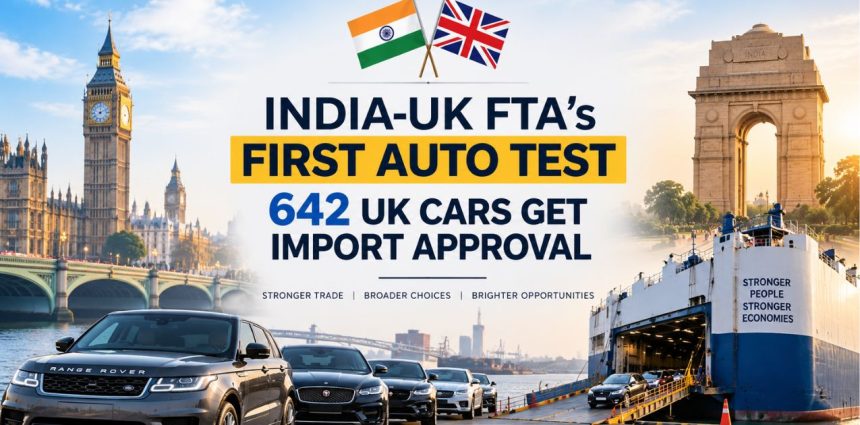
India has approved 642 UK-origin passenger cars under the India–UK FTA’s tariff-rate quota, giving the new trade pact its first measurable test in automobiles. The figure is only a fraction of the full Year 1 quota, leaving actual shipments and wider quota utilisation as the next test.
India has approved 642 UK-origin passenger cars for import under the tariff-rate quota (TRQ) provisions of the India–UK Comprehensive Economic and Trade Agreement (CETA), giving the trade pact its first concrete test in the automobile market.
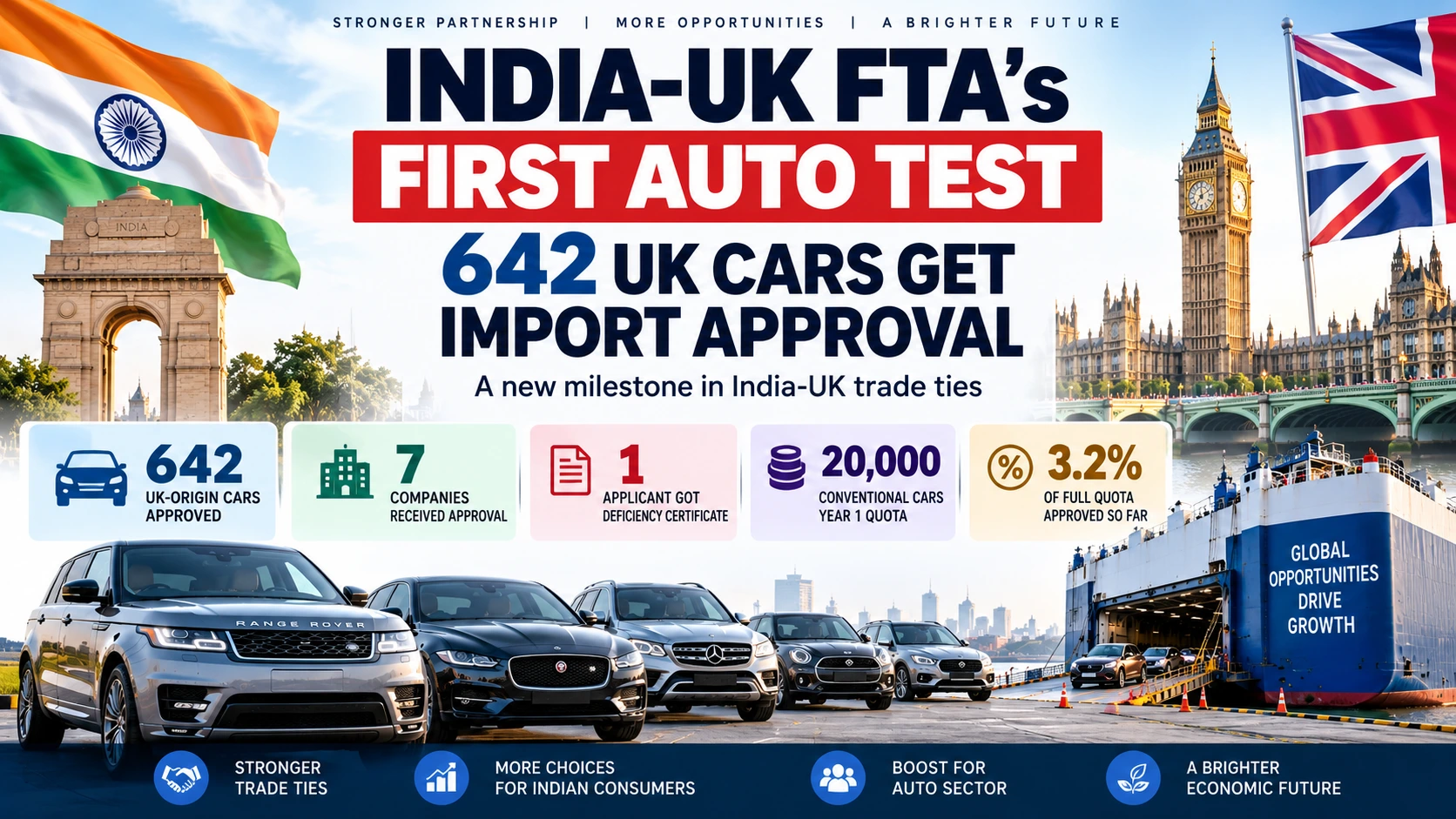
The Directorate General of Foreign Trade (DGFT) approved applications from seven companies, while one of the eight applicants received a deficiency certificate, according to a government official cited by multiple reports. The approvals cover the remainder of 2026 and mark the first allocation under the vehicle TRQ since the agreement came into force on 15 July 2026.
The number is notable, but it needs context.
Under the CETA tariff schedule, India’s full Year 1 quota for conventional-engine passenger cars is 20,000 units. The 642 approved vehicles therefore amount to roughly 3.2% of the full first-year quota. The latest figure is an allocation approval; it should not be treated as evidence that all 642 vehicles have already been physically imported or sold in India.
That creates the next question for the agreement: how much of the available concession will companies actually use?
Need to Know
| India–UK auto FTA | Latest detail |
|---|---|
| CETA effective date | 15 July 2026 |
| Cars approved | 642 |
| Companies receiving approval | 7 |
| Applicants | 8 |
| Full Year 1 ICE passenger-car quota | 20,000 units |
| Share of full Year 1 quota approved | About 3.2% |
| Year 1 duty: large ICE category | 30% vs 110% base rate |
| Year 1 duty: other specified ICE categories | 50% vs 66% base rate |
| Long-run scheduled in-quota duty | 10% for conventional passenger cars |
*Sources: India–UK CETA tariff schedule; DGFT-related reporting. *
CHECK LIVE: NiftyTrader: Live Options Analytics & F&O Trading Tools
642 Cars Put the FTA Into Its First Operational Phase
The significance of the 642 figure is less about the absolute number of vehicles and more about what it demonstrates.
The India–UK CETA is no longer only a negotiated tariff framework. The DGFT has begun administering the vehicle concessions through a TRQ system, allowing eligible UK-origin vehicles to enter India at preferential customs-duty rates within defined quantity limits.
The first approvals came about 63 days after the agreement took effect on 15 July.
Only specified applicants were eligible to seek the concession, including original equipment manufacturers, authorised dealers and authorised channel partners for UK-origin vehicles.
That makes the 642 approvals the first visible evidence of companies attempting to use the automotive provisions of the new agreement.
But approval is only the first step.
Actual utilisation will depend on whether those allocations translate into shipments and whether manufacturers and distributors continue seeking additional quota.
The 642 Is Small Compared With the Full Year 1 Quota
The CETA tariff schedule provides for 20,000 conventional-engine passenger cars in Year 1, divided by engine category.
| Vehicle category | Year 1 quota | Year 1 in-quota base duty |
|---|---|---|
| Petrol above 3,000 cc / diesel above 2,500 cc | 10,000 | 30% |
| Petrol 1,500–3,000 cc / diesel 1,500–2,500 cc | 5,000 | 50% |
| Petrol up to 1,500 cc | 5,000 | 50% |
| Total | 20,000 | — |
The structure means the frequently cited “110% to 10%” auto-tariff headline is a phased outcome rather than an immediate blanket reduction for every UK vehicle.
For the largest conventional-engine category, the Year 1 in-quota base customs duty is 30%, compared with a 110% base rate. For the other specified conventional-engine categories, the Year 1 preferential rate is 50%, compared with a 66% base rate. The rates are subsequently phased down, reaching 10% under the agreement’s longer-term schedule.
The tariff benefit is therefore substantial for eligible vehicles, but the benefit operates within a quota and according to the agreement’s staging schedule.
Lower Tariffs Do Not Automatically Mean More Imports
This is where the first allocation creates an important expectation gap.
The FTA can reduce the customs-duty burden, but a lower tariff does not automatically guarantee that manufacturers will increase shipments at the same pace.
Companies still need to decide which vehicles are commercially viable for India, ensure that vehicles satisfy the applicable origin requirements and arrange supply and distribution.
There is also a pricing question.
A reduction in customs duty creates room for manufacturers or distributors to lower prices, improve margins or combine the benefit with other commercial strategies. But the tariff saving itself does not determine the final showroom price.
Financial Express reported that the limited initial response could reflect the short period remaining in 2026 as well as questions around UK-origin requirements, vehicle pricing and manufacturers’ readiness to use the new framework. Those are reported industry explanations rather than an official government finding.
What the First Allocation Does — and Does Not — Tell Us
The 642 approvals provide an early data point, but several conclusions would be premature.
It does not establish that UK car demand in India is weak.
It does not show that the FTA’s wider trade objectives are falling short.
And it does not mean that only 642 cars can enter India at concessional rates over the agreement’s entire life.
Instead, it shows that during the first phase of implementation, seven companies secured quota covering 642 passenger vehicles.
The next allocation rounds and customs data will be more informative because they can show whether the initial approvals are followed by higher utilisation.
Also Read: India’s FTA Push Hits Execution Test: UK, Oman Deals Due in Weeks
Premium Cars Are Likely to Get the Most Visible Early Tariff Benefit
The initial automotive structure is particularly relevant to premium and luxury vehicles because the largest-engine category carries the biggest difference between the standard base duty and the initial preferential rate.
For petrol vehicles above 3,000 cc and diesel vehicles above 2,500 cc, the Year 1 in-quota base rate is 30%, compared with a 110% base customs-duty rate.
That creates a potentially meaningful pricing advantage for qualifying UK-origin models.
However, the eventual effect on consumers will depend on more than customs duty. Freight, insurance, currency movements, taxes, dealer margins and manufacturer pricing decisions can all affect the final price.
As a result, the tariff reduction should be viewed as a pricing opportunity, not as a guaranteed one-for-one cut in showroom prices.
EVs Have a Different Timeline
The automotive concessions also do not represent an immediate opening of India’s entire imported-car market.
The CETA establishes separate treatment for electric, hybrid and hydrogen-powered passenger cars, with the relevant TRQ structure beginning later in the agreement rather than in Year 1.
That means the first 642 approvals primarily tell us about the early implementation of the agreement’s conventional-engine passenger-car provisions.
The EV impact will depend on the later stages of the tariff and quota schedule.
The Larger India–UK FTA Is Much Bigger Than Cars
Cars are only one part of the wider CETA.
The UK government says the agreement came into force on 15 July 2026, with bilateral trade between the two economies worth about £48 billion in 2025.
The agreement covers trade in goods, services, investment and other areas of economic cooperation. India’s tariff schedule provides for staged liberalisation across a broad range of goods, while the UK’s schedule provides significant market access for Indian exports.
The UK government’s long-run modelling estimates that bilateral trade could increase by £25.5 billion a year compared with a scenario without the agreement. That is a modelled long-term estimate, not a forecast for India’s 2026 automobile imports.
This distinction is important for investors.
The headline economic potential of an FTA can be large, while the initial utilisation of specific concessions can remain modest.
The Next Test Is Actual Utilisation
For the automobile segment, several indicators now matter more than the initial announcement itself.
| What to watch | Why it matters |
|---|---|
| Actual shipments against approved quota | Shows whether approvals convert into physical trade |
| Subsequent TRQ applications | Indicates whether more companies are using the mechanism |
| Quota utilisation rate | Measures how much of the available concession is being used |
| UK-origin compliance | Determines which vehicles qualify for preferential rates |
| Vehicle pricing | Shows how the tariff benefit affects the final customer price |
| Premium-car sales | Indicates whether lower duties support incremental demand |
| Wider India–UK trade | Tests whether utilisation is spreading beyond autos |
The forward-looking risk is therefore not whether the FTA exists — it is how rapidly businesses can convert the agreement’s theoretical market access into actual trade.
A slow ramp-up would not necessarily disprove the agreement’s long-term economic projections, particularly because the pact is designed to operate over many years. But sustained low utilisation would raise questions about the commercial attractiveness of some concessions.
Conversely, stronger applications and actual shipments in subsequent rounds would provide early evidence that businesses are beginning to respond to the new tariff structure.
What Investors Should Watch Next
The 642 approvals are unlikely to be material on their own for India’s overall passenger-vehicle market.
Their significance is as an early implementation indicator.
For investors following the India–UK trade relationship, the useful signals will come from the conversion of approved quota into imports, the pace of subsequent allocations and whether the tariff advantage changes vehicle pricing or sales.
The broader FTA could also create opportunities across sectors beyond automobiles, including goods and services where tariff or market-access barriers are being reduced.
But those benefits are likely to emerge at different speeds.
That is why the first 642 cars are best viewed as the start of the utilisation story rather than its conclusion.
India–UK FTA: From Tariff Promise to Execution
The India–UK CETA entered into force on 15 July 2026, beginning the implementation of a trade pact that the UK government expects to deliver significant long-run gains in bilateral commerce.
The DGFT’s approval of 642 UK-origin passenger cars now provides the first clear automotive example of businesses accessing the agreement’s preferential framework.
But the gap between a negotiated quota and actual trade remains important.
The full Year 1 conventional-engine passenger-car quota is 20,000 units, making the 642 approved cars only about 3.2% of the full quota.
That does not amount to a verdict on the FTA.
It does, however, establish the question that matters next:
Will the first 642 approvals be followed by rising shipments and broader quota utilisation, or will adoption remain gradual?
The answer will depend on what companies actually do with the market access the agreement has created.
Read Next: KOSPI Crosses 7,100 as Korea’s Chip Exports Hit Record
Disclaimer
This article is for informational purposes only and does not constitute investment advice. Trade policies, tariff schedules, quota allocations and company-level commercial impacts may change as implementation progresses and should be independently verified against official notifications and filings.