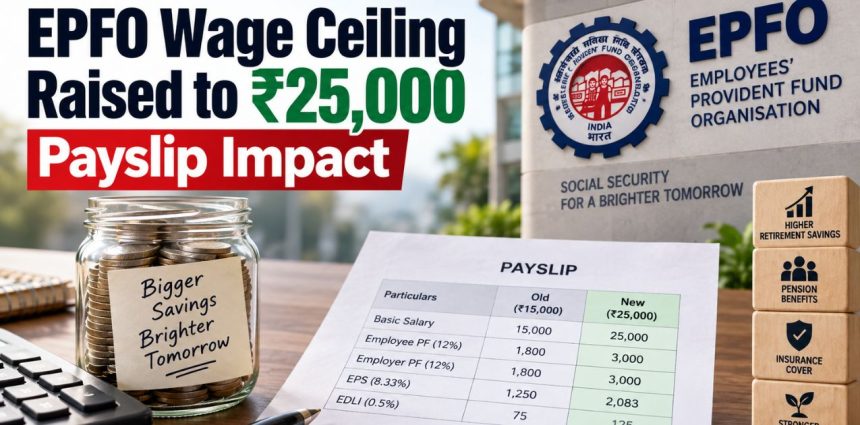
New Delhi: India has raised the wage ceiling for mandatory Employees’ Provident Fund Organisation (EPFO) coverage from ₹15,000 to ₹25,000 a month, ending a 12-year gap since the previous revision. The Union Cabinet approved the change on September 16, 2026, and the revised ceiling came into effect on September 17, 2026.
The Ministry of Labour & Employment and the Press Information Bureau (PIB) said the move is expected to bring more than 51 lakh additional employees under mandatory EPFO coverage, extending access to provident fund savings, pension and insurance protection under the applicable schemes.
For employees in the newly affected wage band, the biggest practical question is not just who gets covered, but what happens to PF deductions, take-home salary, employer contributions and long-term retirement benefits.
The Economic Times’ September 16 video report also confirmed the Cabinet decision, the increase from ₹15,000 to ₹25,000 and the expected 51-lakh expansion in coverage.
TRACK LIVE: NiftyTrader: Live Options Analytics & F&O Trading Tools
What Did the Cabinet Actually Approve?
The Union Cabinet approved the Ministry of Labour & Employment’s proposal to raise the wage ceiling for mandatory EPFO coverage from ₹15,000 to ₹25,000 a month.
According to the Ministry of Labour & Employment and PIB, employees joining employment at wages between ₹15,000 and ₹25,000 who were previously outside mandatory EPFO coverage because they crossed the old threshold will now come within the statutory social-security framework, subject to the applicable provisions.
The revised ceiling covers the EPFO framework involving:
Employees’ Provident Fund (EPF) for retirement savings,
Employees’ Pension Scheme (EPS) for pension benefits, and
Employees’ Deposit Linked Insurance Scheme (EDLI) for insurance protection,
subject to the rules governing each scheme. The government estimates that more than 51 lakh additional employees will come under mandatory coverage.
The increase from ₹15,000 to ₹25,000 represents a 66.7% rise, or roughly 67%, in the statutory wage ceiling.
The New Rule Is Already Effective
This is no longer just a Cabinet proposal.
The government announced the decision on September 16 and made the revised ceiling effective from September 17, 2026. The Ministry of Labour & Employment formally notified the change through Notification S.O. 5109(E) dated September 17, 2026.
A government PIB release also confirms September 17 as the effective date and describes the revision as the first increase in the EPFO wage ceiling after nearly 12 years.
The notification is important because it formalises the new ₹25,000 ceiling within the statutory framework rather than leaving it at the announcement stage.
Why Was the EPFO Wage Ceiling Revised After 12 Years?
The previous ₹15,000 ceiling was introduced in September 2014.
The Ministry of Labour & Employment has said the latest revision takes into account rising wages, higher incomes and the expansion of formal employment over the intervening period. Government releases have also pointed to changes in minimum wages in several states and occupations, making the older ₹15,000 threshold less aligned with current wage conditions.
The issue had also come under judicial consideration.
In January 2026, the Supreme Court directed the Centre and EPFO to take a decision within four months on a representation seeking revision of the EPF wage ceiling. The court’s direction put the long-standing ₹15,000 threshold under renewed scrutiny, but it should not be interpreted as meaning that the Supreme Court directly ordered the eventual ₹25,000 revision.
The eventual policy decision followed the government’s own administrative and financial process. The official PIB release said the proposal went through consultations and was recommended by the Expenditure Finance Committee on June 16, 2026, before Cabinet approval in September.
So, the safer description is that the Supreme Court’s order accelerated scrutiny of the issue, while the ₹25,000 ceiling was ultimately approved through the government’s policy process.
ALSO READ: EPF Interest Rate 2025-26 Approved at 8.25%, EPFO to Credit 7 Crore Members This Month
How Much Could EPF Contributions Change?
The higher wage ceiling can increase the statutory contribution base for affected employees and employers, but the actual payroll impact depends on the employee’s wage structure, EPFO status and the applicable contribution rules.
Under the standard 12% employee contribution rate, a simple ceiling-based illustration gives:
At ₹15,000:
12% = ₹1,800 a month
At ₹25,000:
12% = ₹3,000 a month
That means the employee contribution would be ₹1,200 higher per month if the applicable contribution base moves fully from ₹15,000 to ₹25,000.
Business Standard, in its September 17 explainer, used the same ₹1,800-to-₹3,000 calculation while cautioning that the actual salary impact depends on how employers implement the revised framework and structure compensation.
Important: ₹3,000 Is an Illustration, Not a Universal Deduction
The ₹3,000 figure should not be interpreted as meaning that every employee earning ₹25,000 in gross salary will automatically have ₹3,000 deducted from take-home pay.
The ₹25,000 figure is the wage ceiling for mandatory coverage. EPF calculations depend on the applicable definition of wages, the employee’s EPFO status and the relevant statutory provisions.
Business Standard specifically noted that employees should check whether they were previously outside mandatory EPFO coverage, whether contributions were already being calculated on actual wages or on the statutory ceiling, and whether the employer includes its contribution within CTC.
What Happens to EPS Pension Contribution?
The Employees’ Pension Scheme is another important part of the calculation.
The employer’s contribution is allocated between EPF and EPS under the applicable rules. At an 8.33% calculation on the wage ceiling:
At ₹15,000, the illustrative EPS contribution is approximately ₹1,250 a month.
At ₹25,000, the same calculation gives approximately ₹2,083 a month.
This is a contribution illustration and should not be interpreted as a guaranteed ₹833 increase in an employee’s future pension.
The final pension benefit depends on factors including pensionable salary, pensionable service and the applicable EPS provisions.
Business Standard’s September 18 explainer similarly highlighted that the higher ceiling affects not only EPF but also the pension and insurance components of the social-security framework.
What Happens to EDLI Insurance?
The higher ceiling also changes the maximum wage base relevant to the Employees’ Deposit Linked Insurance Scheme (EDLI), subject to scheme rules.
At a 0.5% contribution rate:
₹15,000 × 0.5% = ₹75
₹25,000 × 0.5% = ₹125
The increase expands the applicable contribution base for covered employees. EDLI provides insurance-linked protection to eligible EPFO members, with benefits governed by the scheme’s conditions.
The Ministry of Labour & Employment has specifically identified EPF, EPS and EDLI as the social-security benefits associated with the newly expanded mandatory coverage.
Will Take-Home Salary Fall?
For employees who are newly brought into mandatory EPFO coverage, higher employee contributions can reduce the cash component of monthly salary while increasing retirement savings.
The basic illustration is straightforward:
Old ceiling: ₹15,000 × 12% = ₹1,800
New ceiling: ₹25,000 × 12% = ₹3,000
Illustrative increase: ₹1,200 a month
Business Standard reported that this could translate into roughly ₹1,200 lower monthly take-home pay in a scenario where the full contribution base moves to the new ceiling.
But there is an important qualification.
A higher employer contribution does not automatically mean another ₹1,200 will be deducted from the employee’s salary.
The actual cash-flow impact depends on the structure of the employee’s compensation and whether the employer’s statutory contribution is already included within CTC.
Why Some Estimates Mention a ₹2,400 Monthly Impact
Some payroll experts have discussed a higher potential impact in certain CTC structures.
Business Standard reported that the total cash-flow effect could theoretically approach ₹2,400 a month in situations where both the employee’s increased contribution and the employer’s additional contribution are accommodated within an unchanged CTC structure.
However, this is not a universal deduction.
It is a scenario-based estimate dependent on compensation structure and how an employer accounts for the additional statutory cost.
Employees should therefore avoid assuming that everyone earning ₹25,000 will automatically lose ₹2,400 from take-home pay.
The practical number can only be determined from the individual’s salary structure and payroll treatment.
Can an Employer Reduce CTC Because of the Higher EPFO Contribution?
This is a more complicated legal question than simply calculating the contribution.
Legal commentary around the revised EPFO ceiling has focused on the restrictions under the Code on Social Security, 2020, including Section 124, concerning reductions in wages or benefits because of an employer’s statutory contribution obligations.
The safer interpretation is that employers cannot simply assume that the entire additional statutory liability can automatically be recovered by cutting an employee’s contractual compensation. The exact treatment depends on the employment agreement, salary structure, applicable law and implementation rules.
For individual disputes, employees and employers should rely on the actual employment contract and qualified legal advice rather than treating a media explanation as a legal ruling.
What Should Employees Check on Their Payslip?
For workers potentially affected by the change, the most useful exercise is to compare the salary structure before and after the revised EPFO framework is implemented.
Look at the:
basic wages or applicable EPF wage base,
employee EPF deduction,
employer EPF/EPS contribution,
CTC structure,
UAN and EPFO enrolment status,
and any change in the cash component of monthly salary.
Business Standard has also advised employees to establish whether they were previously outside mandatory coverage because they exceeded the ₹15,000 threshold or were already contributing under a different arrangement.
That distinction is important because an employee entering EPFO coverage for the first time can have a very different payroll outcome from an existing member already contributing on actual wages.
What Employers Need to Do Now
For employers, the revised ceiling is now an implementation and compliance issue rather than a future proposal.
Companies need to identify employees affected by the revised mandatory-coverage threshold and ensure their payroll and EPFO processes follow the applicable statutory requirements.
The implementation process involves matters such as employee enrolment, UAN linkage or generation, KYC, contribution records and the reporting of eligible workers through the relevant EPFO filings.
Employers should also follow any detailed circulars or instructions issued by EPFO and the Ministry of Labour & Employment as the revised ceiling is operationalised.
The official government releases confirm that the new ceiling is effective from September 17, 2026.
PMVBRY Is a Separate Employer Incentive
The Pradhan Mantri Viksit Bharat Rozgar Yojana (PMVBRY) should not be confused with the EPFO wage-ceiling change.
Under PMVBRY, eligible establishments creating qualifying additional employment can receive an employment-generation incentive of up to ₹3,000 per employee per month, subject to the scheme’s conditions and eligibility criteria.
This is a separate employment incentive, not a direct reimbursement of the additional EPFO contribution arising from the ₹25,000 ceiling.
That distinction matters when businesses calculate their net payroll cost.
Which Sectors Could Feel the Impact?
The impact is likely to be more visible in sectors with large workforces and a significant proportion of employees in the ₹15,000–₹25,000 wage range.
Industry observers cited by Business Standard have highlighted sectors such as:
Manufacturing
Retail
Logistics
IT and IT-enabled services
The precise effect will vary from company to company because salary distributions, employee counts, contract staffing arrangements and existing EPFO contribution practices are different.
For staffing companies, the change may also be relevant because they handle large pools of formal and contract workers and payroll-compliance functions. However, the earnings impact on a listed staffing company cannot be assumed from the policy announcement alone and would require company-specific analysis.
ALSO READ: India Wealth Management Market Set for $436 Billion — What Emkay’s 14% AUM Fall Signals
What Does the EPFO Ceiling Hike Mean for the Stock Market?
For investors, the change is primarily a labour-market, employment and social-security policy development.
It is not automatically a broad-based stock-market trigger.
The immediate economic implications are more closely linked to:
retirement savings,
formal employment,
employee deductions,
employer payroll costs,
and social-security participation.
Listed companies could experience different effects depending on their workforce structure.
A business with a large number of employees in the newly affected wage band could face a more noticeable increase in statutory employment costs, while another company with a different workforce profile could see a much smaller impact.
Therefore, investors assessing any company-specific effect should examine employee costs, wage structures and margins instead of treating the ₹25,000 ceiling increase as a universal market signal.
Government Outgo: ₹11,339 Crore a Year
The government’s estimated annual outgo associated with the enhanced EPFO wage ceiling is approximately ₹11,339 crore, compared with existing annual budgetary support of around ₹10,250 crore.
The estimated expenditure over five years is approximately ₹56,696 crore, according to the Ministry of Labour & Employment and PIB.
There is an important wording point here.
₹11,339 crore is the estimated annual government outgo after the enhancement.
It should not be described as ₹11,339 crore of additional spending over and above the existing ₹10,250 crore.
The difference between the two annual figures is approximately ₹1,089 crore.
The higher government expenditure reflects the broader fiscal commitment associated with extending statutory social-security coverage.
EPFO in Numbers
The size of the EPFO system helps explain why the ceiling revision matters.
According to government figures cited by PIB, EPFO has approximately 7.98 crore contributing members across around 7.68 lakh contributing establishments.
The Employees’ Pension Scheme serves around 82 lakh pensioners.
The government estimates that the revised wage ceiling will add more than 51 lakh employees to mandatory coverage.
This means the policy is not simply a change in a payroll number. It expands the reach of India’s formal social-security system to a sizeable additional group of workers.
Why the Change Matters for Employees
For a worker previously outside mandatory EPFO coverage because wages exceeded ₹15,000, the revised ceiling can change the structure of formal employment.
Instead of receiving the entire applicable wage as cash compensation without mandatory EPFO coverage, the worker can now enter a framework that includes retirement savings and access to pension and insurance benefits, subject to the applicable scheme provisions.
The trade-off is that a higher employee contribution can reduce the cash available each month.
In other words, the immediate effect can be lower take-home pay but higher retirement-linked savings, depending on the worker’s contribution arrangement.
This is why the impact should be considered over both the short and long term.
What the ₹25,000 Ceiling Means in Simple Terms
The policy can be understood through four numbers:
₹15,000 — old EPFO wage ceiling
₹25,000 — new EPFO wage ceiling
51 lakh+ — additional employees expected to come under mandatory coverage
₹11,339 crore — estimated annual government outgo after the enhancement
The revision is the first increase in the ceiling since September 2014.
Key Takeaways
- The EPFO wage ceiling for mandatory coverage has increased from ₹15,000 to ₹25,000 a month, effective September 17, 2026.
- The increase represents a 66.7%, or roughly 67%, rise after 12 years.
- More than 51 lakh additional employees are expected to come under mandatory EPFO coverage.
- Newly covered employees can gain access to EPF, EPS and EDLI, subject to the applicable provisions.
- A simple 12% illustration takes employee contribution from ₹1,800 at ₹15,000 to ₹3,000 at ₹25,000.
- The ₹1,200 difference is an illustrative contribution increase, not an automatic deduction for every employee earning ₹25,000.
- Some payroll experts have estimated a potential ₹2,400 monthly cash-flow impact in certain CTC structures, but that is not a universal outcome.
- The government’s estimated annual outgo after the enhancement is ₹11,339 crore, compared with around ₹10,250 crore in existing annual support.
- PMVBRY is a separate employment incentive and should not be described as reimbursement of the additional EPFO contribution.
- For investors, the policy is primarily a formal-employment and social-security development, with company-specific payroll effects depending on workforce structure.
Bottom Line
The government has raised the EPFO wage ceiling for mandatory coverage from ₹15,000 to ₹25,000 a month, effective September 17, 2026, after the ceiling remained unchanged since September 2014.
The Ministry of Labour & Employment estimates that the move will bring more than 51 lakh additional employees into the statutory social-security framework.
For employees, the change can mean broader access to retirement savings, pension and insurance protection, but potentially a higher monthly EPF contribution and therefore lower cash in hand.
For employers, it can increase statutory payroll costs for affected workers.
For investors, the more relevant question is company-specific: how many employees fall within the newly affected wage band, how compensation is structured, and whether the additional statutory cost materially affects margins.
The ₹25,000 ceiling is therefore more than a headline number. It changes the entry point for mandatory social-security coverage and could alter how millions of workers and employers allocate part of their monthly compensation.
Read Next: Fed Rate Hike Impact on India: Why Oil and RBI Matter in October
FAQs
When did the new EPFO wage ceiling of ₹25,000 come into effect?
The Union Cabinet approved the increase on September 16, 2026, and the revised ceiling became effective from September 17, 2026, according to the Ministry of Labour & Employment and PIB.
Who is most directly affected by the new EPFO ceiling?
Employees in the ₹15,000–₹25,000 wage band who were previously outside mandatory EPFO coverage because they exceeded the old ₹15,000 ceiling are the principal group affected by the expansion, subject to the applicable provisions.
Will every employee earning ₹25,000 pay ₹3,000 into EPF?
Not necessarily. ₹3,000 is a simple illustration of 12% of ₹25,000. The actual EPFO contribution depends on the applicable wage definition, the employee’s EPFO status and the relevant statutory provisions. Business Standard has also highlighted this distinction.
Will my take-home salary fall?
It can, particularly when the employee’s applicable contribution base increases. A full move from a ₹15,000 contribution base to ₹25,000 would increase the illustrative employee contribution by ₹1,200 a month.
The actual reduction in take-home pay depends on the employee’s salary structure and payroll implementation.
Can my take-home salary fall by ₹2,400?
Some experts quoted by Business Standard have estimated a possible cash-flow impact of up to ₹2,400 a month in particular CTC structures. That estimate depends on how the employer’s additional statutory contribution is handled and should not be treated as a universal deduction.
Can an employer automatically cut my CTC to pay its higher EPFO contribution?
The issue depends on the employment contract, wage structure and applicable provisions of the Code on Social Security and EPFO framework. Employers should not assume that increased statutory liability automatically permits a reduction in contractual compensation.
What benefits will newly covered workers receive?
According to the Ministry of Labour & Employment, newly covered employees will have access to provident fund savings, pension under EPS and insurance coverage under EDLI, subject to the applicable scheme provisions.
How many additional workers will come under EPFO?
The government estimates that more than 51 lakh additional employees will come under mandatory EPFO coverage following the increase.
What is the government’s cost of the EPFO ceiling hike?
The government estimates annual outgo of approximately ₹11,339 crore after the enhancement, compared with existing annual budgetary support of around ₹10,250 crore. The five-year expenditure estimate is around ₹56,696 crore.
Is ₹11,339 crore additional spending?
No. The government’s wording refers to ₹11,339 crore as the annual outgo after the enhancement, compared with approximately ₹10,250 crore in existing annual budgetary support.
Is this a stock-market bullish or bearish trigger?
The policy itself does not provide a single market-wide direction. Its direct effects are on formal employment, retirement savings and employer payroll costs. Any impact on listed companies would depend on their workforce profile and cost structure.
Disclaimer: This article is for informational purposes only and does not constitute investment, tax, employment or legal advice. NiftyTrader does not recommend any trading or investment action based on this content. Readers should consult a qualified professional for advice specific to their circumstances.