
Key Takeaways
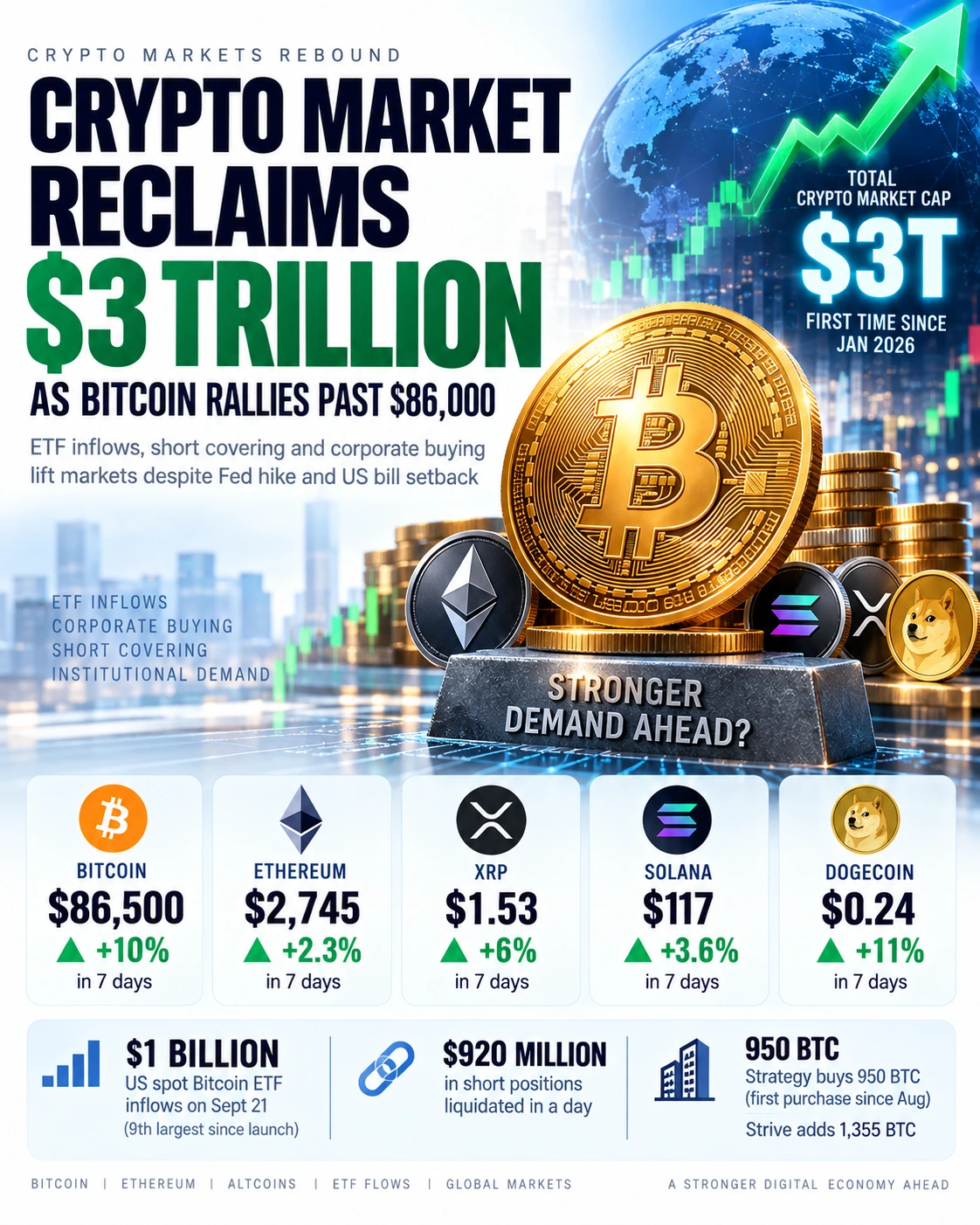
- Total crypto market capitalisation briefly reclaimed $3 trillion on September 22, its first return to that level since January 2026, as Bitcoin and major altcoins extended a sharp weekly rally, according to data from CoinGecko and Cointelegraph.
- Bitcoin traded near $86,500, up roughly 10% over seven days and its first move above $84,000 since January 31, even as it remains about 31% below its October 2025 all-time high of just over $126,000.
- The rally has come despite, not because of, the week’s two biggest headline risks: a 25-basis-point Federal Reserve rate hike on September 16 and the failure of the CLARITY Act’s cloture vote in the US Senate on September 15.
- US spot Bitcoin ETFs pulled in nearly $1 billion in net inflows on September 21 alone, the ninth-largest single-day haul since the funds launched, per Farside Investors data, while roughly $920 million in bearish futures positions were liquidated in a single day, according to Bloomberg.
- Corporate treasury buying has resumed: Strategy (formerly MicroStrategy) purchased 950 BTC on September 21, its first buy since late August, while smaller rival Strive added 1,355 BTC the same day.
CHECK LIVE: Crypto Price Today — Bitcoin, Ethereum & Live Rates
Bitcoin’s sharpest weekly rally in months has pushed the total cryptocurrency market back above the psychologically important $3 trillion mark for the first time since January, even as two of the biggest potential headwinds of 2026, a Federal Reserve rate hike and the collapse of a landmark crypto regulation bill, played out almost simultaneously just days earlier.
Bitcoin was changing hands near $86,500 as of Tuesday, September 22, according to data compiled from CoinGecko, Cointelegraph and CoinDesk, up roughly 10% over the past seven days and more than 15% off the sub-$75,000 lows it touched just a week ago. The move marks Bitcoin’s first trip above the $84,000 level since January 31, per Coinbase market data, though the token remains about 31% below the all-time high of just over $126,000 it hit in October 2025.
The broader market followed. Ether climbed roughly 2.3% to around $2,745, XRP jumped nearly 6% to $1.53, Solana rose 3.6% to about $117, and Dogecoin surged close to 11%, according to CoinGecko figures cited by FXStreet and Cointelegraph. Bitcoin’s dominance of the overall crypto market stood near 57–59%.
A Rally That Shouldn’t Have Happened — On Paper
What makes this move unusual is the timing. In the space of a single week, crypto markets absorbed two developments that would typically be read as bearish.
On September 15, the US Senate’s cloture vote on the Digital Asset Market Clarity Act, the bill meant to formally divide oversight of digital assets between the SEC and CFTC, fell well short of the 60 votes needed to proceed, drawing support in the high-40s range, according to Senate voting records cited by crypto.news and CoinDesk. Negotiations had stalled over unresolved ethics provisions tied to President Trump and his family’s crypto holdings, along with disputes over stablecoin rewards and protections for software developers. Industry figures speaking to CNBC in the run-up to the vote had already flagged the bill’s chances as fading heading into the 2026 midterm cycle.
A day later, on September 16, the Federal Reserve raised its benchmark rate by 25 basis points to a range of 3.75%–4.00%, its first hike since July 2023, in a unanimous 12-0 vote under new Fed Chair Kevin Warsh. The Fed’s own projections showed 16 of 18 officials expecting at least one more increase before year-end, a hawkish signal that pushed the 10-year Treasury yield briefly above 5% before it eased back to roughly 4.96%, according to Yahoo Finance reporting on Fed communications.
Bitcoin initially reacted exactly as textbooks would predict: it slid to roughly $74,887 immediately after the CLARITY Act vote before stabilising, per CoinDesk market data. What has followed since, however, is a rebound that has more than erased that drawdown, raising the question of whether this is a durable shift in demand or a shorter-lived mechanical bounce.
Leverage-Driven Bounce or Genuine Demand?
The honest answer, based on the data, is probably both.
A significant part of the past week’s move looks mechanical. Open interest in Bitcoin perpetual futures climbed to nearly $160 billion, its highest level since late October 2025, while more than $920 million in bearish (short) positions were liquidated in a single day on September 21, according to Bloomberg data cited by Cointelegraph. When large numbers of short sellers are forced to buy back Bitcoin to close losing positions, it mechanically accelerates the rally, independent of any change in underlying demand.
But there is a genuine institutional leg to this move as well. US spot Bitcoin ETFs recorded net inflows of roughly $999 million on September 21 alone, the ninth-largest single-day inflow since the products launched in January 2024, according to TradingKey’s analysis of ETF data. That capped a choppier week: the funds saw about $450 million in outflows on September 15 and a further $296 million on September 16, the two days of the CLARITY Act and Fed news, before flows flipped positive with $159.5 million on September 17 and $433 million on September 18, per Farside Investors data. Citi’s research desk has separately estimated that spot ETF flows explain roughly 45% of Bitcoin’s weekly price moves, making the late-week reversal in flows arguably more informative than the headline price action itself.
Corporate treasuries added a third layer of demand. Strategy, the business-intelligence firm turned Bitcoin proxy, bought 950 BTC for about $76 million on September 21, its first purchase since late August, lifting its total holdings to 846,000 BTC acquired for an aggregate cost of roughly $63.8 billion, according to company disclosures compiled by Bitbase and BitcoinTreasuries.net. Strategy shares jumped 9.47% to close at $168.50 the same day. Smaller rival Strive Enterprises separately bought 1,355 BTC for about $107.7 million, taking its own holdings to 26,355 BTC, per CoinStats’ aggregated market data, evidence that corporate accumulation is no longer a single-company story. Sentiment gauges have followed the price: the Crypto Fear & Greed Index stood at 71, in “Greed” territory, as of September 21.
The Road Back to $100,000
At current levels, Bitcoin sits roughly 14–15% below the $100,000 psychological threshold and about 31% below its October 2025 record. Standard Chartered has stood by a $100,000 year-end target for Bitcoin, citing sustained institutional demand and ETF adoption as the key support, though that call predates the current week’s volatility and will be tested by how durable the ETF-inflow trend proves to be.
Two swing factors stand out for the weeks ahead. First, whether ETF inflows extend beyond the single strong session on September 21 into a sustained trend, given Citi’s estimate that flows, not price momentum, are the better read on real demand. Second, whether the Fed’s hawkish dot plot, and the possibility of another rate hike flagged by 16 of 18 FOMC members, keeps Treasury yields elevated enough to dampen appetite for non-yielding assets like Bitcoin. A revival of the CLARITY Act looks unlikely before the midterms, based on the accounts of people close to the negotiations, removing what had been viewed as a potential regulatory tailwind for the rest of 2026.
ALSO CHECK: Crypto Option Chain India — Live Bitcoin & Ethereum Options on Delta Exchange
What It Means for Indian Investors
Indian crypto investors remain governed by a distinct domestic framework regardless of how global prices move: a flat 30% tax on gains from virtual digital assets, with no provision to offset losses across transactions, alongside a 1% tax deducted at source (TDS) on transfers above prescribed thresholds. That structure has historically dampened onshore trading volumes on platforms even during global rallies, pushing a share of active Indian trading activity towards offshore exchanges. Neither the RBI nor SEBI currently regulates cryptocurrencies as securities, and this article is not a comment on their legal or investment status in India.
For a real-time view of how domestic institutional flows are positioning across asset classes this week, track daily activity on NiftyTrader’s FII-DII Activity Tracker.
Bottom Line
Bitcoin’s return above $86,000 and the crypto market’s brief reclaim of $3 trillion is a genuine data point, not a headline mirage, but it is a rally built on a mix of short covering, a single very strong ETF session, and resumed corporate buying, rather than a clean break in the macro backdrop. The Fed remains in a hiking posture, Treasury yields are near multi-year highs, and the CLARITY Act’s failure leaves US crypto market-structure rules unresolved into 2026’s back half. Whether $86,000 becomes a base for a run at $100,000, or another leveraged air pocket, will likely be decided by whether this week’s ETF inflows repeat, not by the price chart alone.
Read Next: India-UK FTA’s First Auto Test: 642 UK Cars Get Import Approval
This article is for informational purposes only and does not constitute investment advice. Cryptocurrencies are not regulated as securities by SEBI or the RBI in India and carry significant price volatility and regulatory risk. Readers should consult a registered financial advisor before making investment decisions. Market data is as of September 22, 2026, and is subject to change given crypto markets’ 24/7 trading.