
Need to Know
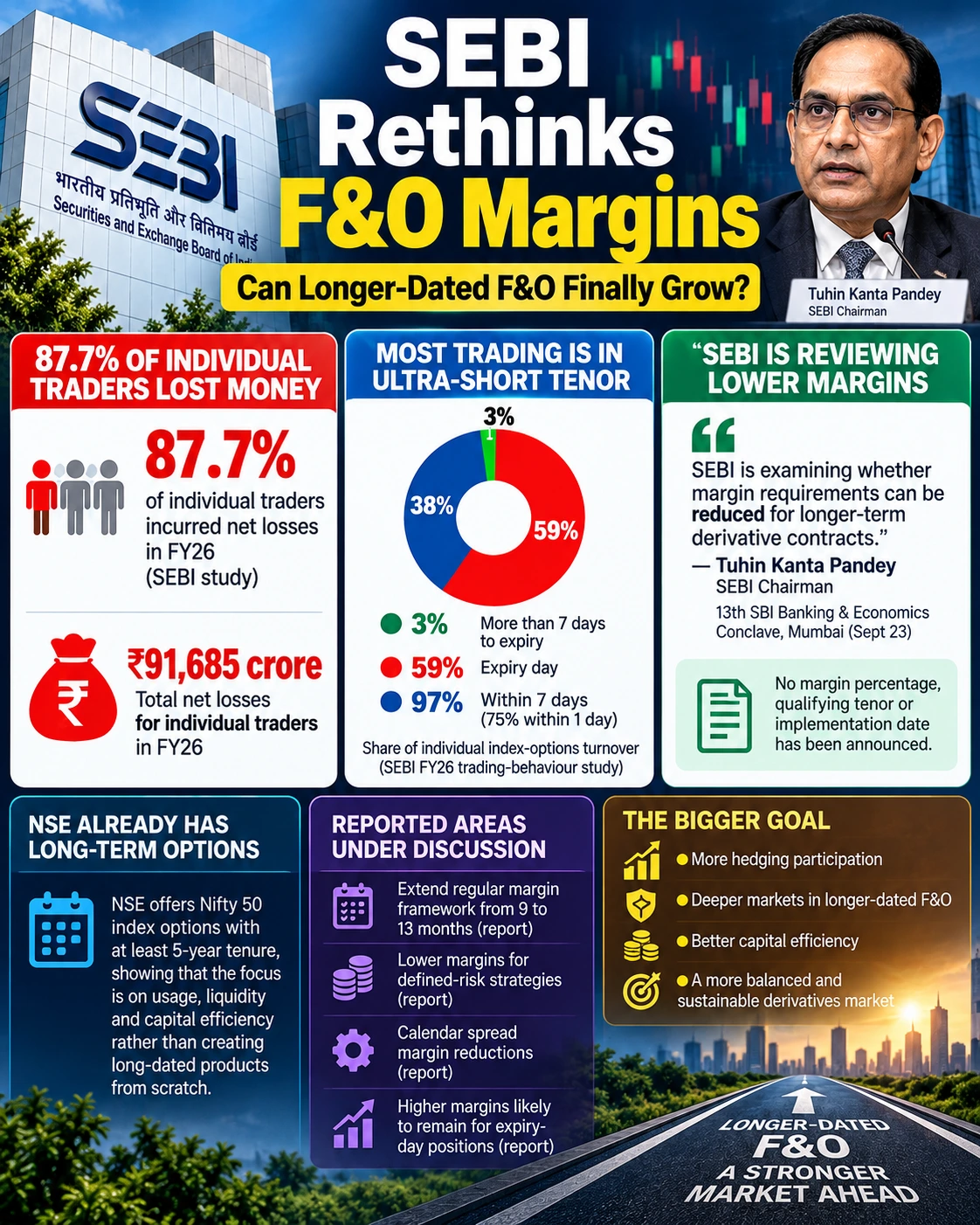
- SEBI is examining lower margins for longer-term derivatives, Chairman Tuhin Kanta Pandey said at the 13th SBI Banking & Economics Conclave in Mumbai on September 23.
- No margin percentage, qualifying tenor or implementation date has been announced. The comments indicate a review, not a final rule change.
- SEBI’s FY26 study found 87.7% of individual traders incurred net losses, with aggregate losses of ₹91,685 crore.
- In the trading-behaviour study, only about 3% of individual index-options turnover came from contracts with more than seven days to expiry, while 59% was on expiry day and 97% was within seven days.
- NSE already offers long-term Nifty 50 index options with at least five-year tenure, showing that the current debate is more about usage, liquidity and capital efficiency than creating long-dated products from scratch.
Check Live: NIFTY50, SENSEX, FII DII DATA | NIFTYTRADER
Only 3% of Index-Options Turnover Was Beyond Seven Days
Only about 3% of individual index-options turnover in SEBI’s FY26 trading-behaviour study came from contracts with more than seven days left to expiry. By contrast, 59% occurred in contracts expiring on the same day, 75% within one day and 97% within one week.
That is the clearest number behind SEBI’s latest long-term F&O discussion.
SEBI Chairman Tuhin Kanta Pandey said on Wednesday that the regulator is examining whether margin requirements can be reduced for longer-term derivative contracts. The remarks were made at the 13th SBI Banking & Economics Conclave in Mumbai and were reported by ET, citing CNBC-TV18; SEBI’s own website confirms that Pandey addressed the conclave on September 23.
The regulatory tension is straightforward: SEBI wants to contain excessive concentration in very short-dated derivatives, but it also wants derivatives to serve genuine hedging and longer-term capital-market needs.
The 3% figure also needs context. It comes from SEBI’s trading-behaviour study, which was based primarily on a random sample of about 5,000 individual traders, so it should not be interpreted as a measure of every participant or of all market turnover.
ALSO CHECK: NSE Option Chain — Live
SEBI Long-Term F&O Margins: What Is Being Reviewed?
Pandey’s latest comments do not specify how much margins could fall or which contracts would qualify.
That matters because a lower margin requirement does two things at once: it can make a hedge or defined-risk strategy less capital-intensive, but it can also allow a trader to take greater exposure against the same capital.
The distinction between risk-defined strategies and outright leveraged positions is therefore likely to be central to the eventual framework.
A July Moneycontrol report had already pointed to a possible redesign of the equity-derivatives margin system. According to sources cited by Moneycontrol, SEBI was considering extending the regular margin treatment for index derivatives from contracts with up to nine months of residual maturity to 13 months. Contracts beyond that threshold currently fall into a separate long-dated margin framework. The report said the discussions were preliminary.
Moneycontrol also reported several other preliminary ideas:
| Reported July proposal | Possible effect |
|---|---|
| Regular margin framework extended from 9 to 13 months | Greater capital efficiency for eligible longer-tenor index derivatives |
| ELM potentially linked to a lower risk measure for defined-risk portfolios | Lower additional margin for selected hedged strategies |
| Hedged index-option strategies | Reported simulations indicated margin reductions of close to 50% for some strategies |
| Calendar spreads | Reported simulations indicated reductions of around 30% |
| Expiry-day positions | Higher margin requirements are expected to remain |
These were reported considerations, not notified SEBI rules. Moneycontrol said SEBI was also considering a more granular SPAN-based approach and changes to the Calendar Spread Charge.
FY26 F&O Losses Still Give SEBI a Second Problem
The long-term derivatives discussion comes just weeks after SEBI published its latest studies on individual F&O participation, trading behaviour and profitability.
The numbers show that participation and aggregate losses both declined, but the market remained difficult for individuals.
| FY26 F&O metric | SEBI study finding |
|---|---|
| Individual traders incurring losses | 87.7% |
| Active individual traders | 87.5 lakh |
| Change in active traders | -18% |
| Aggregate net losses | ₹91,685 crore |
| Average net loss per individual trader, overall | ₹1.17 lakh |
| Average loss among loss-makers | ₹1.47 lakh |
| Average gain among profitable traders | ₹1.22 lakh |
| Share of losses from options | ~92% |
| Individual transaction costs in FY26 | ~₹24,800 crore |
The distinction between those averages is important. The ₹1.17 lakh figure is the average net loss per individual trader overall, while the average loss among traders who actually ended FY26 in the red was ₹1.47 lakh. Profitable traders recorded an average gain of about ₹1.22 lakh.
SEBI’s data also showed that individual participation fell from about 106.2 lakh to 87.5 lakh, an 18% decline. New entrants dropped sharply as well.
Aggregate losses declined to ₹91,685 crore from roughly ₹1.12 lakh crore, but the reduction coincided with the shrinking trader base. That makes the headline decline in losses harder to interpret as a simple improvement in trading outcomes.
0DTE Trading Has Fallen — But Short-Term Activity Still Dominates
SEBI’s data does show that its earlier measures changed the pattern of index-options activity.
In FY25, about 70% of index-options turnover was in contracts expiring on the same day. That fell to 59% in FY26.
The share within one day fell from 80% to 75%, while the share within one week eased only from 98% to 97%. Contracts with more than seven days to expiry accounted for roughly 3% of turnover.
| Time remaining to expiry | FY25 | FY26 |
|---|---|---|
| Same day / 0DTE | 70% | 59% |
| Within 1 day | 80% | 75% |
| Within 7 days | 98% | 97% |
| More than 7 days | ~2% | ~3% |
So the market has moved away from the most extreme expiry-day concentration, but the shift towards genuinely longer-dated contracts remains limited.
That creates the expectation gap around the margin debate: lower capital requirements could make longer-tenor contracts more attractive, but there is no guarantee that liquidity will migrate from weekly or near-expiry options into one-year or longer contracts.
This Is Not a New Direction for SEBI
Pandey had already signalled this direction in August 2025.
Speaking at the FICCI Capital Market Conference, he said SEBI would consult stakeholders on improving the tenor and maturity profile of derivative products so they better serve hedging and long-term investing. He also stressed the need for quality, balance and investor risk awareness.
The latest remarks therefore look more like a continuation of that process than a completely new policy shift.
What has changed is the backdrop.
SEBI now has a full additional year of data showing that its measures have reduced the share of expiry-day activity but have not materially changed the dominance of short-duration options.
India Already Has Five-Year Nifty Options
Another important piece of the story is that long-duration index derivatives already exist.
NSE’s current Nifty 50 contract specification says the exchange offers the three quarterly expiries plus eight following semi-annual June/December expiries, leaving options with at least five years of tenure available at any point in time.
This means the regulatory question is not simply whether India should have long-term F&O.
It is whether those products can become more useful and liquid for hedging and portfolio management when short-term options dominate trading activity.
The distinction is important because long-dated products carry different pricing, liquidity and risk characteristics. Simply adding more expiry dates does not ensure that institutions or hedgers will use them in size.
Why Lower Margins Could Matter
For a longer-dated hedging position, the amount of capital blocked as margin can materially affect its economics.
A framework that recognises offsetting positions and defined-risk structures more efficiently could make some strategies cheaper to maintain without necessarily lowering risk controls for naked or unlimited-risk positions.
That is broadly consistent with the design described in Moneycontrol’s July report, which said SEBI was considering lower requirements for certain risk-defined portfolios while leaving margins for outright directional and naked-risk positions broadly unchanged.
The unresolved question is how far that distinction can be taken without creating a new leverage channel.
That is where the forward-looking risk lies. The same capital efficiency that encourages genuine hedging can also increase the amount of market exposure available against a smaller cash commitment.
SEBI’s Earlier F&O Curbs Are Still in Place
The regulator’s recent derivatives changes were aimed primarily at short-duration concentration and risk management.
Its 2024 framework included measures covering options-premium collection, removal of certain calendar-spread benefits on expiry day, intraday monitoring of position limits and higher minimum contract sizes. SEBI also moved to restrict weekly index derivatives to one benchmark per exchange.
The latest discussion does not indicate that those measures are being reversed.
Instead, the emerging framework is increasingly differentiated: tighter controls around high-risk expiry activity alongside possible greater capital efficiency for longer-tenor or risk-defined positions.
The Derivatives Rulebook Is Still Evolving
The long-term margin discussion is arriving while other derivatives rules are also under review.
On September 12, 2026, SEBI issued a consultation paper covering aspects of the Closing Auction Session, market timings and settlement methodology for derivatives contracts. Public comments are due October 3, 2026.
SEBI had already announced that it would review derivatives settlement methodology in light of the Closing Auction Session framework.
The simultaneous reviews matter because they show that India’s derivatives architecture is still being recalibrated across margining, expiry concentration and settlement mechanics.
Why Market Depth Is Part of the Debate
Pandey’s remarks at Wednesday’s conclave also placed derivatives within a wider capital-market objective.
He said India’s financing needs are becoming more diverse as the economy grows, with different businesses requiring debt, equity, patient capital and risk capital. According to the remarks reported by ANI, Indian market capitalisation has grown at roughly 17% annually since FY16 to about ₹481 trillion, while domestic companies have raised around ₹10 trillion a year on average through equity and debt issuance over the past decade. Mutual fund assets were around ₹87 trillion in August 2026, with the securities-market investor base around 150 million.
| Market-development indicator | Latest figure cited by Pandey |
|---|---|
| India market capitalisation | ~₹481 trillion |
| Market-cap CAGR since FY16 | ~17% |
| Average annual equity + debt mobilisation | ~₹10 trillion |
| Mutual fund assets, Aug 2026 | ~₹87 trillion |
| Unique securities-market investors | ~150 million |
The argument is that a larger economy needs financial instruments suited to different time horizons. Long-term derivatives can form part of that risk-management ecosystem, but the current turnover data show that individual participation remains overwhelmingly concentrated near expiry.
What Happens Next?
The next meaningful development will be a formal SEBI proposal, consultation paper, circular or framework that identifies the contracts and strategies eligible for margin relief.
The important details will be:
Which tenors qualify: A 10-to-13-month contract is a different policy proposition from a multi-year contract.
Which strategies qualify: Relief targeted at hedged or defined-risk positions would have a different effect from a broad cut affecting outright positions.
How expiry safeguards remain: Moneycontrol’s July reporting indicated that higher expiry-day margins could remain even if non-expiry margining becomes more efficient.
Whether liquidity follows: Lower margins can improve the economics of long-duration products, but market depth, spreads and institutional participation will determine whether trading actually moves further out the expiry curve.
For now, the market has evidence of a modest shift away from 0DTE trading, but 97% of individual index-options turnover in the FY26 study still occurred within seven days of expiry. That leaves a substantial distance between SEBI’s longer-term hedging objective and the way individual options activity is currently structured.
Read Next: EPFO Wage Ceiling Raised 67% to ₹25,000 After 12 Years: What Changes for Your Payslip