SEBI Board Meeting: Advertising Code, PMS Reforms and REIT Fundraising Rules on Table
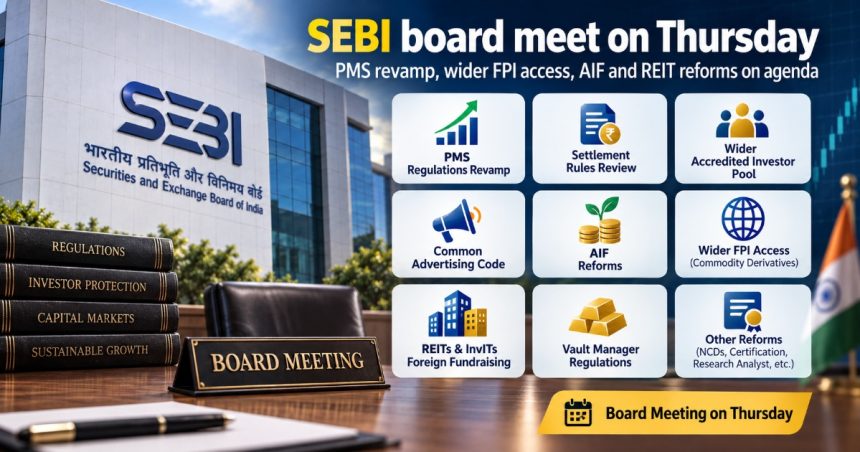
The Securities and Exchange Board of India (SEBI) is preparing for a closely watched board meeting on Thursday, with a broad set of reforms that could reshape how investors, portfolio managers, foreign investors and market intermediaries operate.
The agenda reportedly includes PMS regulations, FPI access to commodity derivatives, settlement rules, advertising norms, Accredited Investors, AIFs and REITs/InvITs. Several of these proposals have already appeared in SEBI consultation papers in recent months.
For investors, the key question is not just what SEBI may approve, but how these changes could affect access, compliance, investment products and foreign capital flows.
Track Live : Opening Price Clues – What Pre-Market Data Says Today
SEBI Board Meeting: PMS rules could open the door to more investment choices
One of the biggest proposals involves a comprehensive overhaul of Portfolio Management Services (PMS) regulations.
The proposed framework could allow PMS managers to invest in overseas securities, including listed foreign equities and debt and overseas mutual funds, subject to applicable rules and client consent.
SEBI is also considering a Mutual Fund-only PMS category, or MF-PMS, focused on direct mutual fund plans, ETFs and specialised investment funds.
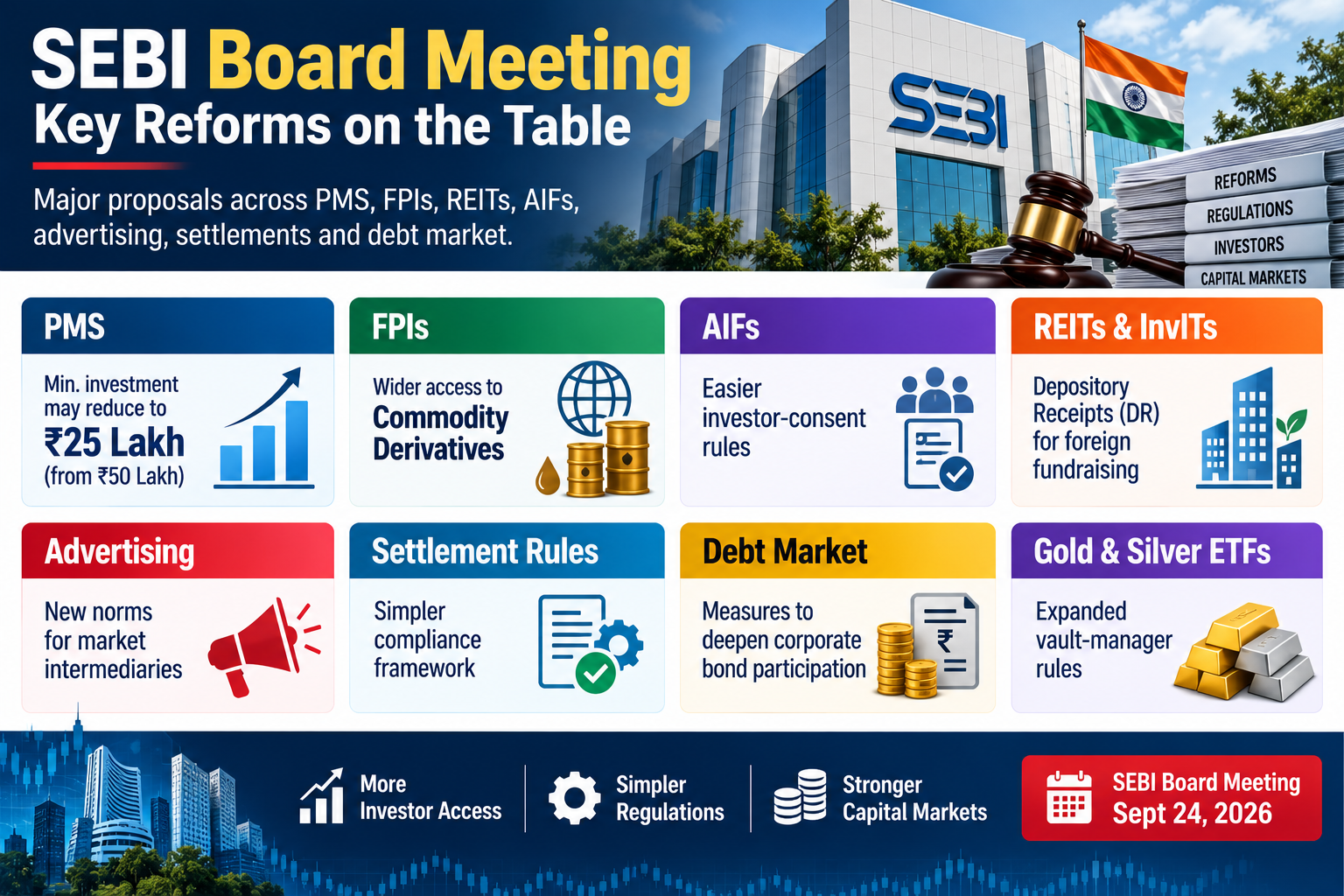
The minimum investment requirement could fall from Rs 50 lakh to Rs 25 lakh, while the applicant net-worth requirement could decline from Rs 5 crore to Rs 2 crore.
Why SEBI’s Board Meeting Matters to Investors
- PMS & wealth management: Proposed reforms could lower entry barriers and expand investment options.
- FPIs: Wider access to commodity derivatives could increase foreign participation in Indian markets.
- AIFs: Changes to investor-consent and related-party rules could affect fund governance.
- REITs & InvITs: Proposed depository receipts could create another route to raise foreign capital.
- Brokers & intermediaries: Settlement and advertising reforms could simplify compliance requirements.
- Debt markets: SEBI is considering measures to deepen corporate-bond participation and simplify some issuance requirements.
- Gold & silver ETFs: Expanded vault-manager rules could strengthen oversight of underlying physical bullion.
- Research analysts: Proposed changes could ease certain call-recording requirements while retaining communication records.
SEBI Board Meeting Agenda: Quick Reference Guide
SEBI is scheduled to consider a broad set of regulatory proposals at its September 24, 2026 board meeting. The proposals cover PMS, FPIs, AIFs, REITs/InvITs, advertising, settlements and the debt market. Several of these measures were already put out for public consultation by SEBI in recent months.
| Segment | Existing framework | Proposed reform | Potential market impact |
|---|---|---|---|
| PMS | Minimum investment generally ₹50 lakh; PMS regulations have separate compliance requirements. | Proposed MF-PMS with ₹25 lakh minimum investment and ₹2 crore net-worth threshold; wider investment options including overseas securities and certain unlisted debt. | Could broaden access to professionally managed products and expand PMS investment choices. |
| Accredited Investors | Accreditation primarily handled through designated accreditation agencies. | Proposed manager-led accreditation, a ₹5 crore securities-market asset criterion and deemed accreditation for certain foreign investors. | Could expand the pool of investors eligible for specialised products. |
| REITs & InvITs | Existing framework does not specifically provide for DR issuance against their units. | Proposed Depository Receipts backed by REIT/InvIT units to facilitate overseas fundraising. | Could provide an additional route for accessing foreign capital. |
| FPIs | FPIs have restrictions around physically settled non-agricultural commodity derivatives. | Proposed wider participation, including non-agricultural index derivatives and certain physically/non-cash-settled contracts, with delivery-period safeguards. | Could broaden institutional participation and market liquidity. |
| AIFs | Investor-consent requirements and conflict-related provisions vary across situations. | Proposed standardisation of specified consent requirements and broader related-party/conflict definitions. | Could change fund-governance and investor-consent processes. |
| Advertising | Different SEBI-regulated entities operate under separate advertising requirements. | Proposed Common Advertising Code, with post-publication reporting for most advertisements and restrictions on misleading practices. | Could simplify compliance while standardising investor-facing communications. |
| Settlement | Settlement procedures operate under the existing SEBI Settlement Proceedings Regulations. | Proposed changes include revised settlement calculations, earlier settlement opportunities and a fast-track route for smaller cases. | Could make regulatory settlement processes more streamlined. |
| Corporate debt | Certain small private debt placements have additional compliance requirements. | Proposed removal of mandatory merchant-banker involvement for some small private placements and a Credit Risk-o-Meter for debt securities. | Could reduce issuance friction and add another risk-disclosure mechanism. |
| Vault managers | Existing framework primarily covers specified electronic-gold-receipt-related vaulting arrangements. | Proposed expansion to bullion underlying gold/silver ETFs and other regulated products, with stronger requirements. |
FPIs could get wider access to commodity derivatives
Another proposal could expand the role of foreign portfolio investors (FPIs) in India’s commodity derivatives market.
SEBI may allow FPIs to participate in physically deliverable non-agricultural commodity derivatives, with safeguards requiring positions to be squared off or rolled over before the delivery period.
SEBI has separately published a consultation paper on FPI participation in exchange-traded commodity derivatives.
For traders, wider FPI participation could increase institutional activity and liquidity in eligible contracts, although the eventual impact will depend on the final framework.
Track Live : Gap Up / Gap Down Stocks – Today’s NSE Opening Gaps

Settlement rules and advertising norms may also change
SEBI is also expected to review its settlement framework, including settlement amounts and mechanisms for cases involving investor losses, wrongful gains or market-wide impact.
A fast-track settlement route for cases involving amounts up to Rs 10 lakh is among the reported proposals.
Another important reform is a proposed common advertising code for regulated entities. The framework could cover stock brokers, mutual funds, PMS providers, investment advisers, research analysts and other intermediaries.
The proposal could replace several entity-specific requirements with unified standards designed to make investor-facing advertisements fair, balanced and transparent.
Read More : Hero Motors Lists Under Issue Price, Then Rallies 17% in Early Trade — Should You Buy Now?
Accredited Investors could get a wider definition
SEBI may also consider expanding the Accredited Investor framework.
Under the proposal, individuals with at least Rs 5 crore in securities-market assets could qualify, alongside a manager-led accreditation process.
The framework could also provide deemed accredited-investor status to certain Persons Resident Outside India, including FPIs.
For wealth-management businesses and sophisticated investors, the change could expand access to products available under accredited-investor frameworks.
REITs and InvITs could get a foreign fundraising route
Another proposal attracting attention is the potential permission for REITs and publicly listed InvITs to issue Depository Receipts (DRs) backed by their units.
This could provide these structures with another route to access overseas capital markets.
SEBI has already published a consultation paper on issuing DRs against units of REITs and publicly listed InvITs.
The board may also consider allowing REITs and InvITs to take minority stakes in certain under-construction third-party projects.
AIFs, research analysts and vault managers are also in focus
The agenda extends beyond PMS and REITs.
For AIFs, SEBI may consider standardising investor-consent requirements at 75% by value for specified decisions and replacing the existing associate test with a broader related-party framework.
Proposals concerning certification requirements, research analyst call-recording rules and vault manager regulations are also expected to be considered.
SEBI has separately proposed expanding the scope of its Vault Managers Regulations and strengthening requirements around security, insurance, compliance and risk management.
Potential Beneficiaries and Potentially Affected Businesses
Businesses that could see increased activity
- Exchanges: Wider participation in commodity derivatives and new investment products could increase trading activity and market volumes.
- Brokers: Greater FPI participation and changes in settlement and trading frameworks could create additional trading and clearing-related activity.
- Asset managers: The proposed wider accredited-investor framework and PMS changes could expand the addressable investor and product universe.
- Wealth managers & PMS providers: A proposed MF-PMS category and lower minimum investment threshold could broaden participation in professionally managed products.
- Depositories: Greater use of dematerialised products, including proposed REIT/InvIT depository receipts, could increase related market infrastructure activity.
- Clearing institutions: Changes involving settlement, commodity derivatives and risk-management processes could affect clearing and post-trade activity.
- REIT/InvIT managers: Proposed depository receipts and greater flexibility for investments in third-party projects could expand capital-raising and investment options.
Businesses facing regulatory or compliance changes
- Research analysts: Proposed changes could ease certain institutional-investor call-recording requirements while retaining communication records.
- Investment advisers: A common advertising framework could introduce standardised requirements for investor-facing communications.
- Mutual funds: The proposed common advertising code and potential MF-PMS framework could change product-marketing and distribution practices.
- Stock brokers: Settlement, advertising and market-infrastructure changes could require adjustments to compliance and operational processes.
- Portfolio managers: PMS reforms could expand permissible investments while changing eligibility and disclosure requirements.
- AIF managers: Proposed changes to accredited-investor eligibility and investor-consent requirements could affect fund governance and onboarding.
- Vault managers: SEBI is considering expanding the vaulting framework to bullion underlying gold and silver ETFs and other regulated products, alongside stronger requirements.
What could SEBI reforms mean for investors and traders?
The immediate market impact will depend on the decisions actually taken on Thursday.
For investors, the PMS changes could influence access to investment products, while wider FPI participation could affect institutional activity in eligible markets.
For REIT and InvIT investors, easier foreign fundraising could become an important factor for future capital availability.
However, these are proposals, not final rules. Investors should therefore focus on the final SEBI decisions, implementation timelines and subsequent circulars before factoring the changes into portfolio decisions.