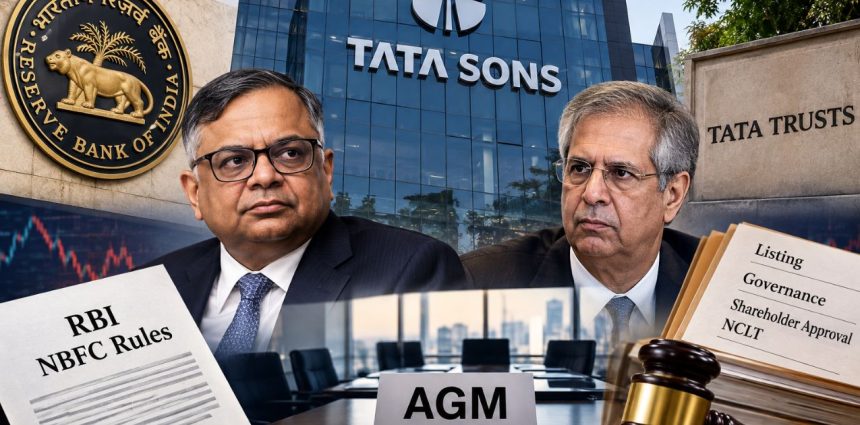
Need to Know
- The RBI’s letter of September 11, 2026, rejected Tata Sons’ application to surrender its NBFC registration and directed the company to comply with upper-layer NBFC rules.
- On September 17, the Tata Sons board approved N Chandrasekaran’s continuation for another five-year term by a 4–1 vote. Tata Trusts nominee Noel Tata voted against, while fellow nominee Venu Srinivasan voted for.
- Tata Trusts holds about 66% of Tata Sons. The Shapoorji Pallonji (SP) Group, with about 18.4%, has backed a listing.
- Listed Tata Group companies lost about ₹38,361 crore ($4 billion) in combined market value on September 18. Tata Sons itself is unlisted.
- Tata Sons plans to reconvene its AGM within a month. The previous meeting was deferred because of a quorum problem, and the company may consider approaching the NCLT if the issue persists.
- Key dates include October 15 for the Charity Commissioner hearing on Mehli Mistry’s objections, December 31 as the extended AGM deadline, and February 20, 2027, when Chandrasekaran’s current term ends.
Why the Tata Sons Dispute Is Back in Focus
The RBI’s September 11 decision did more than reject Tata Sons’ attempt to surrender its NBFC registration. It has pushed the unlisted holding company into a wider dispute over listing, governance, shareholder rights and leadership.
The latest issue is whether Tata Trusts, which controls about 66% of Tata Sons, was adequately informed about the company’s discussions with the RBI. The Indian Express reported, citing sources familiar with the matter, that the Trusts were not adequately updated on submissions made to the regulator, hearings and the regulatory process. Tata Trusts has opposed a straightforward listing and has urged Tata Sons to examine other options.
At the same time, the Tata Sons board has moved toward a public listing. Reuters reported that the board decided to move toward listing, while Tata Trusts has maintained that it did not agree to listing as the sole route and wants alternatives explored.
The result is a widening difference between the board’s reported direction and the position of the controlling shareholder.
What the RBI Actually Rejected
The RBI’s September 11 letter rejected an application dated March 28, 2024, through which Tata Sons sought to surrender its NBFC registration. The regulator directed the company to comply with the applicable upper-layer NBFC requirements.
The RBI had classified Tata Sons in the upper layer in 2022 and given it three years to comply with the applicable requirements. That deadline passed in September 2025.
Reports have linked the upper-layer framework to companies with assets above ₹1 lakh crore or access to public funds. Tata Sons reported assets of ₹2.01 lakh crore as of March 31, 2026. Business Standard has cited a figure of about ₹1.8 trillion. The reported figures differ, but both are above the ₹1 lakh crore threshold.
Noel Tata has interpreted the RBI decision more narrowly, arguing that the letter does not explicitly state that listing is the only possible route. He has reportedly pushed for more time and for Tata Sons to explore alternatives.
The board’s reported move toward listing is therefore being contested by Tata Trusts, which continues to seek consideration of alternatives.
Also Read: RBI Rejects Tata Sons’ Exit Plan. The Listing Question Is Back
Tata Trusts Raises Questions Over RBI Discussions
The latest development on September 24 concerns the information flow between Tata Sons and Tata Trusts.
According to The Indian Express, sources familiar with the matter said the Trusts were not adequately updated on submissions made to the RBI, hearings held with the regulator and the course of the regulatory process.
This is a reported claim rather than a judicial or regulatory finding.
The issue matters because Tata Trusts is the controlling shareholder of Tata Sons. Any major change in Tata Sons’ structure, including a listing or restructuring, could have implications for the Trusts’ ownership and governance rights.
Tata Trusts has opposed a straightforward listing and has asked Tata Sons to consider alternatives. This position differs from the board’s reported move toward listing.
Two Tata Trust Nominees, Two Different Votes
The governance dispute became more visible at the September 17 board meeting.
Chandrasekaran had said on August 12 that he would not seek reappointment when his term ended on February 20, 2027. At the September 17 meeting, the board asked him to reconsider and he agreed.
The board subsequently voted 4–1 in favour of his continuation. Venu Srinivasan, Saurabh Agrawal, Harish Manwani and Anita George supported the move, while Noel Tata opposed it. Chandrasekaran did not vote.
The two Tata Trusts nominees have also taken different positions on the listing issue.
Noel Tata has opposed a straightforward listing and has argued that Tata Sons should explore restructuring and other alternatives. Venu Srinivasan has publicly supported listing, citing governance and capital-raising considerations.
The split is significant because Tata Trusts controls about 66% of Tata Sons, making shareholder approval central to the next stage.
Article 121: Why the 4–1 Vote Is Being Challenged
Tata Trusts has questioned whether the September 17 board decision complied with Tata Sons’ Articles of Association.
Article 121 requires certain board decisions approved by a majority to also receive the affirmative vote of a majority of the Trusts’ nominee directors. With Noel Tata voting against and Venu Srinivasan voting in favour, the Trusts argues that the required majority among its nominees was not achieved.
The Trusts has also argued that the chairman’s casting vote should apply to a tie at the overall board level and not resolve a split between the Trusts’ nominees. Tata Sons interprets the relevant provisions differently.
The 2021 Supreme Court judgment in the Tata-Mistry dispute upheld the affirmative-voting provision. However, it did not specifically decide how that provision applies when the Trusts’ own nominees are divided.
The Trusts has cited a legal opinion from former Chief Justice of India D.Y. Chandrachud. That opinion is not a judicial ruling on the current dispute.
No court has yet ruled on the validity of the September 17 resolution.
Why the AGM Has Become the Next Big Test
The board decision on Chandrasekaran’s continuation is not the end of the process.
His continuation as a director requires shareholder approval, putting the Tata Trusts’ roughly 66% holding at the centre of the next stage.
The problem is that Tata Sons’ previous AGM could not proceed because the required quorum was not available.
Tata Sons now plans to reconvene the AGM within a month. The Economic Times reported on September 24 that the company may approach the National Company Law Tribunal if the quorum issue caused by restrictions on the Sir Ratan Tata Trust continues.
The RoC has already extended Tata Sons’ deadline to hold the AGM until December 31, 2026.
This makes the AGM a key event for both Chandrasekaran’s directorship and the wider governance dispute.
The Tata Trusts’ Own Governance Problem
The Trusts’ internal governance issues are adding another layer to the dispute.
Restrictions on the Sir Ratan Tata Trust
The Charity Commissioner is examining issues concerning the composition of the Sir Ratan Tata Trust board. Restrictions remain in place on the Trust holding meetings or taking certain decisions.
The AGM Quorum Failure
Tata Sons’ Articles require a jointly nominated representative of the Sir Ratan Tata Trust and Sir Dorabji Tata Trust for a valid quorum while the Trusts hold the relevant level of share capital.
The August 18 AGM was adjourned because the required quorum was not available. Tata Sons subsequently received an extension until December 31.
Vijay Singh’s Exit
Vijay Singh stepped down from the Sir Ratan Tata Trust ahead of the August 14 expiry of his term and did not seek reappointment. He continues as a trustee of the Sir Dorabji Tata Trust.
Dividend-Delay Complaint
A complaint filed with the Charity Commissioner estimated that every week’s delay in receiving the roughly ₹2,900 crore dividend could result in an opportunity cost of about ₹3.9 crore, based on an assumed 7% return.
That is an illustrative calculation, not an accounting loss reported by the Trusts.
October 15 Hearing
The Charity Commissioner is scheduled to hear former trustee Mehli Mistry’s objections relating to changes in the composition of three Tata trusts and associated governance matters.
₹31,961 Crore Profit, Zero Borrowings: What Tata Sons’ FY26 Books Show
Tata Sons’ FY26 financial numbers provide another important part of the story.
| Metric | FY26 Figure | Status |
|---|---|---|
| Standalone net profit | ₹31,961 crore, up 21.8% from ₹26,232 crore | Annual report |
| One-off gain on investment sales | ₹6,531 crore | Annual report |
| Dividend income | ₹32,528 crore, down 10% from ₹36,149 crore | Annual report |
| TCS dividend to Tata Sons | ₹28,290.94 crore vs ₹32,184.19 crore | Annual report |
| Cash and equivalents; borrowings | ₹21,841 crore; no borrowings | Annual report |
| Proposed dividend | ₹1,10,717 per share vs ₹64,900 | Awaiting shareholder approval |
| Consolidated net profit | ₹26,616 crore, down 35%, while revenue rose 17% | Annual report |
| TCS share of dividend income | About 87% | NiftyTrader calculation |
| Total assets, March 31, 2026 | ₹2.01 lakh crore vs about ₹1.8 lakh crore | Sources differ |
The FY26 numbers show Tata Sons reported substantial profit, cash and dividend income. The current dispute is centred primarily on governance, regulatory compliance, control, capital structure and the future structure of the holding company.
Tata Sons’ dependence on TCS dividends is also relevant to any restructuring discussion because changes to the holding company’s structure could affect the flow of dividends.
Air India’s loss widened to ₹22,238 crore from ₹10,859 crore, making capital allocation another issue in the debate around Chandrasekaran’s continuation.
₹38,361 Crore Gone: How Tata Stocks Reacted
Reuters calculated that ₹383.61 billion ($4 billion) was wiped from the combined market value of listed Tata Group companies on September 18, from about $268.5 billion at Thursday’s close.
TCS closed down 3.88%, while Tata Chemicals fell 11.04%. Tata Motors Passenger Vehicles and Tata Elxsi each declined 3.4%, while Tata Investment Corporation fell 2.55%. Tata Capital rose 2.42% and Tata Power gained 1.57%.
Other reports calculated the overall decline differently, ranging from nearly ₹39,000 crore to about ₹46,634 crore. The variation reflects differences in the companies included and the calculation methodology.
Tata Chemicals is particularly sensitive to Tata Sons-related developments because it owns a 2.53% stake in Tata Sons. Its September 18 decline reversed the previous day’s 6.5% gain.
Outlook Business has estimated Tata Sons’ value at around ₹11.9 lakh crore based on its holdings in listed Tata companies. Such estimates depend on market prices, holding-company discounts and the treatment of cross-holdings.
SP Group Adds Another Pressure Point
The Shapoorji Pallonji Group is Tata Sons’ second-largest shareholder and has supported a potential listing.
Tata Trusts has said the SP Group proposed monetising part of its stake for at least ₹25,000 crore ($2.61 billion), potentially through a selective capital reduction.
The SP Group has also been working to reduce its debt and raised $2.25 billion in July through refinancing backed by Tata Sons shares.
The shareholder positions therefore remain different: Tata Trusts has opposed a straightforward listing, while the SP Group has supported the listing route.
Restructure, List or Seek More Time?
Three broad options have emerged in the dispute.
Restructure
Noel Tata has reportedly proposed exploring a restructuring of Tata Sons, including a possible split into multiple entities, as an alternative to a straightforward listing.
No detailed demerger plan has been publicly established, and any restructuring would involve regulatory and legal considerations.
Seek More Time
Noel Tata has also reportedly proposed asking the RBI for additional time to meet compliance requirements.
That remains a proposal rather than an announced RBI extension.
List
The Tata Sons board has moved toward a public listing, according to Reuters and The Indian Express. However, Tata Trusts continues to oppose listing as the sole route and has urged the company to examine alternatives.
Reports have pointed to around February 2027 as a possible internal timeline, but Tata Sons has not announced a public IPO date.
Track Live: NiftyTrader News: Stock Market, IPO, Finance, Business
Four Questions Investors Will Watch Next
- Will Chandrasekaran’s reappointment survive the shareholder process?
The board has approved his continuation, but shareholder approval is still required. - Can Tata Sons successfully reconvene its AGM?
The quorum issue linked to the restrictions on the Sir Ratan Tata Trust remains a key hurdle. Tata Sons may consider the NCLT route if the problem continues. - Will Tata Trusts formally challenge the September 17 resolution?
The Trusts has already questioned the validity of the board decision under Tata Sons’ Articles. - What compliance route will Tata Sons ultimately pursue?
The board has moved toward listing, while Tata Trusts continues to push for alternatives.
What Is Confirmed vs Still Disputed?
| Confirmed | Still disputed |
|---|---|
| The RBI’s September 11 letter rejected the surrender application | Whether the RBI route leaves room for alternatives beyond listing |
| The board voted 4–1 on Chandrasekaran’s reappointment | Whether the reappointment is valid under Articles 121 and 118 |
| The two Tata Trusts nominees split their votes | Whether the casting-vote provision can resolve the Trusts’ nominee split |
| Tata Trusts holds about 66% and the SP Group about 18.4% | Whether Tata Trusts was adequately briefed during the RBI process |
| The board has moved toward listing | Whether listing can proceed without resolving the Trusts’ objections |
| ₹383.61 billion was erased from listed Tata Group companies on September 18, according to Reuters | The eventual structure and timing of any Tata Sons listing |
| FY26 profit, dividend and cash figures are reported in the annual report | Whether restructuring or additional time could emerge as an alternative |
| Tata Sons plans to reconvene its AGM | Whether the AGM can achieve the required quorum or require an NCLT route |
Read Next: PB Fintech Share Price Falls 20%: IRDAI Commission Reset Puts Policybazaar Model Under Pressure
This article is for information only and is not investment advice.