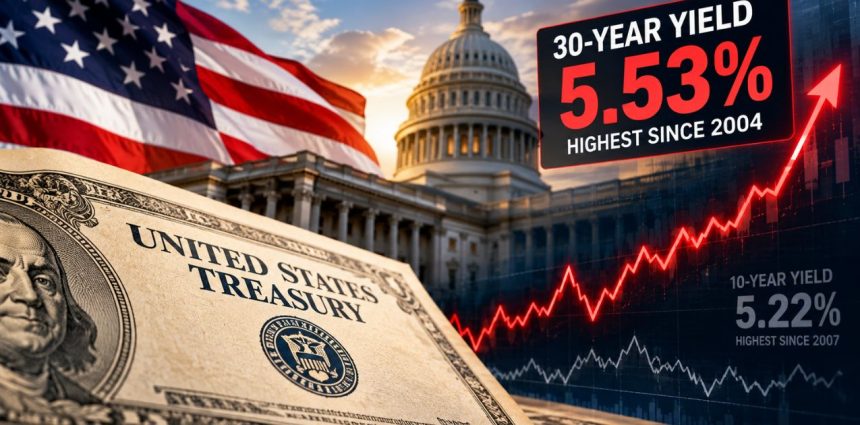
The US bond market is putting renewed focus on the risk that long-term borrowing costs could stay elevated for longer than investors had expected.
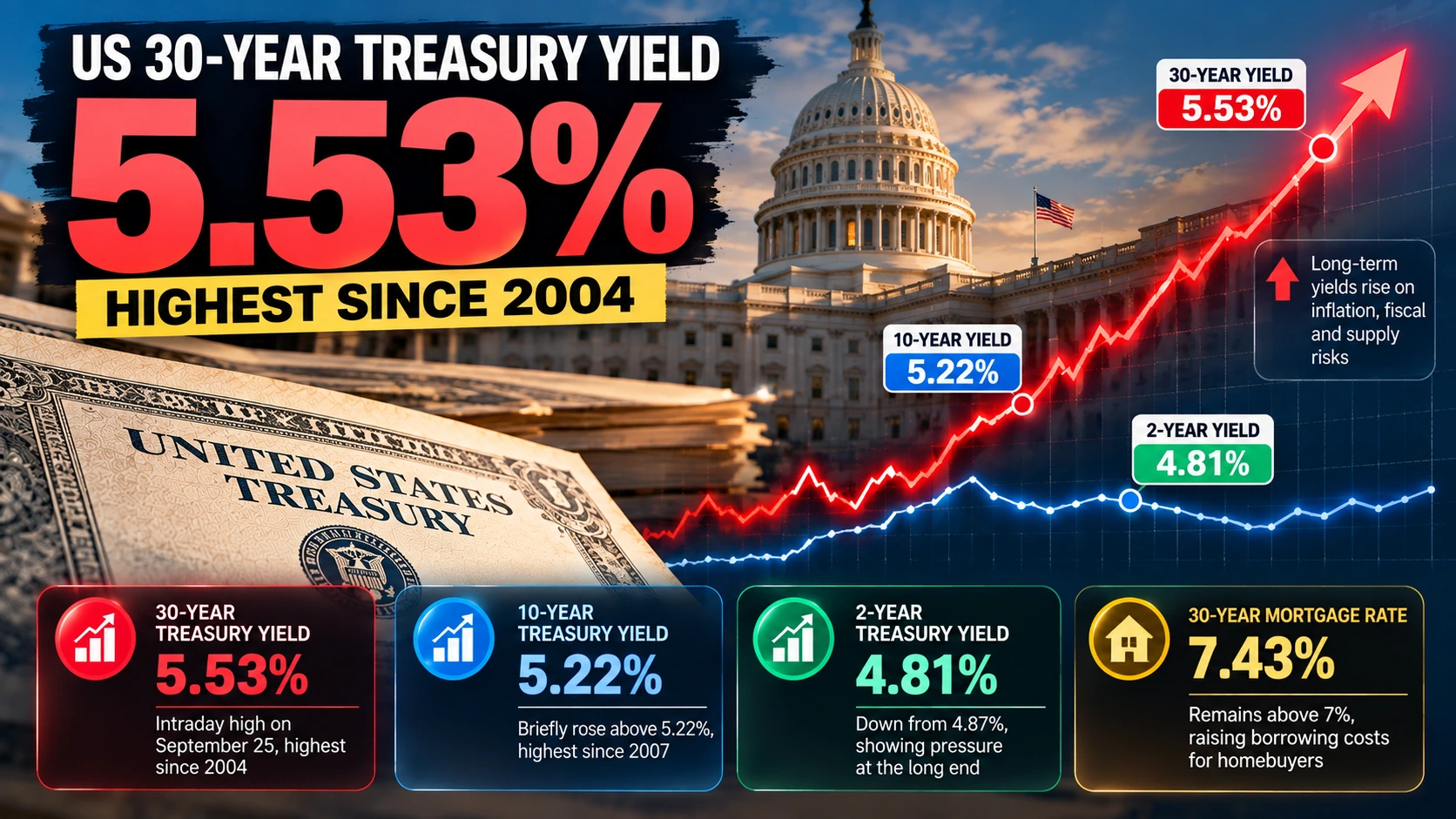
The 30-year US Treasury yield reached an intraday high of about 5.53% on September 25, its highest level since 2004. The 10-year Treasury yield briefly rose above 5.22%, its highest level since 2007, even as shorter-term Treasury yields eased during the session.
The diverging moves highlight a key market concern: the Federal Reserve may eventually be able to reduce short-term interest rates, while long-term borrowing costs could remain elevated because of inflation, fiscal and supply-related risks.
The US Treasury Department’s official daily par-yield curve showed the 30-year rate at 5.49% on September 25. The intraday high and the official daily reading are not contradictory. The 5.53% figure reflects trading during the session, while the Treasury’s daily curve is based on indicative market quotations near 3:30 p.m. ET.
For households, businesses and investors, the move matters far beyond the bond market. Rising long-term Treasury yields can push up mortgage borrowing costs, lift corporate financing expenses, weigh on stock valuations and increase the government’s future debt-service burden.
Treasury yields at` a glance
| Market indicator | Latest reading or move | Why it matters |
|---|---|---|
| US 30-year Treasury yield | Intraday high of about 5.53% on September 25 | Highest level since 2004, according to market reporting |
| Official 30-year Treasury par yield | 5.49% on September 25 | Daily Treasury benchmark based on indicative market quotes |
| US 10-year Treasury yield | Intraday high above 5.22%; official rate 5.17% | A major benchmark for financial conditions and market valuations |
| US two-year Treasury par yield | 4.81%, down from 4.87% | Suggests pressure was concentrated more heavily at the long end |
| Federal-funds target range | 3.75%–4.00% | Set after the Fed’s September rate increase |
| University of Michigan sentiment | 48.1 in September | Above the 47.8 preliminary reading and 47.6 forecast, but below August’s 51.7 |
| 30-year fixed mortgage-rate index | 7.43% on September 25 | Daily Mortgage News Daily index remained above 7% |
| Previous day’s mortgage-rate index | 7.45% on September 24 | Illustrates the recent sharp rise in home-loan borrowing costs |
The Federal Reserve raised its policy rate by 25 basis points in September, lifting the federal-funds target range to 3.75%–4.00%. The move marked the Fed’s first rate increase since 2023 and reinforced the view that policymakers remain focused on inflation risks.
Also Read: US 10-Year Treasury Yield Hits 5.05%: Hot PMI Revives Fed Hike Bets
Why long-term Treasury yields are rising
Treasury yields rise when bond prices fall. Investors selling bonds, or demanding greater compensation for holding them, push yields higher.
The latest move above 5.5% reflects a combination of inflation concerns, resilient economic activity, higher energy prices, fiscal pressures and expectations for further Federal Reserve tightening. Reuters reporting on the sell-off pointed to these overlapping forces, rather than a single data release, as investors reassessed the likely path of interest rates and inflation.
Long-dated government bonds are especially sensitive to risks that stretch beyond the next Federal Reserve meeting. Investors buying 30-year Treasuries must consider the possibility that inflation remains elevated, that government borrowing expands, that economic growth holds up better than expected and that policy rates do not decline as quickly as markets had once anticipated.
Several forces are shaping the long-end sell-off:
- Inflation remains a concern. Energy-market volatility can raise the near-term inflation outlook and affect household expectations for future prices. Rising fuel and transport costs can also spread through parts of the economy.
- The Fed has resumed rate increases. In September, the Federal Reserve lifted its target range to 3.75%–4.00%, signalling that policymakers remain concerned about inflation.
- The US economy has remained more resilient than expected. If consumer spending, employment and business activity remain firm despite higher rates, inflation may take longer to ease.
- Investors may demand a higher term premium. The term premium is the extra return investors require for holding long-dated bonds rather than rolling over short-term debt. It can rise when uncertainty over inflation, fiscal conditions, supply and interest rates increases.
- Government financing needs remain in focus. Larger Treasury issuance can require the market to absorb more long-dated debt, increasing the importance of investor demand at auctions and among institutional buyers.
The key point is that long-term yields are not determined solely by what the Fed does with overnight interest rates. They also reflect the market’s broader view of inflation, growth, government finances and the return investors require to commit money for decades.
Oil fell, but yields still rose
One of the clearest market tensions on September 25 was that long-term Treasury yields climbed even as oil prices declined.
West Texas Intermediate crude settled down 2.3% at $92.41 a barrel. Normally, lower oil prices can ease immediate inflation fears and reduce pressure on bond yields. But the long-end Treasury sell-off continued, suggesting that investors were responding to a wider mix of concerns than that day’s energy-price move alone.
That distinction is important. Oil remains a major input into inflation expectations, but bond investors are also weighing the broader outlook for interest rates, Treasury supply, economic resilience and fiscal conditions.
The move showed that lower oil prices on a single day may not be enough to reverse a market that is re-pricing the possibility of structurally higher long-term borrowing costs.
Yield curve steepens as short rates ease
The most revealing part of the market action was the divergence between shorter- and longer-dated Treasury yields.
On September 25, the Treasury’s official two-year par yield fell to 4.81% from 4.87% the prior day. By contrast, the 30-year par yield rose to 5.49% from 5.47%. The 10-year yield eased slightly to 5.17% from 5.18%, after trading above 5.22% intraday.
That widened the gap between the two-year and 30-year Treasury yields to roughly 68 basis points, from around 60 basis points a day earlier.
| Yield-curve measure | September 24 | September 25 | What changed |
|---|---|---|---|
| Two-year Treasury par yield | 4.87% | 4.81% | Fell 6 basis points |
| Ten-year Treasury par yield | 5.18% | 5.17% | Eased 1 basis point |
| Thirty-year Treasury par yield | 5.47% | 5.49% | Rose 2 basis points |
| Two-year to 30-year spread | About 60 basis points | About 68 basis points | Curve steepened by about 8 basis points |
This kind of move is called a steepening yield curve. It means the difference between short- and long-term yields is widening.
It does not guarantee a recession, a renewed inflation surge or a market crash. However, it can show that investors are demanding more compensation for holding long-term debt, even as some traders see the near-term outlook for policy rates as already restrictive.
That creates an important expectation gap for markets: short-term rates could eventually fall if the Fed reduces rates, but long-term rates may not decline by the same amount if inflation, term-premium or fiscal concerns remain elevated.
What higher yields mean for mortgages
Mortgage rates do not move one-for-one with the 30-year Treasury yield. They are influenced more directly by mortgage-backed securities, lender funding costs, market volatility and borrower credit risk.
Still, broad increases in market yields can lift mortgage financing costs.
Mortgage News Daily’s daily 30-year fixed-rate index stood at 7.43% on September 25, after reaching 7.45% on September 24. The daily index is different from the weekly Freddie Mac mortgage survey, but it offers a timely measure of how lender rates are changing.
For prospective buyers, mortgage rates above 7% can significantly reduce affordability. The same home price can produce a much higher monthly payment when the interest rate rises, forcing buyers to reduce their budget, make a larger down payment or postpone a purchase.
Higher rates can also create a lock-in effect for existing homeowners. Owners with mortgages taken out at much lower rates may be reluctant to sell because moving could require them to replace an older loan with a more expensive one. That can reduce housing-market turnover and limit available supply.
For builders, developers and real-estate companies, elevated financing costs can make projects harder to fund and may weaken demand from buyers.
What higher yields mean for stocks
Rising Treasury yields affect nearly every major asset class because government bonds are a benchmark for the cost of capital.
When long-term Treasury yields rise, investors can receive higher returns from government securities with relatively low credit risk. That can make riskier investments—including stocks, corporate debt and real estate—less attractive unless their expected returns also rise.
Higher yields can affect the stock market in several ways:
- Valuation pressure: Higher interest rates increase the discount rate used to value future corporate earnings. This can be especially important for high-growth companies whose expected profits are further in the future.
- Higher borrowing costs: Businesses refinancing debt or issuing new bonds may face higher interest expenses, potentially reducing profits and curbing investment plans.
- Commercial real-estate pressure: Property valuations depend heavily on financing costs, rental income and capitalization rates. Higher long-term yields can make refinancing more challenging.
- Rising government interest costs: As US Treasury debt matures and is refinanced, higher rates can increase the cost of servicing government borrowing.
The full impact is not always immediate. Many companies have fixed-rate debt that does not mature for years. But if long-term rates remain elevated, tighter financial conditions can gradually affect investment, hiring and profitability.
Consumer sentiment remains weak
The final University of Michigan consumer-sentiment index rose to 48.1 in September, above the preliminary 47.8 reading and the 47.6 forecast in a Reuters poll. Yet the figure was still below August’s 51.7 and marked the weakest consumer-confidence reading in four months.
The data offered a mixed message for markets.
On one hand, the final figure was better than expected, suggesting household confidence was not quite as weak as economists had projected. On the other hand, the low overall reading showed that consumers remain concerned about high prices and the economic outlook.
Inflation expectations also moved higher. One-year inflation expectations rose to 4.6% from 4.0%, while five-year expectations increased to 3.4% from 3.3%, adding to the market’s concern that price pressures may remain difficult to contain.
For investors, that combination is important: consumer confidence is weak, but inflation expectations remain elevated. It is precisely the kind of backdrop that can make Federal Reserve policy more complicated and keep long-term bond investors cautious.
What markets will watch next
The next move in Treasury yields will depend on whether investors see the latest sell-off as a temporary adjustment or the beginning of a more durable shift towards higher long-term rates.
Several developments will be closely watched:
- Inflation data: Evidence that price pressures are easing could lower pressure on long-term yields. Persistent inflation could reinforce the higher-for-longer rate outlook.
- Federal Reserve guidance: Markets will examine speeches, forecasts and policy statements for signs that further rate increases are likely or that policymakers are becoming more cautious.
- Labour-market and spending data: Strong jobs and spending reports could suggest that demand remains resilient despite higher rates. Weaker figures could strengthen expectations for future policy easing.
- Energy prices: Oil-price gains could add to inflation concerns, while sustained declines may offer some relief if they feed through to consumer prices.
- Treasury auctions and investor demand: Strong demand for government debt could help stabilise long-term yields. Weak demand could keep upward pressure on the term premium.
- Housing-market data: Mortgage rates above 7% make home sales, refinancing activity and builder sentiment important indicators of how high market rates are affecting the real economy.
Check Live: GIFT Nifty Live, FII DII Data, Nifty 50 Today, Crude Oil Future
Bottom line
The 30-year US Treasury yield’s intraday move to about 5.53% is a significant signal from the bond market. It reflects a reassessment of the risk that inflation, energy-price uncertainty, resilient economic activity and continued Federal Reserve tightening could keep long-term borrowing costs high.
The important development is not simply that yields rose. It is that the long end of the Treasury curve strengthened relative to the short end: the two-year yield fell, while the 30-year rate increased. That pattern suggests markets are focused less on the next policy decision and more on the longer-term outlook for inflation, government financing and the return required to hold long-duration debt.
For households, the effect is visible in mortgage rates above 7%. For companies, it raises financing costs. For stock investors, it creates a higher hurdle for valuations. And for the Federal Reserve, it highlights the challenge of bringing inflation under control without putting excessive pressure on the broader economy.
Read Next: CAIT No UPI Day: Will UPI Stop on October 2? MDR Rules Explained
Disclaimer: This article is for informational purposes only and does not constitute investment, financial, mortgage or trading advice. Market yields, interest rates and related asset prices can change rapidly, and readers should make decisions based on their own research and risk assessment.