
SEBI May Revisit Stock Exchange Self-Listing Rules; BSE Shares Fall 2%
The rules governing India’s stock exchanges could be heading for another major change, and BSE shares reacted quickly. Shares of BSE fell around 2% on Monday after CNBC-TV18 reported that SEBI may form a panel to examine regulations allowing exchanges to list on their own platforms.
The development comes just days after NSE made its market debut on BSE, putting the long-running question of exchange self-listing back in focus.
Track Live : NSE Option Chain — Live | BSE Option Chain — Live Sensex & Bankex Options Data Today
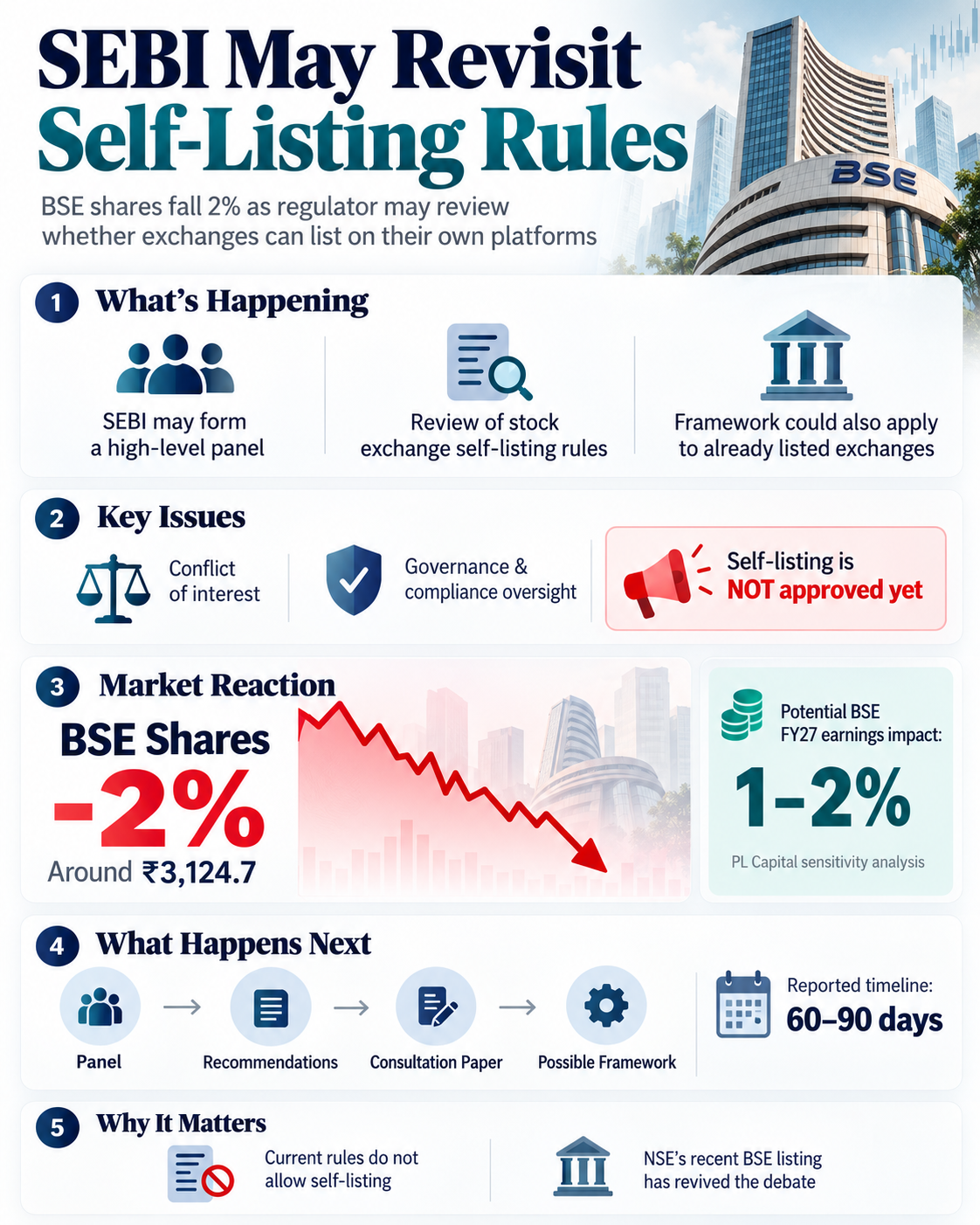
SEBI May Revisit Stock Exchange: Panel May Review Exchange Self-Listing Rules
SEBI is reportedly considering the formation of a high-level panel to examine whether stock exchanges should be permitted to list and trade their own shares on their own platforms. CNBC-TV18 reported the development on September 28, citing sources. The proposed framework could also apply to exchanges that are already listed.
According to reports, the panel could include SEBI officials and market experts and may be given around 60–90 days to submit recommendations. SEBI could subsequently issue a consultation paper based on those recommendations.
Key details of the development
- SEBI may form a panel: The regulator is reportedly considering a panel of SEBI officials and market experts to examine whether stock exchanges should be allowed to list their own shares on their trading platforms. The panel has reportedly not yet been formally constituted.
- Possible 60–90 day timeline: Sources cited in the latest reports say the proposed panel could submit its recommendations within 60 to 90 days. SEBI could then consider issuing a consultation paper on a possible self-listing framework.
- Conflict of interest is the central issue: A self-listed exchange would potentially be involved in regulating, supervising and providing trading infrastructure for its own shares. SEBI’s review is therefore expected to examine conflict-of-interest safeguards, governance arrangements and compliance oversight. One proposal reportedly under consideration is for the primary exchange to retain compliance oversight even after self-listing.
- Current regulation does not permit self-listing: Regulation 45(1) of the SECC Regulations, 2018 allows a recognised stock exchange to apply for listing on another recognised stock exchange, but specifically excludes itself and its associated stock exchange. The provision also requires compliance with ownership and governance requirements and SEBI approval.
- Why NSE is at the centre of the debate: NSE debuted on BSE on September 24, 2026. After the listing, NSE Chairman Srinivas Injeti said SEBI should reconsider the restriction on exchanges listing on their own platforms. He pointed to international markets where self-listing is permitted.
- NSE has not been approved for self-trading: Earlier, NSE CEO Ashishkumar Chauhan said the exchange had not submitted an application to SEBI seeking permission for its shares to trade on NSE’s own platform.
- BSE shares reacted to the report: BSE shares fell roughly 2% on September 28, with reports putting the stock around the ₹3,121–₹3,124 range during the session. The decline followed the report that SEBI could revisit the self-listing framework.
- The rule could potentially apply to existing listed exchanges: Reports say any framework that SEBI eventually approves could also cover exchanges that are already listed, rather than applying only to future listings. This remains part of the reported proposal and is not yet an approved rule.
Current regulatory position
| Issue | Current position |
|---|---|
| Can an exchange list on another exchange? | Yes, subject to SEBI’s requirements |
| Can an exchange list on itself? | No under the current Regulation 45 framework |
| Can NSE currently trade its shares on NSE? | Not under the existing framework |
| Has SEBI approved self-listing? | No |
| Is a SEBI panel officially constituted? | Reportedly under consideration; not yet formally constituted |
| Reported panel timeline | 60–90 days |
| Possible next regulatory step | Consultation paper |
| Main concern | Conflict of interest and governance |
| BSE market reaction | Around 2% decline on September 28 |
SEBI’s own regulatory material confirms that Regulation 45 governs listing of stock exchanges and that SEBI can specify conditions in the interest of the securities market.
What could happen to NSE if self-listing is permitted?
If SEBI eventually permits self-listing, NSE would need to obtain regulatory approval before its shares could trade on its own platform.
The important distinction is that SEBI forming a panel would not itself mean that self-listing has been approved. The likely sequence would be:
Panel formation → recommendations → possible SEBI consultation paper → regulatory framework → approval/implementation.
NDTV Profit reported that the proposed panel could submit recommendations within 60–90 days, after which SEBI may consider a consultation paper.
Track Live : Gap Up / Gap Down Stocks – Today’s NSE Opening Gaps
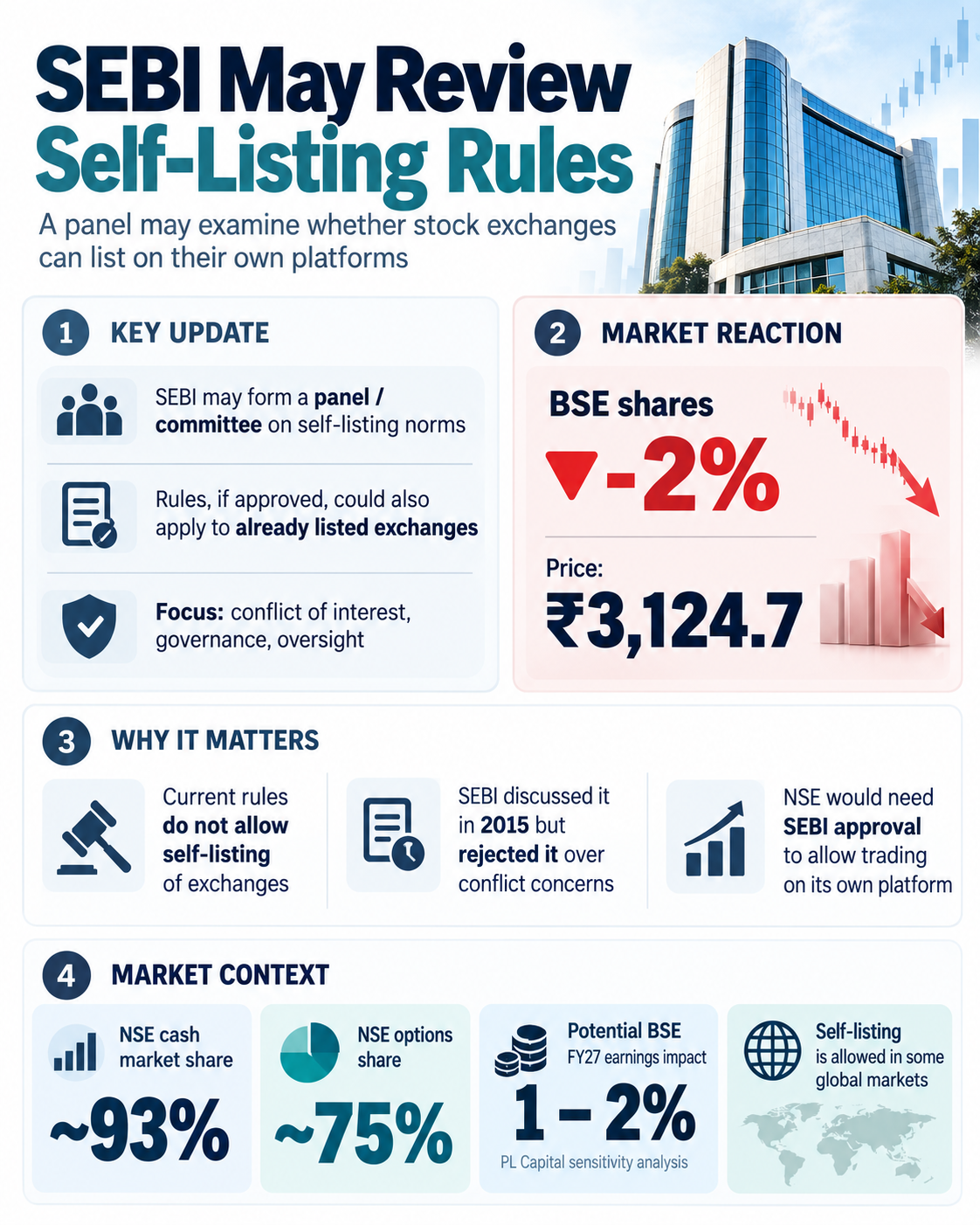
What NSE self-listing could mean for BSE earnings
The potential regulatory change is being closely watched because BSE could lose some trading-related benefits if NSE shares eventually trade on NSE itself.
According to a PL Capital sensitivity analysis, NSE’s potential self-trading could affect BSE’s FY27 earnings by roughly 1–2%, assuming BSE’s cash-market share does not improve further.
For BSE investors, the issue is therefore not simply about where NSE shares trade. It is also about the competitive dynamics between India’s two major exchanges and their ability to capture trading volumes.
Read More : Gold and Silver ETFs Extend Losses, Silver Down 3.6%, as Oil Lifts Rate Bets
How could this affect BSE?
The potential impact on BSE is one of the key market questions.
A PL Capital analysis cited in the original report estimated that NSE’s potential self-listing could affect BSE’s FY27 earnings by around 1–2%, under a sensitivity scenario in which BSE’s cash-market share does not improve further.
That estimate is a brokerage sensitivity analysis, not a confirmed earnings impact.
BSE’s share price reaction therefore needs to be separated from the underlying regulatory development: SEBI has not yet approved self-listing, and the reported panel is still at the review stage.
NSE shares also slip below IPO price
Separately, NSE shares fell below their ₹1,785 IPO price on Monday.
The stock touched ₹1,761, down more than 1% from the previous close, amid broader weakness in Indian equities. NSE had listed at ₹1,800 on September 24 and subsequently reached ₹1,878 during its debut session.
Here’s what happened today and why traders reacted
According to the CNBC-TV18 report, SEBI may constitute a committee to examine self-listing regulations for stock exchanges. If approved, the proposed framework could also apply to exchanges that are already listed.
The regulator is expected to examine potential conflict-of-interest and governance concerns before allowing self-listing. The primary responsibility for oversight could continue to remain with the regulated exchange, the report said.
The report triggered selling in BSE shares, which traded around 2% lower at ₹3,124.70.
What this means for BSE and NSE investors
BSE shares could remain sensitive to further regulatory developments around exchange self-listing, particularly if SEBI moves from reviewing the issue to proposing formal rules.
NSE investors, meanwhile, may watch whether the exchange receives permission to trade its own shares and whether such a move changes liquidity, trading activity or competitive dynamics.
For now, the proposed SEBI panel is only a reported regulatory step, not a final decision. The next important trigger for BSE shares, NSE shares and exchange stocks will be any formal proposal or framework from SEBI.
Key points for investors
- SEBI may form a high-level panel to review exchange self-listing rules.
- The proposed review could cover already-listed exchanges as well.
- Conflict of interest and governance are expected to be major considerations.
- A proposed mechanism could retain primary-exchange oversight after self-listing.
- NSE is currently listed on BSE and trades on MSEI under permitted-to-trade provisions.
- No self-listing approval has been granted yet.
- BSE shares fell around 2% following the report.
- NSE shares slipped below their ₹1,785 IPO price on Monday.