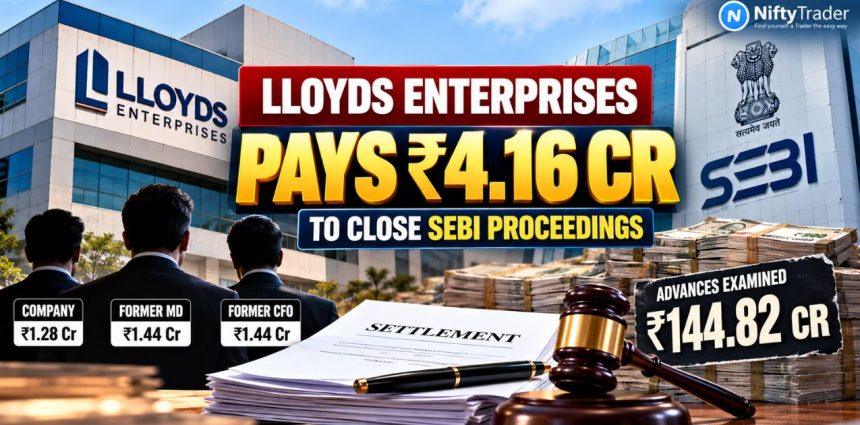
The Company, former MD and CFO, close SEBI proceedings over ₹144.82 crore of promoter-linked advances; the combined payout is about 2.9% of the amount examined.
Lloyds Enterprises, its then Managing Director Rajesh Rajnarayan Gupta and then Chief Financial Officer Viresh Shankar Sohoni have together paid SEBI ₹4.16 crore to settle proceedings linked to ₹144.82 crore of advances given to two promoter-related entities. By NiftyTrader’s calculation, the combined payment is roughly 2.9% of the advances examined, a gap that explains why the two headline numbers should not be read side by side.
The case relates to alleged violations of SEBI’s LODR Regulations and PFUTP Regulations, including alleged lapses in recognising expected credit losses and in disclosing related parties in annual reports. The settlement was made without the applicants admitting or denying SEBI’s findings of fact and conclusions of law.
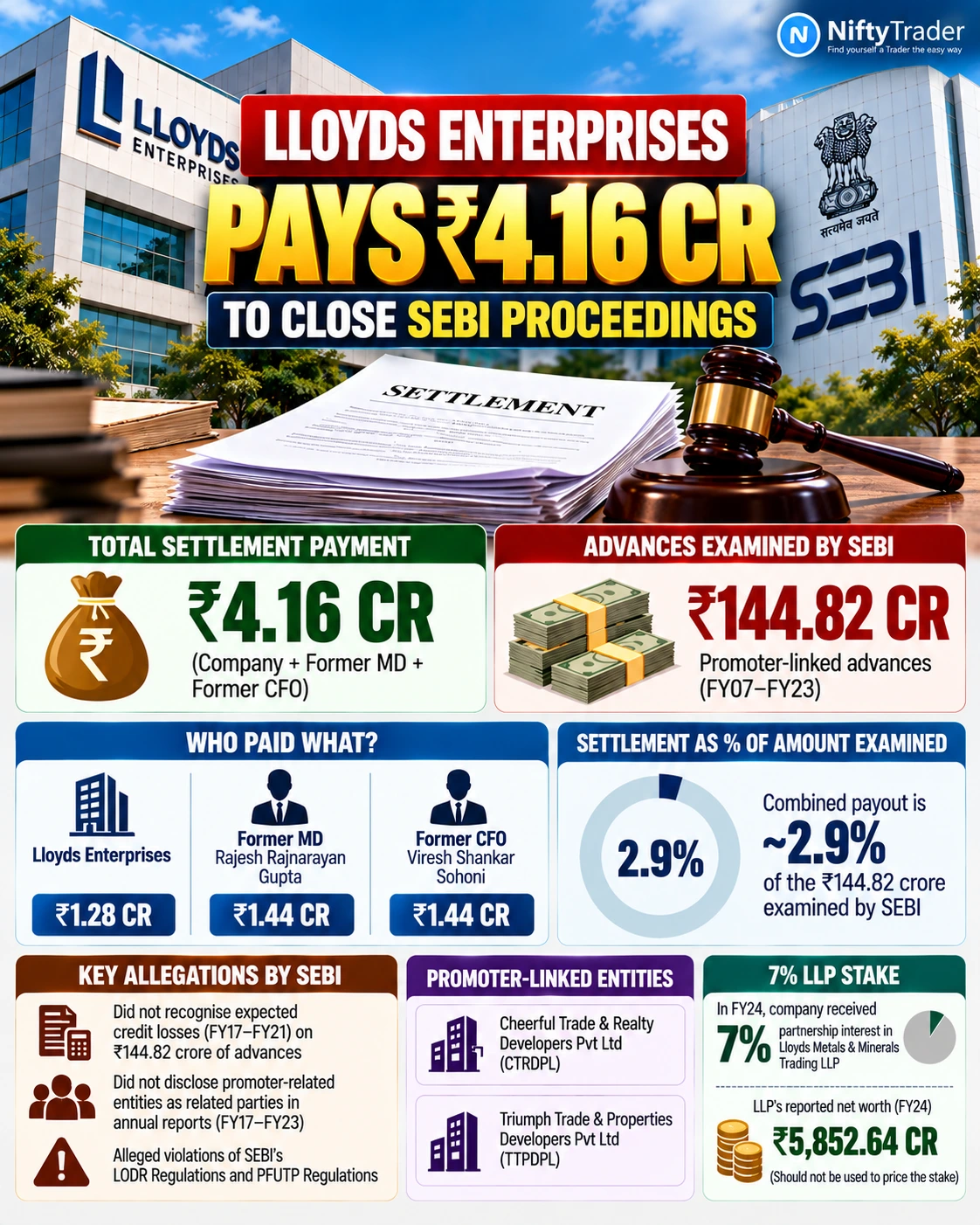
Who Paid What Under the SEBI Settlement
Lloyds Enterprises paid ₹1.28 crore. Gupta paid ₹1.44 crore. Sohoni paid ₹1.44 crore. Together, that makes ₹4.16 crore.
The company and the two individuals filed suo motu settlement applications. SEBI’s High-Powered Advisory Committee considered the revised settlement terms on May 27, 2026, and recommended that the case be settled. The Panel of Whole Time Members approved the recommendations on July 15, 2026, and SEBI issued demand notices on July 21, 2026. The applicants told SEBI in August that the amounts had been remitted, and SEBI confirmed receipt.
What SEBI Examined: ₹144.82 Crore of Promoter-Linked Advances
According to the SEBI order, the investigation began after an alert report from BSE on November 21, 2023, which flagged irregularities in advances reported by Lloyds Enterprises.
SEBI found that Lloyds Enterprises did not recognise expected credit losses between FY17 and FY21 on ₹144.82 crore of outstanding advances to Cheerful Trade & Realty Developers Pvt Ltd (CTRDPL) and Triumph Trade & Properties Developers Pvt Ltd (TTPDPL). SEBI said this treatment was required under Ind-AS 109 and that the company overstated advances in its financial statements.
The order records that the funds were transferred to the two entities in FY07 under a scheme for the benefit of promoters or their related entities, at nil interest and without any agreement. SEBI said this caused a loss to the listed company and that the funds were misutilised from FY07 to FY23. These are SEBI’s findings as recorded in the order, and the applicants neither admitted nor denied them.
Two Separate Issues: Credit Losses and Related-Party Disclosure
The proceedings ran on two tracks. The first was accounting: whether expected credit losses should have been recognised against the outstanding advances. The second was disclosure: SEBI said CTRDPL and TTPDPL were related parties of Lloyds Enterprises under the LODR Regulations, but the company did not disclose them as related parties in its annual reports from FY17 through FY23.
Gupta and Sohoni held the managing director and CFO positions during the relevant period, which is why SEBI proceeded against them as well.
The 7% LLP Stake: The Detail Investors Should Read Carefully
The order also records a later development. In FY24, Lloyds Enterprises received a 7% partnership interest in Lloyds Metals & Minerals Trading LLP in lieu of the ₹144.82 crore advances. According to the settlement order, the LLP had a total net worth of ₹5,852.64 crore in FY24.
That net worth figure should not be used to price the stake. Applying 7% to reported net worth does not establish the transaction value, the accounting value or the cash value of the partnership interest.
₹4.16 Crore vs ₹144.82 Crore: Why This Is Not a Recovery
The two figures measure different things. ₹144.82 crore is the amount of advances examined in the proceedings. ₹4.16 crore is the combined settlement amount paid by the company and its two former officials. The settlement is not a recovery of the advances and should not be described as one.
The company’s own share, ₹1.28 crore, is under 1% of the advances examined. That comparison matters for investors because the regulatory cost of a historical lapse can be far smaller than the balance sheet exposure that triggered scrutiny.
What the Settlement Does and Does Not Mean
The settlement resolves the proceedings covered by the order. It is not an admission of wrongdoing, because the applicants neither admitted nor denied the findings.
It also does not answer every question about the underlying advances. How the 7% LLP interest is carried in the company’s books is a separate matter from the regulatory settlement.
What Investors Should Watch Next
Three areas will shape how this episode reads from here. The first is any further company disclosure on the FY07 advances, the two entities and the 7% LLP interest. The second is how the company reports related parties in future annual reports and exchange filings. The third is whether any additional regulatory or corporate disclosures follow on the promoter-linked entities.
For daily institutional flow trends alongside company-specific news, see the NiftyTrader FII-DII Tracker at niftytrader.in/fii-dii-data.
Bottom Line
Lloyds Enterprises and its two former officials have closed their SEBI proceedings for ₹4.16 crore, but the ₹144.82 crore that triggered them is a different number and still the more important one for investors. The open question is what the 7% LLP interest is worth, and the LLP’s reported net worth alone does not answer it.
Read Next: US 100% Pharma Tariff: Select Indian Specialty Drugs Get Zero Duty
Disclaimer: This article is based on the SEBI settlement order in the matter of Lloyds Enterprises Limited and published reports. Regulatory allegations and findings should not be read as an admission of wrongdoing where the settlement states otherwise. This article is for informational purposes only and should not be treated as investment advice.