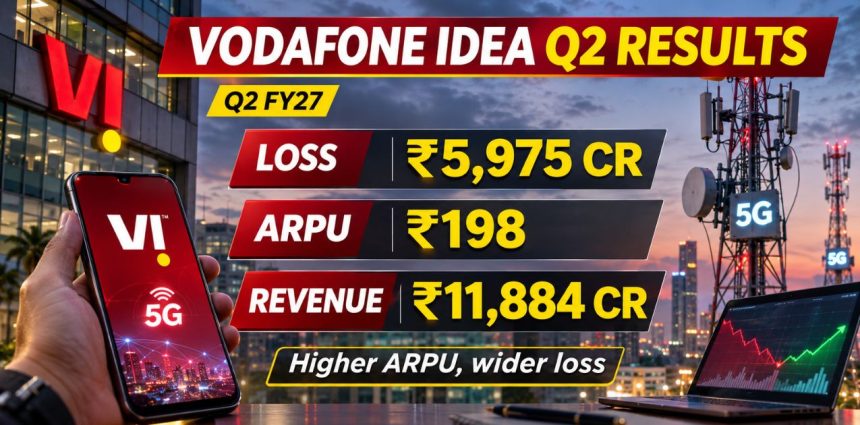
Vodafone Idea‘s Q2FY27 consolidated loss widened 8.2% year-on-year to ₹5,975 crore despite 6.2% revenue growth. A ₹462 crore exceptional charge weighed on reported earnings, while higher ARPU, subscriber additions and faster network investment pointed to improving operations. Government payment obligations remain a major challenge.
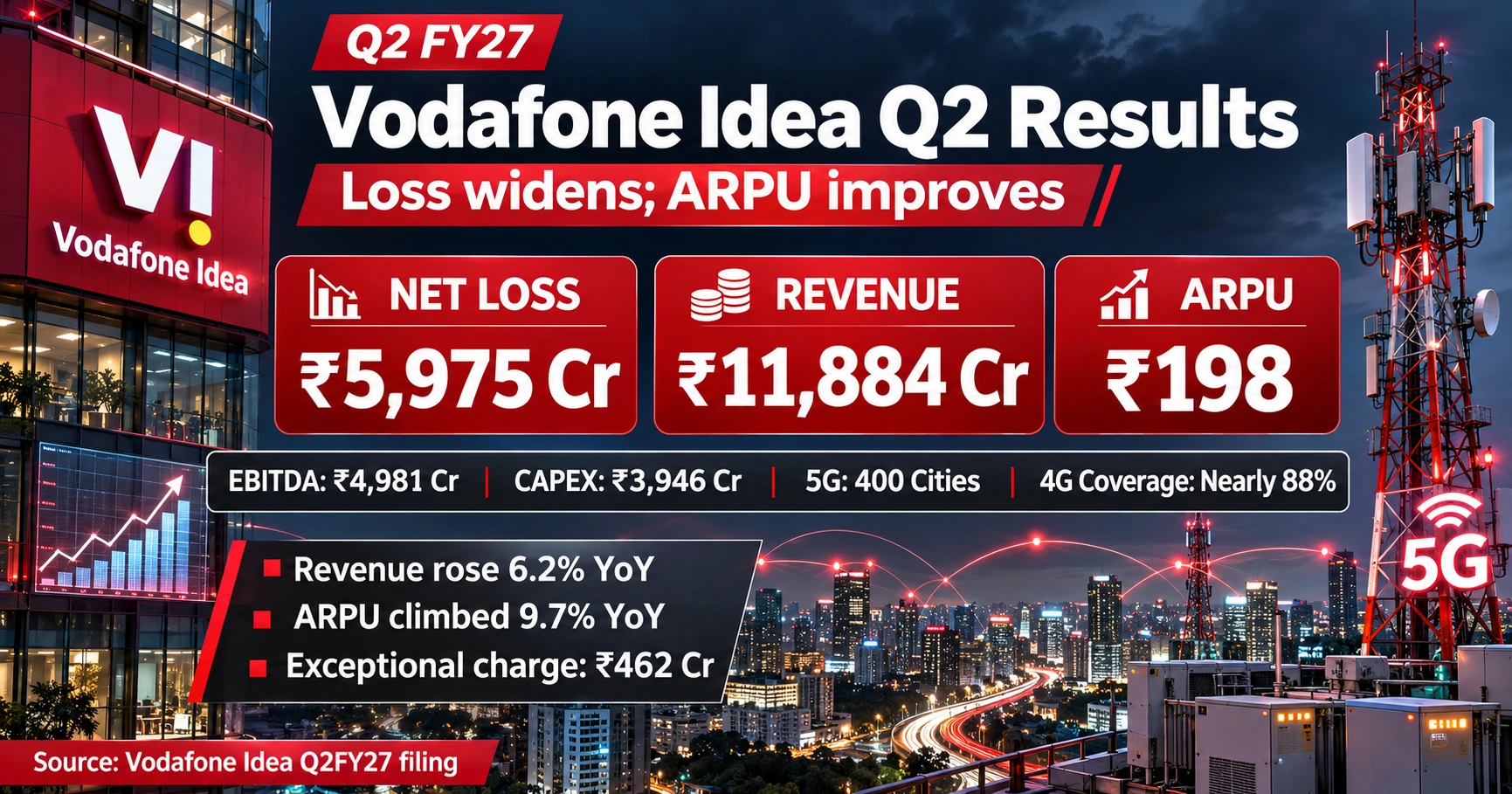
Vodafone Idea reported a consolidated net loss of ₹5,975 crore for the quarter ended September 30, 2026, compared with ₹5,524 crore a year earlier, even as its revenue and average revenue per user (ARPU) improved.
Revenue from operations increased 6.2% year-on-year to ₹11,884 crore from ₹11,195 crore. Customer ARPU rose 9.7% to ₹198, supported primarily by customer upgrades.
The reported loss was affected by a ₹462 crore exceptional charge linked to the remeasurement of settlement assets. Excluding exceptional items, Vodafone Idea’s loss narrowed slightly to ₹5,513 crore from ₹5,562 crore a year earlier.
This distinction is important: the telecom operator recorded progress in several operating indicators, but exceptional accounting adjustments, high finance costs and substantial government payment obligations continue to complicate its financial recovery.
Vodafone Idea Q2FY27 Results: Key Financial Highlights
| Financial metric | Q2FY27 | Q2FY26 |
|---|---|---|
| Revenue from operations | ₹11,884 Cr | ₹11,195 Cr |
| Reported EBITDA | ₹4,981 Cr | ₹4,685 Cr |
| Cash EBITDA (pre-Ind AS 116) | ₹2,498 Cr | ₹2,246 Cr |
| Adjusted net loss* | ₹5,513 Cr | ₹5,562 Cr |
| Reported consolidated net loss | ₹5,975 Cr | ₹5,524 Cr |
| Finance costs | ₹5,351 Cr | ₹4,784 Cr |
| Customer ARPU | ₹198 | ₹180 |
Adjusted net loss excludes exceptional items. Source: Vodafone Idea’s unaudited consolidated financial statements and media release dated November 12, 2026.
Reported EBITDA increased 6.3% year-on-year, while cash EBITDA grew 11.2%.
The company’s cash EBITDA margin improved to 21.0% from 20.1% a year earlier, although it moderated slightly from 21.2% in the June quarter.
Finance costs rose approximately 11.9% year-on-year to ₹5,351 crore, remaining a significant burden on profitability.
Track Live: VODAFONE IDEA Options Chart | Nifty Trader
Why Did Vodafone Idea’s Loss Widen Despite Higher Revenue?
The biggest distinction in the September-quarter results lies in the treatment of exceptional items.
Vodafone Idea recorded a ₹462 crore exceptional loss arising from the remeasurement of settlement assets.
According to the company’s financial statement, the assets include amounts recoverable from promoters of the erstwhile Vodafone India Limited under an implementation agreement.
A portion of these settlement assets is secured through 328 crore Vodafone Idea shares earmarked by certain Vodafone Group entities for five years.
As of September 30, 2026, the fair market value of the earmarked shares, after adjustments for transaction and incidental costs, stood at ₹3,972 crore. The remeasurement resulted in the ₹462 crore exceptional charge.
The corresponding quarter last year had included a positive exceptional item of ₹38 crore.
Consequently, the year-on-year movement in exceptional items represented a ₹500 crore adverse swing, exceeding the ₹451 crore increase in the reported consolidated net loss.
Before exceptional items, the company’s adjusted loss actually narrowed by ₹49 crore.
The figures therefore show that Vodafone Idea’s wider reported loss was not solely a reflection of deteriorating underlying operations.
However, the company remained loss-making even after excluding the exceptional charge.
ARPU Hits ₹198 as Subscriber Base Recovers Sequentially
Vodafone Idea reported further improvement in customer monetisation during the quarter.
Customer ARPU, excluding machine-to-machine connections, increased to ₹198 from ₹180 in Q2FY26 and ₹195 in Q1FY27.
The company attributed the improvement primarily to customer upgrades.
Its total subscriber base increased to 194.4 million from 193.1 million in the preceding quarter, marking a net sequential addition of 1.3 million subscribers.
The postpaid subscriber base rose to 33.9 million from 31.9 million, which the company described as its strongest quarterly postpaid addition in nine quarters.
Meanwhile, the combined 4G and 5G subscriber base increased to 131 million from 127.8 million a year earlier.
Daily data usage climbed 27.1% year-on-year to 93.6 petabytes.
However, the recovery remains incomplete. Vodafone Idea’s total subscriber base was still below the 196.7 million recorded in Q2FY26.
The distinction matters because sequential subscriber growth demonstrates near-term stabilisation, while the year-on-year decline shows that the company has not yet fully reversed its earlier customer losses.
5G Expansion Reaches 400 Cities; Capex More Than Doubles
Vodafone Idea accelerated network investment during the September quarter.
Capital expenditure more than doubled sequentially to ₹3,946 crore, an increase of 104.5%.
The company expanded its 5G coverage to 400 cities and towns across the 17 key telecom circles where it holds 5G spectrum.
It also added nearly 9,000 unique broadband towers during the quarter, its highest quarterly addition in nine quarters.
Over the preceding 12 months, Vodafone Idea added more than 22,500 unique broadband towers, taking its total to 213,616 at the end of September 2026.
Its 4G population coverage increased to nearly 88%, supported by an expansion reaching an additional 45 million people since Q2FY26.
With further planned investment, Vodafone Idea expects its 4G population coverage across the 17 key circles to exceed 95%.
The network expansion is central to its strategy to improve service quality, retain customers and attract higher-value users. However, continuing investment will require substantial funding.
Funding Crosses ₹10,500 Crore, but Government Dues Remain Significant
Vodafone Idea said it had secured funding of more than ₹10,500 crore during the first half of FY27, including warrants and fund-based and non-fund-based facilities.
More than ₹4,000 crore of incremental bank funding was arranged during Q2FY27.
The company had also placed capital expenditure orders exceeding ₹13,200 crore, of which nearly ₹6,000 crore had been executed.
As of September 30, 2026, the company reported cash and bank balances of ₹5,470 crore and bank debt of ₹943 crore in its media release.
The consolidated financial statements separately disclosed outstanding borrowings of ₹4,543 crore from banks, non-convertible debentures and other sources, including accrued interest not yet due.
These debt figures cover different categories and should not be used interchangeably.
More importantly, Vodafone Idea continued to carry substantial deferred payment obligations to the government.
| Deferred obligation | Amount |
|---|---|
| Spectrum dues, including accrued interest | ₹1,31,268 Cr |
| AGR dues, including accrued interest | ₹26,264 Cr |
| Total | ₹1,57,532 Cr |
The combined amount stood at approximately ₹1.58 lakh crore as of September 30, 2026.
According to the financial statements, instalments scheduled against these government obligations through September 2027 amounted to ₹9,216 crore.
Separately, instalments scheduled against bank, debenture and other borrowings through September 2027 amounted to ₹3,108 crore, along with applicable interest.
The company’s consolidated net worth remained negative at ₹44,298 crore at the end of September, while its net loss for the first half of FY27 stood at ₹9,729 crore.
Vodafone Idea stated that it had met its debt obligations payable to lenders and financial institutions, including applicable interest, and was continuing discussions with banks to raise further funds.
Management also expressed confidence in generating sufficient operating cash flows to meet obligations falling due over the following 12 months.
That assessment remains dependent on the company’s ability to sustain operating improvements, secure funding and manage its repayment schedule.
Also Check: Vodafone Idea Option Chain (IDEA) — Live OI, IV & PCR
What Did Vodafone Idea Management Say?
Abhijit Kishore, CEO of Vodafone Idea, said the company’s focus remained on execution and that the second-quarter performance reflected progress against its priorities.
He highlighted improving subscriber additions, network expansion and enhanced customer experience.
Management also pointed to initiatives including free international roaming benefits and prepaid family plans aimed at strengthening customer engagement.
On network investment, the company reiterated that it had placed capex orders of more than ₹13,200 crore and intended to place further orders as funding arrangements progressed.
Vodafone Idea Q2 Results: What Should Investors Watch Next?
Vodafone Idea’s September-quarter performance presents two contrasting developments.
Operationally, ARPU growth, higher cash EBITDA, sequential subscriber additions and faster network expansion indicate progress.
Financially, the company remains under pressure from recurring losses, high financing costs, a negative net worth and substantial deferred payment commitments.
A further question is whether operating cash generation can improve sufficiently to support planned network investments while meeting scheduled obligations.
Vodafone Idea is scheduled to hold its Q2FY27 earnings conference call on Friday, November 13, 2026, at 2:30 PM IST, with CEO Abhijit Kishore and CFO Tejas Mehta.
Investors will be watching for additional clarity on funding progress, capex execution, operating cash flows and the company’s approach to its upcoming payment obligations.
The November 12 financial results were approved after the close of regular equity trading. Consequently, that day’s share-price movements should not be presented as a market reaction to the published results.
Bottom line: Vodafone Idea’s Q2FY27 reported net loss widened to ₹5,975 crore, but the adjusted loss narrowed marginally and operating indicators improved. The next phase of its recovery will depend not only on customer growth and higher ARPU, but also on securing funding and managing its considerable financial obligations.
Read Next: F&O Buildup Today, Nov 12: Short Signals Rise to 68 as Nifty Ends Higher
Disclaimer: This article is for informational and educational purposes only and does not constitute investment advice. Financial figures are based on Vodafone Idea’s unaudited results, accompanied by its auditor’s limited review report.